In our modern, digital-first world, poor posture has become a silent epidemic. Whether you are hunched over a smartphone, slouching in an office chair, or driving for long commutes, the cumulative effect of these habits can wreak havoc on your musculoskeletal health. This condition, often colloquially referred to as “tech neck” or “sitting disease,” involves more than just aesthetics; it fundamentally alters the biomechanics of your spine.
Fortunately, correcting these imbalances does not always require expensive equipment or invasive interventions. Yoga, an ancient practice now validated by modern sports medicine, offers a sustainable path toward realignment. By focusing on core stability, spinal elongation, and body awareness (proprioception), specific yoga poses can counteract the effects of gravity and sedentary behavior.
This article explores the anatomical importance of good posture and provides a comprehensive, medically reviewed guide to yoga poses designed to straighten your spine and alleviate chronic discomfort.
Why Posture Is More Than Just Standing Tall
While good posture is often associated with confidence and poise, its impact on your physiological health is profound. Posture refers to the position in which you hold your body while standing, sitting, or lying down. Good posture involves training your body to stand, walk, sit, and lie in positions where the least strain is placed on supporting muscles and ligaments during movement or weight-bearing activities.
According to research published in PubMed, prolonged poor posture can lead to a cascade of health issues, including:
- Musculoskeletal Dysfunction: Misalignment can wear away at the spine, making it more fragile and prone to injury.
- Respiratory Issues: Slouching compresses the diaphragm, reducing lung capacity and oxygen intake.
- Digestive Problems: Compressing the abdomen can slow peristalsis, leading to digestive discomfort.
- Chronic Pain: Poor alignment is a leading contributor to tension headaches, jaw pain, and lower back pain.
Furthermore, the Mayo Clinic emphasizes that maintaining the natural curves of your spine is essential for shock absorption and balance.
The Science: How Yoga Corrects Alignment
Yoga is uniquely suited to address postural issues because it targets the root causes: muscle weakness, tension, and lack of awareness. Many postural deviations, such as upper crossed syndrome (rounded shoulders), stem from a muscle imbalance where the chest muscles are tight, and the upper back muscles are weak.
A systematic review by the National Center for Complementary and Integrative Health (NCCIH) suggests that yoga improves functional fitness, flexibility, and muscle endurance. Through consistent practice, yoga helps by:
- Strengthening the Core: A strong core supports the spine, acting as a natural corset.
- Increasing Flexibility: Stretching tight muscle groups (like the pectorals and hamstrings) allows the skeleton to return to a neutral alignment.
- Enhancing Proprioception: Yoga teaches you to feel where your body is in space, allowing you to self-correct your posture throughout the day.
To dive deeper into the physiological impacts of practice, read our guide on the benefits of yoga.
7 Essential Yoga Poses for Better Posture
The following poses are selected to target the specific muscle groups responsible for maintaining an upright spine. If you have a pre-existing injury, consult a physical therapist before beginning.
1. Mountain Pose (Tadasana)
It may look like simply standing, but Tadasana is the blueprint for all other yoga poses. It teaches you neutral alignment.
How it helps: It re-educates the body on what “straight” actually feels like, engaging the thighs, core, and back muscles to support the spine.
Steps:
- Stand with your big toes touching and heels slightly apart.
- Lift your toes and spread them wide to create a solid foundation.
- Engage your quadriceps to lift your kneecaps.
- Rotate your thighs slightly inward and tuck your tailbone slightly to neutralize the lower back curve.
- Roll your shoulders back and down, away from your ears.
- Imagine a string pulling the crown of your head toward the ceiling.
For a detailed breakdown, see our tutorial on mastering Mountain Pose.
2. Cat-Cow Stretch (Marjaryasana-Bitilasana)
This dynamic flow warms up the spine and relieves stiffness in the back and neck.
How it helps: It improves the flexibility of the intervertebral discs and encourages the spine to move through its full range of motion (flexion and extension). The American Council on Exercise recommends this sequence for increasing spinal awareness.
Steps:
- Start on your hands and knees in a tabletop position. Wrists should be under shoulders, knees under hips.
- Inhale (Cow): Drop your belly toward the mat, lift your chin and chest, and gaze up.
- Exhale (Cat): Draw your belly to your spine and round your back toward the ceiling. The pose should look like a cat stretching.
- Repeat for 5–10 breaths.
3. Plank Pose (Phalakasana)
Posture is reliant on core strength. Without strong abdominal muscles, the lower back takes on excessive load, leading to lordosis (swayback).
How it helps: Plank engages the transverse abdominis, the deep core muscles that stabilize the trunk. Learn more about plank exercise benefits here.
Steps:
- From tabletop, step your feet back until your legs are straight.
- Keep your shoulders directly over your wrists.
- Engage your core, glutes, and thighs. Your body should form a straight line from head to heels.
- Gaze slightly forward to keep the neck neutral. Hold for 30–60 seconds.
4. Cobra Pose (Bhujangasana)
This gentle backbend is the antidote to slouching. It opens the chest and strengthens the erector spinae muscles runs along the spine.
How it helps: By extending the thoracic spine, Cobra pose counteracts the kyphosis (rounding) caused by hunching over desks. Research in the Journal of Physical Therapy Science indicates that extension exercises are critical for correcting forward head posture.
Steps:
- Lie on your stomach with your legs extended and tops of feet on the floor.
- Place your hands under your shoulders, elbows hugged into your ribs.
- Inhale and begin to straighten the arms to lift the chest off the floor. Keep a slight bend in the elbows.
- Focus on lifting with your back muscles rather than pushing with your hands.
5. Bridge Pose (Setu Bandha Sarvangasana)
Weak glutes often contribute to poor pelvic alignment. Bridge pose strengthens the posterior chain (back body) while opening the anterior chain (front body).
How it helps: It stretches the hip flexors—which are often tight from sitting—and strengthens the glutes and hamstrings. For more on this muscle group, read about glute strengthening exercises.
Steps:
- Lie on your back with knees bent and feet flat on the floor, hip-width apart.
- Press your feet and arms into the floor.
- Inhale and lift your hips toward the ceiling.
- Roll your shoulders underneath you and clasp your hands if possible.
- Keep your thighs parallel. Hold for 5–8 breaths.
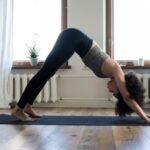
6. Downward-Facing Dog (Adho Mukha Svanasana)
This inversion lengthens the entire back body, from the heels to the neck.
How it helps: It decompresses the spine and opens the shoulders. According to Johns Hopkins Medicine, poses like this can help manage stress, which often manifests as tension in the shoulders and neck.
Steps:
- Start on hands and knees. Tuck your toes and lift your hips up and back.
- Straighten your legs as much as possible without rounding your back (bend knees if hamstrings are tight).
- Press firmly into your hands, lengthening your spine.
- Relax your head and neck.
7. Child’s Pose (Balasana)
A restorative pose that allows the spine to lengthen passively.
How it helps: It gently stretches the lower back and hips, providing a reset for the spine. It is also excellent for mental relaxation; see our article on stress relief yoga.
Steps:
- Kneel on the floor, touching your big toes together.
- Sit back on your heels and separate your knees about hip-width apart.
- Exhale and lay your torso down between your thighs.
- Extend your arms forward with palms down. Rest your forehead on the mat.
Integrating Posture Awareness into Daily Life
Practicing yoga for 30 minutes a day is beneficial, but it cannot fully undo the damage of sitting poorly for the other 15 hours. To see lasting changes, you must integrate mindfulness into your daily routine.
Ergonomic Tips:
- Monitor Height: Ensure your computer screen is at eye level to prevent neck strain.
- Take Breaks: Harvard Health suggests moving every 30 minutes to prevent muscle stiffness.
- Desk Yoga: Incorporate simple stretches at your workstation. Check out our desk exercises guide.
Safety and Modifications
While yoga is generally safe, listening to your body is paramount. If you experience sharp or shooting pain, stop immediately. The CDC advises that physical activity should be done at a level appropriate for your fitness status.
Modifications:
- Use Props: Yoga blocks can bring the floor closer to you, preventing you from compromising your spinal alignment to reach the ground.
- Bend Your Knees: In forward folds or Downward Dog, tight hamstrings can pull on the lower back. Bending the knees protects the lumbar spine.
- Avoid Overextension: In backbends, focus on length rather than depth to avoid pinching the lower back vertebrae.
If you are prone to injury, review our guide on preventing common sports injuries.
When to Seek Professional Help
Sometimes, poor posture is a symptom of a structural issue rather than a functional habit. Conditions such as scoliosis (curvature of the spine) or structural kyphosis may require medical intervention.
Consult a healthcare provider if:
- You have persistent back or neck pain that does not improve with rest or stretching.
- You experience numbness, tingling, or weakness in your arms or legs.
- You notice a visible deformity in your spine.
The Cleveland Clinic notes that early diagnosis of spinal conditions is key to effective management. For ongoing discomfort, explore our resources on managing chronic pain.
The Bottom Line
Improving your posture is a journey of unlearning bad habits and strengthening the body’s natural support systems. By incorporating these yoga poses into your weekly routine, you can build the core strength, flexibility, and body awareness necessary to stand tall.
Remember that consistency beats intensity. A few minutes of mindful movement daily can have a profound impact on your spinal health, respiratory function, and overall well-being. As with any new exercise regimen, start slowly, use props, and consult a medical professional if you have concerns about your back health.
Read more about the connection between stress and physical health on ScienceDaily.