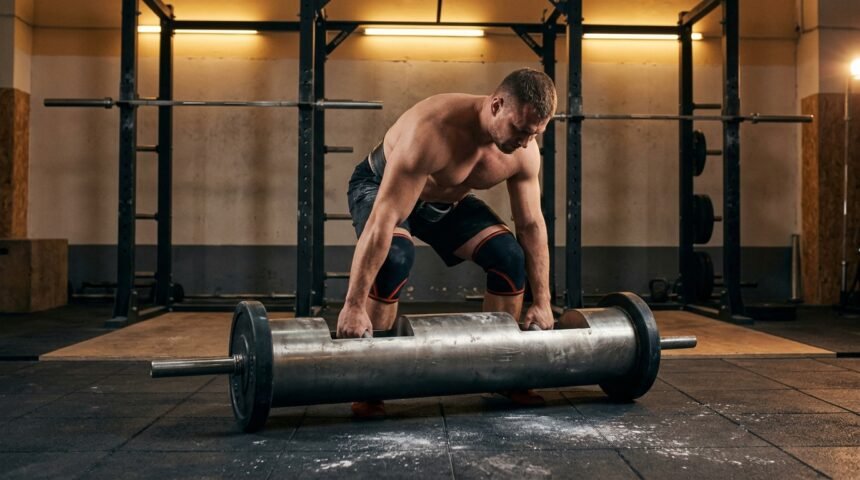
If you have ever watched a strongman competition, you have undoubtedly seen the log press. It is one of the most iconic and frequently contested events in the sport. Unlike the standard barbell overhead press, the log press requires a unique blend of brute strength, technical precision, and full-body coordination.
For those new to strongman training for beginners, the log can seem intimidating. The implement itself is cumbersome, often thicker than a standard bar, and requires a neutral grip. However, mastering this lift offers immense benefits, not just for competitive athletes but for anyone looking to build functional power and an impressive physique.
While the movement may look simple—pick up a heavy log and push it overhead—the biomechanics are complex. It places significant demand on the upper back, core, and legs, making it a true test of systemic power. Understanding the nuances of the lift, from the lap to the lockout, is essential for progress and safety.
Understanding the Mechanics of the Log Press
To master the log press, you must first understand how it differs from traditional pressing movements. The most obvious difference is the grip. The handles inside the log allow for a neutral grip (palms facing each other).
There are significant neutral grip overhead press benefits to consider. This hand position is generally friendlier on the shoulder joints, reducing the risk of impingement compared to the internally rotated position often required by a straight barbell. This makes the log press a viable option for lifters who struggle with shoulder mobility or pain during standard overhead pressing.
However, the log’s diameter pushes the weight further away from your body’s centre of gravity. This increased lever arm demands greater thoracic extension mobility and upper back strength to keep the implement stable. It also forces you to lean back further to clear your chin, requiring a robust lower back and core.
Muscles Targeted
The log press is a compound movement that engages nearly every muscle in the body. While the front deltoid hypertrophy stimulated by this lift is substantial, it is far more than just a shoulder exercise.
Key muscle groups include:
- Triceps: Essential for the lockout phase.
- Upper Back and Traps: Crucial for the clean and stabilising the load overhead.
- Core: Provides core stability under load, protecting the spine during the lean-back.
- Legs and Glutes: Generate the explosive power needed to drive the log from the chest to the overhead position.
To understand more about the anatomy involved in overhead pressing, you can refer to Healthline’s guide on the deltoid muscle.
The Three Phases of the Lift
Executing a perfect log press involves three distinct phases: the clean (getting the log to the lap), the roll (moving it to the chest), and the press (driving it overhead). Mastering the log clean and press technique is often where athletes see the biggest jump in their numbers.
1. The Clean and Lap
Unlike a barbell clean, you cannot simply pull the log straight up. You must row it into your lap first.
Start with a wide stance, bending at the hips and knees to grasp the handles. Your arms should be straight. Drive through your heels and use your lats to row the log up your body while extending your hips. As the log clears your knees, sit into a squat position, effectively “lapping” the log on your thighs.
This phase relies heavily on back strength. If you struggle here, incorporating specific back work is vital. You can learn more about developing a strong posterior chain in our article on Rack Pulls vs Deadlifts: Which is Better for Back Development?.
2. The Roll and Rack
Once the log is in your lap, you need to bring it to the “rack” position on your chest. Take a deep breath to brace your core—this is an example of the importance of core stability noted by Harvard Health.
Roll the log toward your stomach, then explosively drive your hips forward and up. This triple extension propels the log up your torso. As the log floats, rotate your elbows underneath the handles, catching the log high on your chest with your elbows pointed upward.
3. The Press
The press begins with the log resting on your chest and your head tilted slightly back. Dip your knees slightly—about a quarter squat—and drive up explosively. This leg drive mechanics transfer energy from your lower body through your torso and into the log.
As the log clears your head, push your head through the “window” created by your arms and lock your elbows out. This is where upper body explosive power is paramount. For athletes struggling with the lockout, exercises that overload the top portion of the lift, such as those discussed in Floor Press: Benefits, Proper Form, and Muscle Groups Targeted, can be incredibly beneficial.
Technique Tips and Common Mistakes
Even experienced lifters can fall into bad habits. To ensure shoulder injury prevention in strongman, pay attention to these technical cues.
Mistake 1: Inefficient Dip and Drive
A common error is dipping too slowly or dipping too low. The dip should be sharp and quick, utilising the stretch-shortening cycle. Think of your legs as a stiff spring. If you squat too deep, you lose tension.
Research published by the National Strength and Conditioning Association (NSCA) highlights that quick, explosive movements recruit high-threshold motor units more effectively. To improve your power output, consider reading Using Pin Squats to Overcome Training Plateaus and Build Power.
Mistake 2: Pressing Too Early
Don’t start pressing with your arms until your legs have done their job. You want to ride the momentum created by your legs for as long as possible. If you press too early, you turn the movement into a strict press, limiting the weight you can handle. This concept of timing is similar to the efficiency required in Viper press vs strict press techniques, where momentum is utilised differently.
Mistake 3: Poor Rack Position
If your elbows drop, the log will roll forward, placing immense strain on your wrists and lower back. Keep your elbows high and the log close to your throat. Good log press setup cues always emphasise a high chest and high elbows. For those struggling with wrist discomfort or grip issues, A Complete Guide to Steel Club Training for Grip and Joint Health offers excellent supplementary work.
Progression and Accessory Work
To continue building your log press, you must strengthen the individual components of the lift. Strongman implement training is specific, but general strength exercises have high carryover.
improving Stability
The log is unstable. To combat this, you need a core that can resist flexion and rotation. Overhead stability exercises are crucial. You might find that The Science of Isometric Holds for Building Functional Strength provides great strategies for improving your stability under heavy loads.
Furthermore, if you lack the shoulder mobility to achieve a safe lockout position, you increase the risk of injury. Incorporating mobility tools is wise; read The Benefits of Macebell Training for Shoulder Mobility and Power for unconventional but effective methods.
Building Raw Strength
While technique is king, raw strength is the kingdom. You must build your absolute strength foundation. According to the Mayo Clinic, resistance training is essential for preserving muscle mass and bone density, which supports heavy lifting.
Focus on compound movements like squats and deadlifts. Interestingly, transitioning from barbell to log often exposes weaknesses in the upper back. Exercises like the Zercher squat can help mimic the front-loaded stress of the log. Learn more in How to Master the Zercher Squat for Superior Core Strength.
Managing Volume and Intensity
Because the log press is taxing on the central nervous system, volume should be managed carefully. Heavy log pressing once a week is usually sufficient. You can supplement this with lighter overhead work or triple extension in lifting drills on other days.
Understanding how to control the descent of the log is also critical for safety and muscle growth. This focus on the lowering phase is detailed in How Eccentric Loading Can Accelerate Muscle Growth and Repair.
Safety Considerations
Safety should always be the priority. The British Journal of Sports Medicine notes that while strongman training has an injury rate comparable to other strength sports, the lower back and shoulders are common injury sites.
Always warm up thoroughly. The NHS guidelines on strength and flexibility suggest a progressive warm-up to prepare the joints. When training the log press, ensure you have a safe area to drop the log if you miss a lift. Never try to “save” a lift that has gone behind your head; let it go.
Additionally, consider your relative strength. Being able to press heavy weights is impressive, but moving your own bodyweight and implements efficiently is the hallmark of a good athlete. See Why Relative Strength Matters for Athletes and Daily Function for a deeper dive.
Also, do not neglect functional conditioning. While the log is static, strongman often involves moving loads. Why Sandbag Carries are the Ultimate Functional Strength Exercise explains how moving heavy objects builds a resilient torso, which directly aids your log press stability.
The Bottom Line
Mastering the log press is a journey of patience and persistence. It demands high levels of strength, mobility, and technical proficiency. By focusing on the clean, optimising your rack position, and utilising your legs for a powerful drive, you can unlock new levels of upper body power.
Remember to incorporate accessory work that targets your weaknesses, whether that be thoracic extension mobility, triceps strength, or core stability. Listen to your body and consult reputable resources like ExRx.net or Verywell Fit’s overhead press guide to ensure your form remains on point.
Ultimately, whether you are competing or just training for personal growth, the log press is a rewarding challenge that builds undeniable strength and character. Keep pressing.