


Men’s mental health month is a time to talk openly about the emotional health of men and boys. If you have ever asked when is men’s mental health month, the short answer is June in the United States, with a second wave of attention in November through Movember.
This guide explains what men’s mental health month means, what month is men’s mental health month, and when was men’s mental health month created. You will also learn how common depression is in men, why roughly 70% of people with major depressive disorder (MDD) may still carry residual symptoms after treatment, and which warning signs deserve attention.
We cover simple ways to support a friend, partner, father, or son, plus clear guidance on when to seek help. Everything is written in plain language and based on trusted public health sources. It is for education only and does not replace advice from a licensed doctor or mental health professional. If you are in crisis in the US, call or text 988 right now.
Introduction
Every June, hospitals, charities, employers, and families shine a light on how men are really doing. That spotlight is called men’s mental health month.
It matters because many men still stay quiet about stress, sadness, and fear. They push through. They joke it off. They wait until things fall apart.
That silence has a cost. In the United States, men die by suicide at nearly four times the rate of women, according to CDC figures that major mental health groups cite. Men are also less likely to see a professional when they struggle.
This guide covers everything you need to know about men’s mental health month. You will find the dates, the history, the numbers, and the warning signs. You will also find a clear section on when to seek help.
We pay special attention to major depressive disorder (MDD). It is common, treatable, and often missed in men. Many people also do not realize that symptoms can linger after treatment starts. Those leftover symptoms are called residual symptoms, and they matter a lot.
Use this page as a starting point. Share it with a brother, a father, a friend, or a coworker. One honest conversation can change a life.
What Is Men’s Mental Health Month?
Men’s mental health month is an awareness period that focuses on the emotional and psychological well-being of men and boys. In plain terms, it is a time set aside to make mental health a normal topic for men.
Here is an honest note on accuracy. The official, government-recognized observance is Men’s Health Month. Many hospitals, nonprofits, and clinics use men’s mental health month as a friendly label for the mental health side of that June campaign. Both names point to the same effort.
The goals are simple:
- Raise awareness of depression, anxiety, stress, and suicide risk in men
- Break down stigma and the “tough it out” mindset
- Encourage men to see a doctor or therapist early
- Give families and workplaces tools to support men
- Share reliable, science-based information
Think of men’s mental health month as a yearly reset. It is a reminder to check in, ask real questions, and listen without judgment.
It is not only for men. Partners, mothers, sisters, daughters, friends, and bosses all play a part. Mental health is a team effort.
Why a Dedicated Month Helps
Awareness months work because they give people a reason to start a hard conversation. It feels easier to say, “I saw it is men’s mental health month, how are you doing?” than to say, “I’m worried about you.”
The month also pushes media, schools, and employers to share resources at the same time. That repetition helps messages stick.

When Is Men’s Mental Health Month?
Most people want a quick answer to when is men’s mental health month. Here it is.
Men’s mental health month is observed in June in the United States and in many other countries.
So, what month is men’s mental health month? June. That is why you will often see the phrase June men’s mental health month on clinic websites, social media posts, and workplace calendars.
Some people type whens men’s mental health month into a search bar and get mixed answers. The mix-up happens because several awareness efforts share the same space. We explain those in the next section.
Key Dates to Remember
Today is October 31, 2026. The next June observance falls in 2027.
- Men’s Health Month: June 1 to June 30, 2027
- Men’s Health Week: June 14 to June 20, 2027, the week that ends on Father’s Day
- Movember: November 1 to November 30, every year
- International Men’s Day: November 19, every year
Men’s Health Week always ends on Father’s Day. That timing is on purpose. It links men’s health to family, which helps many men take it more seriously.
Is There a Men’s Mental Health Week?
There is no single, worldwide “Men’s Mental Health Week.” Many countries run their own weeks or campaigns. In the US, Men’s Health Week inside men’s mental health month is the closest match.
Is November Men’s Mental Health Month?
This is one of the most common questions. Is November men’s mental health month? Not officially. But November is a big month for men’s mental health, and that is why the confusion exists.
Two events drive it:
- Movember. This global charity campaign began in Australia in 2003. Men grow mustaches and raise money for prostate cancer, testicular cancer, and men’s mental health and suicide prevention.
- International Men’s Day. Held on November 19, it highlights men’s health, positive role models, and well-being.
Because of these events, many people say men’s mental health month November when they mean “the November awareness push.” It is a fair shorthand, as long as you know June holds the official month.
June or November: Which One Should You Follow?
You do not have to pick. Use both.
- Use June for check-ins, workplace talks, and doctor visits.
- Use November for fundraising, community events, and keeping the conversation going.
The real goal is year-round care. Two months on the calendar are only the start.
When Was Men’s Mental Health Month Created?
Let’s answer when was men’s mental health month created with the facts we can verify.
The roots go back to 1994. That year, the US Congress passed a bill, and President Bill Clinton signed it, creating National Men’s Health Week. Senator Bob Dole and Congressman Bill Richardson led the effort with support from the Men’s Health Network. The goal was to promote early detection and treatment of preventable health problems in men and boys.
Over time, the week grew into a full month. June became Men’s Health Month.
The effort also went global. Men’s Health Network organized meetings at the World Congress on Men’s Health in Vienna in 2001 and again in 2002. Those talks helped build International Men’s Health Week.
So what about the mental health label? The 1994 law focused on men’s health in general. The specific phrase men’s mental health month gained popularity later, as doctors and advocates pushed mental health to the front. Its early history is not well documented, and we do not want to invent a date.
In short, men’s mental health month rests on a 1994 foundation and has grown with each decade.
Why Men’s Mental Health Matters: The Numbers
Facts make the case better than opinions. Here is what trusted sources report. Figures can change each year, so always check the latest data.
- Depression is common. The National Institute of Mental Health has estimated that about 6 million men in the US experience depression each year.
- Many cases go unnoticed. Men are less likely than women to be diagnosed, even though experts believe the true rates are closer than the diagnosis gap suggests.
- Suicide risk is higher. Men die by suicide at nearly four times the rate of women in the US. Men over 75 have among the highest rates of any group.
- Help-seeking is low. Surveys repeatedly show that fewer men than women talk to a mental health professional.
These numbers explain why men’s mental health month exists. The gap is not about weakness. It is about stigma, habits, and missed signs.
Why Men Often Stay Silent
Many men grow up hearing “man up” and “don’t cry.” Those messages stick. Over time, men learn to hide pain, even from themselves.
Common barriers include:
- Fear of being judged or seen as weak
- Belief that they must solve problems alone
- Worry about job impact
- Lack of time or insurance
- Not knowing the signs of depression
Men’s mental health month pushes back on every one of these barriers.
What Is Major Depressive Disorder (MDD)?
Major depressive disorder, or MDD, is a medical condition. It is not a character flaw or a bad mood.
Definition
MDD is diagnosed when someone has a low mood or loss of interest nearly every day for at least two weeks, along with other symptoms that hurt daily life. Doctors use the DSM-5 criteria, which list nine symptoms. A person needs five or more, and one must be low mood or loss of interest.
The nine symptoms are:
- Depressed mood
- Loss of interest or pleasure
- Big changes in appetite or weight
- Sleeping too little or too much
- Feeling slowed down or restless
- Fatigue or low energy
- Feeling worthless or guilty
- Trouble thinking or concentrating
- Thoughts of death or suicide
How MDD Can Look Different in Men
Men often do not say “I feel sad.” They show it in other ways. During men’s mental health month, doctors stress this point again and again.
Common signs in men include:
- Irritability, anger, or sudden outbursts
- Taking more risks, such as reckless driving
- Drinking or using drugs to cope
- Working nonstop to avoid feelings
- Headaches, stomach trouble, or chronic pain with no clear cause
- Pulling away from family and friends
- Loss of interest in sex or hobbies
Because these signs do not match the usual picture of depression, they are easy to miss. That is a big reason men’s mental health month matters.
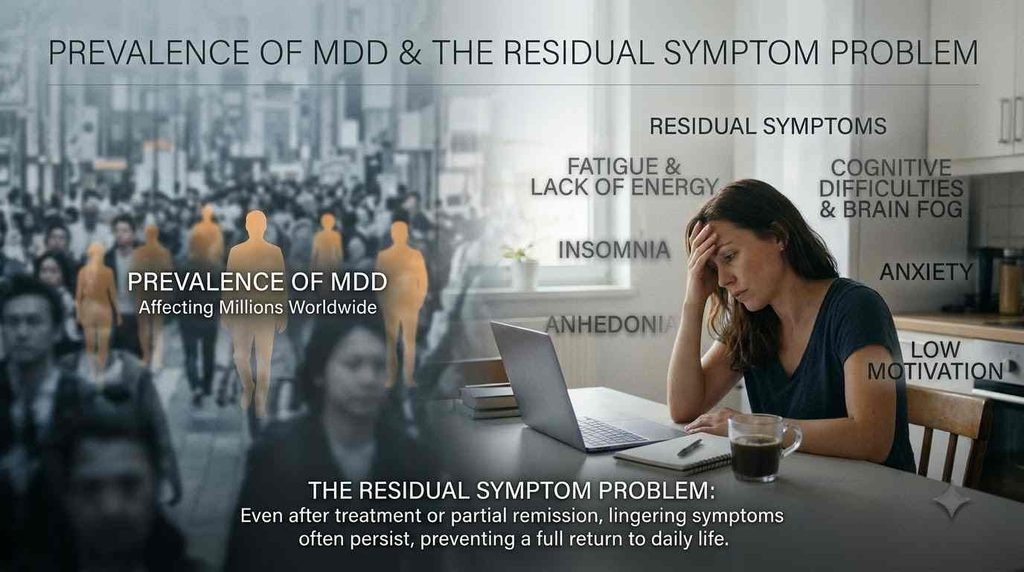
Prevalence of MDD and the Residual Symptom Problem
Here is a point that gets too little attention. Starting treatment is a great step. But feeling better is not always the same as feeling well.
What Are Residual Symptoms?
Residual symptoms are depression symptoms that remain after treatment has helped. A person may no longer meet the full criteria for MDD, yet still feel “off.”
Research suggests that roughly 70% of people with MDD who respond to treatment still report at least one residual symptom. Exact figures vary by study and by how researchers define improvement, so treat this as a working estimate and talk to your doctor about your own case.
Common Residual Symptoms
- Poor sleep or waking too early
- Ongoing tiredness
- Trouble focusing
- Low motivation or reduced pleasure
- Irritability
- Lingering worry or anxiety
In men, these can be brushed off as “just stress,” “getting older,” or “my personality.” That is risky.
Why Residual Symptoms Matter
Studies link residual symptoms to a higher chance of relapse, which means the depression returns. They can also hurt work, relationships, and quality of life.
The good news is that they can be treated. Options your doctor may discuss include adjusting medication, adding therapy such as cognitive behavioral therapy (CBT), improving sleep, and building regular exercise into your week.
What You Can Do
- Tell your doctor about every leftover symptom, even small ones
- Never stop medication on your own
- Track sleep, mood, and energy for a few weeks
- Keep follow-up visits, even when you feel better
During men’s mental health month, make a promise to aim for full recovery, not just “good enough.”
Warning Signs Men Often Miss
During men’s mental health month, you will hear a lot about “signs.” Here is a practical checklist. No single item means a diagnosis. A pattern that lasts two weeks or more is a reason to talk to someone.
Mood and Thinking
- Feeling empty, numb, or hopeless
- Constant irritability or a short temper
- Feeling like a burden
- Trouble making decisions
- Dark or intrusive thoughts
Body and Behavior
- Sleeping far more or far less than usual
- Changes in appetite or weight
- Low energy that rest does not fix
- Drinking more, gambling, or using drugs
- Skipping work, hobbies, or social plans
Relationships
- Snapping at a partner or children
- Pulling away from friends
- Feeling disconnected even in a crowd
If you notice several of these in yourself or someone you love, take it seriously. Early help works better than late help.
Anxiety, Stress, and Burnout in Men
Depression is only one piece. Anxiety, chronic stress, and burnout are also common in men.
Anxiety can look like constant worry, a racing heart, tight muscles, or trouble sleeping. Burnout often shows up as exhaustion, cynicism about work, and a drop in performance.
Money stress, job loss, divorce, caregiving, and loneliness raise the risk. So does heavy alcohol use.
The key message of men’s mental health month is that all of these are valid reasons to ask for help. You do not need to hit rock bottom first.
Barriers to Getting Help (and How to Beat Them)
Knowing the signs is not enough. Many men still do not act. Here are the most common roadblocks and simple fixes.
“I Should Handle This Myself”
Self-reliance is a strength in many areas of life. With mental health, it can become a trap. You would not set your own broken bone. Treat depression the same way and let a professional help.
“It Will Hurt My Career”
This fear is real, but many workplaces now offer confidential employee assistance programs. Ask HR or your doctor about private options. Telehealth also lets you attend sessions from home.
“I Don’t Have Time or Money”
Try your primary care doctor first. Many community clinics use sliding-scale fees. Some employers and insurers cover several therapy sessions at low or no cost.
“Therapy Is Not for Men Like Me”
Therapy is practical. A good therapist gives you tools, a plan, and honest feedback. Many men prefer goal-focused approaches such as CBT. If the first therapist is not a fit, try another. That is normal.
When to Seek Help
This is the most important section of this guide. Please read it slowly.
Seek Help Soon If:
- Low mood, irritability, or loss of interest lasts two weeks or longer
- Sleep, appetite, or energy has changed in a lasting way
- Work, school, or relationships are suffering
- You are using alcohol or drugs more to cope
- You still have symptoms after starting treatment (possible residual symptoms)
- You feel stuck, numb, or worn down for no clear reason
A good first step is your primary care doctor. They can check for physical causes such as thyroid problems, low vitamin levels, sleep apnea, or medication side effects. They can also refer you to a mental health professional.
Get Help Right Away If:
- You are thinking about suicide or self-harm
- You have made a plan or have access to a way to hurt yourself
- You feel unsafe, or someone you love seems unsafe
- You are hearing or seeing things that are not there
In the United States, call or text 988 to reach the 988 Suicide & Crisis Lifeline. Veterans can press 1 after dialing 988. If someone is in immediate danger, call 911. Outside the US, contact your local emergency number or a local crisis line.
Asking someone directly, “Are you thinking about suicide?” does not plant the idea. Experts say it can open the door to help.
This is the heart of men’s mental health month: reaching out is a sign of strength, not weakness.
How to Support a Man in Your Life
You do not need to be a therapist. You just need to show up.
Start the Conversation
- Pick a calm, private moment. A walk or a drive often feels easier than a face-to-face talk.
- Be specific: “You’ve seemed down lately. I’m worried about you.”
- Ask open questions: “What has been hardest?”
- Listen more than you talk.
What to Avoid
- Do not say “snap out of it” or “others have it worse.”
- Do not try to fix everything on the spot.
- Do not joke about his feelings.
- Do not promise to keep secrets if his safety is at risk.
What Helps
- Offer to help him book an appointment, or go with him
- Check in again in a few days
- Invite him to do something low pressure, such as a meal or a workout
- Learn the warning signs so you can spot changes early
Small, steady support beats one big speech. That is why men’s mental health month encourages regular check-ins all year.
Role of Workplaces, Schools, and Communities
Men spend a large share of their lives at work, so employers have a big role.
Good workplace steps include:
- Training managers to spot stress and respond with care
- Sharing confidential support options clearly
- Allowing flexible hours for appointments
- Leaders openly talking about mental health
Schools and sports clubs matter too. Boys who learn early that feelings are normal grow into men who ask for help sooner.
In June, many organizations use men’s mental health month to host talks, wellness walks, and free screenings. Ask your own workplace or community group what is planned.
Daily Habits That Support Mental Health
Habits do not replace treatment for MDD. But they can strengthen it and may help reduce residual symptoms.
- Move your body. Regular physical activity is linked to better mood. Even a 20-minute walk counts.
- Protect your sleep. Keep a steady bedtime and limit screens at night.
- Eat regular meals. Balanced food supports energy and focus.
- Limit alcohol. It can worsen mood and sleep, and it can interfere with some medications.
- Stay connected. Schedule time with friends, family, or a group, even when you do not feel like it.
- Spend time outdoors. Daylight helps regulate sleep and mood.
- Manage stress. Try slow breathing, stretching, prayer, or meditation.
Pick one habit this week. Small changes add up.

Treatment Options for Depression in Men
Depression is treatable. Most people improve with the right care.
Talk Therapy
CBT and interpersonal therapy are well studied for depression. Therapy teaches you to spot unhelpful thought patterns and build coping skills.
Medication
Antidepressants can help many people. They often take several weeks to work, and finding the right one can take time. Always talk to your prescriber before changing or stopping a dose.
Combined Care
For many people, therapy plus medication works best, especially for moderate to severe MDD. If residual symptoms remain, your doctor may adjust the plan.
Other Options
If standard treatments do not work, specialists may discuss options such as brain stimulation therapies. These are for a doctor to decide, not for self-diagnosis.
Remember that the best treatment is the one you will actually follow. Be honest with your care team about what is working and what is not.
Common Myths About Men’s Mental Health
Myth: Real Men Do Not Get Depressed
Fact: Depression affects men of every age, job, and background. Strength has nothing to do with it.
Myth: Talking About It Makes It Worse
Fact: Talking helps. Silence tends to make symptoms grow.
Myth: If I Feel Better, I Can Stop Treatment
Fact: Feeling better is great, but stopping early can raise the risk of relapse. Talk to your doctor first, and ask about residual symptoms.
Myth: Men’s Mental Health Is Only a June Topic
Fact: Men’s mental health month starts the conversation. Care should continue all year.
Frequently Asked Questions
When is men’s mental health month?
Men’s mental health month is observed in June. Men’s Health Week falls in the middle of the month and ends on Father’s Day.
What month is men’s mental health month?
June. Many groups also promote men’s mental health in November through Movember and International Men’s Day on November 19.
Is November men’s mental health month?
Not officially. November is a major awareness period for men’s health, but the main observance is june men’s mental health month.
When was men’s mental health month created?
The foundation was laid in 1994, when Congress created National Men’s Health Week. It later grew into Men’s Health Month in June.
How common are residual symptoms in MDD?
Research suggests that roughly 70% of people who respond to treatment still have at least one. Discuss any leftover symptoms with your doctor.
How can I take part in men’s mental health month?
Check in with a man you care about, share this article, attend a local event, or book your own overdue appointment. Taking part in men’s mental health month can be that simple.
Conclusion
Men’s mental health month is more than a date on a calendar. It is a call to listen, to learn, and to act.
Here is the short version:
- June is the main month, with a strong second push in November
- The roots go back to 1994
- Depression is common, treatable, and often hidden in men
- Residual symptoms affect many people with MDD, so keep talking to your doctor after you start to feel better
- Seek help early, and get help right away in a crisis
If you take one step today, make it a small one. Send a text. Make the call. Ask the question. Whether it is men’s mental health month or any other day, help is available and recovery is possible.
Medical Disclaimer and Sources
This article is for general education. It is not medical advice, diagnosis, or treatment, and it does not replace a conversation with a licensed healthcare professional. Mental health topics fall under Your Money or Your Life (YMYL) content, so we rely on established public health organizations and encourage you to confirm details with your own doctor. Statistics change over time, so please check the latest figures from the organizations linked above, including the National Institute of Mental Health, the Men’s Health Network, and the 988 Suicide & Crisis Lifeline.
If you or someone you know is in crisis in the US, call or text 988, or call 911 for immediate danger.