Every January, a new “miracle diet” takes the world by storm. We have seen the Cabbage Soup Diet, the Grapefruit Diet, Low-Fat, Low-Carb, Carnivore, and Keto. They skyrocket in popularity, promise rapid weight loss, and then quietly disappear when people realize they are unsustainable.
But there is one way of eating that hasn’t disappeared. It hasn’t changed in 50 years. It is consistently ranked as the #1 Best Diet Overall by U.S. News & World Report, year after year.
It is the Mediterranean Diet.
Unlike other diets that are invented by gurus to sell books, the Mediterranean Diet wasn’t “invented” at all. It was discovered. In the mid-20th century, researchers noticed that people living in Crete, Greece, and Southern Italy had exceptionally low rates of heart disease and lived longer than almost anyone else on earth—despite having limited access to modern healthcare.
The secret wasn’t a pill; it was their plate.
If you are looking for a way of eating that doesn’t feel like a punishment—one that includes wine, bread, and olive oil—this is the guide for you. Here is why doctors recommend the Mediterranean Diet most, and how you can adopt it today.
What Actually Is the Mediterranean Diet?
It is important to clarify what this is not. It is not a license to eat unlimited bowls of pasta and pepperoni pizza.
The diet is based on the traditional eating habits of the countries bordering the Mediterranean Sea in the 1960s. It is a plant-heavy diet, but not a plant-only diet.
The Core Structure:
- The Foundation (Daily): Vegetables, fruits, whole grains, beans, nuts, seeds, and Extra Virgin Olive Oil (EVOO).
- The Middle (Weekly): Fish, seafood, poultry, eggs, and fermented dairy (yogurt and cheese).
- The Peak (Rarely): Red meat and added sugars (eaten only on special occasions).
It is high in healthy fats, moderate in protein, and moderate in carbohydrates. There is no calorie counting and no macro tracking. It relies on the quality of food to regulate your appetite naturally.
The “Secret Sauce”: Extra Virgin Olive Oil
If there is one superstar ingredient that defines this diet, it is Extra Virgin Olive Oil (EVOO).
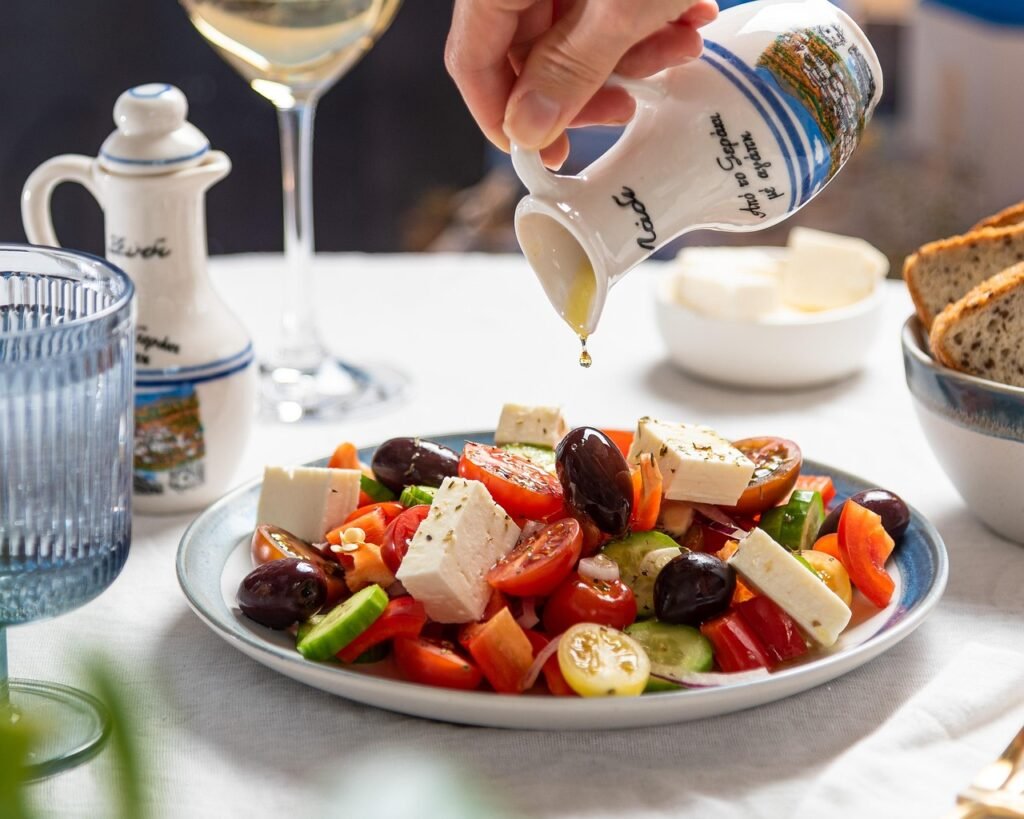
In the Mediterranean, olive oil isn’t just used to grease a pan; it is a primary source of calories. It is drizzled over salads, soups, vegetables, and bread.
Why is it magic?
High-quality EVOO is packed with Polyphenols (specifically oleocanthal). These are potent antioxidants that reduce inflammation. As we discussed in Article #10, inflammation is the root of heart disease. By consuming 2–4 tablespoons of EVOO daily, you are essentially bathing your cells in anti-inflammatory protection.
- Note: Vegetable oils (canola, soybean) do not have the same benefit.
The Medical Evidence: Why Doctors Love It
Doctors rely on data, and the data for this diet is overwhelming.
1. The PREDIMED Study (Heart Health)
This was one of the largest nutrition studies ever conducted. Thousands of people at high risk for heart disease were split into groups. One group followed a low-fat diet; the other followed a Mediterranean diet with nuts and olive oil.
- The Result: The study had to be stopped early because the results were so dramatic. The Mediterranean group had a 30% lower risk of heart attacks and strokes compared to the low-fat group.
2. Brain Protection (Alzheimer’s)
The brain loves healthy fats. The “MIND Diet” (a hybrid of Mediterranean and DASH diets) has been shown to lower the risk of Alzheimer’s disease by up to 53% in those who follow it strictly. The combination of leafy greens, berries, and fish seems to protect neurons from degeneration.
3. Diabetes Management
Because the diet is rich in fiber (from beans and veggies) and healthy fats, it prevents blood sugar spikes. It improves insulin sensitivity, making it a frontline treatment for Type 2 Diabetes.
The Lifestyle Factor: “Vitamin S” (Social)
Here is the component most Americans miss. The Mediterranean Diet is not just about ingredients; it is about how you eat.
In the Blue Zones (areas where people live longest), meals are communal. They are slow. They are enjoyed with family and friends.
- Stress Reduction: Eating slowly activates the “Rest and Digest” (parasympathetic) nervous system.
- Portion Control: When you are talking and laughing, you eat slower, giving your brain time to register fullness.
- Connection: Loneliness is as dangerous to health as smoking. Sharing a meal fixes that.
If you eat a Mediterranean salad alone in your car while stressed in traffic, you are only getting half the benefits.
The Comparison: The “SAD” vs. The Mediterranean
How does this compare to the Standard American Diet (SAD)?
| Feature | Standard American Diet (SAD) | Mediterranean Diet |
| Primary Fat | Soybean/Corn Oil, Saturated Animal Fat | Extra Virgin Olive Oil, Nuts, Avocados |
| Carbohydrates | Refined (White Bread, Sugar, Soda) | Complex (Beans, Lentils, Whole Wheat) |
| Protein Source | Red Meat, Processed Deli Meats | Fish, Beans, Poultry, Yogurt |
| Vegetables | Usually a side dish (or french fries) | The main course (Half the plate) |
| Flavoring | Salt and Sugar | Herbs, Spices, Garlic, Lemon, Onion |
| Beverage | Soda, Sweet Tea, Juice | Water, Coffee, Red Wine (Moderate) |
A Perfect Mediterranean Day of Eating
You don’t need to live in Italy to eat this way. Here is a realistic plan for a Tuesday in the suburbs.
Breakfast: Savory Greek Yogurt
- Full-fat Greek yogurt topped with walnuts, a drizzle of honey, and sliced figs or berries.
Lunch: The “Everything” Salad
- A base of mixed greens and arugula.
- 1/2 cup of chickpeas (rinsed from a can).
- Chopped cucumbers, tomatoes, and red onion.
- Feta cheese crumbles.
- Dressing: Generous pour of Olive Oil and lemon juice.
Snack:
- A handful of almonds and an orange.
Dinner: Baked Cod & Veggies
- White fish baked with garlic and herbs.
- A side of roasted zucchini and eggplant.
- A small portion of couscous or quinoa.
- Optional: A small glass of red wine.
The “Red Wine” Controversy
We can’t talk about this diet without talking about wine.
Traditionally, wine is consumed in moderation (1 glass for women, 2 for men) with meals. Red wine contains Resveratrol, an antioxidant linked to longevity.
However, modern science is shifting. Recent studies suggest that no amount of alcohol is “safe” for cancer risk.
- The Verdict: If you don’t drink, don’t start. If you do drink, switch to red wine, enjoy it slowly with food, and keep it moderate. The diet works perfectly fine with just water.
How to Get Started (The Shopping List)
You don’t need to overhaul your life overnight. Start with these three swaps:
- Swap your oil: Buy the most expensive Extra Virgin Olive Oil you can afford. Use it for everything.
- Swap your meat: Commit to “Meatless Mondays” (bean-based) and “Fish Fridays.” Save red meat for the weekend.
- Swap your crunch: Trade chips for nuts (walnuts, almonds, pistachios).
Conclusion: The “Forever” Diet
The reason the Mediterranean Diet wins every year is that it is sustainable.
It doesn’t ask you to starve. It doesn’t ban entire food groups. It doesn’t make you calculate math equations before dinner.
It simply asks you to eat real, high-quality food, enjoy it with people you love, and savor the flavor. It is not a diet you go “on” and “off.” It is a way of living that you can keep up until you are 100 years old.
So, pour the olive oil, break the bread, and raise a glass. To your health