Lower back pain is a pervasive issue that affects millions of adults worldwide. Whether caused by a sedentary office job, improper lifting techniques, or general stress, the ache in the lumbar region can range from a dull throb to debilitating agony. Fortunately, you do not always need expensive equipment or clinical intervention to find relief. Implementing easy yoga stretches lower back pain at home can be a transformative practice for your spinal health.
According to the World Health Organization, low back pain is the single leading cause of disability globally. While medical intervention is sometimes necessary, many experts agree that gentle movement and stretching are often more effective than bed rest for chronic non-specific back pain. This guide details a professional, safe, and effective yoga routine designed to restore mobility and reduce discomfort from the comfort of your living room.
Understanding the Link Between Yoga and Back Health
Before diving into the poses, it is essential to understand why yoga is uniquely check-suited for spinal health. Unlike high-impact aerobics or weightlifting, yoga emphasizes controlled movement, breathwork, and alignment.
The Science of Stretching
Research from the National Center for Complementary and Integrative Health (NCCIH) suggests that yoga is an effective treatment for chronic low back pain, helping to improve function and reduce pain intensity. The practice works by:
- Increasing Blood Flow: Stretching delivers oxygen-rich blood to tight muscles, aiding in repair.
- Improving Flexibility: Loosening the hamstrings and hip flexors reduces mechanical strain on the lower back.
- Strengthening the Core: Many yoga poses engage the abdominal muscles, which act as a corset to support the spine.
Safety First: Pre-Session Guidelines
While these are easy yoga stretches, safety is paramount. If you have a history of herniated discs, osteoporosis, or severe acute pain, consult a healthcare provider before starting. As noted by the Mayo Clinic, you should seek immediate medical attention if back pain is accompanied by fever, weight loss, or numbness in the legs.
Guidelines for Practice:
- Listen to your body: Sensation is good; sharp pain is a warning signal to stop.
- Use props: Yoga blocks, straps, or even a folded towel can make poses more accessible.
- Focus on breath: Deep breathing activates the parasympathetic nervous system, helping muscles relax.
5 Easy Yoga Stretches for Lower Back Pain at Home
Perform this routine on a yoga mat or a carpeted floor. Hold each pose for 30 to 60 seconds, breathing deeply.
1. Cat-Cow Pose (Marjaryasana-Bitilasana)
This dynamic flow warms up the spine and relieves tension in the back and neck.
- How to do it: Start on your hands and knees (tabletop position). Inhale, drop your belly towards the floor, and look up (Cow). Exhale, round your spine toward the ceiling like an angry cat, tucking your chin (Cat).
- Why it works: It promotes spinal flexibility and mobilizes the vertebrae. Yoga Journal highlights this as an essential foundational movement for beginners.
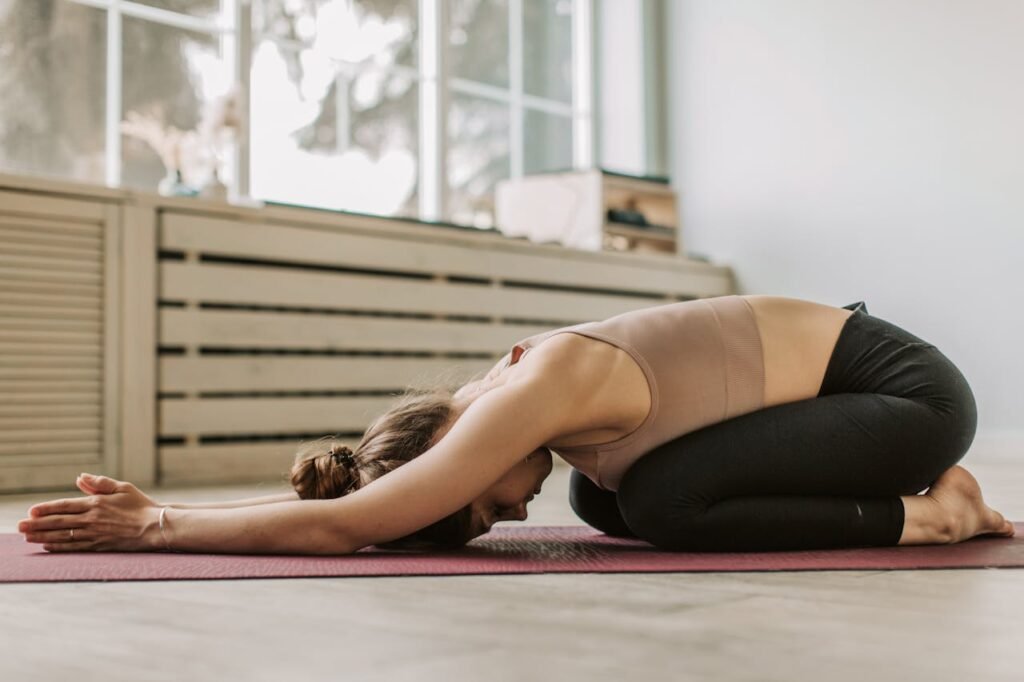
2. Child’s Pose (Balasana)
Child’s Pose is a resting posture that gently stretches the lower back muscles while opening the hips.
- How to do it: From tabletop, sink your hips back toward your heels. Extend your arms forward on the mat and rest your forehead on the ground.
- Why it works: It elongates the spine passively. According to Cleveland Clinic, gentle stretching exercises like this can alleviate pressure on the sciatic nerve.
3. Sphinx Pose (Salamba Bhujangasana)
For those who sit at a desk all day, the lower back often loses its natural curve. Sphinx pose offers a gentle extension.
- How to do it: Lie on your stomach. Prop yourself up on your forearms, elbows under shoulders. Press your pubic bone into the floor and gently lift your chest.
- Why it works: It stimulates the sacral-lumbar arch and strengthens the spine without the intensity of a full Cobra pose.
4. Supine Spinal Twist (Supta Matsyendrasana)
Twisting helps realign the spine and hydrate the intervertebral discs.
- How to do it: Lie on your back. Hug your right knee into your chest. Guide the right knee across your body to the left side. Extend your right arm out and look toward your right hand. Repeat on the other side.
- Why it works: Rotational movements help release tension in the quadratus lumborum (QL) muscles.
5. Legs-Up-the-Wall (Viparita Karani)
This is a restorative inversion that requires minimal effort but offers maximum relief.
- How to do it: Sit close to a wall and swing your legs up so they are resting vertically against it while your back is flat on the floor.
- Why it works: Harvard Health notes that restorative yoga poses help reduce stress, which is often a significant contributor to muscle tension and back pain.
Comparison: Yoga vs. Other Pain Management Methods
When managing chronic pain, it helps to weigh your options. Below is a comparison of implementing a home yoga practice versus other common interventions.
| Feature | Yoga Practice | Pain Medication (OTC) | Physical Therapy | Surgery |
|---|---|---|---|---|
| Cost | Free / Low (Mat cost) | Low to Medium (Recurring) | High (Co-pays/Insurance) | Very High |
| Invasiveness | Non-invasive | Systemic (Chemical) | Non-invasive | Invasive |
| Side Effects | Soreness, improved flexibility | Stomach issues, dependency risk | Soreness, improved strength | Recovery time, infection risk |
| Root Cause Focus | High (Addresses muscular imbalance) | Low (Masks symptoms) | High (Addresses mechanics) | High (Structural repair) |
| Accessibility | Immediate (At home) | Immediate | Requires appointments | Requires lengthy process |
Data regarding treatment efficacy and costs reflects general trends in healthcare management.
Integrating Yoga into Your Daily Life
Consistency is the key to success. You do not need to practice for an hour every day. Research from the Centers for Disease Control and Prevention (CDC) supports the idea that breaking physical activity into smaller chunks is still beneficial. Even 10 minutes of easy yoga stretches lower back pain at home upon waking or before bed can prevent stiffness from setting in.
Tips for Habit Formation:
- Stack your habits: Do your stretches immediately after brushing your teeth.
- Create a calming environment: Dim the lights or play soft music to encourage mental relaxation.
- Track your progress: Note pain levels before and after your session to visualize the benefits.
Furthermore, maintaining a healthy weight through diet and exercise reduces the mechanical load on the spine. The American Heart Association emphasizes that overall physical health is intrinsically linked to musculoskeletal health.
When to Seek Professional Help
While yoga is powerful, it is not a cure-all for structural injuries. If your pain persists despite regular stretching, or if you experience radiating pain (sciatica), it is crucial to consult a specialist. Organizations like the American Chiropractic Association can provide resources for finding licensed professionals who can perform manual adjustments to complement your yoga practice.
Additionally, for those suffering from arthritis-related back pain, the Arthritis Foundation recommends specific water-based exercises or modified yoga to avoid stressing the joints.
Conclusion
Taking control of your spinal health doesn’t require a gym membership or pharmaceutical intervention. By integrating these easy yoga stretches lower back pain at home, you are actively participating in your own recovery and well-being. The sequence of Cat-Cow, Child’s Pose, Sphinx, Twists, and Legs-Up-the-Wall offers a balanced approach to flexion, extension, and rotation.
Remember that the journey to a pain-free back is a marathon, not a sprint. Start gently, listen to your body, and enjoy the relief that comes with a fluid, flexible spine. Roll out your mat today and give your back the relief it deserves.