Creating a sanctuary within your home has never been more important. We often assume that once we close our front door, we are shutting out the pollution and chaos of the outside world. However, evidence suggests that indoor air quality can sometimes be significantly poorer than the air outside.
Investing in an air purifier is a proactive step towards safeguarding your respiratory health. These devices work tirelessly in the background to trap dust, allergens, and pollutants. Yet, many owners fall into the trap of “set and forget.” An air purifier is only as effective as its filter.
If you neglect this crucial component, you aren’t just losing efficiency; you might be circulating contaminants back into your room. Understanding the lifespan of your filter is essential for maintaining a healthy home environment.
According to statistics from GOV.UK, poor air quality is the largest environmental risk to public health in the UK. Ensuring your device functions correctly is not just about home maintenance; it is a vital health intervention.
What is a HEPA filter?
Before discussing replacement schedules, it helps to understand what is happening inside your machine. HEPA stands for High Efficiency Particulate Air. It is not merely a brand name but a strict standard of efficiency.
A true HEPA filter must capture at least 99.97% of particles that are 0.3 microns in diameter. To put that into perspective, a human hair is roughly 50 to 70 microns wide. These filters trap microscopic invaders such as:
- Pollen and plant spores
- Dust mites and their waste
- Pet dander
- Mould spores
- Bacteria and some viruses
How it works
The filter is typically made from a mat of randomly arranged fibres, usually composed of fibreglass. As Healthline explains in their guide to air purifiers, these devices are instrumental in removing triggers for asthma and allergy sufferers. The mechanism relies on the density of this fibre web. Over time, as the web traps more debris, the spaces between the fibres become clogged. This is why replacement is non-negotiable.
Unlike a hard surface you can wipe down, a HEPA filter holds contaminants deep within its structure. Once it reaches saturation, air cannot pass through effectively, straining the motor and reducing the clean air delivery rate (CADR).
Signs you need to replace your HEPA filter
While most modern devices feature an indicator light, these are often based on a simple timer rather than the actual condition of the filter. You should rely on your senses and physical checks to determine the true state of your unit.
1. Visible discoloration
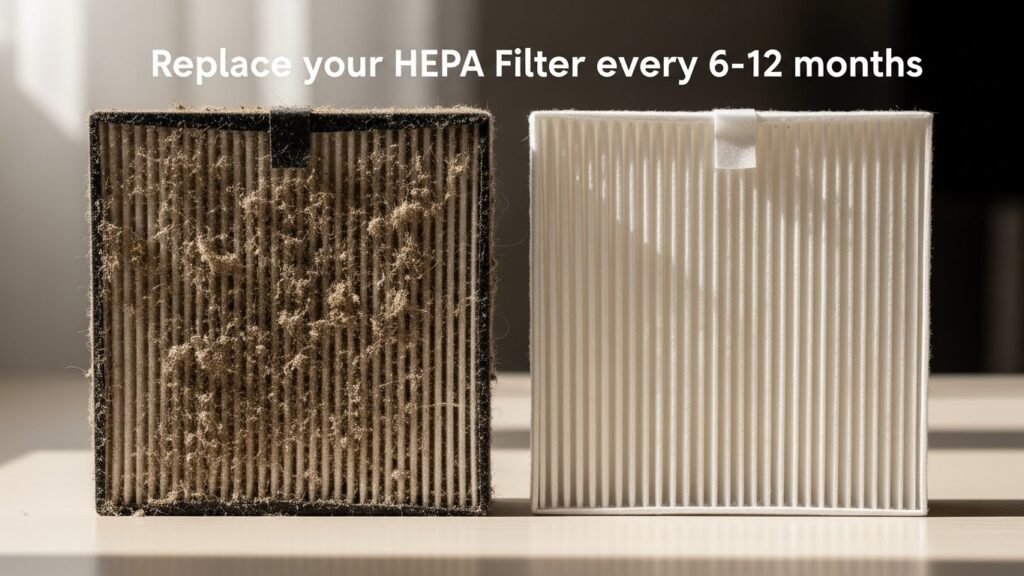
A new HEPA filter is typically stark white. Over time, it will turn grey, and eventually dark charcoal or black. If you open your unit and the filter looks like the contents of a vacuum cleaner bag, it is time for a change. However, be aware that even a white filter can be clogged with microscopic particles invisible to the naked eye.
2. Reduced airflow
If you notice that the air coming out of the purifier feels weaker than usual, or if the unit sounds like it is working harder (making more noise) to push air through, the filter is likely blocked. This restriction causes the fan to spin faster or work under higher pressure, which consumes more electricity.
3. Unpleasant odours
HEPA filters trap particles, but if they become damp or excessively dirty, they can start to smell musty. If your air purifier begins to emit a sour or dusty smell, it is no longer cleaning the air—it is polluting it. According to consumer advice from Which?, a smelly filter suggests microbial growth or saturation and requires immediate disposal.
4. Return of allergy symptoms
Perhaps the most telling sign is the return of your symptoms. If you start sneezing, coughing, or experiencing itchy eyes while indoors, your purifier is likely no longer capturing allergens effectively. The NHS lists these as key symptoms of allergic rhinitis, which air purifiers are meant to alleviate. If these return, check your filter immediately.
How often should you really change it?
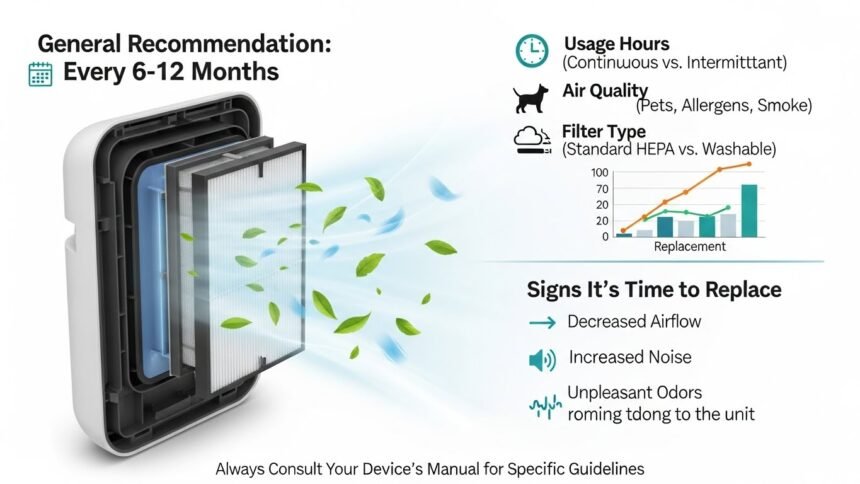
The standard recommendation from most manufacturers is to replace the HEPA filter every 6 to 12 months. However, this is a broad estimate. Your specific replacement frequency depends entirely on your environment and usage.
Factor 1: Usage duration
Do you run your purifier 24/7, or only at night? A filter used continuously will naturally reach saturation faster than one used for eight hours a day. If you prioritise constant clean air, expect to replace the filter closer to the 6-month mark.
Factor 2: Indoor pollution levels
Homes with high levels of particulate matter will exhaust filters quickly. This includes homes with:
- Smokers: Cigarette smoke contains tar that coats filters rapidly.
- Open fires or wood burners: Soot and ash are heavy particulates.
- Kitchen fumes: Cooking without an extractor fan increases airborne grease and particles.
The British Lung Foundation (Asthma + Lung UK) highlights that indoor combustion sources significantly increase the load on air filtration systems.
Factor 3: Pets
Our furry friends are wonderful, but they are tough on air purifiers. Pet dander (skin flakes) and fur can clog the pre-filter and the main HEPA unit quickly. If you have multiple pets, you may need to check your filter every 4 months. For those managing pet allergies, Allergy UK suggests rigorous control of dander, which implies keeping your filtration operating at peak performance.
Factor 4: Location
Living in a city centre or near a busy road exposes your home to traffic pollution, tyre dust, and brake dust. These fine particles (PM2.5) are exactly what HEPA filters target, but high concentrations mean the filter works much harder than it would in a rural setting.
Comparison of filter lifespans
To help you plan your maintenance, here is a breakdown of typical filter types and their expected longevity.
| Filter Type | Estimated Lifespan | Best For | Maintenance Note |
|---|---|---|---|
| True HEPA | 6–12 months | Allergies, Dust, Pollen | Do not wash. Vacuum only if specified by manual. |
| Carbon Pre-filter | 3 months | Odours, VOCs, Smoke | Often a thin sheet. Replace more frequently than HEPA. |
| Washable HEPA-Type | 6–12 months | General Dust | Can be rinsed, but efficiency is lower than True HEPA. |
| Permanent Filter | 3–5 years | Cost saving | Requires regular vacuuming. Loses efficiency over time. |
| Combination Filter | 6–12 months | All-in-one care | The whole unit must be tossed even if one layer is fine. |
Step-by-step: How to replace your filter safely
Changing a filter isn’t just about swapping parts; it’s about doing so without releasing the trapped dust back into your home. Follow this protocol for a safe exchange.
- Turn it off: Switch off and unplug your unit to ensure safety.
- Wear protection: If you are sensitive to dust, wear a face mask and disposable gloves. You are about to handle a concentrated block of allergens.
- Go outside (optional): If possible, take the unit outside or to a garage to remove the old filter. This prevents a dust cloud from settling in your clean room.
- Remove and bag: Take the old filter out and immediately place it in a plastic bag. Tie it tight. This containment is crucial. The Health and Safety Executive (HSE) advises containment as a primary method for controlling dust exposure.
- Clean the cavity: Before inserting the new filter, use a vacuum hose or a damp microfibre cloth to clean the interior dust from the air purifier housing.
- Insert the new filter: Ensure it is facing the correct direction (look for airflow arrows).
- Reset the indicator: Most machines have a specific button combination to reset the “Check Filter” light. Consult your manual.
Risks of delaying replacement
Stretching the life of your filter to save money is a false economy. Beyond the return of allergies, a clogged filter can become a breeding ground for mould. In humid environments, the organic matter trapped in the mesh (skin cells, dust) can absorb moisture, allowing fungal spores to germinate.
A study available via the National Institutes of Health (PubMed) indicates that microbial growth on loaded filters can eventually result in the release of fungal spores back into the air stream, effectively doing the opposite of what the machine was designed for.
Furthermore, a blocked filter increases the energy consumption of the fan. The Carbon Trust consistently advises that well-maintained equipment operates more efficiently; a strained motor draws more power and is prone to overheating and premature failure.
Frequently asked questions
Can I wash my HEPA filter to make it last longer?
Generally, no. Most True HEPA filters are made of delicate fibreglass. Washing them damages the mesh structure, destroying their ability to trap microscopic particles. Only wash filters explicitly labelled as “washable” or “permanent.”
Why is my filter black after only two months?
This usually indicates heavy pollution sources, such as candles, smoking, or proximity to a busy road. Activated carbon filters (often paired with HEPA) are black by design, so ensure you are looking at the HEPA layer.
Do generic filters work as well as brand name ones?
Often, yes, provided they are certified True HEPA. However, check the fit carefully. Even a millimetre gap allows air to bypass the filter entirely, rendering it useless.
How do I dispose of the old filter?
Most HEPA filters are not recyclable due to the mix of materials and the trapped contaminants. They should go in your general waste bin, sealed in a bag.
The bottom line
Your air purifier is a guardian of your respiratory health, but it requires your support to function. A degraded filter transforms a health device into little more than a noisy fan.
For most households, checking the filter every few months and replacing it at least once a year is the standard. However, if you have pets, allergies, or live in a high-pollution area, be prepared to change it every 4 to 6 months.
Prioritise your health by keeping your schedule strict. As reported by BBC News, the long-term benefits of breathing cleaner air are profound. Treat your filter replacement not as a chore, but as a prescription for a healthier life.