Your eyesight is arguably your most precious sense. It allows you to navigate the world, connect with loved ones, and enjoy the beauty of your surroundings. However, as we age, changes in our eyes can threaten this vital connection to the world. One of the most common concerns for older adults is a condition known as age-related macular degeneration (AMD).
It is natural to feel anxious when you notice changes in your vision. You might worry about losing your independence or no longer being able to enjoy hobbies like reading or driving. It is important to remember that you are not alone in this experience. AMD is the leading cause of vision loss in the UK, affecting over 600,000 people. While the diagnosis can feel overwhelming, understanding the condition is the first step toward managing it effectively.
Knowledge is power. By recognising the symptoms early and understanding the risk factors, you can take proactive steps to protect your sight. This guide breaks down the complexities of AMD into clear, actionable information, helping you prioritise your eye health with confidence and clarity.
What is age-related macular degeneration?
Age-related macular degeneration is a chronic eye disease that affects the macula. The macula is the small, highly sensitive area at the very centre of the retina, which is the layer of tissue at the back of your eye that processes light.
Think of the macula as the film in a camera. It is responsible for your central vision—the ability to see fine details clearly, recognise faces, and read text. When the macula becomes damaged, your central vision can become blurry, distorted, or even develop dark patches.
It is crucial to note that AMD primarily affects central vision. It rarely leads to total blindness because it typically spares your peripheral (side) vision. You will likely retain the ability to walk around and perform daily tasks, even in advanced stages, though detailed work may become difficult.
The two main types of AMD
There are two distinct forms of the condition, and understanding the difference is vital for treatment.
1. Dry AMD (Atrophic)
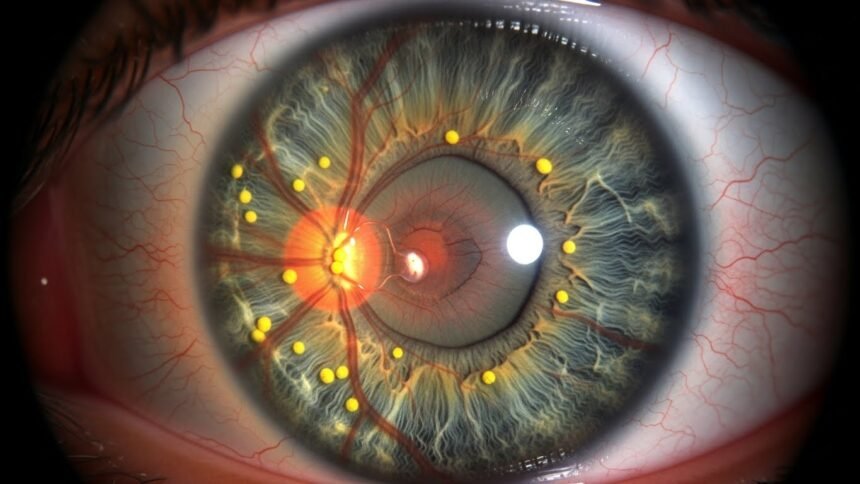
This is the most common form, accounting for approximately 90% of cases. It occurs when the macula thins over time as part of the ageing process. Tiny clumps of protein, known as drusen, grow under the macula. You can learn more about these changes through the NHS overview of the condition. Dry AMD tends to progress slowly, causing a gradual fading of central vision.
2. Wet AMD (Neovascular)
This is a less common but much more serious type. It occurs when abnormal blood vessels grow underneath the retina. These vessels are fragile and can leak fluid and blood, which causes scarring of the macula. This can lead to a rapid loss of central vision, sometimes occurring over weeks or even days.
Symptoms and early warning signs
In the early stages, age-related macular degeneration may not present any noticeable symptoms. This is why regular check-ups with an optometrist are essential, especially if you are over the age of 50.
As the condition progresses, you may notice subtle changes in how you see the world. Being vigilant about these signs can lead to earlier diagnosis and better outcomes.
Common symptoms include:
- Distorted lines: Straight lines, such as door frames or lines of text on a page, may appear wavy, bent, or crooked.
- Blurry central vision: You might find that the centre of your vision is fuzzy, while your side vision remains clear.
- Difficulty adapting to light: Transitioning from bright environments to dimly lit rooms may become harder.
- Faded colours: Colours may not look as bright or vibrant as they used to.
- Dark spots: A dark or empty area (blind spot) may appear in the centre of your vision.
- Difficulty recognising faces: Because the macula handles fine detail, faces may become blurry even when people are standing close to you.
If you experience sudden distortion or a blank spot in your vision, seek immediate medical attention, as this could be a sign of wet AMD.

Risk factors: Who is most likely to develop AMD?
While the exact cause of AMD is unknown, extensive research has identified several key risk factors. Some of these, like age and genetics, are beyond your control. However, others are related to lifestyle choices, giving you an opportunity to lower your risk.
1. Age
This is the most significant risk factor. The condition is rare in people under 50, but the risk increases steeply as you get older. By the time you reach 75, the likelihood of developing some form of macular degeneration rises significantly. This makes regular eye exams critical for seniors.
2. Smoking
If you need another reason to quit, this is a big one. Smoking is one of the only modifiable risk factors consistently linked to AMD. Research suggests that smokers are up to four times more likely to develop the condition than non-smokers. The oxidative stress caused by smoking damages the retina and reduces blood flow to the eyes.
3. Family history and genetics
If your parents or siblings have had AMD, your risk is higher. Scientists have identified several genes associated with the condition. While you cannot change your DNA, knowing your family history allows you to be more vigilant with monitoring.
4. Race and ethnicity
AMD is more prevalent in Caucasian populations compared to African-American or Hispanic/Latino populations. Those with lighter coloured eyes (blue or green) may also have a slightly higher risk, potentially due to less protective pigment in the eye.
5. Cardiovascular health
Your eyes rely on a healthy supply of oxygen-rich blood. Conditions that affect your heart and blood vessels, such as managing high blood pressure and high cholesterol, can negatively impact your eye health. Obesity is also a risk factor, likely due to the systemic inflammation it causes in the body.
Comparison: Dry AMD vs. Wet AMD
Understanding the differences between the two types can help you better understand your diagnosis or risk profile.
| Feature | Dry AMD | Wet AMD |
|---|---|---|
| Prevalence | Common (approx. 90% of cases). | Less common (approx. 10% of cases). |
| Progression Speed | Slow; occurs over years. | Rapid; can worsen in weeks or days. |
| Cause | Thinning of macula; accumulation of tiny yellow deposits known as drusen. | Abnormal blood vessel growth leaking fluid. |
| Primary Symptom | Gradual blurring of central vision. | Distortion (wavy lines) and blind spots. |
| Treatment | Nutritional supplements; visual aids. | Anti-VEGF injections; laser therapy. |
Tips for prevention and management
While you cannot stop the ageing process, you can adopt habits that support your macular health. These steps are beneficial not just for your eyes, but for your overall well-being.
Prioritise a nutrient-rich diet
What you eat matters. Your eyes require specific nutrients to protect against oxidative damage. Focus on:
- Leafy green vegetables: Kale, spinach, and collard greens are rich in lutein and zeaxanthin, antioxidants found in high concentrations in a healthy macula.
- Fatty fish: Salmon, mackerel, and tuna provide Omega-3 fatty acids, which help reduce inflammation.
- Colourful fruits: Oranges, peppers, and berries offer Vitamin C, a crucial antioxidant.
Consider specific supplements
For those with intermediate or advanced AMD, ordinary multivitamins may not be enough. The AREDS2 formula is a specific combination of vitamins and minerals (including zinc, copper, Vitamin C, Vitamin E, lutein, and zeaxanthin) proven to slow the progression of the disease. Always consult your GP before starting new supplements.
Protect your eyes from UV light
Long-term exposure to ultraviolet (UV) light may damage the retina. Wear sunglasses that block 100% of UVA and UVB rays when you are outdoors, even on cloudy days. A wide-brimmed hat offers additional protection.
Monitor your vision at home
You can use an Amsler grid—a simple grid of horizontal and vertical lines—to check for distortion daily. If the lines suddenly look wavy or broken, contact your eye specialist immediately. For more comprehensive macular degeneration resources, checking trusted health portals regularly can keep you informed on new monitoring tools.
Frequently asked questions
Can age-related macular degeneration be cured?
Currently, there is no total cure for AMD. However, treatments for Wet AMD, such as injections, can stop the progression and sometimes restore some vision. For Dry AMD, lifestyle changes and supplements can slow its advance.
Will I lose my sight completely?
It is very rare to lose all sight from AMD. It affects central vision, meaning your peripheral (side) vision usually remains intact. This generally prevents severe sight impairment regarding mobility, though reading and recognising faces becomes difficult.
Can I still drive with AMD?
You must meet the visual standards for driving set by the DVLA. If your central vision is affected, you may need to stop driving. You are legally required to inform the DVLA if you are diagnosed with AMD in both eyes.
The bottom line
Receiving a diagnosis of age-related macular degeneration can be unsettling, but it does not mean your life has to stop. Millions of people in the UK manage this condition while maintaining a high quality of life. The key lies in early detection and consistent management.
By attending regular eye exams, adopting a diet rich in leafy greens, and protecting your eyes from the sun, you can support your retinal health. If you notice any sudden changes—like straight lines looking wavy—seek help immediately. Medical advancements are constantly improving, offering new hope for preserving sight. Prioritise your eyes; they are your window to the world.