



For many aquatic enthusiasts, the pool is a sanctuary. The rhythmic sound of water breaking, the weightlessness, and the solitude offer a unique form of meditation. However, there is a common adversary that plagues even the most dedicated athletes: “Black Line Fever.” Staring at the bottom of the pool for hours, repeating the same laps at the same pace, can eventually lead to mental fatigue and a plateau in physical progress.
To maintain long-term consistency and improve cardiovascular health, it is crucial to transform your routine. By incorporating engaging swim workouts, you can reignite your passion for the pool, stimulate different muscle groups, and sharpen your mental focus. This guide explores professional strategies to banish boredom and elevate your aquatic fitness.
The Science of Swimmer’s Burnout
Before diving into the solutions, it is helpful to understand why burnout occurs. Swimming is a sensory-deprived sport. Unlike runners who have changing scenery, or cyclists who must navigate traffic, swimmers operate in a controlled, repetitive environment. According to Psychology Today, repetitive tasks can lead to a state of autopilot that diminishes motivation and cognitive engagement.
Furthermore, doing the same continuous swim day after day forces your body to adapt to that specific stress level, leading to diminished returns. To spark change—both mental and physical—you must introduce variability.
1. Structured Interval Training (HIIT in the Pool)
One of the most effective ways to create engaging swim workouts is to abandon the “continuous swim” model. Instead, adopt High-Intensity Interval Training (HIIT). Interval training not only burns more calories but also keeps your mind active as you calculate split times and rest periods.
The Pyramid Set
Pyramid sets are a classic method to build endurance and speed while keeping the brain occupied. A standard pyramid might look like this:
- 1 x 50m (Rest 10s)
- 1 x 100m (Rest 15s)
- 1 x 200m (Rest 20s)
- 1 x 100m (Rest 15s)
- 1 x 50m (Rest 10s)
The American Council on Exercise notes that varying intensity levels during a workout improves aerobic capacity faster than steady-state cardio. By focusing on pace and counting laps for specific distances, you leave no room for boredom.
2. Incorporate Training Aids and Equipment
Introducing toys to your swim bag is not just for beginners. Equipment changes your body position, resistance, and propulsion, forcing you to adapt your stroke. This variation is key to developing a holistic feel for the water.
Comparison of Swim Training Equipment
The following table outlines common swim equipment and how they contribute to workout variety and muscle targeting:
| Equipment Item | Primary Function | Muscle Focus | Engagement Benefit |
|---|---|---|---|
| Kickboard | Isolates legs | Quadriceps, Hamstrings, Glutes | Allows social interaction; focuses on leg endurance. |
| Pull Buoy | Isolates upper body | Lats, Shoulders, Tricaps | Removes leg fatigue; focuses on stroke mechanics and high elbow catch. |
| Swim Fins | Adds propulsion & resistance | Ankles, Core, Legs | Increases speed sensation; allows for drills at race pace. |
| Hand Paddles | Increases surface area | Upper Back, Shoulders | Highlights inefficiencies in the catch phase; builds strength. |
| Center Snorkel | Neutralizes head position | Neck, Core Alignment | Eliminates breathing rotation; allows 100% focus on technique. |
Using fins can be particularly exhilarating because they allow you to swim at speeds usually reserved for elite sprinters, providing a dopamine hit that makes the workout feel fun and fast.
3. Master the Art of Technical Drills
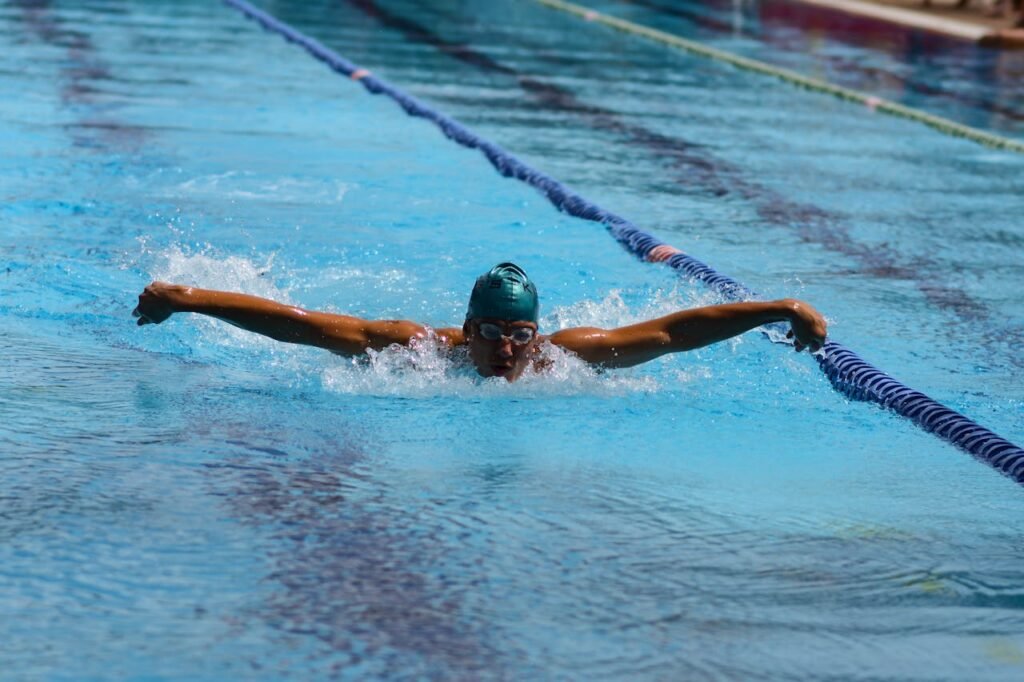
Swimming is highly technical. If you are bored, it is likely you are not thinking enough about your form. dedicating 20% of your workout to drills can drastically improve your efficiency.
- Catch-Up Drill: Wait until one hand touches the other before starting the next stroke. This emphasizes a long glide and isolates the pull.
- Fist Drill: Swim with closed fists. This removes the surface area of your hand, forcing you to use your forearm for propulsion (the “high elbow catch”).
- Count Your Strokes: Try to reduce the number of strokes it takes to get across the pool (SWOLF score). This turns every lap into a game of efficiency.
Resources like Swimming World Magazine offer extensive libraries of drills that target specific stroke defects, ensuring you always have a new skill to master.
4. Join a Masters Swim Team
Solitude is the enemy of engagement. Joining a group transforms swimming from a solitary chore into a social event. U.S. Masters Swimming provides organized workouts for adults of all ability levels.
Benefits of group swimming include:
- Accountability: It is harder to skip a workout when teammates expect you.
- Coaching: A coach on deck provides real-time feedback and structured sets you wouldn’t write for yourself.
- Competition: Friendly racing during practice pushes you harder than you would push yourself alone.
5. Gamify Your Swim with Technology
In the digital age, data is a powerful motivator. Modern waterproof wearables have revolutionized how we track aquatic performance. Devices from brands like Garmin or Apple can track laps, stroke rate, SWOLF efficiency, and heart rate.
By syncing your data to platforms like Strava, you can compete in virtual challenges, track your monthly distance against friends, and visualize your progress over time. Seeing a graph of your pace improvement provides tangible proof of your hard work, which is incredibly motivating.
6. Embrace the Open Water
If the pool walls feel like they are closing in, it might be time to step outside. Open water swimming presents a dynamic environment with no black lines, no walls to push off, and variable conditions (waves, currents, temperature).
Open water requires a different skill set, including “sighting” (lifting the head to navigate). The World Open Water Swimming Association highlights that the unpredictability of nature forces heightened awareness and engagement. However, safety is paramount; always swim with a buddy and a bright tow float in open water.
7. Mix Strokes (The IM Approach)
Many fitness swimmers stick strictly to freestyle. However, learning the other three competitive strokes—Backstroke, Breaststroke, and Butterfly—engages different muscle groups and prevents repetitive strain injuries.
Training for the Individual Medley (IM) is one of the best ways to ensure full-body fitness. According to the Mayo Clinic, cross-training muscle groups within the same activity reduces injury risk and balances strength development. Even if your butterfly is messy, the attempt alone raises your heart rate significantly and breaks the monotony of freestyle.
8. The “Challenge” Sets
Once a week, introduce a “Challenge Set.” This is a difficult workout designed to test your mental grit. Completing a challenge set gives you a sense of accomplishment that lasts all week.
Examples include:
- The 100x100s: A marathon set usually reserved for holidays, but scaled-down versions (e.g., 30x100s) work well.
- Locomotive: Alternating fast and slow laps in increasing and decreasing increments.
- Breath Control: Swimming 3, 5, 7, or 9 strokes per breath (hypoxic training). Note: Practice hypoxic training with caution and never alone.
Referencing safety guidelines from World Aquatics (formerly FINA) regarding training limits is essential when pushing boundaries.
Conclusion
Consistency is the key to fitness, but variety is the key to consistency. By integrating equipment, structured intervals, social elements, and new environments, you can transform your relationship with the water.
Engaging swim workouts are not just about physical exertion; they are about keeping the mind sharp and the spirit motivated. Don’t let the black line hypnotize you into boredom. Pick one strategy from this list—whether it’s buying a pair of fins, joining a Masters club, or trying a pyramid set—and implement it in your next session. Your body and your mind will thank you.
Ready to upgrade your routine? Check out the CDC’s guidelines on physical activity to see how swimming fits into a balanced healthy lifestyle, and dive back in with renewed purpose.


