Modern environmental neuroscience now regards ocean waves as a multi-sensory therapeutic stimulus capable of modulating stress physiology, affective state, and musculoskeletal function. Coastal researchers often describe this as the “blue health” or “blue mind” effect, referring to measurable shifts in the autonomic nervous system and brain activity when humans are near, in, or even just listening to water.[1][2]
In this guide, we will unpack the mechanisms behind the healing power of ocean waves and translate the data into practical protocols you can integrate into a beach wellness routine for beginners, including simple beach meditation for anxiety relief, morning beach yoga for a stiff back, and low impact beach workouts for seniors.
How Ocean Waves Affect the Brain and Nervous System
Blue Space, Stress Recovery, and Cognitive Restoration
Environmental psychology consistently shows that coastal environments outperform urban settings for stress reduction and perceived restoration.[4] In stress recovery theory (SRT), natural environments rich in water facilitate rapid downshifts in sympathetic arousal (fight-or-flight) and enhance positive affect, calm, and interest.[4] A large qualitative study on coastal visits found that participants repeatedly described feeling “calm,” “recharged,” and “reborn” after time by the sea, especially when exposed to sound, open vistas, and wave motion.[4]
Evidence from blue space epidemiology indicates that living near coasts is associated with improved mental health, greater physical activity, and better overall well-being compared to inland urban residence.[1][4] According to research summarized by a leading UK coastal health initiative, hearing ocean sound alone can reduce perceived stress and generate a sense of calm, even when accessed digitally.[1]
The “Blue Mind” Effect and Autonomic Regulation
Marine biologists and neuroscientists have popularized the concept of “blue mind”—a mildly meditative, calm but alert state induced by proximity to water and repetitive wave patterns.[2] Cognitive neuroscience frameworks suggest that:
- The ocean provides a predictable visual and auditory background, which decreases cognitive load on threat-detection circuits and allows limbic (emotional) centers to relax.[2]
- Subtle variations in wave forms and sounds still provide enough novelty to trigger small dopamine releases, supporting interest and gentle focus without overstimulation.[2]
Immersion and hydrotherapy studies show that being in water can rebalance sympathetic and parasympathetic activity and reduce cortisol, the primary stress hormone.[2] A frequently cited hydrotherapy trial reported significant reductions in salivary cortisol after spa-style bathing, reinforcing the role of aquatic exposure in stress modulation.[2]
Physiological Markers: Heart Rate, Blood Pressure, Hormones
Controlled experiments on viewing or hearing water have documented reductions in heart rate and blood pressure when participants are exposed to aquatic scenes versus non-water controls, indicating a cardiovascular relaxation response.[6] Ocean-focused mental health resources further highlight that simply being near water can make people feel calmer and more at ease, suggesting a reproducible relaxation effect on both subjective mood and objective physiology.[7]
Ocean-focused conservation organizations also report convergent findings: exposure to waves, sea air, and coastal vistas is associated with reduced stress, improved mood, and increased serotonin, the neurotransmitter associated with positive affect.[5]
Multisensory Inputs: Sound, Sight, Air, and Touch
Wave Sound as a Natural Auditory Regulator
Neuroscientists and psychologists have begun to characterize wave acoustics as a form of natural sound therapy. In one comparison, the sound of waves was more effective at reducing cortisol than specially designed relaxing music, indicating a unique regulatory quality in the frequency spectrum and rhythm of surf noise.[8] University-led blue health programs have therefore recommended the sound of the ocean—live or recorded—as a self-care tool for stress management and mental health support.[1]
Listening to rhythmic waves activates the parasympathetic nervous system, slowing respiration and heart rate and facilitating a transition toward a rest-and-digest state.[3] For individuals with anxiety, this can serve as an accessible, low-friction sensory anchor during meditation or breathing exercises.
Visual Blue Space and the Neuroscience of Calm
Visual exposure to bodies of water has been shown to alter both subjective relaxation and physiological markers. In experimental settings, participants viewing water scenes demonstrated lower average heart rate and more favorable blood pressure measures compared to non-water conditions.[6] Some participants even reported high relaxation scores while showing mild physiological arousal, which researchers interpret as a blend of joy and fascination rather than stress.[6]
Color psychology and cognitive experiments also support that the color blue is strongly associated with calm, peace, and even creativity, which may partially explain the mental clarity many report when looking at the ocean horizon.[3]
Air, Aerosols, and Sensory Chemistry
Coastal environments generate sea spray aerosols and are rich in negative air ions that may contribute to mood improvements and immune modulation.[4][3] Negative ion exposure has been investigated as a potential adjunctive treatment for seasonal affective disorder and is thought to influence serotonin pathways.[3] Coastal temperatures and humidity also support thermoregulation, adding to physical comfort and reducing physiological stress.[4]
Saltwater immersion further benefits circulation, helps decrease inflammation, and supports faster healing of some skin issues, in addition to relaxing muscles—a valuable factor for anyone undertaking morning beach yoga for a stiff back or gentle swim-based exercise.[3]
Practical Beach Wellness Protocols for Beginners
1. Beach Wellness Routine for Beginners: Core Components
A structured beach wellness routine for beginners can be built around three evidence-aligned pillars: exposure, movement, and regulation.
- Exposure (10–15 minutes)
- Walk slowly along the shoreline, keeping visual focus on the horizon and auditory focus on the waves.
Breathe nasally with a 4–6 second inhale and 6–8 second exhale to amplify parasympathetic activation, leveraging the natural slowing effect of wave sound on breathing rhythms.[3][8]
Movement (15–20 minutes)
Alternate between slow walking on firm wet sand and short intervals on dry sand, which slightly increases muscular demand and proprioceptive input while keeping impact low for joints—particularly important for deconditioned or older adults.[4]
Regulation (5–10 minutes)
- Conclude with seated or lying relaxation, eyes half-closed, listening to waves as a continuous auditory anchor.
- This combines environmental exposure with a meditative protocol similar to those shown to increase grey matter in regions related to emotion regulation and perspective-taking.[3]
2. Simple Beach Meditation for Anxiety Relief
For simple beach meditation for anxiety relief, ocean waves function as both white noise and biofeedback for breath.
Protocol (10–12 minutes):
- Sit facing the water, spine neutral, hands resting on thighs.
- Inhale gently through the nose as a wave rises; exhale slowly as it falls or recedes. Match the cadence of your breath to the wave cycle, extending exhalation to enhance vagal tone.[3]
- When intrusive thoughts appear, label them neutrally (e.g., “thinking”) and relocate attention to the texture of the sound: the low-frequency rumble vs. the high-frequency hiss of breaking surf.
- This attentional redirection mirrors clinically validated mindfulness strategies and leverages the unique acoustic complexity of waves as a focus object.
Because evidence suggests that even virtual or recorded water can support mental health when live access is limited, this same protocol can be performed at home with high-fidelity ocean sound recordings when a beach is not accessible.[7][1]
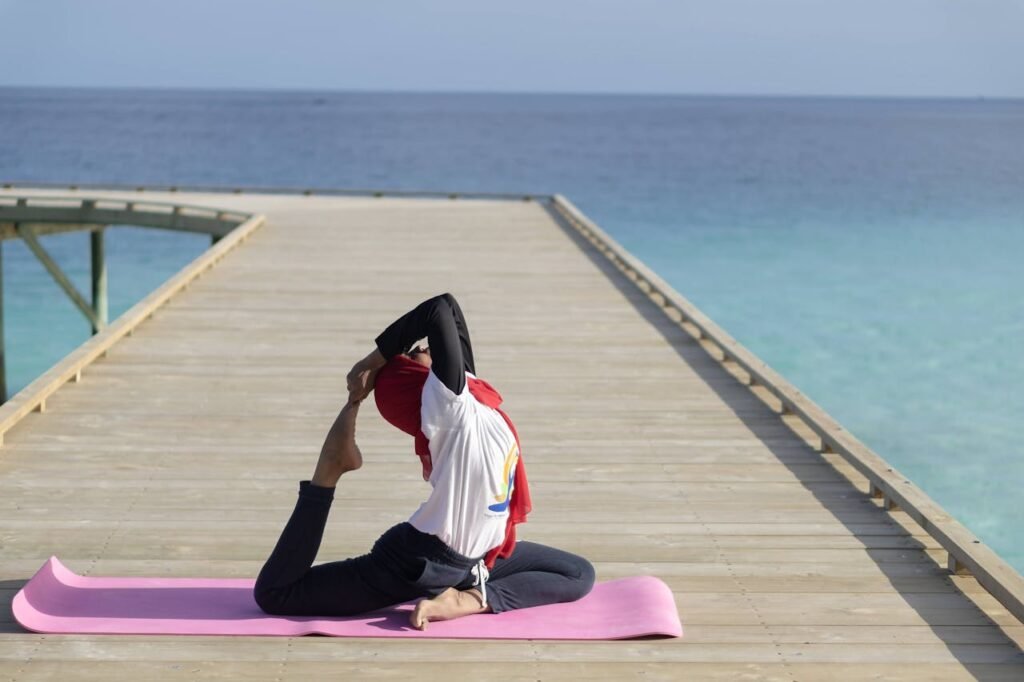
3. Morning Beach Yoga for a Stiff Back
Morning beach yoga for a stiff back benefits from the combined action of gentle spinal mobility, core activation on an unstable substrate (sand), and the muscle-relaxing effects of warmth and humidity.
Foundational sequence (15–20 minutes):
- Cat–Cow in kneeling or tabletop on a mat to mobilize spinal segments safely.
- Low lunge with torso upright to open hip flexors, often implicated in lumbar stiffness from prolonged sitting.
- Supported forward fold with micro-bend in knees, using a block or towel, to lengthen posterior chain without overloading lumbar discs.
- Supine figure-four stretch for gluteal and piriformis release, easing sciatic-type discomfort.
Sand slightly increases proprioceptive demand and encourages intrinsic foot muscle activation, which can support overall kinetic chain alignment for the spine.[4] If pain is present, maintaining neutral lumbar alignment and shorter ranges of motion is critical; discomfort that centralizes or diminishes with gentle movement is typically a positive sign, whereas radiating pain warrants professional assessment.
4. Low Impact Beach Workout for Seniors
A low impact beach workout for seniors should prioritize joint preservation, balance, and cardiovascular conditioning, using the natural resistance and cushioning of sand.
Sample session (20–25 minutes):
Warm-up (5 minutes):
Slow shoreline walk on firm sand, focusing on upright posture and reciprocal arm swing.Functional strength circuit (12–15 minutes):
- Sit-to-stand from a portable low chair placed on stable sand.
- Heel-to-toe tandem walking near the waterline for balance training.
Gentle calf raises using a railing or companion for light support.
Cool-down (5 minutes):
Seated ankle circles, gentle neck rotations, and diaphragmatic breathing synchronized with wave sound to assist in autonomic downregulation.[3][8]
Research on coastal physical activity highlights swimming and water-based movement as supportive for chronic conditions like rheumatism and arthritis, due to buoyancy reducing joint load.[4] Seniors who are water-confident may integrate shallow-water walking or light swimming to exploit these advantages.
Implementation, Safety, and Frequency
Studies in blue health suggest that routine exposure—even weekly or bi-weekly—to coastal environments yields cumulative benefits for mood and perceived stress.[1][4][5] For most individuals, 30–45 minutes per session incorporating exposure, movement, and regulation elements at the beach provides a practical and sustainable starting dose.
Important safety considerations include UV exposure, hydration, heat and cold stress, and terrain stability, all of which can influence the net benefit of a beach session, especially for older adults or those with cardiovascular or balance disorders. When in doubt, programs should be reviewed with a healthcare provider, particularly if preexisting conditions are present.
As environmental health research advances, ocean waves are increasingly framed not only as a symbol of relaxation but as a clinically relevant, multimodal therapeutic stimulus. By structuring intentional practices around sound, sight, movement, and breath, individuals can harness the full spectrum of the ocean’s healing potential—from acute anxiety relief to long-term improvements in mental and physical resilience.
Resources & References
- University-based coastal health initiative discussing the mental health benefits of ocean sound and the role of blue space in public health.[1]
- Ocean therapy organization summarizing the “blue mind” phenomenon and cognitive neuroscience of water immersion.[2]
- Applied psychology resource detailing how beach visits change the brain, including parasympathetic activation and negative ion effects.[3]
- Peer-reviewed qualitative study on emotions at the coast, blue space, and restorative mechanisms.[4]
- Conservation organization overview of ocean wellness and the surprising benefits of being near the sea.[5]
- University research article on the health benefits of viewing water, including heart rate and blood pressure responses.[6]
- Mental health-focused article on how being near water—even virtually—supports mental well-being.[7]
- Coastal hospitality resource describing empirical findings on wave sound vs. relaxing music for cortisol reduction.[8]
- Blue health program materials focusing on water and human health and wellbeing.[1]
- Environmental psychology commentary on how coastal margins can help address physical inactivity and mental health challenges.[1]
- Commentary on predictable water environments as a normalizing background for emotional centers of the brain.[2]
- Hydrotherapy research summary on spa bathing and stress biomarkers in college students.[2]
- Ocean therapy discussion on hydrostatic pressure and sensory support in water for various neurological conditions.[2]
- Blue space meta-analytic findings linking coastal exposure to decreased stress, anxiety, and depressed mood.[4]
- Environmental health notes on sea spray aerosols, temperature regulation, and coastal mechanisms for well-being.[4]