For centuries, civilizations have worshipped the sun as a source of life, warmth, and vitality. While modern medicine has evolved significantly since ancient times, recent research confirms that our ancestors were onto something profound. The sun is not merely a celestial body that dictates our sleep cycles; it is the primary generator of a critical hormone precursor known as Vitamin D.
While most people associate the “sunshine vitamin” with strong bones and calcium absorption, its role extends far beyond skeletal integrity. Emerging science has illuminated a direct and powerful connection between vitamin d deficiency heart health, and overall longevity. In a world where heart disease remains the leading cause of death globally, understanding this connection is no longer optional—it is essential.
The Sunshine Hormone: Redefining Vitamin D
Technically, Vitamin D is not a vitamin at all; it is a pro-hormone produced cutaneously when ultraviolet B (UVB) rays interact with cholesterol in the skin. Once synthesized or ingested, it undergoes activation in the liver and kidneys to become calcitriol, the biologically active form.
According to the National Institutes of Health (NIH), Vitamin D receptors are found in nearly every cell in the human body, including cardiomyocytes (heart muscle cells) and vascular smooth muscle cells. This ubiquity suggests that Vitamin D plays a systemic role in maintaining homeostasis, influencing everything from immune function to cardiovascular stability.
The Biological Mechanisms: How D Protects the Heart
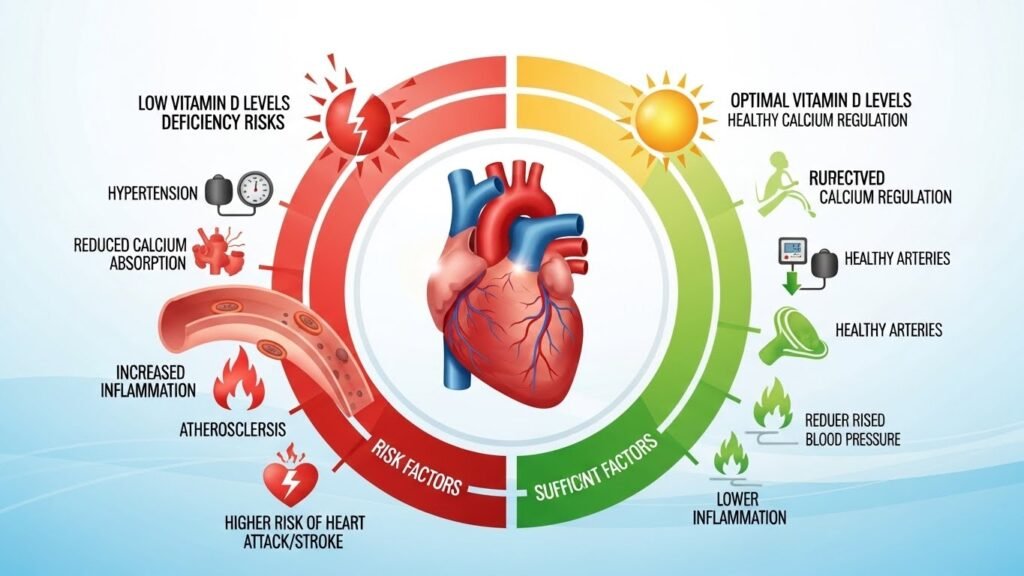
The correlation between low Vitamin D levels and heart disease is not just statistical; it is biological. Researchers have identified several specific pathways through which Vitamin D exerts a protective influence on the cardiovascular system.
1. Regulating Blood Pressure
One of the most significant ways Vitamin D protects the heart is by regulating the Renin-Angiotensin-Aldosterone System (RAAS). The RAAS is a hormone system that regulates blood pressure and fluid balance. Overactivation of this system leads to hypertension (high blood pressure), a major risk factor for heart attacks and strokes.
Studies published in journals archived by the National Library of Medicine suggest that Vitamin D acts as a natural inhibitor of renin, an enzyme that triggers the blood pressure-raising cascade. By keeping renin levels in check, adequate Vitamin D helps maintain vascular relaxation and healthy blood pressure levels.
2. Reducing Systemic Inflammation
Cardiovascular disease is increasingly viewed as an inflammatory condition. Chronic inflammation damages the lining of blood vessels (the endothelium), leading to atherosclerosis (hardening of the arteries). Vitamin D exhibits potent anti-inflammatory properties, suppressing pro-inflammatory cytokines that contribute to arterial stiffness.
According to Harvard Health Publishing, correcting deficiency may help reduce the inflammatory markers associated with coronary artery disease.
3. Improving Insulin Sensitivity
There is a strong comorbidity between Type 2 diabetes and heart disease. Vitamin D is essential for proper insulin secretion and sensitivity. By helping the body process blood sugar more efficiently, Vitamin D indirectly protects the heart from the diabetic complications that destroy blood vessels and nerves.
The Silent Epidemic: Vitamin D Deficiency Heart Health Risks
Despite the availability of sunlight and fortified foods, Vitamin D deficiency is a global pandemic. Modern lifestyles, which involve spending approximately 90% of our time indoors, have severed our connection to the sun. This shift has dire consequences for cardiovascular wellness.
When levels drop, the protective mechanisms fail. The connection between vitamin d deficiency heart health risks is evident in observational studies showing that individuals with low levels of 25-hydroxyvitamin D have a significantly higher risk of heart attacks, heart failure, and stroke compared to those with sufficient levels.
According to the Cleveland Clinic, symptoms of deficiency are often subtle—fatigue, muscle weakness, or mood changes—meaning many people are damaging their hearts without realizing it until a major event occurs.
Data Analysis: Serum Levels and Cardiovascular Risk
Understanding your numbers is the first step toward prevention. The following table outlines the general medical consensus regarding serum 25(OH)D levels and their associated cardiovascular implications.
| Serum Level (ng/mL) | Status | Cardiovascular Implications |
|---|---|---|
| < 12 ng/mL | Severe Deficiency | High Risk. Strongly associated with hypertension, myocardial infarction, and increased arterial stiffness. |
| 12 – 20 ng/mL | Deficiency | Moderate Risk. Elevated risk of inflammation, reduced immunity, and gradual vascular damage. |
| 20 – 29 ng/mL | Insufficiency | Elevated Risk. Sub-optimal for heart protection; regulatory systems (like RAAS) may not function at peak efficiency. |
| 30 – 50 ng/mL | Optimal | Low Risk. Ideal range for maximizing anti-inflammatory effects and blood pressure regulation. |
| > 100 ng/mL | Toxicity | Potential Risk. Can lead to hypercalcemia (excess calcium), which may cause calcification of arteries (hardening). |
Sources of Salvation: Sun, Food, and Supplements
To mitigate the risks associated with vitamin d deficiency heart health issues, one must adopt a multi-faceted approach to intake. While the sun is the most potent source, it is not always reliable due to geography and seasons.
1. Smart Sun Exposure
The Skin Cancer Foundation warns against unprotected exposure due to cancer risks, yet moderate exposure is necessary for D production. For many, 10 to 15 minutes of midday sun exposure on the arms and legs, two to three times a week without sunscreen, is sufficient to generate adequate Vitamin D. However, darker skin tones contain more melanin, which acts as a natural sunblock, requiring longer exposure times to produce the same amount of the hormone.
2. Dietary Sources
Few foods naturally contain high levels of Vitamin D, but incorporating them is beneficial. Key sources include:
- Fatty fish (salmon, mackerel, tuna)
- Egg yolks
- Fortified dairy and plant milks
- Beef liver
The American Heart Association (AHA) recommends a heart-healthy diet that includes these options, though diet alone is rarely enough to correct a severe deficiency.
3. Supplementation
For those living at northern latitudes (above the 37th parallel) or those with limited sun exposure, supplementation is often necessary. Vitamin D3 (cholecalciferol) is the preferred form as it is more effective at raising blood levels than D2. Always consult a healthcare provider before starting a regimen, as Vitamin D is fat-soluble and can accumulate to toxic levels if taken in excess.
Who is Most at Risk?
Certain demographics face a statistically higher probability of deficiency and subsequent heart issues.
- The Elderly: As we age, our skin becomes less efficient at converting sunlight into Vitamin D. The Mayo Clinic notes that older adults are also more likely to spend time indoors.
- People with Darker Skin: High melanin levels reduce UV absorption.
- Obese Individuals: Vitamin D is sequestered in fat cells, preventing it from circulating in the blood where it is needed.
- Residents of Northern Latitudes: In places like the UK, Canada, or the northern US, the sun is not strong enough in winter to trigger synthesis.
Action Plan: Protecting Your Heart
Understanding the link between sunlight and heart health is empowering. Here is how you can take action today:
- Get Tested: Ask your doctor for a 25-hydroxyvitamin D blood test. Do not guess; knowing your baseline is crucial.
- Spend Time Outdoors: Aim for sensible sun exposure. A short walk during your lunch break can boost both your mood and your heart health.
- Review Your Meds: Some medications, such as corticosteroids, can interfere with Vitamin D metabolism. Discuss this with your pharmacist.
- Consider Cofactors: Vitamin D works synergistically with Vitamin K2 and Magnesium. Healthline reports that K2 helps direct calcium into the bones and away from the arteries, preventing calcification.
Conclusion
The narrative of heart health is often dominated by cholesterol, cardio exercises, and sodium intake. While these are vital, we cannot afford to overlook the fundamental need for Vitamin D. The evidence linking vitamin d deficiency heart health risks is compelling, painting a picture of a nutrient that acts as a guardian for our vascular system.
By stepping into the light—literally and metaphorically—and managing your Vitamin D levels, you offer your heart a layer of protection that nature intended. Don’t wait for symptoms to arise. Schedule a check-up, enjoy the morning sun, and take proactive steps to bask in better health today.