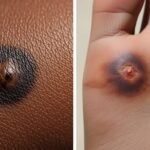
It happens to almost everyone eventually. You are looking in the mirror, perhaps applying moisturiser or stepping out of the shower, and you notice something new on your skin. A small, brown mark that wasn’t there before.
Immediately, your mind might race. Is it just a sign of getting older, or is it something more sinister? With skin cancer rates rising, it is completely normal to feel a pang of anxiety when you spot a change in your pigmentation.
However, not every new mark is a cause for alarm. Our skin changes constantly throughout our lives, reacting to sun exposure, hormonal shifts, and the natural ageing process. Distinguishing between a common mole, a harmless age spot, and something requiring medical attention is a vital skill for monitoring your health.
This guide will help you understand the key differences between these common skin marks, what causes them, and—most importantly—when you should book an appointment with your GP.
What is a mole?
Moles, medically known as melanocytic naevi, are small clusters of pigmented cells called melanocytes. These are the cells responsible for producing melanin, the substance that gives your skin its natural colour. When these cells grow in a cluster rather than spreading out evenly, a mole is formed.
Most people have between 10 and 40 moles, and they can appear anywhere on the body. While many are present from birth or early childhood, it is quite common to develop new moles up until the age of roughly 40.
Characteristics of a typical mole
Moles can vary significantly in appearance. They might be:
- Raised or flat: Some sit on top of the skin like a small bump, while others are flush with the surface.
- Colour: They are typically brown or black, but can also be pink, skin-coloured, or even blueish.
- Shape: Benign moles are usually round or oval with a smooth edge.
According to the NHS, hormonal changes during puberty and pregnancy can often cause moles to become slightly darker or larger. This is usually a normal physiological response.
What is an age spot?
Age spots go by several names: liver spots, solar lentigines, or sun spots. Unlike moles, which are determined largely by genetics and can appear without sun exposure, age spots are directly linked to ultraviolet (UV) light damage.
These marks are flat, brown, grey, or black spots that appear on areas of the skin most exposed to the sun. This includes the face, hands, shoulders, and arms. They are most common in adults older than 50, but younger people can get them if they spend a significant amount of time in the sun without protection.
Why do they appear?
Age spots are essentially the result of your skin attempting to protect itself. When exposed to UV rays, your skin produces melanin to absorb the radiation. Over years of exposure, melanin can clump together in high concentrations, creating these permanent flat marks.
You can read more about the specific causes of hyperpigmentation on Healthline.
The third possibility: Seborrhoeic Keratosis
There is a third common skin growth that often causes confusion: seborrhoeic keratosis. These are harmless, wart-like growths that are extremely common as we age.
They often look like they have been “stuck on” to the skin and can have a waxy or crusty surface. They can range from pale tan to black. While they can look alarming due to their rough texture and dark colour, they are benign and do not turn into cancer.
For more detailed images and descriptions, the British Association of Dermatologists provides excellent resources on these benign growths.
Mole vs Age Spot: Key Differences
To help you differentiate between these marks at home, look for these specific features. However, remember that self-diagnosis is never a substitute for professional medical advice.
Texture and profile
This is often the easiest way to tell them apart.
- Age spots are always flat. You cannot feel them if you run your finger over them; they feel exactly like the surrounding skin.
- Moles can be flat, but they are often raised, dome-shaped, or have a slight bump.
- Seborrhoeic keratoses feel rough, warty, or scaly.
Colour consistency
- Age spots tend to be a uniform tan or light brown colour.
- Moles are usually a darker brown or black.
- If a spot has multiple colours mixed together (such as brown, black, and red), this is a warning sign to get it checked.
Evolution
- Age spots generally do not change shape quickly. They may darken slightly after summer holidays but remain relatively stable.
- Moles should also be stable. A mole that changes size, shape, or bleeds is a red flag.
Comparison Table
| Feature | Common Mole | Age Spot (Solar Lentigo) | Seborrhoeic Keratosis |
|---|---|---|---|
| Texture | Smooth, can be raised or flat | Always flat | Rough, warty, “stuck on” |
| Colour | Dark brown, black, pink | Tan, light brown | Tan, brown, black |
| Cause | Genetics, cell clusters | UV Exposure | Ageing, genetics |
| Location | Anywhere on the body | Sun-exposed areas (face, hands) | Trunk, face, neck |
| Age of Onset | Childhood to age 40 | Usually 40+ (or younger with high sun exposure) | Usually 40+ |

When to see a doctor: The ABCDE Rule
The biggest concern when evaluating a new spot is ruling out melanoma, a serious form of skin cancer. Melanoma can develop from an existing mole or appear as a new mark. Early detection makes it highly treatable.
Dermatologists recommend using the ABCDE rule to monitor your skin. If you notice any of these signs, book an appointment with your GP immediately.
- Asymmetry: One half of the mole does not match the other half.
- Border: The edges are irregular, ragged, notched, or blurred.
- Colour: The colour is not the same all over and may include shades of brown or black, sometimes with patches of pink, red, white, or blue.
- Diameter: The spot is larger than 6mm wide (although melanomas can sometimes be smaller than this).
- Evolving: The mole is changing in size, shape, or colour.
According to Cancer Research UK, itching, bleeding, or crusting are also significant warning signs that should never be ignored.
Furthermore, the British Skin Foundation advises looking out for the “ugly duckling” sign—a spot that looks completely different from all your other moles.
Actionable steps for skin health
Whether you have moles, age spots, or neither, protecting your skin from UV damage is the single most important step you can take to prevent cosmetic damage and health risks.
1. Prioritise sun protection
UV radiation is the primary driver of age spots and the leading cause of most skin cancers. You should wear a high-factor sunscreen (at least SPF 30) every day, even when it is cloudy.
The NHS offers a comprehensive guide on how to choose the right sunscreen and apply it correctly.
2. Perform regular self-exams
Get to know your skin. Once a month, check your entire body, including awkward places like the soles of your feet, your back (use a mirror), and your scalp.
Macmillan Cancer Support suggests taking photos of any moles you are worried about. This allows you to compare them over time to see if they are truly evolving.
3. Seek professional removal if desired
If a mole or age spot is benign but you dislike its appearance, there are removal options. Age spots can often be treated with laser therapy, cryotherapy (freezing), or prescription creams.
Moles can be surgically removed, but this is usually only done on the NHS if there is a clinical need (i.e., suspicion of cancer). For cosmetic removal, you would likely need to visit a private dermatology clinic. NICE guidelines provide strict criteria for what constitutes a suspicious lesion requiring urgent referral.
Frequently Asked Questions
Can age spots turn into cancer? True age spots (solar lentigines) are benign and do not become cancerous. However, early skin cancer can look like an age spot. If a “flat brown spot” is changing, get it checked.
Can I remove a mole at home? No. Never attempt to shave off or remove a mole at home. This can lead to infection, scarring, and—critically—you might be removing a melanoma without knowing it, allowing the cancer to spread internally.
Do moles disappear with age? Surprisingly, yes. While we gain moles in our youth, some moles can fade or disappear in later life. However, Patient.info notes that this is a gradual process.
The Bottom Line
Noticing a new mark on your skin can be unsettling, but in the vast majority of cases, it is a harmless sign of life’s natural progression. Age spots are flat and linked to sun exposure, while moles can be raised and are often genetic.
The most critical action you can take is to stay vigilant. Familiarise yourself with your skin’s landscape. If you see something that breaks the ABCDE rules, or simply a spot that feels “wrong,” trust your instincts and see a doctor.
For more information on sun safety and skin health, you can visit GOV.UK for official public health guidance.