In our modern, digital-centric world, gravity is often winning the battle against our spines. From hunching over smartphones to slumping in office chairs, the collective posture of the general population is declining. This phenomenon, often termed “tech neck” or Upper Crossed Syndrome, does not just affect how we look; it fundamentally alters our musculoskeletal health, digestion, and even our mood. Fortunately, the ancient practice of yoga offers a sophisticated, functional solution.
By integrating specific yoga poses to improve standing posture, we can retrain the body to hold itself with grace, strength, and alignment. This comprehensive guide explores the anatomy of posture, the mechanics of key yoga asanas, and actionable strategies to reclaim a vertical life.
The Anatomy of Alignment: Why Standing Tall Matters
Posture is not merely about pulling your shoulders back; it is a dynamic state of musculoskeletal balance that protects the supporting structures of the body against injury or progressive deformity. According to the Mayo Clinic, good posture maintains the natural curves of your spine at the cervical (neck), thoracic (upper back), and lumbar (lower back) regions.
When we stand correctly, the bones stack in a way that requires minimal muscular effort to maintain. However, when misalignment occurs, muscles must work overtime to stabilize the body, leading to fatigue and chronic pain. Yoga focuses on proprioception—the body’s ability to sense its location, movements, and actions. Developing this awareness is the first step toward correction.
The Core Connection
Many individuals mistakenly believe that standing posture is solely a function of the back muscles. In reality, the abdominal muscles play a critical role in supporting the spine. Harvard Health Publishing notes that a weak core contributes significantly to slouching and lower back pain. If the corset of muscles around the midsection is weak, the pelvis tilts, throwing the entire spinal column out of alignment.
Therefore, the most effective yoga poses to improve standing posture do not just stretch the chest; they rigorously strengthen the core and lower body.
Essential Yoga Poses to Improve Standing Posture
Below are five fundamental poses designed to realign the spine, strengthen the postural muscles, and open the chest.
1. Tadasana (Mountain Pose)
While it looks like simply standing still, Tadasana is the blueprint for all standing yoga postures. It teaches the body neutral alignment.
- How to do it: Stand with big toes touching and heels slightly apart. Lift your toes to engage the arches of your feet, then press them down. Engage your quadriceps to lift your kneecaps. Rotate your inner thighs back. Tuck the tailbone slightly to lengthen the lower back. Shrug your shoulders up to your ears, then roll them back and down.
- Postural Benefit: It corrects the “swayback” (lumbar lordosis) and forward head carriage common in office workers. Yoga Journal describes this as the foundational pose for cultivating stillness and stability.
2. Utkatasana (Chair Pose)
This pose is a powerhouse for strengthening the lower back and legs, which are the pillars of upright posture.
- How to do it: From Tadasana, inhale and raise your arms overhead. Exhale and bend your knees, sitting back as if into an invisible chair. Keep the weight in your heels. Ensure your knees do not extend past your toes. Keep the chest lifted and the spine long.
- Postural Benefit: It strengthens the erector spinae muscles that run along the spine, counteracting the tendency to round the back.
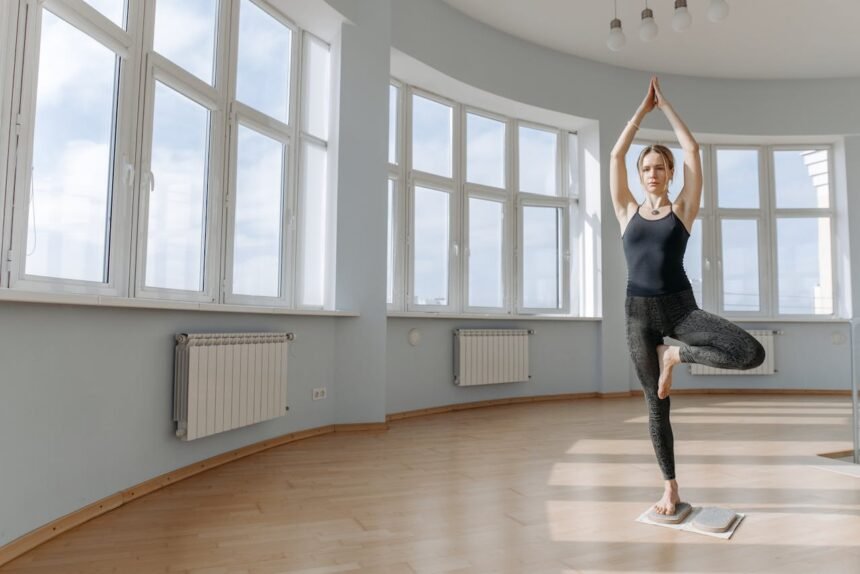
3. Vrikshasana (Tree Pose)
Balance is intrinsic to posture. Tree pose forces the stabilizing muscles of the standing leg and the core to engage fully to prevent falling.
- How to do it: Shift weight to the left foot. Place the sole of the right foot on the inner left thigh or calf (avoid the knee joint). Press the thigh into the foot and the foot into the thigh. Bring hands to the heart center or reach them overhead.
- Postural Benefit: According to ACE Fitness, balance exercises improve neuromuscular coordination, helping the body make micro-adjustments to stay upright throughout the day.
4. Gomukhasana Arms (Cow Face Arms)
Tight shoulders and pectoral muscles pull us forward into a slump. This arm variation opens the chest deeply.
- How to do it: Reach your right arm up, bend the elbow, and drop the hand down the center of your back. Reach the left arm behind and up the back to clasp fingers (use a strap if they don’t touch). Keep the head upright, pressing against the top arm.
- Postural Benefit: This combats the kyphotic curve (hunchback) of the upper spine caused by excessive screen time.
5. Bhujangasana (Cobra Pose)
Though not a standing pose, this prone backbend is essential for strengthening the upper back muscles necessary for standing tall.
- How to do it: Lie on your stomach, hands under shoulders. Press the tops of the feet into the mat. Inhale and lift the chest off the floor using back strength rather than arm strength. Keep the neck long.
- Postural Benefit: It reverses the C-shape of a sedentary spine, stretching the abdominals and opening the lungs. The Cleveland Clinic suggests extension exercises like this to alleviate mechanical back pain.

Comparison of Postural Yoga Asanas
To help you structure your practice, here is a breakdown of how these specific poses target different aspects of posture.
| Yoga Pose | Primary Postural Focus | Target Muscle Groups | Difficulty Level |
|---|---|---|---|
| Tadasana (Mountain) | Alignment & Proprioception | Feet, Quadriceps, Core | Beginner |
| Utkatasana (Chair) | Spinal Strength & Endurance | Glutes, Erector Spinae, Quads | Intermediate |
| Vrikshasana (Tree) | Balance & Stabilization | Core, Adductors, Ankles | Beginner/Intermediate |
| Gomukhasana Arms | Chest Opening & Mobility | Rotator Cuff, Pectorals, Triceps | Intermediate |
| Bhujangasana (Cobra) | Thoracic Extension | Upper Back, Lats, Abdominals | Beginner |
Beyond Muscles: The Psychological Impact of Posture
The benefits of utilizing yoga poses to improve standing posture extend beyond the physical realm. There is a strong psychosomatic link between how we hold our bodies and how we feel. This concept, often referred to as “embodied cognition,” suggests that an expansive, upright posture can signal confidence to the brain.
Research highlighted by Psychology Today indicates that upright posture is associated with higher self-esteem and more positive mood states compared to slumped postures. Furthermore, proper alignment allows the diaphragm to descend fully, facilitating deeper breathing. The American Lung Association emphasizes that slouching compresses the lungs, reducing vital capacity, whereas standing tall maximizes oxygen intake.
Integrating Posture Work into Daily Life
Practicing yoga for one hour a day will not negate 12 hours of poor posture. To truly improve, you must integrate mindfulness into your daily routine.
Ergonomic Adjustments
Even the best yoga practice cannot compete with a poorly designed workspace. Ensure your computer monitor is at eye level so your neck remains neutral. The Occupational Safety and Health Administration (OSHA) provides guidelines on setting up a neutral body positioning workstation to reduce musculoskeletal stress.
The “Reset” Drill
Set a timer for every 30 minutes. When it goes off, stand up and perform a quick Tadasana check:
- Ground the feet.
- Engage the glutes slightly.
- Roll the shoulders back.
- Tuck the chin slightly to lengthen the neck.
The Role of Consistency
Correcting years of misalignment takes time. The connective tissues (fascia) have likely set in a specific pattern. To reshape this, consistency is key. A study published by the National Institutes of Health (NCBI) confirms that yoga is an effective method for treating chronic low back pain and improving function, but results are cumulative.
Start with holding each of the poses listed above for 5 to 10 breaths, three times a week. As your endurance builds, you can increase the duration and frequency.
Conclusion
Achieving perfect posture is not about rigid military attention; it is about finding a sustainable, aligned ease in the body. By regularly practicing these yoga poses to improve standing posture, you are doing more than just straightening your spine. You are opening your chest to breathe better, strengthening your core to support your frame, and presenting a more confident version of yourself to the world.
Remember, the journey to better alignment is a marathon, not a sprint. Listen to your body, respect your limits, and enjoy the feeling of standing tall.
Ready to transform your posture? Roll out your mat today and try the Mountain Pose. Your future self—and your spine—will thank you.