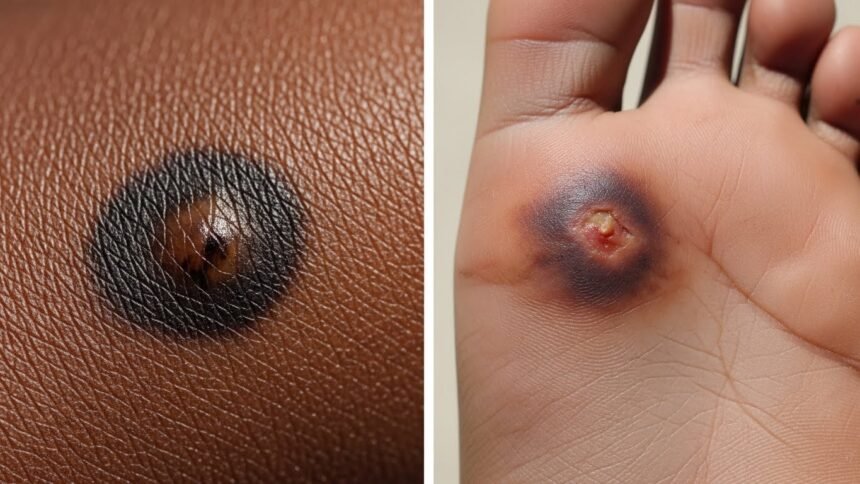
In fact, skin cancer in people of colour is often diagnosed at a much later stage than in those with fair skin. This delay can lead to a worse prognosis and fewer treatment options. Understanding how symptoms present differently on pigmented skin is absolutely vital for early detection and survival.
For many in the Black, Asian, and Minority Ethnic communities, the standard advice to look for “pink patches” or “red spots” is simply not applicable. Lesions can appear purple, dark brown, ashen, or grey, blending in with the surrounding skin.
We are here to help you bridge that knowledge gap.
Recognising the signs requires a shift in perspective. It means checking areas you might not suspect, such as the soles of your feet or the palms of your hands. By learning what to look for, you can prioritise your health and seek medical advice when it matters most.
Understanding Skin Cancer in Darker Skin Tones
Skin cancer occurs when the DNA in skin cells becomes damaged, leading to uncontrolled growth. While UV radiation from the sun is the primary cause for fair-skinned individuals, the drivers for skin cancer in darker skin are often different and less associated with sun exposure.
Those with darker skin types (often categorised as IV to VI on the Fitzpatrick scale) have more eumelanin. This type of melanin absorbs and scatters UV radiation, providing a natural sun protection factor (SPF) of approximately 13.4. However, this does not mean you are safe from damage.
According to Cancer Research UK statistics, while incidence rates are lower, the mortality rates for skin cancer in people of colour are disproportionately high. This is largely due to a lack of awareness and the fact that medical textbooks often feature images of skin conditions on white skin, leading to misdiagnosis by professionals.
It is crucial to realise that skin cancer in dark skin often appears in non-sun-exposed areas. This includes:
- The palms of the hands
- The soles of the feet
- Underneath the fingernails or toenails
- Inside the mouth or genital areas
The biology of the disease remains the same, but the clinical presentation—what you see in the mirror—can be drastically different.
Identifying the Signs: A Detailed Breakdown
Knowing exactly what to look for can save your life. The three most common types of skin cancer—Basal Cell Carcinoma (BCC), Squamous Cell Carcinoma (SCC), and Melanoma—behave differently on pigmented skin.
1. Acral Lentiginous Melanoma (ALM)
This is the most common form of melanoma found in people with dark skin tones. Unlike other melanomas, ALM is not typically linked to sun exposure. It famously claimed the life of reggae icon Bob Marley, who initially mistook a spot under his toenail for a football injury.
What to look for:
- Dark streaks: Look for a black or brown vertical band running down a fingernail or toenail. This is often mistaken for a bruise or fungal infection.
- Hutchinson’s sign: This occurs when the pigment from the nail streak spreads onto the skin of the cuticle or the finger itself.
- Changing spots: A new dark spot on the palms or soles that changes shape or size.
If you notice a dark stripe on your nail that is not growing out or is getting wider, you must see a GP immediately. For a broader overview of these signs, you can refer to this skin cancer overview.
2. Basal Cell Carcinoma (BCC)
On fair skin, BCC often looks like a pearly pink bump. On dark skin, it is rarely pink. Instead, it is often pigmented (coloured), making it harder to distinguish from a normal mole or a seborrheic keratosis (a harmless skin growth).
Key characteristics:
- Pigmentation: It typically appears brown or black. About 50% of BCCs in darker skin types are pigmented.
- Translucency: Despite the dark colour, the bump may still have a slightly translucent or shiny quality.
- Rolled edges: You might feel a raised border with a central indentation that may bleed or ooze.
Because these can look like benign moles, the British Skin Foundation advises monitoring any growth that bleeds easily or refuses to heal.
3. Squamous Cell Carcinoma (SCC)
SCC is the second most common form of skin cancer in Black patients. It often develops in areas of chronic inflammation or scarring rather than just sun-exposed areas.
Common locations and signs:
- Old scars: SCC can arise in old burn scars or areas of previous trauma. This is sometimes called a Marjolin’s ulcer.
- Legs and Anus: It appears more frequently on the legs and anogenital region in darker skin types.
- Appearance: Look for a scaly patch, a sore that won’t heal, or a growth that feels rough and crusty. It may look like a wart that is growing.
The Importance of the EFG Rule
While the ABCDE rule (Asymmetry, Border, Colour, Diameter, Evolving) is the gold standard, some aggressive cancers in skin of colour are nodular. For these, experts recommend adding the EFG rule:
- E – Elevated: Is the lesion raised above the skin?
- F – Firm: Does it feel hard to the touch, like a small stone?
- G – Growing: Is it growing progressively for more than a month?
Performing a Self-Exam
You should examine your skin once a month. Good lighting is essential. You may need a partner to help you check your back or scalp.
- Face and Scalp: Use a mirror and a blow dryer to move hair aside. Check inside your mouth.
- Hands: Check palms and backs, and critically, check the fingernails.
- Torso: Check your chest, neck, and genital area.
- Legs and Feet: Look at the soles of your feet and between your toes.
For visual guides on what constitutes a suspicious mole, resources from DermNet NZ are highly regarded by dermatologists worldwide.
Comparison: Light Skin vs. Dark Skin Symptoms
The table below outlines how the presentation of skin cancer symptoms can differ based on melanin levels.
| Feature | Light Skin Presentation | Dark Skin Presentation |
|---|---|---|
| Common Location | Sun-exposed areas (face, ears, neck) | Non-sun-exposed areas (palms, soles, nails, inside mouth) |
| Basal Cell Carcinoma | Pink, pearly, translucent bump | Brown/black pigmented bump, often shiny |
| Squamous Cell Carcinoma | Red, scaly patch | Scaly, greyish patch or ulcer in an old scar |
| Melanoma Colour | Multi-coloured (red, white, blue) | Predominantly black, brown, or violet |
| Nail Symptoms | Dark streak (less common) | Dark vertical band (common ALM sign) |
| Diagnosis Timing | Often early stage | Often late stage due to low suspicion |
Frequently Asked Questions
Do I really need to wear sunscreen if I have dark skin?
Yes. While you have more natural protection, UV rays still cause DNA damage and photo-ageing. Furthermore, wearing sunscreen helps prevent hyperpigmentation (dark spots) which is a common concern for darker skin. The NHS guidance recommends at least SPF 30 for everyone, regardless of skin tone.
Can skin cancer look like a bruise?
Absolutely. A form of cancer called nodular melanoma or ALM under the nail can resemble a bruise or a blood blister. If a “bruise” does not heal or fade within a few weeks, or if it appears without any trauma, seek medical advice from a professional listed by the British Association of Dermatologists.
Is Vitamin D deficiency a risk if I avoid the sun?
People with darker skin require more sun exposure to synthesise Vitamin D, which creates a tricky balance. However, you can maintain healthy levels through diet and supplements. You do not need to burn to get your vitamins. Consult GOV.UK sun safety advice for balanced recommendations on supplements.
What if my doctor dismisses my concerns?
Sadly, medical bias exists. If you feel a spot is suspicious and your GP dismisses it without a thorough check, you have the right to ask for a referral to a dermatologist or a second opinion. Organisations like Macmillan Cancer Support provide excellent advocacy tools for patients.
The Bottom Line
Skin cancer in people with dark skin tones is less common than in white populations, but it is often more dangerous due to late detection.
The “immunity myth” is a barrier to seeking help. By shifting your focus to the palms, soles, nails, and mucous membranes, and by looking for changes in texture and new pigmented lesions, you can take control of your health.
Remember, if you see something new, changing, or unusual, do not wait. The “wait and see” approach is not a safety strategy. Early detection is the most powerful tool we have. Whether it is a streak on your nail or a sore that won’t heal, consulting a medical professional is always the right choice.
Stay vigilant, check your skin monthly, and protect your body from UV damage. Your skin is your body’s largest organ, and it deserves your full attention and care.