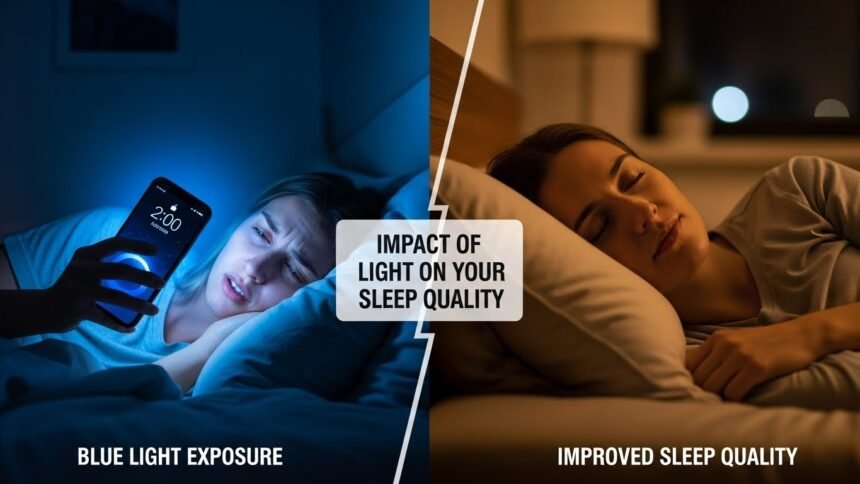
We have all been there. You get into bed, intending to sleep, but decide to quickly check your emails or scroll through social media one last time. Before you know it, an hour has passed, and despite feeling tired, you find yourself tossing and turning, unable to drift off.
In our modern, hyper-connected world, screens are ubiquitous. From the smartphone in your pocket to the LED television in your living room, artificial light is a constant presence. However, a growing body of scientific evidence suggests that the specific type of light emitted by these devices—blue light—may be silently sabotaging your rest.
Understanding the relationship between blue light and sleep is essential for maintaining not just your energy levels, but your overall long-term health. While light is necessary for navigating the world, the timing and spectrum of that light play a pivotal role in how your brain regulates its internal clock.
This article explores the science behind blue light, how it disrupts your natural rhythms, and practical, evidence-based strategies to manage your exposure for a better night’s sleep.
Overview: What Is Blue Light?
To understand why blue light impacts sleep, we must first look at the nature of light itself. Visible light is much more complex than it appears to the naked eye. It comprises a spectrum of different coloured rays, each possessing unique wavelengths and energy levels.
On one end of the visible spectrum, we have red light, which has longer wavelengths and less energy. On the other end sits blue light, characterised by short wavelengths and high energy.
Sources of Blue Light
While we often associate blue light with technology, the primary source is actually the sun. During daylight hours, blue wavelengths are beneficial. They boost attention, reaction times, and mood.
However, the issue arises when the sun goes down. We are now surrounded by artificial sources that mimic this daylight, including:
- Smartphones and tablets
- Computer monitors and laptops
- Flat-screen LED televisions
- Fluorescent and LED lighting
- E-readers
The proliferation of these devices means our eyes are processing high-energy visible (HEV) light long after our bodies should be preparing for rest.
Causes and Factors: The Circadian Connection
The primary mechanism through which blue light affects your sleep involves your circadian rhythm—your body’s internal 20-24 hour clock. This internal timekeeper controls your sleep-wake cycle, hormone release, and body temperature.
The Role of Melatonin
Historically, the circadian rhythm was aligned with the rising and setting of the sun. When darkness falls, the pineal gland in the brain begins to secrete melatonin, a hormone that signals to the body that it is time to sleep.
However, specific light receptors in the eye, known as intrinsically photosensitive retinal ganglion cells (ipRGCs), are particularly sensitive to blue wavelengths. When these cells detect blue light, they send a signal to the brain to suppress melatonin production.
According to Harvard Health, blue light suppresses melatonin for about twice as long as green light and shifts circadian rhythms by twice as much. This suppression tricks your brain into thinking it is still daytime, leading to:
- Delayed Sleep Onset: You take longer to fall asleep.
- Reduced Sleep Duration: You sleep for fewer hours overall.
- Poor Sleep Quality: You spend less time in restorative REM (rapid eye movement) sleep.
Digital Eye Strain and Alertness
Beyond the hormonal impact, the content we consume on screens often contributes to wakefulness. The cognitive stimulation of reading news, replying to messages, or playing games keeps the brain alert.
Furthermore, the high energy of blue light scatters more easily than other visible light, reducing contrast and contributing to digital eye strain. The American Academy of Ophthalmology notes that while blue light from screens does not cause permanent eye damage, the strain can cause discomfort that makes relaxing difficult.

Treatment and Management
Managing the impact of blue light and sleep disruption does not necessarily mean returning to the dark ages. It requires a balanced approach to technology usage, particularly in the evening hours.
Blue Light Blocking Glasses
One of the most popular interventions is the use of amber-tinted glasses. These lenses are designed to block or absorb blue wavelengths, theoretically preventing them from reaching the retina and suppressing melatonin.
While marketing claims can be bold, some research supports their efficacy. A study highlighted by the National Sleep Foundation suggests that wearing these glasses for a few hours before bed can help maintain normal melatonin levels, even while using devices.
Software Solutions
Most modern devices now come equipped with built-in “night modes” (such as Night Shift on iOS or Night Light on Windows). These programmes adjust the colour temperature of your screen based on the time of day, reducing blue emission and increasing warmer, redder tones as the evening progresses.
While these tools are helpful, they are not a cure-all. Even with a warmer screen tone, the brightness of the screen and the mental stimulation of the content can still hinder sleep efforts.
Lighting Environment
Management extends beyond screens to your home environment. Energy-efficient LED lighting often emits a significant amount of blue light.
Comparison of Light Sources:
| Light Source | Blue Light Emission | Suitability for Evening |
|---|---|---|
| Cool White LED | Very High | Poor |
| Fluorescent Tube | High | Poor |
| Incandescent Bulb | Low | Good |
| Warm White LED | Moderate | Fair |
| Red/Amber Night Light | Negligible | Excellent |
Switching to dimmable, warm-coloured bulbs in the bedroom and living room can significantly signal to your body that the day is ending.
Practical Tips for Better Sleep Hygiene
If you are struggling with sleep and suspect screen time is the culprit, incorporating these evidence-based strategies can help reset your circadian rhythm.
1. The Two-Hour Rule
Ideally, you should disconnect from all blue-light-emitting devices at least two hours before bedtime. This provides a sufficient window for melatonin levels to rise naturally. If two hours feels impossible, start with 30 minutes and gradually increase the duration.
2. Create a Tech-Free Bedroom
Establish your bedroom as a sanctuary for sleep. Charge your phones and tablets in another room (such as the kitchen or hallway). This removes the temptation to scroll if you wake up in the middle of the night. Using a standard alarm clock instead of your phone is a simple but effective switch recommended by the NHS.
3. Use “Dark Mode” and Dim Brightness
If you must use devices in the evening, reduce the brightness to the lowest possible setting that is still comfortable. Enable “Dark Mode” on apps and operating systems, which changes the background from bright white (high blue light) to black or dark grey.
4. Maximise Daytime Light Exposure
Regulating your sleep cycle isn’t just about avoiding light at night; it is also about getting enough light during the day. Exposure to bright natural daylight, especially in the morning, reinforces your circadian rhythm.
Research from the CDC indicates that getting bright light early in the day helps you fall asleep faster at night. Aim for a 20-minute walk outside each morning.
5. Opt for Analogue Entertainment
Replace your evening scrolling habit with non-screen activities. Reading a physical book, listening to a podcast or audiobook, practicing gentle yoga, or taking a warm bath are excellent ways to wind down without blue light exposure.
6. Consider Supplementation (With Caution)
If modifying light exposure doesn’t fully resolve your sleep issues, some people find relief with melatonin supplements. However, as noted by the Mayo Clinic, supplements should be used under the guidance of a healthcare professional and are not a long-term substitute for good sleep hygiene.
The Bottom Line
Blue light is not inherently bad. In fact, during the day, it is essential for keeping us alert, happy, and productive. However, the timing of exposure is critical. In our modern environment, the line between day and night has been blurred by artificial illumination, confusing our biological clocks.
The impact of blue light and sleep quality is significant. Chronic sleep deprivation is linked to a host of health issues, including obesity, heart disease, and depression. By understanding the science of melatonin suppression and making small, consistent changes to your evening routine, you can mitigate these risks.
You do not need to abandon technology entirely. Instead, aim to be mindful of your usage. Use night filters, dim the lights, and prioritise a winding-down period. Your brain—and your body—will thank you for the rest.
Read this article on Healthline for more insights on blocking blue light to improve sleep quality. Additionally, staying informed through resources like Scientific American and WebMD can help you navigate the evolving science of sleep health.
For a deeper dive into the physiological mechanisms, you can review studies catalogued by the National Center for Biotechnology Information (NCBI).