When it comes to skin health, knowledge is your most powerful tool. Basal cell carcinoma (BCC) is the most common form of skin cancer in the UK and worldwide. While the word “cancer” is frightening, it is important to realise that BCC is highly treatable and very rarely life-threatening when caught early.
However, ignoring these changes can lead to disfigurement or more invasive treatments down the line. Understanding the subtle visual cues of this condition is the first step toward protecting your health.
This guide will walk you through exactly what a basal cell carcinoma looks like, how to distinguish it from other skin conditions, and the actionable steps you should take if you spot something suspicious.
What is Basal Cell Carcinoma?
Basal cell carcinoma begins in the basal cells, which are found at the bottom of the epidermis (the outermost layer of your skin). These cells are responsible for producing new skin cells as old ones die and slough off.
Damage to the DNA in these basal cells—most often caused by exposure to ultraviolet (UV) radiation from the sun or tanning beds—triggers the uncontrolled growth that characterizes this cancer.
According to Cancer Research UK, there are significantly high numbers of non-melanoma skin cancer cases diagnosed every year, with BCC accounting for the vast majority. Because these cancers tend to grow slowly, they are often dismissed as simple pimples, insect bites, or scars that won’t fade.
Who is at risk?
While anyone can develop BCC, certain factors increase your likelihood:
- Fair skin: People who burn easily or have light hair and blue or green eyes.
- Sun exposure: A history of intense sun exposure or sunburns.
- Age: The risk increases as you get older, though it is appearing more frequently in younger adults.
- Geography: Living in areas with high UV indexes.
For a deeper understanding of how these cancers develop, you can read more about skin cancer types and stages on Healthline.
What Does a Basal Cell Carcinoma Look Like?
One of the most challenging aspects of identifying basal cell carcinoma appearance is that it is not uniform. It can masquerade as several different non-cancerous skin conditions like eczema or psoriasis.
However, there are specific “classic” features that dermatologists look for. BCCs predominantly appear on sun-exposed areas such as the face, ears, neck, scalp, shoulders, and back.
Here is a detailed breakdown of the common visual presentations.
1. The “Pearly” Bump (Nodular BCC)
This is the most common presentation. It often manifests as a shiny, skin-coloured, or pinkish bump.
- Texture: It looks translucent or “pearly.”
- Blood Vessels: You may see tiny, broken blood vessels (telangiectasia) threading across the surface.
- Colour: In people with darker skin tones, the lesion might appear darker but will still retain a shiny or glossy quality.
2. The Red Patch (Superficial BCC)
Frequently found on the chest or back, this type looks like a flat, scaly, reddish patch.
- Edges: The edge might be slightly raised.
- Sensation: It can sometimes be itchy but is usually painless.
- Confusion: It is often mistaken for a patch of eczema or ringworm. If a patch treated with moisturisers or anti-fungals does not clear up within a few weeks, it requires medical assessment.
3. The Open Sore (Rodent Ulcer)
A classic sign of BCC is a sore that bleeds, oozes, or crusts over and remains open for a few weeks.
- Cycle: It may appear to heal, only to bleed again later.
- Persistence: A persistent, non-healing sore is a major red flag according to the NHS guide on non-melanoma skin cancer.
4. The Pink Growth
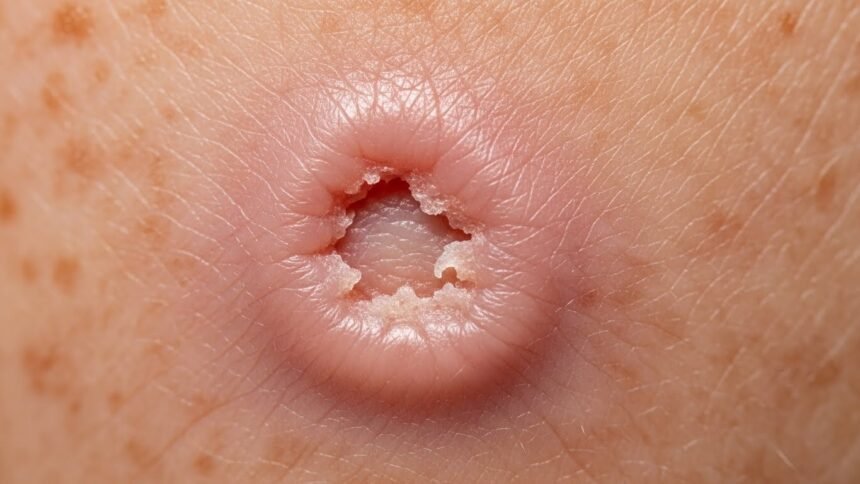
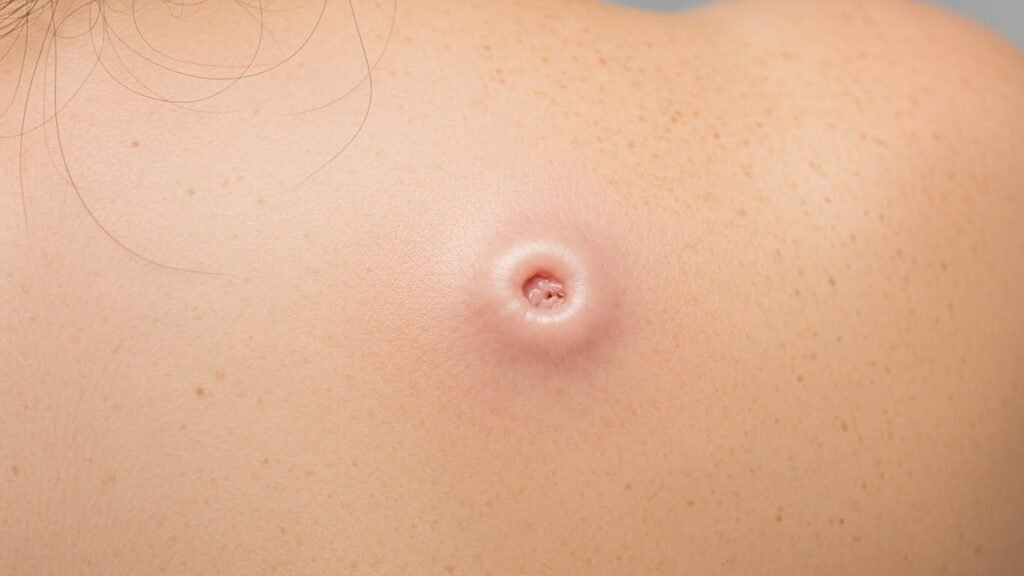
These appear as a slightly elevated pink growth with a rolled border and a crusted indentation in the centre.
- Shape: Imagine a miniature volcano or a doughnut shape.
- Progression: As the growth slowly expands, tiny blood vessels may develop on the surface.
5. The Scar-Like Area (Morpheaform BCC)
This is the least common but often the most dangerous form because it is subtle and harder to detect.
- Appearance: It looks like a white, yellow, or waxy scar.
- Borders: The borders are often poorly defined.
- Texture: The skin appears shiny and taut.
- Warning: This appearance suggests the cancer may be more invasive and deeper than it appears on the surface.
For a visual reference, the British Association of Dermatologists provides comprehensive leaflets describing these variations.
Visual Comparison of Skin Lesions
To help you distinguish between potential concerns, we have compared the features of common skin cancers below.
| Feature | Basal Cell Carcinoma (BCC) | Squamous Cell Carcinoma (SCC) | Melanoma |
|---|---|---|---|
| Common Appearance | Pearly bump, flesh-coloured, shiny pink patch. | Scaly red patch, raised warty growth, open sore. | Asymmetrical mole, multi-coloured, changing border. |
| Texture | Smooth, rolled edges, translucent. | Rough, scaly, crusty, thickened. | Usually flat or slightly raised, irregular. |
| Growth Rate | Very slow growing (months to years). | Moderate growth rate. | Can grow and change rapidly. |
| Bleeding | Often bleeds, scabs, and recurs. | Can bleed if bumped or scratched. | May bleed in later stages. |
| Location | Face, neck, ears (sun-exposed). | Face, ears, lips, hands. | Anywhere (legs in women, back in men common). |
Actionable Tips for Monitoring and Prevention
Protecting your skin requires a proactive approach. You do not need to live in fear of the sun, but you should respect its power.
Adopt the ‘Ugly Duckling’ Strategy
While the ABCDE rule is typically used for melanoma, the “Ugly Duckling” sign is useful for BCCs. Look for any spot that looks different from your other moles or freckles. If it stands out, get it checked.
Sun Safety Protocol
Prevention is always better than cure. The British Skin Foundation emphasises the following:
- Seek Shade: Especially between 11 am and 3 pm when UV rays are strongest in the UK.
- Wear Protection: Use a wide-brimmed hat and sunglasses.
- Use SPF: Apply a broad-spectrum sunscreen of at least SPF 30 (SPF 50 is better). Ensure it has a high star rating for UVA protection.
How to Perform a Self-Exam
- Lighting: Use a bright room and a full-length mirror.
- Tools: Use a hand mirror to check hard-to-see areas like your back, neck, and behind your ears.
- Scalp: Use a hairdryer to part your hair and check your scalp.
- Documentation: Take photos of any spots you are monitoring. This helps you and your GP track changes over time.
If you are unsure about safe sun practices, GOV.UK provides public health guidance relevant to outdoor exposure.
Frequently Asked Questions
Is basal cell carcinoma painful?
Generally, no. Most BCCs are painless. However, some may feel tender to the touch, or they can become itchy. If a spot bleeds or crusts, it may cause mild discomfort.
Can it spread to other parts of the body?
It is extremely rare for basal cell carcinoma to metastasise (spread) to other organs. However, if left untreated, it can grow deep into surrounding tissue, damaging nerves and bones. This local destruction is why early treatment is vital, as noted by Macmillan Cancer Support.
How is it diagnosed?
A dermatologist will examine the lesion, often using a dermatoscope (a magnifying skin tool). If they suspect BCC, they will perform a biopsy, taking a small sample of the skin to analyse in a lab.
What are the treatment options?
Treatments are highly effective and include surgical excision, Mohs surgery (for sensitive areas like the face), cryotherapy (freezing), or topical creams for superficial cases. NICE guidelines provide the framework for these treatments in the UK.
The Bottom Line
Basal cell carcinoma typically appears as a pearly bump, a pinkish patch, or a sore that refuses to heal. While it is the most common form of skin cancer, it is also highly curable when detected early.
The most important takeaway is to trust your instincts. If you notice a change in your skin that persists for more than three weeks, make an appointment with your GP. It is likely nothing serious, but getting it checked provides peace of mind and ensures prompt treatment if necessary.
Prioritise your skin health by maintaining good sun safety habits. Avoiding excessive UV radiation, as recommended by the World Health Organization, remains your best defence against developing these lesions.
Remember: check your skin regularly, protect yourself from the sun, and never hesitate to seek professional advice for a changing mole or spot. Your health is worth it.
For further reading on dermatological studies and pathology, resources such as PubMed offer access to peer-reviewed research.