



Trying to pick between oat milk vs almond milk? This clear, friendly guide compares both plant milks so you can choose with confidence. We break down oat milk vs almond milk calories, carbs, protein, and fat, then look at blood sugar impact, taste, and cost.
You will also see how each milk affects weight loss goals and how it stacks up against soy. We cover the environmental story, including water use and emissions, and explain which option works best in coffee and smoothies. A handy Starbucks section shows how your drink order changes the numbers.
Every claim is written in plain language and based on trusted nutrition sources, with safety notes for people who manage diabetes, allergies, or special diets. Read the full oat milk vs almond milk comparison, use the tables to decide fast, and find the carton that fits your body, your budget, and your morning cup.
Oat Milk vs Almond Milk: Which One Should You Choose?
The oat milk vs almond milk debate comes up in almost every grocery aisle. Both are plant-based, dairy-free, and easy to find. Yet they are very different drinks.
Oat milk is creamy, a little sweet, and higher in calories and carbs. Almond milk is light, nutty, and low in calories. Your best pick depends on your health goals, your taste, and how you plan to use it.
I have tried both in coffee, cereal, smoothies, and baking for years. I also compared labels from many brands, because the numbers change a lot from one carton to the next. This guide shares what actually matters in the oat milk vs almond milk choice, without hype.
Here is a quick preview. Almond milk usually wins on calories and carbs. Oat milk usually wins on creaminess, protein, and fiber content, and it froths well in coffee. For the planet, both beat dairy, but they trade off water and land in different ways.
A quick note on safety. Food choices affect real health, especially for people with diabetes, nut allergies, or celiac disease. Use this article as general education, and talk to a doctor or registered dietitian for personal advice about oat milk vs almond milk.
The Short Answer
Choose almond milk if you want the fewest calories and carbs. Choose oat milk if you want a creamy texture and a milk that works well for lattes. If blood sugar control or weight loss is your main goal, unsweetened almond milk is usually the safer starting point.
That said, no single milk is perfect for everyone. Some people do best with soy milk, which has more protein than both. We will compare all three in the sections below.
What Are Oat Milk and Almond Milk?
Before we compare numbers, let us look at what is inside each carton. Knowing how these drinks are made helps you read labels and spot the differences. It also explains why the oat milk vs almond milk results look so different.
How Oat Milk Is Made
Oat milk starts with oats and water. The mixture is blended, often with enzymes that break down the oat starch. Then it is strained to remove the solids.
This enzyme step creates natural sugar called maltose. That is why oat milk tastes sweet even when no sugar is added. Many brands also add oil, salt, and added vitamins and minerals.
How Almond Milk Is Made
Almond milk is made from ground almonds and water. The mix is strained, and the almond pulp is removed. What is left is a thin, light milk.
Because only a small amount of almonds goes into each carton, the nutrition is quite low. Most store brands contain about two percent almonds or less. Brands add thickeners, flavor, and vitamins to improve taste and texture.
Why Labels Matter So Much
Two cartons with the same name can have very different numbers. One may be sweetened and another unsweetened. One may be fortified with calcium and vitamin D, and another may not be.
Always check the nutrition label before you compare oat milk vs almond milk in your own kitchen. Look at serving size, added sugar, protein, and fortification. This one habit saves you from many label surprises.
Calories, Carbs, and Protein Comparison
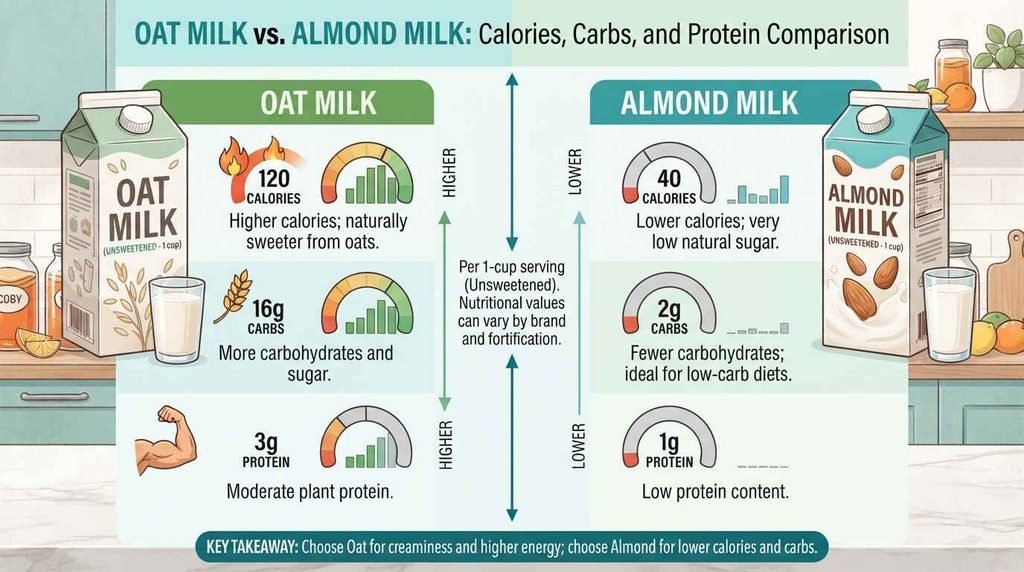
This is the section most readers want first. Calories, carbs, and protein show the biggest gap in oat milk vs almond milk nutrition. The table below uses typical values for one cup (240 ml) of unsweetened or original plain products.
Numbers vary by brand, so treat them as a guide. Always confirm on your own label. For a broader side-by-side breakdown, you can also check Healthline’s oat milk versus almond milk comparison.
Nutrition Table: Per Cup (240 ml)
| Nutrient (approx.) | Oat Milk (Original) | Almond Milk (Unsweetened) | Soy Milk (Unsweetened) | Dairy Milk (2%) |
|---|---|---|---|---|
| Calories | 120 | 30 to 40 | 80 to 100 | 120 |
| Total carbs | 16 g | 1 to 2 g | 3 to 4 g | 12 g |
| Sugar | 7 g (from oat breakdown) | 0 g | 1 g | 12 g (natural lactose) |
| Protein | 3 g | 1 g | 6 to 7 g | 8 g |
| Fat | 5 g | 2.5 to 3 g | 4 g | 5 g |
| Fiber | 1 to 2 g | 0 to 1 g | 1 g | 0 g |
This table tells a clear story. In the oat milk vs almond milk matchup, oat milk carries about three to four times the calories of unsweetened almond milk. It also has many more carbs. Soy and dairy lead the group for protein.
Calories in Oat Milk vs Almond Milk
Let us zoom in on the calories in oat milk vs almond milk. A cup of oat milk lands around 120 calories. A cup of unsweetened almond milk lands around 30 to 40.
That difference of roughly 80 to 90 calories per cup adds up. If you drink two cups a day, you save about 170 calories by choosing almond milk. Over a week, that is more than 1,000 calories.
Still, calories are only one part of the story. Oat milk offers more fullness for some people because of its carbs and a bit of fiber. So the best oat milk vs almond milk calories choice depends on whether you want a light drink or a satisfying one.
Carbs in Oat Milk vs Almond Milk
Now the carbs in oat milk vs almond milk. Oat milk has about 16 grams of carbs per cup, while unsweetened almond milk has just 1 to 2 grams. This is the biggest nutrition gap between them.
The carbs in oat milk come from the oats themselves and from the sugars created during processing. Almond milk is mostly water, so it has very few carbs. That is why low-carb and keto eaters often prefer almond milk.
If you track carbs closely, read the label twice. Flavored and sweetened almond milks can jump to 10 or more grams of carbs. Plain, unsweetened versions are the ones that keep the numbers low.
Protein in Oat Milk vs Almond Milk
Protein is a small win for oat milk. A cup holds about 3 grams, compared with about 1 gram in almond milk. Neither one is a strong protein source.
If protein matters to you, look at soy milk or pea milk instead. Both offer around 6 to 8 grams per cup. You can also pair either milk with protein-rich foods like eggs, yogurt, nuts, or a protein shake.
Fat and Fiber
Oat milk has slightly more fat and more fiber, thanks to the oats. The fiber in oat milk often includes beta-glucan, which research links with heart health. Many commercial oat milks keep only a small amount of it, so do not rely on a carton as your main fiber source.
Almond milk has less fat overall, and most of it is the unsaturated kind. Vitamin E is a natural strength of almonds. Many brands also fortify almond milk with calcium and vitamin D.
Oat Milk vs Almond Milk for Weight Loss
Many readers ask about oat milk vs almond milk for weight loss. The honest answer is that no milk melts fat on its own. What matters is your total daily calories and eating pattern.
Unsweetened almond milk makes calorie control easier. It adds very little energy to coffee, cereal, or smoothies. If you want to cut calories without changing your habits, it is a simple swap.
Oat milk can still fit a weight loss plan. You just need to measure your portions and count it in your day. A small splash in coffee adds little, while a large glass adds the same energy as a small snack.
A Simple Rule for Weight Loss
Use unsweetened almond milk when you want volume with very few calories. Use oat milk in smaller portions when you want creaminess. Keep both away from flavored and sweetened versions, which can double the calories.
Also, remember protein. Low-protein drinks do not keep you full for long. So for oat milk vs almond milk for weight loss, consider adding protein from other foods to your meal.
Quick Weight Loss Comparison
Here is how the two compare when your goal is losing weight. Think of this as a small decision aid, not a strict rule.
- Almond milk: very low calories, easy to fit into any plan, but low in protein and not very filling.
- Oat milk: more calories and carbs, but creamier, a bit more satisfying, and better for lattes.
- Best habit: measure your serving, choose unsweetened, and check the label every time.
People on keto or very low-carb plans will do better with almond milk. People who train hard and need more carbs may enjoy oat milk around workouts. Both choices work when they match your goals.
Oat Milk vs Almond Milk Taste and Texture
Taste often decides the winner in the oat milk vs almond milk taste debate. The two are very different in the glass. Let us look at each.
Oat milk tastes mild, slightly sweet, and a little toasty. Its texture is thick and smooth, close to whole milk. That is why many coffee shops love it.
Almond milk tastes light, nutty, and thin. It has a gentle sweetness, especially in vanilla versions. The texture is watery compared with oat milk, which some people like and others dislike.
Taste in Everyday Use
In cereal, oat milk feels rich and cozy, while almond milk feels crisp and light. In baking, oat milk gives moist, tender results. Almond milk works well too, but cakes can come out a little less rich.
In savory cooking, unsweetened almond milk is usually the safer pick. Oat milk can add a sweet note to soups and sauces that you may not want. When in doubt, use the unsweetened version of either milk for cooking.
Taste is personal, so try small cartons first. Many people find a new favorite brand this way. Online communities like the r/nutrition subreddit on Reddit are full of real-life opinions about brands and flavors, though you should treat those posts as personal experience and not medical advice.

Blood Sugar Impact of Oat Milk
Blood sugar is one of the most important parts of the oat milk vs almond milk conversation. It matters most for people with diabetes or prediabetes. It also matters for anyone who feels sleepy after sweet drinks.
Oat milk has a bigger effect on blood sugar than almond milk. The reason is simple. Oats are a starchy grain, and the enzyme step turns some of that starch into maltose, a sugar that digests quickly.
Almond milk, when unsweetened, has almost no carbs. So it barely moves blood sugar at all. That makes it a common pick for people who watch glucose closely.
Why Oat Milk Can Raise Blood Sugar Faster
Maltose has a high glycemic index. Because of this, some oat milks are reported to have a medium-to-high glycemic index, depending on the brand and process. Exact values differ between products, and testing methods vary.
A small splash of oat milk in coffee has a mild effect. A full glass on an empty stomach can have a bigger one. Pairing oat milk with protein, fat, or fiber can slow the spike.
If you manage diabetes, speak with your doctor or dietitian before changing your daily milk. Monitor your own glucose to see how you respond. Personal results can differ from averages, and this matters a lot in any oat milk vs almond milk choice.
Blood Sugar Guide Table
Use this table as a general guide. It compares how each option usually affects blood sugar. Individual reactions vary, so use it as a starting point and not a medical rule.
| Milk Type | Carbs per Cup (approx.) | Typical Blood Sugar Effect | Tip for Better Balance |
|---|---|---|---|
| Oat milk (original) | 16 g | Moderate to high | Use small portions and pair with protein |
| Oat milk (low-sugar versions) | 8 to 12 g | Moderate | Check labels for added sugar |
| Almond milk (unsweetened) | 1 to 2 g | Very low | Best choice for tight glucose control |
| Almond milk (sweetened/vanilla) | 8 to 15 g | Moderate | Pick unsweetened whenever possible |
| Soy milk (unsweetened) | 3 to 4 g | Low | Good protein, steady energy |
The pattern is clear. Unsweetened almond milk is the gentlest on blood sugar. Oat milk needs more care. In the oat milk vs almond milk matchup for glucose control, almond milk wins most of the time.
Oat Milk vs Almond Milk vs Soy Milk
Many shoppers also want to know about oat milk vs almond milk vs soy milk. Soy is the third big player in the plant milk aisle. It deserves a fair look.
Soy milk has the most protein of the three, usually 6 to 7 grams per cup. That is close to dairy milk. It has moderate calories and fewer carbs than oat milk.
In taste, soy has a distinct beany, creamy flavor that some people love and others avoid. It also froths well and is a solid choice for coffee. Soy is a common allergen, so people with soy allergies should skip it.
Who Should Pick Which?
Pick oat milk if you want creaminess and do not mind extra carbs. Pick almond milk if you want the lightest option. Pick soy milk if you want protein and balanced nutrition.
This three-way view helps many readers move past the simple oat milk vs almond milk question. A good fit is the one you enjoy, tolerate, and can afford. For more practical nutrition articles, EatingWell offers a wide range of dietitian-reviewed guidance on plant milks and healthy eating.
Starbucks Oat Milk vs Almond Milk Calories
Many people ask about Starbucks oat milk vs almond milk calories. Coffee shop drinks can change the numbers a lot. Milk choice, size, syrup, and toppings all matter.
In general, almond milk is the lower-calorie option at Starbucks. Oat milk adds noticeably more calories, because the oat milk used there is richer and creamier. For a standard latte, the difference can be around 80 to 100 calories or more, depending on the size.
Exact numbers change over time and by country, so check the Starbucks app or website for your drink before you order. Treat any number in a blog as an estimate. The idea behind Starbucks oat milk vs almond milk calories stays the same: almond milk is lighter, and oat milk is creamier.
Smart Ordering Tips
- Skip the syrup or ask for fewer pumps. Syrup adds more sugar than the milk does.
- Choose a smaller size. A short or tall drink uses less milk.
- Pick oat milk for flavor and almond milk for calories. Decide what matters most that day.
- Ask for no whipped cream. It saves extra calories fast.
These small changes make a real difference. A creamy oat latte can still fit your day if you plan for it. You do not need to give up your favorite drink to eat well.
Environmental and Water Usage Differences
Sustainability is a big reason people switch to plant milk. Here, the oat milk vs almond milk story gets interesting. Both are much better for the planet than dairy milk, but they are not equal.
Almond milk uses more water. Almonds are a thirsty crop, and most of the world’s almonds come from dry regions like California. Oat milk uses much less water, because oats are grown in rainier regions with fewer irrigation needs.
A widely cited 2018 study led by researchers at the University of Oxford looked at the footprint of food and drinks. It found that almond milk needed far more water per liter than oat or soy milk. The same research found that all plant milks produced much lower greenhouse gas emissions than dairy milk. Numbers vary between studies, so the table below uses rounded values from that research.
Environmental Table: Per Liter of Milk (approx.)
| Milk Type | Water Use (liters) | Greenhouse Gas Emissions (kg CO2e) | Land Use (m² per year) |
|---|---|---|---|
| Dairy milk | About 630 | About 3.2 | About 9 |
| Almond milk | About 370 | About 0.7 | About 0.5 |
| Oat milk | About 50 | About 0.9 | About 0.8 |
| Soy milk | About 30 | About 1.0 | About 0.7 |
These numbers show a clear trade-off. Almond milk has low emissions but high water use. Oat milk has low water use and low emissions. In the oat milk vs almond milk environmental fight, oat milk is usually the better all-around choice.
What This Means for You
If water scarcity worries you most, choose oat or soy milk. If you want the lowest emissions, almond milk is slightly ahead of oat milk. Either way, switching from dairy to plants helps.
Packaging, shipping, and brand practices also matter. Buy from companies that share clear sourcing details. Recycle your cartons when possible, and avoid wasting milk at home.

Best Choice for Coffee and Smoothies
How you plan to use your milk changes the right answer. Let us look at coffee and smoothies, the two most common uses. This is where the oat milk vs almond milk choice becomes very practical.
Oat Milk vs Almond Milk in Coffee
Oat milk is the favorite of baristas. It froths into silky microfoam, stays smooth in hot coffee, and tastes mild enough not to fight the espresso. That is why it is so popular in lattes and flat whites.
Almond milk can be tricky in hot coffee. It sometimes separates or curdles, especially with acidic coffee. It also makes thinner foam. To reduce curdling, warm the milk gently first and pour it in slowly.
Oat Milk vs Almond Milk in Smoothies
For smoothies, the story flips a little. Almond milk blends well and keeps calories low, so it is great for fruit or green smoothies. Oat milk makes a thicker, creamier smoothie, which suits banana or chocolate blends.
If you want a high-protein smoothie, neither is ideal on its own. Add protein powder, Greek-style plant yogurt, or nut butter. This simple trick balances the lighter nutrition in both oat milk vs almond milk options.
Use-Case Table: Which Milk Wins?
| Use | Best Pick | Why |
|---|---|---|
| Hot latte or cappuccino | Oat milk | Creamy texture and strong foam |
| Iced coffee | Almond milk or oat milk | Both stay smooth when cold |
| Low-calorie smoothie | Almond milk | Very low calories and carbs |
| Thick, creamy smoothie | Oat milk | Rich body and mild sweetness |
| Cereal and granola | Oat milk | Cozy, creamy taste |
| Savory cooking | Unsweetened almond milk | Neutral flavor with no added sweetness |
| Baking | Oat milk | Moist, tender results |
This table gives you a fast shortcut. Keep both cartons in the fridge if you can. Many households use oat milk for coffee and almond milk for smoothies, which is a smart split in the oat milk vs almond milk debate.
Safety, Allergies, and Special Diets
Food choices affect health, so a few cautions matter here. This section is general education and not medical advice. Please speak with a doctor or registered dietitian about your situation.
Almond milk is not safe for people with tree nut allergies. Even a small amount can cause a serious reaction. If you have a nut allergy, choose oat, soy, or another nut-free milk and always read the label.
Oat milk can be a problem for people with celiac disease or gluten sensitivity. Oats are often cross-contaminated with wheat during growing or processing. Look for oat milk that is clearly labeled gluten-free.
Babies under one year should not drink plant milks as a main drink, and young children need milks that meet their nutrition needs. Many plant milks are low in protein, calories, and some vitamins. Ask a pediatrician before using any plant milk for a child.
Watch Out for Added Sugar and Additives
Many cartons contain added sugar, oils, gums, and flavorings. These are usually safe in small amounts, but they affect calories and carbs. The best habit is to buy plain or unsweetened versions and read the ingredient list.
Also check fortification. Dairy milk naturally has calcium, vitamin B12, and vitamin D, while plant milks only have them when added. If you rely on plant milk daily, choose a fortified one and shake the carton well, since minerals settle at the bottom.
Why You Can Trust This Guide
This guide uses typical nutrition label values, widely cited research, and established dietary guidance. We keep every claim modest and avoid miracle promises. I compared real products, tasted them in everyday meals, and focused on what helps ordinary readers choose well.
No milk cures illness, and none replaces medical care. If you have a health condition, use this oat milk vs almond milk comparison as a conversation starter with your healthcare provider. Your own needs always come first.
How to Choose: A Simple Decision Guide
Still not sure? Answer a few questions. Your answers will point you to the right milk.
- Do you want the fewest calories and carbs? Choose unsweetened almond milk.
- Do you want creamy lattes at home? Choose oat milk.
- Do you manage blood sugar closely? Lean toward unsweetened almond milk or soy milk, and ask your doctor.
- Do you have a nut allergy? Skip almond milk.
- Do you have celiac disease? Choose certified gluten-free oat milk or another option.
- Do you care about water use? Oat milk and soy milk beat almond milk.
This quick list answers most oat milk vs almond milk questions. Print it or save it on your phone. Then test a small carton before you buy a large pack.
Frequently Asked Questions
Which is healthier, oat milk or almond milk?
It depends on your goals. Unsweetened almond milk is lower in calories and carbs. Oat milk has more protein and fiber, but also more carbs and calories. Neither is a perfect health food on its own.
Is oat milk or almond milk better for weight loss?
Unsweetened almond milk is usually easier for weight loss because it has far fewer calories. Oat milk can still fit if you measure portions. The best oat milk vs almond milk for weight loss choice is the one you can stick with.
Does oat milk spike blood sugar?
It can raise blood sugar faster than almond milk, since it has more carbs and contains maltose. The effect depends on the amount, the brand, and what you eat with it. People with diabetes should check with their doctor.
Which one is better for coffee?
Oat milk is usually better for hot coffee because it froths well and tastes smooth. Almond milk works, but it can separate in very hot or acidic coffee.
Are the calories in oat milk vs almond milk really that different?
Yes. A cup of oat milk has about 120 calories, while unsweetened almond milk has about 30 to 40. That is a big gap, and it is the main reason many dieters choose almond milk.
Can I mix both milks?
Yes. Some people blend them for balance, using almond milk for lightness and oat milk for creaminess. This works well in smoothies and in home lattes.
Final Thoughts
The oat milk vs almond milk choice is really about what you value most. Almond milk is light, low in calories, and gentle on blood sugar. Oat milk is creamy, great in coffee, and friendlier on water use.
Use the tables in this guide to compare calories, carbs, and environmental impact side by side. Read labels, choose unsweetened versions, and watch for allergens. Small label checks protect your health and your budget.
Start with the milk that fits your main goal today. Test it for a week, and adjust. With a little attention, your oat milk vs almond milk decision becomes simple, and every cup you pour fits your life.