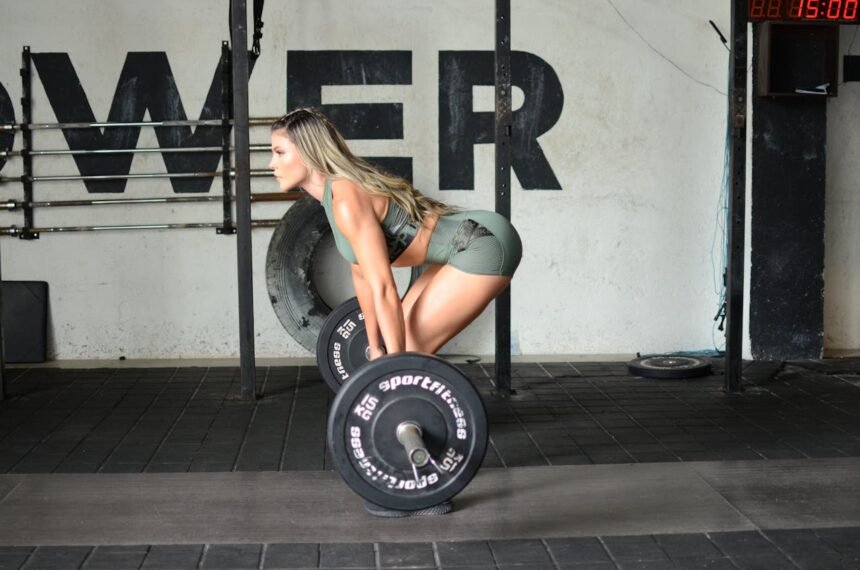
When constructing a programme for a stronger, thicker back, the conventional deadlift is often hailed as the king of exercises. However, for those specifically targeting the upper back or looking to overload the muscles without the fatigue of a full range of motion, rack pulls have emerged as a powerful contender.
Choosing between these two heavy hitters depends largely on your specific goals, biomechanics, and injury history. While they look similar, the physiological demands they place on your body are distinct.
This article explores the science behind rack pulls versus deadlifts to help you decide which is best for your training needs.
Overview: The Mechanics of the Movement
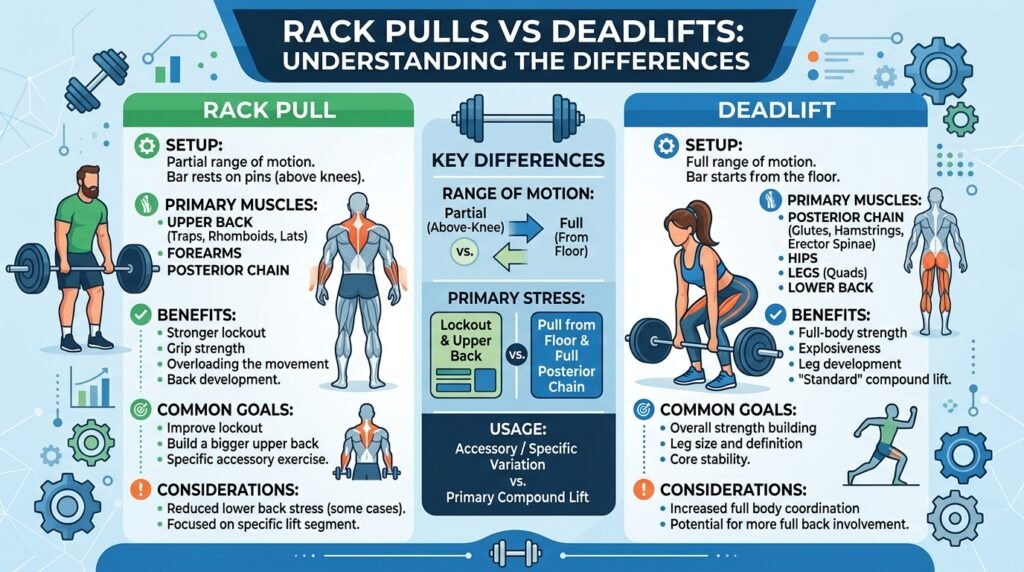
To understand the difference, we must first look at the range of motion. The deadlift involves pulling a weight from the floor to a standing position. It requires significant hip mobility and engages the entire posterior chain, from the hamstrings to the traps.
In contrast, rack pulls are essentially a partial deadlift. You begin with the barbell resting on the safety pins of a power rack (hence the name), usually set just below or above the knee. By eliminating the bottom portion of the lift, you remove much of the leg drive, shifting the focus heavily onto the back muscles.
This is a form of partial range of motion training, a technique often used to target sticking points or handle heavier loads than would be possible with a full range of motion. Similar to how Using Pin Squats to Overcome Training Plateaus and Build Power targets specific ranges in a squat, rack pulls isolate the lockout phase of the hinge pattern.
Muscles Worked and Hypertrophy Potential
Both movements recruit the posterior chain, but the emphasis shifts dramatically based on the starting height.
The Deadlift:
- Primary Drivers: Hamstrings, glutes, quadriceps (off the floor), erector spinae.
- Stabilisers: Lats, traps, forearms, core.
The deadlift is a comprehensive compound movement. According to research on muscle activation, the initial pull from the floor places the highest demand on the hamstrings and glutes. It is a raw test of absolute strength.
The Rack Pull:
- Primary Drivers: Erector spinae, latissimus dorsi, trapezius, glutes (lockout).
- Reduced Involvement: Hamstrings and quadriceps.
Because you are starting from a higher position, the leverage is more advantageous for the lower body, allowing the upper back to take the brunt of the load. This makes rack pulls for hypertrophy particularly effective if your goal is upper back thickness. The limited range allows for massive loading on the traps and lats without the central nervous system fatigue often associated with heavy floor pulling.
For those interested in the science of muscle growth, this heavy loading facilitates Sarcoplasmic Hypertrophy: What It Is and How to Achieve It, contributing to that dense, muscular look.
Benefits of Rack Pulls
Why might you choose the rack pull over the traditional deadlift? Here are several evidence-based reasons.
1. Targeted Back Development
By removing the floor phase, you eliminate the mechanical disadvantage of the start. This allows you to handle supramaximal weights—loads heavier than your one-rep max deadlift. This overload creates immense isometric back tension, forcing the lats and traps to work overtime to keep the spine neutral.
2. Breaking Through Plateaus
Many lifters struggle with the “lockout” phase of a deadlift. If you can get the bar to your knees but fail to stand tall, you have a lockout weakness. This exercise acts as a potent deadlift plateau breaker by strengthening the exact muscles needed to finish the lift. It enhances your lockout strength improvement capabilities significantly.
3. Reduced Lower Back Stress
For individuals with lower back issues or limited hip mobility, pulling from the floor can be risky if form breaks down. Rack pulls allow for a more upright torso angle, which can result in safer lower back safety lifting mechanics for some populations. This concept is similar to the Floor Press: Benefits, Proper Form, and Muscle Groups Targeted, where limiting range of motion can spare joints while maintaining high intensity.
4. Grip Strength Enhancement
Because you can hold more weight on a rack pull than a deadlift, your grip is tested to its limits. While straps are often used, performing this movement without them is one of the ultimate grip strength variations for advanced lifters.
Benefits of Conventional Deadlifts
Despite the specific benefits of rack pulls, the deadlift remains a fundamental movement for general athleticism.
1. Full Posterior Chain Activation
No other exercise coordinates the hamstrings, glutes, and back quite like the deadlift. For posterior chain activation, it is unrivalled. It teaches the body to move as a single unit, which is crucial for functional tasks—something discussed in our guide on Why Sandbag Carries are the Ultimate Functional Strength Exercise.
2. Range of Motion
Moving a load through a full range of motion generally elicits a greater hormonal response and caloric expenditure. It ensures that you maintain hip mobility and flexibility.
3. Functional Application
Picking heavy objects off the ground is a daily necessity. The deadlift builds the absolute strength vs relative strength required for real-world tasks. Understanding Absolute Strength vs Relative Strength: Understanding the Difference is key for athletes, and the deadlift builds both effectively.
Safety and Technique Considerations
Regardless of which lift you choose, safety is paramount. The spine must remain neutral.
Managing Stress on the Spine
While rack pulls can be safer for the lower back due to the upright angle, the sheer amount of weight used can cause spinal compression. It is vital to engage the core. Techniques found in The Science of Isometric Holds for Building Functional Strength can apply here; learning to brace effectively protects the discs.
Rack Pull Height
One of the most common questions concerns the rack pull height benefits.
- Below the Knee: improved carryover to the deadlift; hits hamstrings more.
- Above the Knee: maximizes upper back and trap load; allows for the heaviest weight.
Setting the pins too high (mid-thigh) often reduces the range of motion so much that it becomes an ego lift with diminished returns. Conversely, setting them too low might not mitigate the lower back stress enough.
Controlling the Descent
Do not simply drop the weight. Use the descent to build strength. How Eccentric Loading Can Accelerate Muscle Growth and Repair explains that the lowering phase is crucial for tissue adaptation. Control the bar back to the pins—do not crash it.
Who Should Prioritise Rack Pulls?
Rack pulls are not just a “cheat” deadlift; they are a strategic tool.
- Bodybuilders: For those seeking back thickness exercises, the rack pull allows for higher volume on the traps and lats without tiring the legs.
- Athletes with Mobility Issues: If you cannot maintain a neutral spine from the floor, rack pulls serve as excellent deadlift regression exercises while you work on flexibility.
- Powerlifters: Specifically used to target sticking points.
Conversely, if you are a general fitness enthusiast looking for maximum caloric burn and total body coordination, the conventional deadlift or variants like the Jefferson Squat might be more appropriate.
Tips for Performing Rack Pulls
To maximise safety and efficacy, follow these guidelines.
- The Setup: Ensure a proper barbell rack pull setup. The bar should be positioned securely on safety pins or blocks. Do not hold the weight in the air to start; pull from a dead stop.
- The Pull: Engage your lats by imagining you are bending the bar around your shins. Drive your hips forward rather than just pulling up with your back.
- The Grip: Use a double overhand grip for lighter sets. For heavy sets, straps are recommended to prevent grip failure from limiting back stimulation.
- Tempo: Consider tempo lifting principles. Explode up, pause briefly, and lower under control. Read more in Understanding Tempo Lifting for Maximised Muscle Hypertrophy.
- Assessment: Regularly perform a rack pulls form check. Film yourself to ensure your spine does not round under the supramaximal loads.
The Bottom Line
Is one better than the other? Not necessarily. They are different tools for different jobs.
If your primary goal is trapezius muscle growth and thickening the upper back, or if you are lifting with limited mobility, rack pulls are arguably superior. They isolate the target muscles and allow for incredible loading.
However, for overall posterior chain development, athletic performance, and hamstring strength, the conventional deadlift remains the gold standard. For many, a periodised approach incorporating both—perhaps cycling them or using rack pulls as an accessory—yields the best results.
Before adding heavy rack pulls to your routine, ensure your core stability is solid. You might even benefit from cross-training with unstable loads, such as those described in A Complete Guide to Steel Club Training for Grip and Joint Health, to prepare your stabilisers for the demands of heavy static lifting.