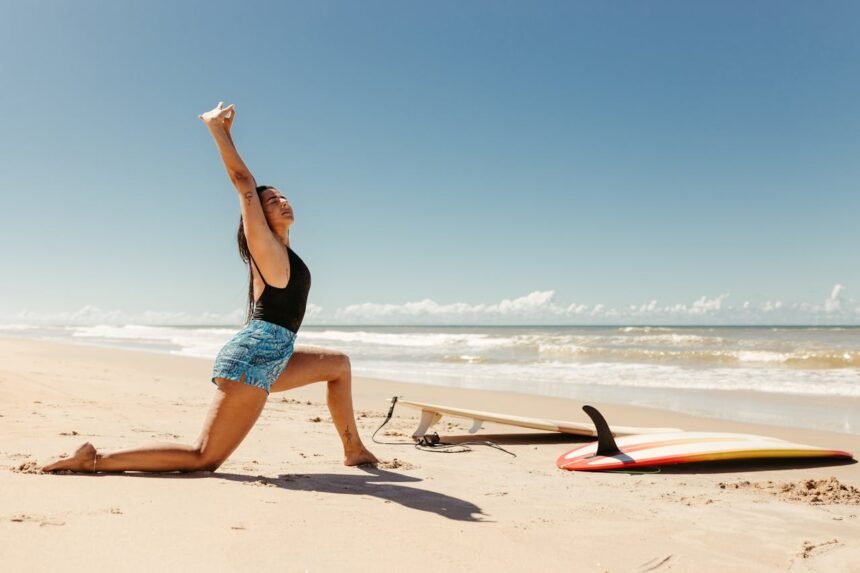
When most people imagine a workout, they visualize rigid gym floors, rubberized mats, or asphalt tracks. However, one of the most effective, functional, and therapeutic training environments is found in nature: the beach. Low-impact sand workouts for beginners offer a unique opportunity to build strength, enhance proprioception, and burn calories without the jarring stress that pavement places on the joints.
Whether you live near the coast or are planning a vacation, utilizing the unstable surface of sand can transform a simple routine into a comprehensive strength-building session. The shifting grains require your body to engage micro-stabilizer muscles that often lie dormant on flat surfaces, providing a higher return on investment for your physical effort.
This guide provides a professional deep dive into the mechanics of sand training, safety protocols, and five specific exercises designed for beginners seeking low-impact, high-reward movement.
The Science: Why Sand Training is Superior for Strength
Before diving into the movements, it is essential to understand why sand is such a potent tool for fitness. The primary benefit lies in the increased energy cost of locomotion. Studies have shown that walking or running on sand requires 1.6 to 2.7 times more energy than moving on a hard surface. This is largely due to two factors: mechanical work and inefficiency.
1. Reduced Impact Forces
Unlike concrete, which returns energy to your legs (often causing shin splints or knee pain), sand absorbs the force of your step. This absorption reduces the impact shock transmitted through the skeletal system, making it an ideal medium for individuals with arthritis or previous joint injuries. According to the Arthritis Foundation, low-impact exercises are crucial for maintaining joint mobility without causing further damage.
2. Enhanced Proprioception and Balance
Proprioception is the body’s ability to sense its location, movements, and actions. The uneven texture of sand forces the nervous system to constantly adjust, improving balance and coordination. This is particularly beneficial for older adults or those recovering from injury, as suggested by the National Institute on Aging, which emphasizes balance training to prevent falls.
Preparation: Gear and Safety
To maximize the benefits of low-impact sand workouts for beginners, preparation is key.
- Footwear: For true strengthening of the intrinsic foot muscles, training barefoot is recommended. However, if you have plantar fasciitis or diabetes, consult WebMD’s foot health guidelines and consider using minimalist sand socks or flexible shoes.
- Surface Selection: Beginners should start on wet, packed sand near the water’s edge. It provides a firmer surface than the dry, fluffy sand further up the beach, offering a middle ground between stability and resistance.
- Sun Protection: Always apply broad-spectrum sunscreen. The Skin Cancer Foundation warns that sand reflects UV rays, increasing exposure risks.
- Hydration: Training in the heat increases fluid loss. Follow hydration strategies from the Academy of Nutrition and Dietetics to prevent heat exhaustion.
The 5 Low-Impact Sand Workouts for Beginners
These exercises are designed to be performed as a circuit. Complete 10–12 repetitions (or 45 seconds) of each movement, rest for 60 seconds, and repeat the circuit 3 times.
1. The Sand March (High Knees)
This is the foundational movement of sand training. It elevates the heart rate without the ballistic shock of running.
- Execution: Stand tall with feet hip-width apart. Drive your right knee up toward your chest while swinging your left arm forward. Place the foot down deliberately (ball of foot first) and switch sides.
- The Sand Effect: On pavement, momentum helps you move. In sand, you must actively pull your foot out of the shifting grains, significantly engaging the hip flexors and quads.
- Focus: Keep your core tight to prevent swaying.
2. Unstable Bodyweight Squats
Squatting on sand forces the glutes and hamstrings to work harder to maintain stabilization during the descent and ascent.
- Execution: Stand with feet slightly wider than shoulder-width. Lower your hips back and down as if sitting in a chair. Go only as deep as you can while maintaining a neutral spine. Drive through the heels to return to standing.
- The Sand Effect: You will feel your feet making micro-adjustments to find balance. This strengthens the ankles and knees. Refer to Harvard Health for proper squat mechanics to protect your lower back.
- Modification: If balance is an issue, perform this exercise closer to a lifeguard stand or a sturdy piece of driftwood for support.
3. Lateral Sand Lunges
Most people move only in the sagittal plane (forward and backward). Lateral movements are vital for hip health and adductor strength.
- Execution: Start with feet together. Step out wide to the right, keeping the left leg straight and bending the right knee. Push off the right foot to return to the center. Repeat on the left.
- The Sand Effect: The push-off phase is more difficult on sand because the ground “gives” way. This requires greater force production from the glute medius.
- Benefit: This movement targets the inner and outer thighs, areas often neglected in traditional walking or running.
4. The Bear Crawl
This is a full-body engagement exercise that builds shoulder stability and core strength without heavy weights.
- Execution: Start on all fours (hands and knees). Lift your knees an inch off the sand so only your hands and toes are touching. Crawl forward by moving the right hand and left foot simultaneously, then the left hand and right foot.
- The Sand Effect: Your wrists and shoulders must stabilize against the uneven surface. It is a fantastic functional movement recommended by experts at ACE Fitness for integrated core conditioning.
- Note: Keep your back flat like a table. Do not let your hips hike up.
5. Sand Plank with Alternating Leg Lifts
Core stability is the anchor of all movement. Doing planks on sand adds an element of instability that fires up the deep abdominal muscles.
- Execution: Assume a forearm plank position. Ensure your body forms a straight line from head to heels. Slowly lift your right leg off the sand, hold for two seconds, and lower it. Repeat with the left leg.
- The Sand Effect: As you lift a leg, the sand under your supporting toes may shift, forcing your obliques to correct the imbalance immediately.
- Safety: Do not let your lower back sag. If this is too difficult, hold a static plank on your knees.
Comparative Analysis: Sand vs. Pavement
To better understand the value proposition of these low-impact sand workouts for beginners, we can compare the physiological demands of sand training against standard pavement training.
| Metric | Sand Training | Pavement/Gym Floor |
|---|---|---|
| Impact Force | Low (High Absorption) | High (High Energy Return) |
| Calorie Burn | 1.6x – 2.7x Higher | Baseline |
| Muscle Recruitment | High (Includes Stabilizers) | Moderate (Primary Movers) |
| Injury Risk (Impact) | Low | Moderate to High |
| Injury Risk (Twisting) | Moderate (Uneven Surface) | Low |
| Proprioception | Excellent | Minimal |
Progression: How to Advance
Once you have mastered these basic movements, you don’t need to start jumping or sprinting to make them harder. According to the American Heart Association, increasing intensity can be achieved by altering tempo or duration.
- Move to Soft Sand: Transitioning from wet, packed sand to dry, loose sand increases the instability and effort required.
- Slow Down: Perform the eccentric (lowering) phase of squats and lunges slower (count to 4). This increases time under tension.
- Add Resistance: Use resistance bands, which are lightweight and portable, to add load to your squats or lateral walks.
Recovery and Post-Workout Care
Because sand training works muscles differently, you may experience Delayed Onset Muscle Soreness (DOMS) in the calves and feet.
- Calf Stretching: Tight calves are common after sand workouts. Perform static stretches immediately after cooling down.
- Hydration: Replenish electrolytes.
- Rest: Allow at least 48 hours before the next sand session to allow tendons to adapt.
For more on recovery science, the Mayo Clinic offers excellent resources on stretching and flexibility.
Frequently Asked Questions (FAQ)
1. Do I need to wear shoes for sand workouts?
Generally, barefoot is best for strengthening the feet and ankles. However, if the sand is extremely hot, or if the beach has shells and debris, minimalist shoes or “sand socks” are highly recommended to prevent lacerations. If you require orthotics for arch support, stick to wearing sneakers on the harder, wet sand.
2. Can sand workouts cause shin splints?
While sand reduces impact, the increased range of motion required at the ankle can strain the anterior tibialis (shin muscle) if you do too much too soon. Beginners should start with short sessions (15-20 minutes) to allow the lower leg muscles to adapt.
3. How often should I do low-impact sand workouts?
For beginners, 2 times per week is sufficient. Because sand training is more demanding on the nervous system and stabilizer muscles, your body needs adequate recovery time. You can alternate these days with standard walking or swimming.
4. Is sand walking good for weight loss?
Yes. A study cited by PubMed indicates that walking on sand requires significantly more mechanical work than walking on a hard surface. This increased energy expenditure leads to a higher calorie burn per minute, making it an efficient option for weight management.
5. What is the best time of day for beach workouts?
The best time is usually early morning or late afternoon. This avoids the peak UV radiation hours (10 AM to 4 PM). additionally, checking tide charts is helpful; low tide offers the most surface area of flat, packed sand, which is ideal for beginners. You can check local tides via reputable weather sites like NOAA.
Conclusion
Adopting low-impact sand workouts for beginners is more than just a change of scenery; it is a strategic move toward functional longevity and strength. By leveraging the natural resistance and instability of the beach, you can build a resilient body capable of handling real-world physical challenges.
Remember, the goal is not speed, but stability and control. Start on the wet sand, listen to your body, and enjoy the dual benefits of physical exertion and the mental clarity that comes from training by the ocean. Whether you are doing bear crawls or simple marching, the sand is a forgiving yet demanding training partner that yields exceptional results.
Start your journey next time you visit the coast, and experience the difference of earth-based training.