In the modern world, anxiety has become a silent epidemic. From the jarring sound of the morning alarm to the blue light of our screens late at night, our nervous systems are constantly bombarded with stimuli. According to the National Institute of Mental Health, nearly one-third of adults in the United States experience an anxiety disorder at some point in their lives. While professional help is vital, there is an ancient, accessible tool that resides strictly within your own body: your breath.
Welcome to the world of Pranayama. If you are looking for effective pranayama for anxiety beginners, you have arrived at the right place. This guide will bridge the gap between ancient yogic wisdom and modern physiological science, providing you with actionable techniques to calm your mind and reclaim your peace.
The Science of Breath: Why It Works
Before diving into the techniques, it is crucial to understand why breathing works. Most of us breathe shallowly into our chests, a habit that signals the brain that we are in danger. This triggers the sympathetic nervous system—the “fight or flight” response—flooding the body with cortisol and adrenaline.
Pranayama (Sanskrit for “control of breath”) hacks this system. By consciously slowing and deepening the breath, you stimulate the Vagus nerve, which runs from the brainstem down to the abdomen. This activation switches on the parasympathetic nervous system, often called the “rest and digest” mode. As noted by Harvard Health, deep breathing encourages the body to trade muscle tension and a racing heart for a state of deep relaxation.
Getting Started: Preparing for Practice
To get the most out of pranayama for anxiety beginners, setting the scene is helpful, though not strictly necessary. The beauty of breathwork is that it can be done anywhere—at your desk, in your car (parked), or on a yoga mat.
- Posture: Sit comfortably with a straight spine. This allows the diaphragm to move freely. You can sit cross-legged on a cushion or in a sturdy chair with your feet flat on the floor.
- Environment: Minimize distractions. Turn off notifications.
- Safety: If you feel dizzy or lightheaded, return to normal breathing immediately. As with any wellness practice, consult a healthcare provider if you have respiratory issues, as recommended by the American Lung Association.
4 Essential Pranayama Techniques for Anxiety
1. Sama Vritti (Box Breathing)
Sama Vritti, or “Equal Fluctuation,” is often referred to as Box Breathing. It is a technique famously utilized by Navy SEALs to maintain calm and focus in high-stress situations. It is arguably the best entry point for pranayama for anxiety beginners because of its simplicity.
How to do it:
- Inhale through your nose for a count of 4.
- Hold the breath at the top for a count of 4.
- Exhale through your nose for a count of 4.
- Hold the breath at the bottom (empty) for a count of 4.
- Repeat this cycle for 3 to 5 minutes.
Why it helps: The rhythmic nature of this breath forces the mind to focus on counting, effectively disrupting the loop of anxious thoughts. The Cleveland Clinic highlights its efficacy in resetting the autonomic nervous system.
2. Nadi Shodhana (Alternate Nostril Breathing)
Nadi Shodhana translates to “channel cleaning.” In yoga physiology, it is believed to balance the left (lunar/calming) and right (solar/energizing) hemispheres of the brain. Scientifically, it improves airflow and brings a sense of centeredness.
How to do it:
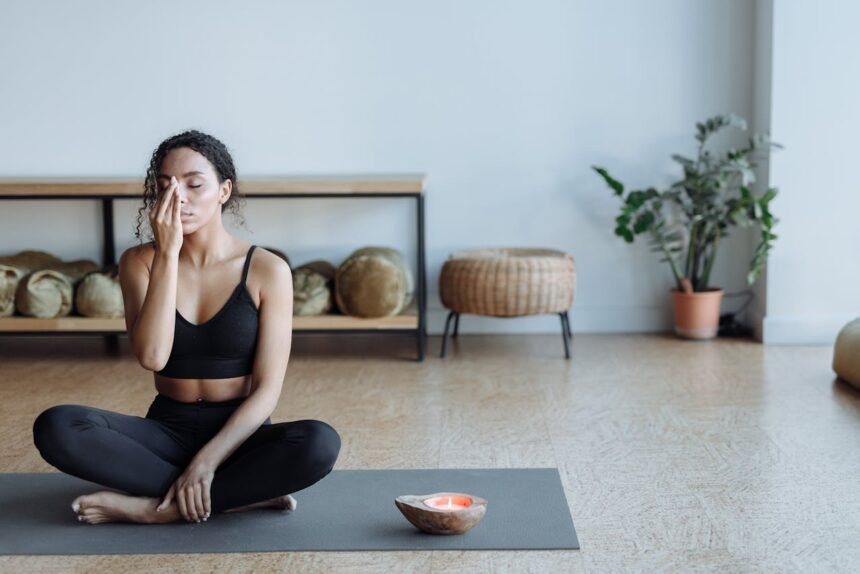
- Sit comfortably. Bring your right hand up to your face (Vishnu Mudra: fold index and middle fingers in, leave thumb, ring, and pinky out).
- Close your right nostril with your thumb and inhale gently through the left nostril.
- Close the left nostril with your ring finger, release the thumb, and exhale through the right nostril.
- Inhale through the right nostril.
- Close the right nostril, release the ring finger, and exhale through the left nostril.
- This completes one round. Aim for 10 rounds.
Research published in the International Journal of Yoga suggests that practicing Nadi Shodhana regularly can significantly reduce pulse rate and blood pressure, markers often elevated by anxiety.
3. Bhramari (Humming Bee Breath)
If your anxiety manifests as racing thoughts or a “noisy” mind, Bhramari is the antidote. This technique utilizes sound vibration to soothe the nervous system.
How to do it:
- Close your eyes. Place your thumbs on the cartilage (tragus) of your ears to block out external sound.
- Place your index fingers gently on your forehead and the remaining fingers over your eyes.
- Inhale deeply through the nose.
- As you exhale, keep your mouth closed and make a low-pitched humming sound (like a bee) in the back of your throat: Mmmmmm.
- Feel the vibration in your skull and teeth. Repeat for 5 to 10 minutes.
The vibration stimulates the vagus nerve and creates a sensory withdrawal (pratyahara), which Yoga Journal notes is excellent for mitigating anger and agitation.
4. The 4-7-8 Technique
Popularized by integrative medicine specialist Dr. Andrew Weil, this technique acts as a natural tranquilizer for the nervous system. It is particularly effective for those who have trouble falling asleep due to anxiety.
How to do it:
- Exhale completely through your mouth, making a whoosh sound.
- Close your mouth and inhale quietly through your nose to a count of 4.
- Hold your breath for a count of 7.
- Exhale completely through your mouth, making a whoosh sound to a count of 8.
- Repeat the cycle four times.
Comparison of Techniques
To help you decide which pranayama for anxiety beginners fits your current needs, consult the table below:
| Technique | Sanskrit Name | Best Used For | Difficulty Level | Avg. Duration |
|---|---|---|---|---|
| Box Breathing | Sama Vritti | Sudden stress, regaining focus | Very Easy | 2-5 Minutes |
| Alternate Nostril | Nadi Shodhana | General anxiety, balancing energy | Easy/Moderate | 5-10 Minutes |
| Humming Bee | Bhramari | Racing thoughts, sensory overload | Moderate | 5-10 Minutes |
| 4-7-8 Breath | N/A | Insomnia, panic attacks | Easy | 2-4 Cycles |
| Ocean Breath | Ujjayi | Physical tension, during yoga practice | Moderate | Continuous |
Integrating Pranayama into Your Life
Knowing the techniques is only half the battle; consistency is where the transformation happens. According to behavioral science discussed by James Clear, author of Atomic Habits, starting small is the key to building a lasting routine. Do not aim for 30 minutes a day immediately.
Tips for Success:
- Anchor the habit: Practice your breathing immediately after a current habit, such as brushing your teeth or pouring your morning coffee.
- Use technology: Apps like Calm or Headspace can provide timers and guided sessions if you find silence difficult at first.
- Be patient: You are retraining your nervous system. Some days it will feel easy; other days your mind will wander. This is normal.
A Note on Long-Term Benefits
The benefits of pranayama extend beyond the immediate reduction of anxiety. The NCCIH (National Center for Complementary and Integrative Health) reports that regular yoga and breathwork practice can improve overall quality of life, reduce chronic pain, and improve sleep patterns.
Conclusion
Anxiety often feels like being caught in a storm without an umbrella. While we cannot always control the weather of our lives, we can control how we navigate through it. By mastering pranayama for anxiety beginners, you are equipping yourself with a portable, potent tool for self-regulation.
Start today. Choose one technique from the list above—perhaps the Box Breath—and dedicate just three minutes to it. Close your eyes, inhale deeply, and remember: as long as you can breathe, you have the power to calm your mind.
Ready to deepen your practice? Unroll your mat and join our beginner’s yoga challenge to combine movement with your new breathing skills.