



Short description: Akkermansia is a gut bacterium that has become one of the most talked-about names in microbiome research. It lives in the mucus layer that lines your intestine, and early studies link it with metabolic health.
Supplements now promise big things, from blood sugar support to a “stronger gut barrier.” But the evidence is still young. Most findings come from cell and animal studies, plus a few small human trials. This guide explains what is Akkermansia, how an Akkermansia probiotic differs from standard probiotics, and what the research really shows about Akkermansia benefits.
You will also learn about Akkermansia side effects, what to look for in an Akkermansia supplement, and how to read claims about Pendulum products. The guide is written in plain language and stays conservative. It is not medical advice, and Akkermansia is not a proven treatment for any condition.
The Bottom Line First
Before the details, here is the core message.
Akkermansia is a promising area of research. It is not a proven treatment. Here is where the evidence stands:
- Most findings come from cell and animal studies
- Human trials are few, small, and short
- Some of the best-known human data comes from company-linked studies
- Supplements are not FDA-approved to treat, cure, or prevent any disease
Keep that in mind as you read. It will help you spot hype.
What Is Akkermansia?
So, what is Akkermansia? The full name is Akkermansia muciniphila, often shortened to A. muciniphila.
It is a bacterium that lives in the human gut. It was isolated from human feces and uses mucin as its only source of carbon and nitrogen. Mucin is the main building block of the mucus layer that coats your intestinal wall.
It was discovered only in 2004. That makes it a young subject in science. Many questions are still open.
Where It Lives
Think of your gut lining as a wall with a slippery coat on top. That coat is mucus. Akkermansia lives in and feeds on that layer.
This is unusual. Most gut microbes feed on fiber that reaches the colon. This one eats mucus. Scientists think that may help the body renew its mucus layer, but this idea is still being studied.
Why Researchers Care
Several studies have noticed a pattern. People with overweight, obesity, untreated type 2 diabetes, or high blood pressure tended to have lower levels of A. muciniphila.
But a pattern is not proof. Lower levels might be a cause, a result, or just a side effect of diet or medicine. That is why trials matter.
Quick Fact Check
- It is a normal part of many healthy guts
- It is a strict anaerobe, which means it dies in oxygen
- No common food contains it in meaningful amounts
- Levels vary a lot from person to person
The Evidence Level: A Clear Look
Let’s be direct about how strong the science is. Researchers use a rough ladder.
| Level | What it means | Akkermansia status |
|---|---|---|
| Cell and lab studies | Test tube experiments | Many studies, early stage |
| Animal studies | Mostly mice | Many promising results |
| Small human pilot trials | Dozens of people | A few exist |
| Large randomized trials | Hundreds or thousands | Largely missing |
| Guidelines or approvals | Doctors’ recommendations | None for treating disease |
One 2026 review of 43 reports on supplementation made the same point. It found plenty of mouse studies, fewer human ones, and many unanswered questions due to limited scope, inconsistent results, and risk of bias.
Another review noted that the number of human trials is low in this area, and that evidence for neurological conditions was conflicting.
So when you see a bold claim on a bottle, ask: which rung of the ladder does it stand on?
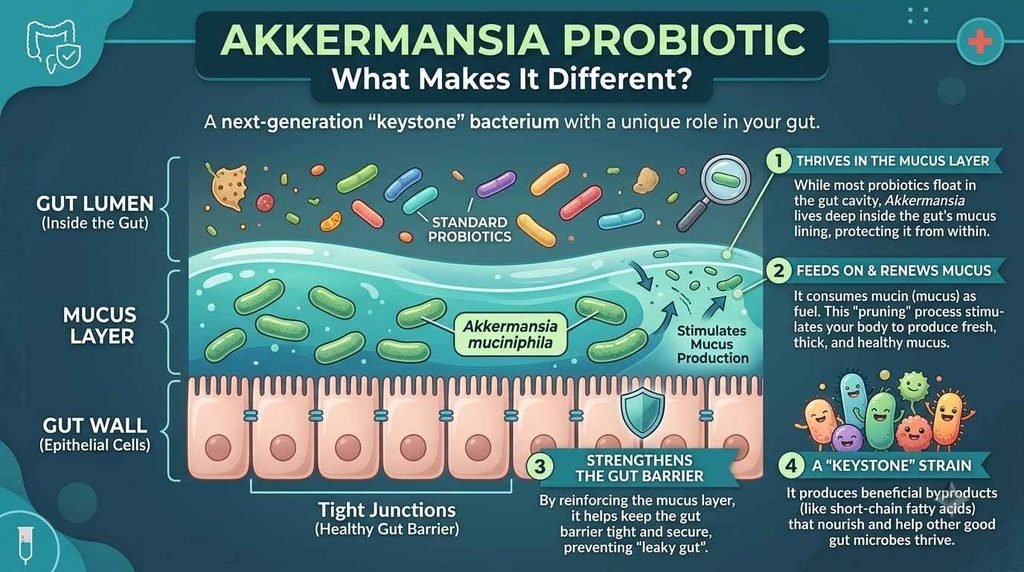
Akkermansia Probiotic: What Makes It Different?
You will often see Akkermansia probiotic described as a “next-generation probiotic.” Let’s unpack that.
Classic Probiotics
Common probiotics include Lactobacillus and Bifidobacterium. They are found in yogurt and many supplements. Many have decades of safety use.
Next-Generation Probiotics
These are newer microbes taken from the gut itself. They are harder to grow and often have less safety history. Akkermansia is the best-known example.
Live vs Pasteurized
This difference matters a lot.
- Live means the bacteria are alive when taken. They must survive stomach acid and oxygen.
- Pasteurized means the bacteria are heat-treated and no longer alive. Their cell parts may still affect the body.
In the best-known human trial, the pasteurized form did better than the live form. We will look at that next. Many people assume “live” is always better. For this microbe, the science does not say that.
Regulation Notes
Safety rules differ by region. One review noted that the European Food Safety Authority did not recommend the species for its “qualified presumption of safety” list, though a pasteurized biomass has been handled separately. The details are technical, but the takeaway is simple: regulators treat this as a newer ingredient and want evidence.
Akkermansia Benefits: Three Tiers of Evidence
When people search for Akkermansia benefits, they find a mix of real research and marketing. Let’s sort it into three tiers.
Tier 1: Animal and Lab Findings
This is the largest pile of evidence. In mice, giving this bacterium has been linked to:
- Better blood sugar handling
- Less weight gain on high-fat diets
- A thicker mucus layer
- Lower markers of inflammation
These findings are interesting. But mice are not people. Many mouse results fail to repeat in humans.
Tier 2: Early Human Trials
Here the evidence is thin but real. Let’s walk through the most cited trial.
The 2019 Pilot Study in Nature Medicine
Researchers in Belgium ran a small study. Here is what they did:
- It was a randomized, double-blind, placebo-controlled pilot study in overweight or obese adults with insulin resistance; 40 were enrolled and 32 finished.
- Volunteers took placebo, live A. muciniphila, or pasteurized A. muciniphila daily for three months.
- They were asked to keep their usual diet and activity.
What did it find? Compared with placebo, the pasteurized form improved insulin sensitivity by about 29 percent, lowered insulin levels by about 34 percent, and reduced total cholesterol by about 9 percent.
The authors reported that the supplement was safe and well tolerated at the dose studied. You can read the study in this Nature Medicine pilot trial of Akkermansia supplementation.
Now the limits, which matter just as much:
- Only 32 people finished
- It lasted just three months
- It was a single center
- Body weight dropped slightly (about 2.3 kg), but that change did not reach statistical significance.
- It tested pasteurized and live forms at one dose level, not a range of products
- The authors noted that participants receiving the pasteurized cells differed from others at the start of the trial.
- The authors called it a “proof-of-concept”
In plain terms: it is a hopeful first step. It does not prove that Akkermansia supplement products help people with metabolic problems.
Other Human Data
Other trials exist, including studies of multi-strain formulas. A multi-strain trial cannot tell you what one microbe did. We cover the Pendulum trial in its own section below.
Tier 3: Marketing Claims Without Solid Evidence
Be careful with claims such as:
- “Melts belly fat”
- “Reverses insulin resistance”
- “Heals leaky gut”
- “Works like a GLP-1 drug”
- “Detoxes your gut”
None of these has been shown by strong human trials for Akkermansia on its own. A drug-style claim on a supplement is also a red flag under US rules.
Evidence by Claim
| Claim | Animal data | Human data | Verdict |
|---|---|---|---|
| Improves insulin sensitivity | Yes | One small pilot with pasteurized form | Promising, unproven |
| Lowers cholesterol | Some | One small pilot showed a reduction | Early signal |
| Aids weight loss | Yes | Slight change, not statistically significant | Not shown |
| Strengthens gut barrier | Yes | Limited | Mostly preclinical |
| Reduces inflammation | Yes | Limited | Mostly preclinical |
| Treats any disease | No | No | No evidence |
This table is a simplified snapshot. It will need updating as new trials report.

Akkermansia Supplement: What You Are Actually Buying
Now let’s turn to the shelf. An Akkermansia supplement can look very different from one brand to the next.
Common Forms
- Live capsules: Contain living bacteria, often in special protective capsules
- Pasteurized products: Heat-treated bacteria
- Blends: Akkermansia plus other strains or prebiotic fibers
- Polyphenol or fiber add-ons: Sold to “feed” the microbe
Doses: Trials vs Labels
The Belgian pilot used a daily dose of 10 billion bacteria. Labels often list different units, such as colony-forming units (CFU) or “active fluorescent units” (AFU). Those units are not always directly comparable.
For example, one provider page lists a Pendulum survey of providers who recommended a product labeled “Akkermansia 500 million AFU.” A dose that is far below the trial dose is not necessarily better or worse. It is just unproven in its own right.
Strain Matters
Different strains of a species can act differently. Ask whether the product names the exact strain and whether that exact strain was tested in people.
Label Red Flags
Be cautious if a product:
- Promises to treat or reverse a disease
- Hides the strain name or dose
- Gives no storage or expiration information
- Offers no third-party testing
- Uses only testimonials as proof
- Claims “clinically proven” without naming the study
Buying Checklist
| Check | Why it matters |
|---|---|
| Strain name listed | Strains differ in effect |
| Live or pasteurized stated | The trial result was for pasteurized |
| Dose in clear units | Lets you compare with studies |
| Third-party testing | Verifies identity and contamination |
| Expiry and storage rules | This microbe is oxygen-sensitive |
| Study named, not just “clinically studied” | You can check what was actually tested |
| Allergen and additive list | Avoid surprises |
| Honest claims | Disease claims are a warning sign |
Who Should Skip or Ask First
Talk to a clinician before taking one if you:
- Are pregnant or breastfeeding
- Have a weakened immune system
- Have a serious illness or recent surgery
- Take diabetes medicines
- Take many medicines
- Are choosing it for a child
Pendulum Akkermansia: A Fair, Factual Overview
Many readers search for Pendulum Akkermansia. Pendulum Therapeutics is a well-known US brand in this space. This section is a factual overview. It is not an endorsement or a review of whether the products work.
What the Company Sells
Pendulum describes itself as the first US company to market live Akkermansia muciniphila. Its range includes:
- A single-strain Akkermansia product in more than one strength
- Glucose Control, a five-strain blend
- A GLP-1 Probiotic with three strains, launched in 2024
- Fiber and polyphenol products
One market analysis reported that the company sells six products priced between $27 and $99 per month. Prices change, so check the brand’s site.
The Clinical Trial Behind the Brand
The company’s main clinical data is for Glucose Control, not the single-strain product. That figure comes from one 12-week study of 76 participants. The trial was published in a BMJ journal and enrolled people with type 2 diabetes. You can read the BMJ Open Diabetes Research and Care trial.
Important details:
- The trial tested a combination of strains in people with type 2 diabetes who were also on metformin.
- The product is a multi-strain blend, so the results cannot be credited to Akkermansia alone.
- The study was a single company-run trial.
Single-Strain Product Evidence
One news report noted that the company’s other gut-health products, including the single-strain Akkermansia product, are sold as dietary supplements and had not been tested alone in clinical trials at the time of that reporting. The company has said other trials are underway. Check for updates.
A separate market analysis added that the single-strain product is sold on gut-lining claims rather than glucose claims.
The Advertising Review
In 2021, a self-regulation body reviewed Pendulum’s diabetes-related ads. The National Advertising Division found the claims were supported but recommended changes, including limiting them to people taking metformin and removing percent-reduction figures where clinical relevance was not shown. The company said it was pleased with the decision and would comply.
Note that this body is an industry self-regulation group, not a government agency. Its rulings are not legally binding. You can read the decision in this National Advertising Division summary.
How to Think About It
- Company-funded trials are common in supplements, but they deserve extra scrutiny
- Independent replication is the gold standard, and it is still limited
- A multi-strain result does not prove a single-strain product works
- “Doctor recommended” and survey stats are marketing, not outcome data
Is Pendulum Akkermansia worth it? That is a personal decision. It depends on your health, your budget, and your doctor’s advice. The evidence does not allow a clear yes or no.
Akkermansia Side Effects and Safety
The honest answer on Akkermansia side effects is: the known data is limited.
What Trials Report
In the Belgian pilot, reports of side effects were low. Self-reported nausea and flatulence appeared in all groups, including placebo, with similar rates. The authors said the intervention was well tolerated.
A university press release stated that the groups reported no side effects. The paper’s supplementary data show some mild digestive complaints. That is a reminder to read the source, not only the headline.
Possible Effects to Watch
Based on general probiotic experience, people sometimes notice:
- Gas
- Bloating
- Loose stools
- Mild stomach upset
These are not proven for every product, but they are common with new microbes or fibers.
What We Do Not Know
- Long-term safety beyond a few months
- Safety in children, pregnancy, or serious illness
- Interactions with medicines
- Effects of very high doses
- Differences between brands and strains
One older review noted that at the time of writing there were no published open clinical trials in humans, leaving strong safety evidence lacking. Since then, small trials have appeared, but the long-term picture is still thin. You can read the safety and metabolic disorders review for background.
Special Cautions
- Weakened immunity: Live bacterial products can carry added risk, so check with your doctor.
- Diabetes medicines: If a supplement changes blood sugar, your dose might need review. Never change your medicine on your own.
- Contamination: Supplements are not tested like drugs. Third-party testing helps.
A reminder: not having a reported side effect does not prove a product is safe for you.

Can You Get More Akkermansia From Food?
No food is a reliable source of this bacterium. It is not in yogurt, kefir, or fermented vegetables in any meaningful amount.
Some studies suggest that plant polyphenols (found in foods such as berries and pomegranate) and certain fibers might support its growth. That research is early, and results vary a lot from person to person. Eating more plants is good for other reasons, so there is little downside. Just do not expect a guaranteed rise in this one microbe.
Be careful with tests too. Many online gut tests report a “low Akkermansia” result. These reports have limits:
- Stool tests give a snapshot, not a stable number
- Results vary between companies
- No agreed “normal” range exists
- A low number does not diagnose a disease
If a report says your levels are low, treat it as a conversation starter for your doctor, not a reason to buy a pricey product.
When More Akkermansia Is Not Better
It is tempting to think more is always better. The science is not that simple.
Some studies have found higher levels of this bacterium in certain conditions. For example, reviews note conflicting evidence in some neurological diseases, and opposite results were observed in some mouse models of Alzheimer’s disease.
Why does this matter? It shows that association is not cause. A microbe can rise because of a disease, a medicine, or a diet change. It does not mean the microbe is the reason.
That is also why you should avoid the thinking that “my number is low, so I need to fix it.”
Realistic Expectations
If you try a supplement, set sensible goals.
- Expect small or no noticeable change
- Do not stop prescribed medicines
- Do not use it in place of care
- Give it a trial period, then reassess with your doctor
- Track symptoms and any lab results
The biggest drivers of metabolic and gut health are not in a capsule. They include:
- Fiber and plant variety: vegetables, fruits, beans, whole grains, nuts
- Physical activity: even regular walking helps
- Sleep: poor sleep affects blood sugar and appetite
- Limiting ultra-processed foods and added sugar
- Managing stress
- Medical follow-up: regular checks if you have risk factors
These habits are well supported by large studies. Akkermansia is still a research topic.
Who Should Talk to a Doctor First
Please speak to a clinician before starting any Akkermansia supplement if you:
- Have diabetes or prediabetes
- Take blood sugar, blood pressure, or cholesterol medicines
- Are pregnant, trying to conceive, or breastfeeding
- Have a weakened immune system or take immunosuppressants
- Have inflammatory bowel disease, severe constipation, or ongoing digestive symptoms
- Have had recent surgery or a serious illness
- Are buying for a child
See a doctor sooner if you have:
- Unexplained weight loss
- Blood in your stool
- Ongoing belly pain
- Changes in bowel habits lasting weeks
- Extreme thirst or frequent urination
These need medical evaluation, not supplements.
Myths About Akkermansia
“It is a proven weight-loss aid.”
No. The best-known trial saw a small weight change that was not statistically significant.
“Live is always better than pasteurized.”
Not necessarily. The key pilot found stronger effects with the pasteurized form.
“Low levels mean I am sick.”
No. Levels vary, and tests have limits.
“More CFU means more benefit.”
Not proven. Strains, forms, and units differ.
“If a doctor recommends it, it is proven.”
No. Recommendations can reflect preference or marketing, not trial proof.
“It is a natural GLP-1 drug.”
No. Supplements are not equal to prescription drugs.
Frequently Asked Questions
What is Akkermansia?
Akkermansia (A. muciniphila) is a gut bacterium that lives in the mucus layer of the intestine. It was discovered in 2004 and is a hot research topic for metabolic health.
Is an Akkermansia probiotic safe?
Small trials report good tolerance for periods of about three months. Long-term safety data is limited. People with weak immunity, pregnant people, and people with serious conditions should ask a doctor first.
What are the proven Akkermansia benefits?
No benefit is proven for treating a disease. Early human data suggest possible improvements in insulin sensitivity and cholesterol with a pasteurized form, but the study was small and short.
Is Pendulum Akkermansia worth it?
The evidence does not give a clear answer. The company’s main published trial tested a multi-strain blend in people with type 2 diabetes, not the single-strain product. Talk with your clinician and check current evidence.
What are the main Akkermansia side effects?
Reported effects are mild, such as gas or nausea, and appeared in placebo groups too. Long-term and special-population safety is unknown.
Does an Akkermansia supplement help with weight loss?
Not shown. One pilot saw a small weight change that was not statistically significant. Do not buy it as a weight-loss product.
Can food raise my Akkermansia levels?
No food contains meaningful amounts. Plant polyphenols and fiber are being studied, but results are early and variable.
Should I take an Akkermansia supplement if my gut test says my level is low?
Not on that basis alone. Gut tests have limits, and there is no agreed healthy range. Discuss the result with a clinician first.
Key Takeaways
- Akkermansia is a gut microbe that lives in the mucus layer
- Evidence is mostly preclinical, with a few small early human trials
- The best-known trial had 32 completers and lasted three months
- It is not a proven treatment for any condition
- Pasteurized and live forms are not equal in the research
- Pendulum’s main trial was a multi-strain blend and was company-run
- Side effect data is limited, especially long-term
- Diet, sleep, and activity have far stronger evidence
Conclusion
Akkermansia is exciting science. But excitement is not proof. The research so far suggests a possible role in metabolic health, yet the human data is small and early.
If you are curious, read labels carefully, favor products that name their strain and study, and talk to your doctor. Do not use a supplement in place of medical care.