In an era defined by rapid connectivity and ceaseless demands, anxiety has become a pervasive companion for many. While modern medicine offers various treatments, an increasing number of individuals are turning to ancient practices to find equilibrium. Among these, yoga stands out not merely as physical exercise, but as a profound somatic tool for mental regulation. Integrating specific yoga sequences for anxiety management into your daily routine can serve as a powerful bridge between a frantic mind and a grounded body.
This guide explores the physiological mechanisms behind yoga’s calming effects and provides actionable sequences designed to soothe the nervous system.
The Physiology of Peace: How Yoga Affects the Brain
To understand why movement heals, we must look at the nervous system. Anxiety often stems from an overactive sympathetic nervous system—the body’s “fight or flight” response. When chronic stress persists, our bodies are flooded with cortisol and adrenaline.
Yoga functions by activating the parasympathetic nervous system, often referred to as the “rest and digest” state. according to Harvard Health Publishing, yoga modulates stress response systems, decreasing physiological arousal. This is largely achieved through the stimulation of the vagus nerve, which connects the brain to major organs and controls heart rate and relaxation.
Core Principles for Anxiety-Reducing Practice
Before diving into the sequences, it is vital to understand the principles that distinguish a workout from a therapeutic practice:
- Breath Centricity: The breath is the remote control for the nervous system. Deep, rhythmic breathing signals safety to the brain.
- Grounding: Poses that connect the body to the floor create a sense of stability.
- Introspection: Turning the gaze inward (Pratyahara) helps detach from external stressors.
Comparison: Yoga Styles for Mental Health
Not all yoga is created equal when the goal is anxiety reduction. While a heated power flow might release endorphins, it can sometimes elevate heart rates too high for someone already experiencing panic. The table below outlines styles best suited for anxiety management.
| Yoga Style | Intensity Level | Primary Anxiety Benefit | Best Time to Practice |
|---|---|---|---|
| Restorative | Very Low | Deep nervous system reset; lowers cortisol drastically. | Evening or high-stress moments |
| Yin Yoga | Low | Releases deep fascial tension; teaches sitting with discomfort. | Late evening or after work |
| Hatha | Low-Medium | Balances energy; focuses on breath-movement coordination. | Morning or Mid-day |
| Vinyasa (Slow) | Medium | Moving meditation; burns off excess nervous energy. | Morning |
| Kundalini | Variable | Uses breath and chanting to shift mental states quickly. | Early Morning |
Sequence 1: The Morning Grounding Flow (15 Minutes)
Starting the day with anxiety can set a chaotic tone. This yoga sequence for anxiety management focuses on standing poses to build confidence and stability. This flow leverages the benefits of proprioception—knowing where your body is in space—to anchor the mind.
1. Mountain Pose (Tadasana)
Stand with feet hip-width apart. Press firmly into all four corners of the feet. Engage the thighs, lengthen the spine, and roll shoulders back. Close your eyes and visualize roots extending from your heels into the earth.
2. Tree Pose (Vrksasana)
Shift weight to the left foot. Place the right foot on the inner left thigh or calf (avoid the knee). Press palms together at the heart. Balancing poses force the mind to focus on the present moment, interrupting anxious loops.
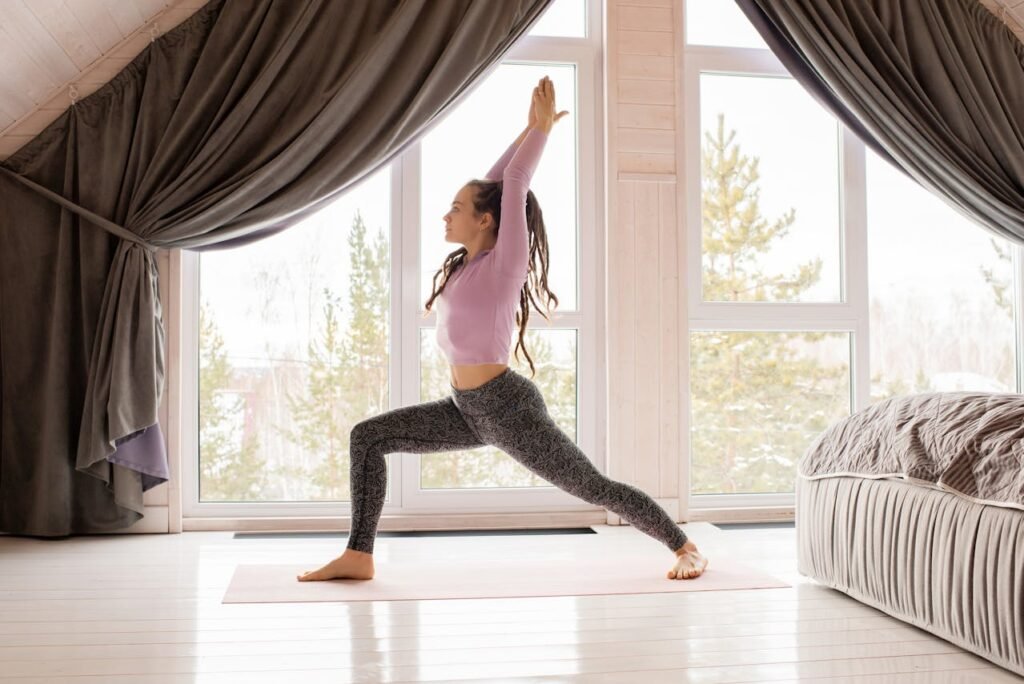
3. Warrior II (Virabhadrasana II)
Step feet wide. Turn the right foot out and bend the right knee. Extend arms parallel to the floor. Gaze over the front middle finger. This pose builds resilience and stamina, as noted by Yoga Journal for its empowering qualities.
4. Standing Forward Fold (Uttanasana)
Exhale and fold over your legs. Let the head hang heavy. Forward folds are inherently cooling and soothing to the nervous system as they increase blood flow to the brain while shielding the sensory organs.
Sequence 2: The Midday Reset (Office-Friendly)
Workplace stress is a leading cause of anxiety. According to the American Institute of Stress, workload is the primary source of stress for 46% of employees. This mini-sequence can be done in a chair or small space.
- Seated Cat-Cow: Inhale to arch the back (Cow), exhale to round the spine (Cat). This releases tension in the thoracic spine where we hold protective armor.
- Neck Rolls: Gently drop the right ear to the right shoulder, roll the chin to the chest, and over to the left. The neck is a primary storage depot for tension.
- Eagle Arms (Garudasana Arms): Wrap right arm under left. Lift elbows. This stretches the upper back and shoulders, releasing the physical manifestation of “carrying the weight of the world.”
Sequence 3: The Evening Wind-Down (Restorative)
Insomnia is a frequent bedfellow of anxiety. This sequence prepares the body for deep REM sleep by shifting fully into parasympathetic dominance. The Sleep Foundation suggests that regular yoga practice can improve sleep quality significantly.
1. Child’s Pose (Balasana)
Kneel on the floor, toes together, knees wide. Fold forward, resting the forehead on the mat. This posture mimics the fetal position, creating a primal sense of safety and introspection.
2. Legs-Up-The-Wall (Viparita Karani)
Sit sideways against a wall and swing your legs up. Lie back. This inversion facilitates venous return (blood flow back to the heart) and slows the heart rate. It is perhaps the single most effective pose for acute anxiety.
3. Reclined Bound Angle (Supta Baddha Konasana)
Lie on your back, soles of feet together, knees dropping open. Place one hand on the heart and one on the belly. Connect with the rhythm of your breath.
4. Corpse Pose (Savasana)
Lie flat, arms by sides, palms up. Scan the body for tension and consciously release it. Stay here for at least 5-10 minutes. Savasana allows the brain to integrate the benefits of the practice.
The Vital Role of Breathwork (Pranayama)
Physical poses (Asana) are only half the equation. Integrating Pranayama is essential for a comprehensive yoga sequence for anxiety management.
- 4-7-8 Breathing: Inhale for 4, hold for 7, exhale audibly for 8. Dr. Andrew Weil popularized this technique as a “natural tranquilizer for the nervous system.”
- Alternate Nostril Breathing (Nadi Shodhana): This technique balances the left and right hemispheres of the brain. The National Center for Complementary and Integrative Health (NCCIH) recognizes breathing exercises as a key component of yoga’s mental health benefits.
Safety and Modifications
While yoga is generally safe, it is crucial to approach it with mindfulness. If you have a history of trauma, some poses might be triggering. This is where Trauma-Sensitive Yoga comes into play, creating a safe container for practice.
Always consult with a healthcare provider before starting a new regimen, especially if you have pre-existing conditions. Resources like the Mayo Clinic offer excellent guidelines on starting safely.
Integrating Yoga into a Holisitic Lifestyle
Yoga is most effective when part of a broader lifestyle approach to anxiety. This includes:
- Hydration and Nutrition: A balanced gut microbiome influences mental health (the gut-brain axis).
- Professional Support: Yoga is a complementary therapy, not a replacement for professional psychological care. Organizations like the Anxiety and Depression Association of America (ADAA) provide resources for finding clinical help.
- Mindfulness Meditation: Pairing yoga with seated meditation amplifies the results. The American Psychological Association highlights mindfulness as a key factor in stress reduction.
Conclusion: Taking the First Step
Embracing calm is not about forcing the mind to be silent; it is about giving the body a way to process the noise. By utilizing these yoga sequences for anxiety management, you provide your nervous system with a roadmap back to safety.
You do not need to commit to an hour of practice every day to see results. Consistency beats intensity. Start with the Morning Grounding Flow tomorrow, or try five minutes of Legs-Up-The-Wall tonight. Your breath is always with you, waiting to guide you back to peace.
Roll out your mat, take a deep breath, and begin.