It begins with a groan. perhaps it is the sound you make when rolling out of bed in the morning, or the audible sigh as you stand up after hours of sitting at a desk. Stiffness is not merely a sign of aging; it is a symptom of modern living. In an era defined by sedentary jobs and high stress, our bodies often become rigid cages, trapping tension in our necks, hips, and hamstrings. While high-intensity interval training and powerlifting have their place in fitness, sometimes the antidote to a rigid life is fluid movement.
This guide explores gentle yoga for stiff bodies—a practice designed not to force you into pretzel-like shapes, but to coax your muscles into relaxation and restore your natural range of motion. Whether you are a complete beginner or a seasoned athlete looking to improve recovery, finding your flow can transform how you move through the world.
The Physiology of Stiffness: Why Do We Lock Up?
Before diving into the solution, it is vital to understand the problem. Why does the body stiffen? According to Harvard Health Publishing, prolonged periods of inactivity, such as sitting, cause the hip flexors to shorten and the glutes to weaken. This imbalance pulls on the lower back, creating a chain reaction of tightness.
Furthermore, stiffness is not purely mechanical; it is also chemical. When we are stressed, our bodies release cortisol and adrenaline, preparing us for a “fight or flight” response. This evolutionary mechanism causes muscles to guard and contract. Over time, chronic stress leads to chronic tension. Research from the National Center for Complementary and Integrative Health (NCCIH) suggests that yoga is particularly effective because it addresses both the physical shortening of muscles and the neurological state of the practitioner.
The Role of Fascia
It is not just about muscle fibers. Deep within the body lies the fascia, a connective tissue that encases muscles and organs. Imagine fascia as a wetsuit; if it is pliable, you move freely. If it is dehydrated and matted down due to lack of movement, you feel restricted. Studies found in the National Library of Medicine (PubMed) indicate that slow, sustained stretching helps rehydrate this tissue, restoring the “glide” between muscle layers.
Preparing for Practice: The Mindset of Ahimsa
In yoga philosophy, the first yama (ethical rule) is Ahimsa, or non-violence. When applying gentle yoga for stiff bodies, this translates to a simple rule: do not force it. If you feel sharp pain, pull back. The goal is a sensation of “sweet discomfort” or a dull ache associated with stretching, never sharp or shooting pain.
Essential Props for the Stiff Practitioner:
- Yoga Blocks: Bring the floor closer to you.
- Strap or Belt: Extends your reach for hamstring stretches.
- Bolster or Cushion: Provides support for restorative poses.
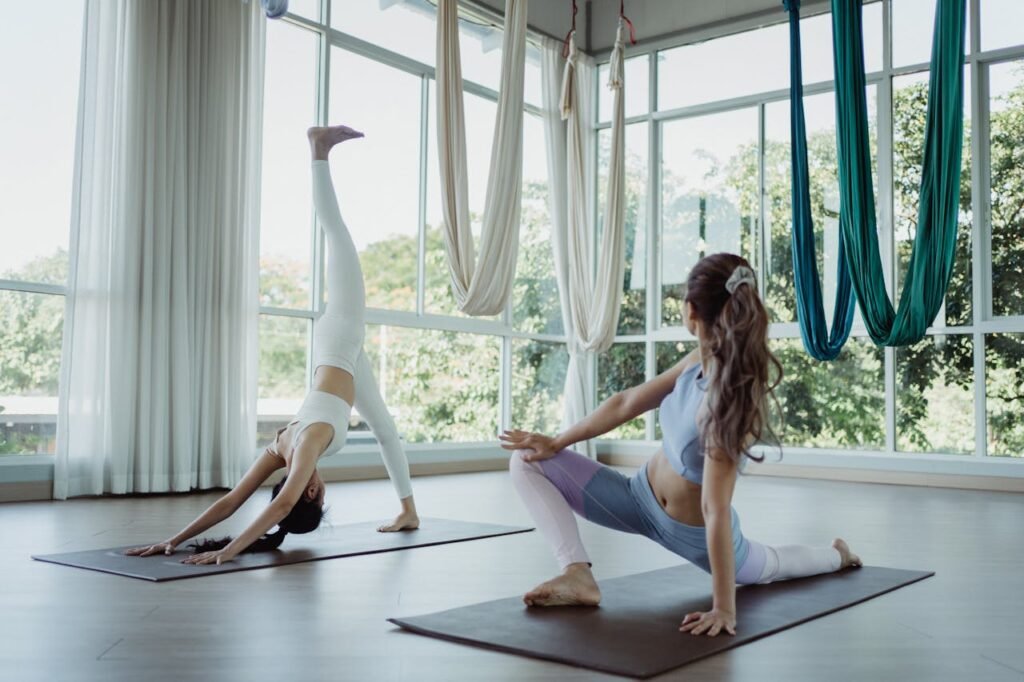
5 Essential Gentle Yoga Poses for Stiff Bodies
These poses are selected for their accessibility and their ability to target the most common areas of tension: the spine, hips, and shoulders.
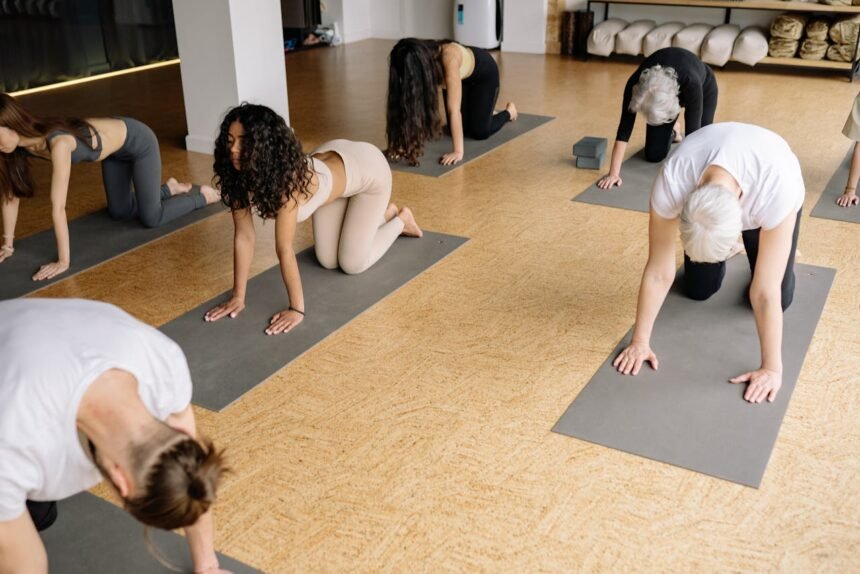
1. Cat-Cow Stretch (Marjaryasana-Bitilasana)
This dynamic movement warms up the spine and lubricates the vertebrae. It is the perfect antidote to the “desk hunch.”
How to do it:
- Start on your hands and knees (tabletop position). Ensure wrists are under shoulders and knees under hips.
- Inhale (Cow): Drop your belly towards the mat, lift your chin and chest, and gaze up.
- Exhale (Cat): Draw your belly to your spine and round your back toward the ceiling like a stretching cat. Release your head toward the floor.
- Repeat for 10 breath cycles.
According to Yoga Journal, syncing this movement with breath helps calm the central nervous system.
2. Supported Child’s Pose (Balasana)
A resting pose that gently stretches the lower back and hips while quieting the mind.
How to do it:
- Kneel on the floor, touching your big toes together and sitting on your heels.
- Separate your knees about as wide as your hips.
- Exhale and lay your torso down between your thighs.
- Extend your arms forward with palms down.
- Modification: If your hips don’t touch your heels, place a block or folded blanket between your calves and hamstrings.
3. Ragdoll Forward Fold (Uttanasana Variation)
This is a gravity-assisted release for the hamstrings and the entire back line of the body. It is often cited by the Mayo Clinic as a beneficial posture for stress relief.
How to do it:
- Stand with feet hip-width apart.
- Bend your knees deeply (this is crucial for stiff backs) and fold forward at the hips.
- Let your head hang heavy. Shake it “yes” and “no.”
- Clasp opposite elbows with your hands and sway gently side to side.
- Hold for 1 minute.
4. Thread the Needle (Parsva Balasana)
This pose targets the upper back and shoulders—a trouble spot for anyone who drives or types frequently.
How to do it:
- From a tabletop position, inhale and reach your right arm high to the sky.
- Exhale and slide your right arm underneath your left arm, palm facing up.
- Rest your right shoulder and ear on the mat.
- Keep your hips high. Hold for 5-8 breaths, then switch sides.
5. Legs-Up-The-Wall (Viparita Karani)
Perhaps the most restorative pose in existence, this inversion facilitates venous return (blood flow back to the heart) and relaxes the pelvic floor.
How to do it:
- Sit sideways next to a wall.
- Swing your legs up the wall as you lie back on the floor.
- Rest your arms by your sides. Close your eyes.
- Stay here for 5 to 10 minutes.
The Cleveland Clinic notes that this pose is excellent for reducing swelling in the legs and calming the mind before sleep.
Comparison of Yoga Styles for Stiffness
Not all yoga is created equal. If you are dealing with significant stiffness, choosing the right style is paramount. The table below outlines the best options.
| Yoga Style | Intensity | Focus | Best For |
|---|---|---|---|
| Hatha | Low-Medium | Basics, alignment, holding poses for several breaths. | Beginners learning the mechanics of movement. |
| Yin Yoga | Low | Passive stretching, holding poses for 3-5 minutes. Targets deep connective tissue (fascia). | Those with deep-seated joint stiffness and limited flexibility. |
| Restorative | Very Low | Complete relaxation using props (bolsters, blankets) to support the body. | High stress, recovery from injury, or extreme fatigue. |
| Vinyasa (Flow) | Medium-High | Breath-synchronized movement. Continuous flow. | Those who need heat generation to loosen muscles (caution advised for beginners). |
| Iyengar | Low-Medium | Precision and alignment using many props. | Structural issues, scoliosis, or very stiff practitioners needing support. |
The Role of Consistency and Hydration
Practicing gentle yoga for stiff bodies once a month will yield minimal results. The American Council on Exercise (ACE) emphasizes that consistency beats intensity. A 15-minute gentle flow done daily is more effective than a 90-minute class done once a week. This frequency trains the nervous system to tolerate a new range of motion.
Additionally, hydration plays a critical role in tissue elasticity. Water is a primary component of synovial fluid, which lubricates our joints. Without adequate hydration, the fascia becomes sticky, leading to that feeling of being “glued together.” The Centers for Disease Control and Prevention (CDC) recommends making water your primary beverage choice to support overall joint health.
Modifications for Common Limitations
Never be afraid to modify. It is not a sign of weakness; it is a sign of intelligence.
- Tight Hamstrings: Keep a generous bend in your knees during forward folds. Use a strap for leg raises.
- Sore Knees: Place a folded blanket under your knees in tabletop positions. Avoid deep squats (Malasana) if there is pain.
- Wrist Pain: Perform poses on your forearms (e.g., Dolphin pose instead of Downward Dog) or make fists to keep the wrists neutral.
The Arthritis Foundation supports the use of chairs for yoga if getting up and down from the floor is not currently accessible.
Conclusion: The Journey to Fluidity
Embracing gentle yoga for stiff bodies is an act of self-care that pays dividends in every aspect of life. By dedicating just a few minutes a day to these movements, you can reduce pain, improve your posture, and lower your stress levels. Remember, the goal is not to touch your toes, but to learn what your body needs when you reach down.
Start small. Listen to your body. Breathe deeply. The stiffness did not accumulate overnight, and it will not vanish overnight. However, with patience and practice, you will find your flow and rediscover the joy of moving freely.
Are you ready to unlock your body? Roll out your mat today and try the Cat-Cow stretch—your spine will thank you.