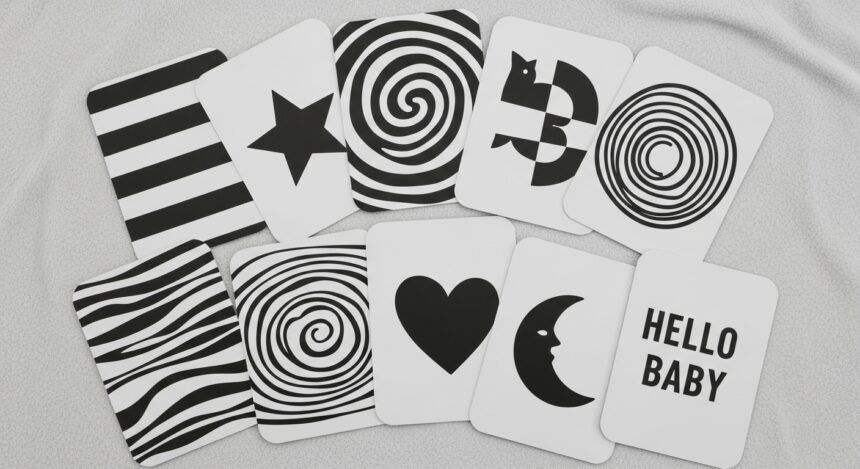
Welcome to the fascinating world of infant development. If you are a new parent or caregiver, you might have noticed that newborn babies do not focus on objects the same way adults do. Their vision is still developing, and the world often appears blurry to them. This is where contrast cards come into play. These simple yet effective tools are designed to help your baby make sense of their new environment.
In this guide, we will explore exactly what contrast cards are, why newborn visual stimulation* is crucial, and how you can use these tools to support *baby brain development. We will use clear, British English to ensure you have all the information you need to give your little one the best start.
What Are Contrast Cards?
Contrast cards*, often referred to as *black and white baby cards, are visual aids specifically designed for infants. Unlike standard flashcards that might feature complex colourful illustrations of animals or letters, contrast cards use bold, high-contrast images. Typically, these are black geometric shapes on a white background, or vice versa.
> “Research suggests that black and white registers the strongest on a baby’s retina, sending strong visual signals to the brain.”
The reason for this design is simple. At birth, a baby’s retina is not fully developed. They struggle to distinguish between subtle shades of colour* like pastel pinks or blues. However, the stark difference between black and white is highly visible to them. This makes *high contrast patterns the perfect tool for capturing a newborn’s attention.
For more on general development, you can visit the NHS Baby Development page.
The Science Behind Newborn Vision
To understand the benefits of high contrast cards, we must first look at how infant vision works. When a baby is born, their visual acuity is approximately 20/400. This means they can only see clearly at a distance of about 20 to 30 centimetres—roughly the distance to your face whilst feeding.
Brain Development and Visual Pathways
The optic nerve connects the eye to the brain. In newborns, this connection is still forming. Visual input is essential for myelination, the process where nerve cells are coated to allow faster signal transmission. High contrast images provide a strong visual stimulus that accelerates this growth.
According to the American Optometric Association, proper visual stimulation is critical during the first six months of life to ensure the visual cortex develops correctly. By using monochrome nursery decor or cards, you are essentially exercising your baby’s optic nerve.
Benefits of Using High Contrast Cards for Newborns
Using sensory play ideas like contrast cards offers multiple benefits beyond just keeping your baby occupied. Here is why they are a staple in many modern nurseries.
1. Enhancing Concentration and Focus
Newborns have a very short attention span. However, when presented with black and white baby cards*, you may notice your baby staring intently for seconds or even minutes. This practice helps lengthen their attention span. *Newborn focus exercises like this lay the groundwork for future learning capabilities.
2. Encouraging Physical Development
Contrast cards are excellent companions for tummy time activities. Tummy time is vital for strengthening neck and shoulder muscles, but many babies find it uncomfortable. Placing a card in front of them gives them something interesting to look at, distracting them from the effort and encouraging them to lift their heads higher.
Learn more about safe exercises at NCT UK.
3. Calming a Fussy Baby
Because the world can be visually overwhelming for a newborn, the simplicity of high contrast shapes can be soothing. It provides a clear focal point in a blurry world. This is why montessori baby activities often prioritise simple, uncluttered environments.
How to Use Baby Contrast Cards Effectively
You do not need a degree in child psychology to use these cards. However, a few techniques can maximise their effectiveness. Here is a step-by-step guide on how to use sensory cards.
Distance and Positioning
* The Sweet Spot: Hold the card 20 to 30 centimetres (8–12 inches) away from your baby’s face. This is the zone where they can focus best.
* Stationary Viewing: Start by holding the card still. Let your baby fixate on the image. You might see their eyes widen or their movements slow down as they concentrate.
* Visual Tracking for Babies: Once your baby locks eyes on the card, slowly move it horizontally to the right, then back to the centre. This helps them learn to track moving objects, a skill crucial for later coordination.
For further reading on milestones, check Pathways.org.
incorporating into Daily Routine
You can weave these cards into various parts of your day:
- Nappy Changes: Stick a card on the wall next to the changing table to keep them still.
- Play Gym: Attach cards to their hanging mobile.
- Cuddle Time: Show them cards whilst they rest on your lap.
DIY Contrast Cards vs Store-Bought
Many parents wonder if they should buy premium sets or make their own. Both options have their merits.
Store-Bought Options
Professional sets are often printed on thick, durable board which withstands drool and tearing. They usually come with a wide variety of patterns, from simple shapes to complex animals. You can find recommendations for the best sensory toys for newborns on sites like MadeForMums.
DIY Contrast Cards
If you are on a budget, DIY contrast cards are incredibly easy to make.
* Materials: White cardstock, black marker pen, or a printer.
* Designs: Draw bold circles, squares, stripes, or checkerboards.
* Tip: Ensure the lines are thick. Thin, sketchy lines are harder for babies to see.
Making your own allows you to customise images. You could even draw simple faces, as babies are naturally drawn to facial structures. For creative inspiration, Pinterest is a great resource, though expert advice on Zero to Three focuses more on the interaction than the art quality.
When to Start and Stop
It is never too early to start. You can introduce infant vision development tools from day one.
* 0–3 Months: Stick to simple geometric black and white patterns.
* 3–6 Months: As their colour vision develops (starting with red), you can introduce cards with splashes of bright colour.
6+ Months:** By this stage, babies can see more depth and detail. You can transition to realistic pictures of animals or objects to help with vocabulary, moving away from purely abstract *high contrast patterns.
According to BabyCentre UK, babies begin to see full colour by around five months, making this the perfect transition period.

The Montessori Connection
The Montessori method emphasises independence and respect for a child’s natural psychological development. Montessori baby activities often utilise contrast cards (sometimes called “Munari mobiles” in the early stages) to foster concentration without overstimulation.
Unlike noisy, flashing electronic toys, these cards encourage the baby to be an active participant in their learning. They must focus their eyes and process the image, rather than passively watching lights flash. This aligns with advice from the Harvard Center on the Developing Child regarding serve-and-return interactions.
Common Mistakes to Avoid
While using these cards is simple, avoid these common pitfalls to ensure your baby stays happy and engaged.
* Overstimulation: If your baby looks away, cries, or arches their back, they have likely had enough. Respect their signals.
* Too Fast: Moving the cards too quickly prevents the baby from focusing. Remember, their processing speed is slower than yours.
* Clutter: Showing too many cards at once can be confusing. Present one image at a time.
For more on reading baby cues, Raising Children Network offers excellent advice.
Conclusion
Contrast cards* are a simple, affordable, and scientifically backed tool to help your baby’s visual and cognitive growth. By incorporating *black and white sensory cards into your daily routine, you are doing more than just playing; you are building the neural pathways that will help your child learn and perceive the world for the rest of their life.
Remember, every baby develops at their own pace. Use these cards as a fun way to bond, not as a test. Whether you buy a set or create DIY contrast cards, the most important element is the interaction between you and your little one.
For further guidance on early years education, resources like UNICEF’s Early Childhood Development and The Lullaby Trust (for safe sleep and play context) are invaluable.
—
Frequently Asked Questions (FAQ)
1. When should I start using contrast cards with my newborn?
You can start using contrast cards from birth. In the first few weeks, your baby’s vision is very blurry, and high contrast black and white images are the easiest for them to see and focus on.
2. How long should I show the cards to my baby?
There is no set time limit, but newborn attention spans are short. Aim for a few minutes at a time, perhaps during tummy time or quiet alert periods. Stop if your baby shows signs of tiredness or overstimulation.
3. Do contrast cards really help with brain development?
Yes. Visual stimulation causes the nerve cells in the brain to multiply and connect. Using high contrast images helps accelerate the myelination of the optic nerve and strengthens the visual cortex.
4. Can I use contrast cards on a tablet or phone screen?
While digital images work, printed cards are generally better. Screens emit blue light which might not be ideal for very young eyes, and physical cards allow you to adjust the distance and angle more easily without glare.
5. When should I switch from black and white to coloured cards?
Babies start to perceive the colour red around 3 months of age, followed by other bright colours. You can start introducing primary colours around 3 to 4 months, and fully detailed images by 6 months.
—
References and Further Reading:
* KidsHealth – Your Newborn’s Hearing, Vision, and Other Senses
* Royal College of Ophthalmologists
* National Literacy Trust