


Wondering how much fiber per day your body really needs? Most adults fall short, eating around 16 grams when the target sits between 21 and 38 grams. This guide breaks down how much fiber per day you need by age and sex, with clear numbers for women, men, and kids.
You will also learn how much fiber per day to lose weight, how to estimate your own number with a simple calculator method, and which foods make it easy to reach your goal. We cover a practical food list, a sample day of eating, and the side effects that show up when you increase fiber too fast.
Every number comes from trusted public health sources, so you can plan with confidence. Read on to build a fiber routine that supports your gut, your heart, your blood sugar, and your waistline without the bloating drama. It is written in plain language, so you can start using these numbers today.
Why Fiber Deserves a Spot on Your Plate
Fiber is the part of plant foods your body cannot fully digest. It passes through your gut and quietly does a lot of good work along the way. It feeds helpful gut bacteria, keeps digestion moving, and helps you feel full.
Most people know fiber is “good for you,” but few know the actual number. That gap is why searches for how much fiber per day keep climbing, and you can see that rising interest in Google Trends data for this topic. Social media has pushed a trend called fibermaxxing, which makes the question even more popular.
The honest answer is simple. Knowing how much fiber per day you need takes the guesswork out of eating well. In this guide, we keep the language plain and the advice practical.
Quick Answer: How Much Fiber Per Day Do You Need?
For most healthy adults, the answer to how much fiber per day falls between 21 and 38 grams. The exact number depends on your age and sex. Women usually aim for 25 grams, while men usually aim for 38 grams, until age 50.
The U.S. Dietary Guidelines for Americans also offer a calorie-based rule. They suggest about 14 grams of fiber for every 1,000 calories you eat. This rule is handy because it adjusts to your own energy needs.
Here is the short version of how much fiber per day to aim for:
- Adult women (19 to 50): about 25 grams
- Adult men (19 to 50): about 38 grams
- Women over 50: about 21 grams
- Men over 50: about 30 grams
These numbers are “adequate intake” values. They are not strict limits, and they are not a prescription. They are a healthy target that most people can work toward.
Why Most People Fall Short
The average adult in the United States eats roughly 16 grams of fiber a day, according to the NIH Office of Dietary Supplements fiber fact sheet. That is well below what most adults need. Only a small share of people reach the recommended level.
The reason is easy to spot. Modern diets lean on refined grains, packaged snacks, and fast food. These foods lose most of their fiber during processing.
The fix does not require a total diet overhaul. Small swaps add up quickly. Once you know how much fiber per day is realistic, you can build it into meals you already eat.
What Fiber Actually Does in Your Body
Fiber comes in two main types, and both matter. Soluble fiber dissolves in water and forms a gel. Insoluble fiber does not dissolve and adds bulk to stool.
Soluble fiber helps slow digestion. That can smooth out blood sugar spikes and help lower LDL cholesterol. Oats, beans, apples, and citrus fruits are rich in this type.
Insoluble fiber keeps things moving. It helps prevent constipation and supports regular bowel habits. Whole grains, nuts, and vegetables like cauliflower and green beans are good sources.
Most plant foods contain a mix of both. That is why eating a variety of foods matters more than chasing one “perfect” source. When you plan how much fiber per day to eat, think variety first and grams second.
Age and Sex Differences: 7 Daily Fiber Targets
Fiber needs change through life. Body size, calorie needs, and hormones all play a role. Here are the seven main groups and their daily goals.
1. Toddlers (Ages 1 to 3)
Toddlers need about 19 grams a day. Their stomachs are small, so fiber should come from soft, whole foods. Think mashed beans, berries, and oatmeal.
2. Children (Ages 4 to 8)
Kids in this range need about 25 grams a day. This is also when picky eating peaks. Fruit, popcorn, and whole grain bread can help close the gap.
3. Tweens and Teens (Ages 9 to 18)
Needs split by sex here. Girls need about 26 grams a day, while boys need about 31 grams at ages 9 to 13 and 38 grams at ages 14 to 18. Growth spurts raise calorie needs, so fiber needs rise too.
4. Women (Ages 19 to 50)
The target is about 25 grams a day. This is the group most often searching for how much fiber per day for a woman. We cover it in detail in the next section.
5. Men (Ages 19 to 50)
The target is about 38 grams a day. Men generally eat more calories, which is why their number is higher. We break this down further when we look at how much fiber per day men should aim for.
6. Adults Over 50
Women need about 21 grams, and men need about 30 grams. These numbers are lower because older adults usually eat fewer calories. The calorie-based rule of 14 grams per 1,000 calories still applies.
7. Pregnancy and Breastfeeding
Pregnant women need about 28 grams a day. Breastfeeding women need about 29 grams. Pregnancy often slows digestion, so fiber and water become even more important.
These numbers come from the same Dietary Reference Intakes used in the NIH fact sheet. They answer the question of how much fiber per day across every stage of life. Always check with your doctor if you have a health condition that affects your diet.

How Much Fiber Per Day for a Woman
If you are searching for how much fiber per day for a woman, the standard answer is 25 grams for ages 19 to 50. After 50, the target drops to about 21 grams. During pregnancy it rises to 28 grams, and while breastfeeding it is about 29 grams.
Women face a few unique fiber challenges. Hormone shifts during the menstrual cycle can slow digestion and cause bloating. Pregnancy and later life can bring constipation, too.
A steady fiber routine can help with all of this. Aim to spread your fiber across the day instead of loading it into one meal. This approach works best for how much fiber per day for a woman who wants steady digestion.
Here is a simple example of a 25-gram day for a woman:
- Breakfast: oatmeal with raspberries and chia seeds (about 10 grams)
- Lunch: lentil soup with a side salad (about 9 grams)
- Snack: a pear with the skin on (about 5 grams)
- Dinner: grilled chicken with broccoli and brown rice (about 6 grams)
That adds up to about 30 grams, so you can trim a portion and still land in range. Small changes make it easy to hit your target for how much fiber per day each woman needs.
How Much Fiber Per Day Men Need
Men have a higher target because they typically eat more calories. For ages 19 to 50, the goal for how much fiber per day men need is about 38 grams. After age 50, it drops to about 30 grams.
Reaching 38 grams takes planning. Many men eat plenty of meat and refined carbs but very few beans, fruit, or vegetables. That is why most men fall well short of the goal.
A few easy upgrades can close the gap fast. Swap white bread for whole grain, add beans to chili or tacos, and keep nuts or fruit nearby. These habits make how much fiber per day men need feel achievable.
Here is a simple example of a 38-gram day for a man:
- Breakfast: bran cereal with banana and almonds (about 12 grams)
- Lunch: black bean burrito bowl with brown rice and avocado (about 16 grams)
- Snack: apple with peanut butter (about 6 grams)
- Dinner: salmon with roasted sweet potato and green beans (about 8 grams)
That meal plan lands near 42 grams, so there is room to flex. You do not need to be exact every day. What matters is your average over the week.
How Much Fiber Per Day to Lose Weight
Fiber is one of the most useful tools for weight management. It adds volume to meals without adding many calories. It also slows digestion, which helps you feel full longer.
When people ask how much fiber per day to lose weight, the honest answer is that the standard targets still apply. There is no special “weight loss number” backed by strong evidence. Aiming for 25 to 38 grams a day, depending on your sex and calories, is a solid goal.
Here is why fiber helps. High-fiber foods take longer to chew and digest, so you tend to eat less without feeling deprived. Studies on higher-fiber diets often link them to better appetite control and healthier body weight over time.
That said, fiber is not a magic fix. It works best alongside enough protein, regular movement, good sleep, and a sensible calorie level. Think of fiber as a helpful partner, not a shortcut.
If you want to use fiber for weight loss, try these tips:
- Start each meal with a vegetable or salad
- Choose whole fruit over juice
- Add beans or lentils to meals a few times a week
- Pick whole grains over refined ones
These small steps put how much fiber per day to lose weight into practice without strict rules.
How Much Fiber Per Day to Lose Weight for a Woman
Many women search for how much fiber per day to lose weight for a woman because weight loss can feel harder with hormone changes. The target is the same as the general guideline. Most women should aim for 25 grams a day, and women over 50 should aim for about 21 grams.
If you eat fewer calories while dieting, the calorie-based rule may give you a lower number. For example, at 1,500 calories, the 14-grams-per-1,000-calories rule gives you about 21 grams. Many women choose to aim for the higher 25-gram target anyway, as long as they increase fiber slowly.
Women trying to lose weight often skip meals or eat very little, which can backfire. Low-calorie diets can also lower fiber if they cut out grains, beans, and fruit. That is why how much fiber per day to lose weight for a woman should always be paired with enough food.
Be extra careful if you are pregnant, breastfeeding, or taking weight loss medication. Your needs may differ, and your doctor should guide your plan. Never use fiber to replace meals or to push your body too hard.
How Much Fiber Per Day to Lose Weight Calculator
You do not need an app to work out your target. A simple how much fiber per day to lose weight calculator method uses the guideline of 14 grams per 1,000 calories. Here is the formula:
Daily calories ÷ 1,000 × 14 = your fiber goal in grams
Let us run a few examples through this how much fiber per day to lose weight calculator formula:
- 1,500 calories: 1.5 × 14 = about 21 grams
- 1,800 calories: 1.8 × 14 = about 25 grams
- 2,000 calories: 2.0 × 14 = about 28 grams
- 2,500 calories: 2.5 × 14 = about 35 grams
Now compare your result to the standard targets for your age and sex. If your calorie-based number is lower than the standard, many people still aim for the standard target. If it is higher, you can use the higher number once your body adjusts.
A how much fiber per day to lose weight calculator is only a starting point. Your real needs depend on your health, your medications, and how your digestion responds. Track how you feel and adjust slowly.
Soluble vs. Insoluble Fiber: Do You Need Both?
Yes, you need both types. Most foods contain a blend, so you do not need to count each type. Eating a wide range of plants covers both.
Soluble fiber is best known for heart and blood sugar benefits. Good sources include oats, barley, beans, lentils, apples, and citrus. These foods form a gel that helps slow digestion.
Insoluble fiber helps with regularity. Good sources include wheat bran, whole grains, nuts, seeds, and vegetables. These foods add bulk and help waste move through the gut.
When people think about how much fiber per day to eat, they often forget variety. Aim for a mix of beans, whole grains, fruits, vegetables, nuts, and seeds. This variety also feeds a wider range of gut bacteria.
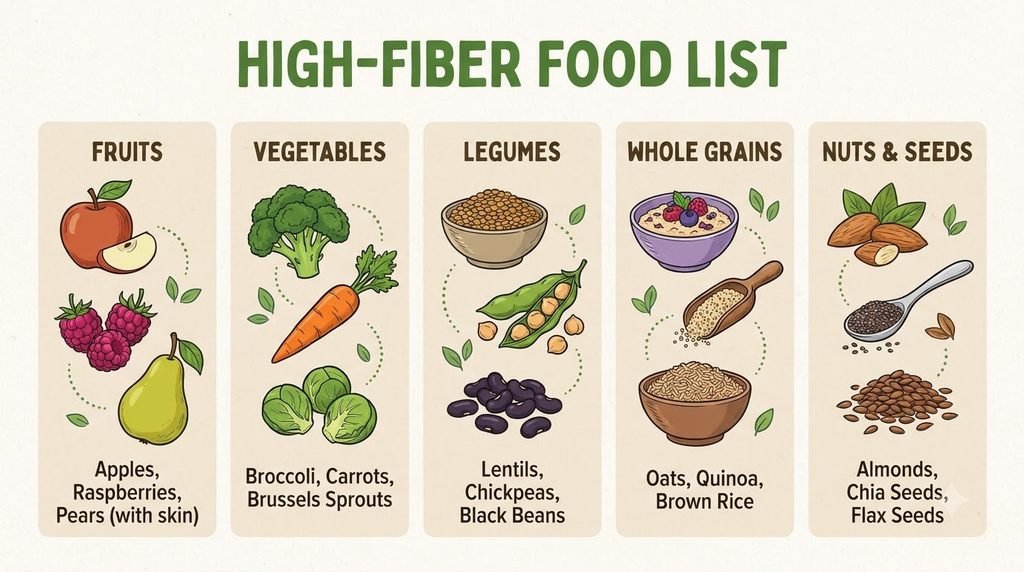
High-Fiber Food List: Easy Ways to Hit Your Number
Knowing how much fiber per day you need is only half the job. The other half is knowing which foods deliver. Below are the best options, with approximate grams per serving.
The NIH fiber fact sheet lists many foods and their fiber content. Exact amounts vary by brand and preparation, so check labels when you can.
Beans and Legumes
- Navy beans, ½ cup cooked: about 9.5 grams
- Split peas, ½ cup cooked: about 8 grams
- Lentils, ½ cup cooked: about 8 grams
- Black beans, ½ cup cooked: about 7.5 grams
- Chickpeas, ½ cup cooked: about 6 grams
Beans are the single best fiber source for most people. They are cheap, filling, and easy to add to soups, salads, and tacos. Even a half cup a day makes a big difference.
Fruits
- Raspberries, 1 cup: about 8 grams
- Pear with skin, 1 medium: about 5.5 grams
- Apple with skin, 1 medium: about 4.5 grams
- Banana, 1 medium: about 3 grams
- Orange, 1 medium: about 3 grams
Leave the skin on when you can, since much of the fiber lives there. Whole fruit also beats juice, which has almost no fiber. Berries are a great pick because they pack a lot of fiber for few calories.
Vegetables
- Green peas, ½ cup cooked: about 4.5 grams
- Sweet potato with skin, 1 medium: about 4 grams
- Broccoli, ½ cup cooked: about 2.5 grams
- Brussels sprouts, ½ cup cooked: about 2 grams
- Carrots, 1 medium raw: about 2 grams
Vegetables bring fiber plus vitamins, minerals, and antioxidants. Mix raw and cooked options for variety. Aim to fill half your plate with them at lunch and dinner.
Whole Grains
- Whole wheat spaghetti, 1 cup cooked: about 6 grams
- Bran flakes cereal, ¾ cup: about 5.5 grams
- Oatmeal, 1 cup cooked: about 4 grams
- Popcorn, 3 cups air-popped: about 3.5 grams
- Brown rice, 1 cup cooked: about 3.5 grams
Look for the words “whole grain” or “whole wheat” as the first ingredient. Many “multigrain” products are mostly refined flour. Reading labels helps you spot the real thing.
Nuts and Seeds
- Chia seeds, 1 ounce: about 10 grams
- Flaxseed, 1 ounce: about 8 grams
- Almonds, 1 ounce: about 3.5 grams
- Pistachios, 1 ounce: about 3 grams
- Sunflower seeds, 1 ounce: about 3 grams
Seeds and nuts are small but mighty. Sprinkle chia or flax on yogurt or oatmeal for an easy boost. Keep portions modest, since nuts and seeds are also high in calories.

Health Benefits Behind the Numbers
Fiber earns its reputation for good reasons. Large reviews of eating patterns link higher fiber intake with a lower risk of heart disease, type 2 diabetes, and bowel problems. These links do not prove that fiber alone is the cause, but they are consistent and strong.
Soluble fiber can help lower LDL cholesterol by binding bile acids in the gut. It also slows how quickly sugar enters your blood, which supports steadier energy. People who eat more fiber also tend to have healthier gut bacteria and more regular bowel habits.
These benefits explain why public health groups care about how much fiber per day people eat. Closing the gap between the average 16 grams and the 25 to 38 gram target is a simple way to improve daily health. You do not need a perfect diet to see progress.
How to Read Food Labels for Fiber
Labels make it much easier to track how much fiber per day you eat. Look for the “Dietary Fiber” line under total carbohydrate on the Nutrition Facts panel. The label also shows a percent daily value, based on a 28-gram daily reference.
A food with 5 grams or more per serving is considered a high-fiber choice. A food with 2.5 to 4.9 grams is a good source. These quick rules help you compare breads, cereals, and snacks in seconds.
Be careful with “added fiber” products such as bars and shakes. Ingredients like inulin or chicory root fiber raise the number on the label, but they may cause more gas in some people. Whole foods are still the best way to reach how much fiber per day you need.
6 Common Fiber Mistakes to Avoid
Even people with good intentions can slip up. Here are the mistakes we see most often.
- Jumping up too fast. A sudden spike leads to gas, bloating, and cramps.
- Skipping water. Fiber needs fluid to move smoothly through your gut.
- Relying on bars and powders. Whole foods give you far more nutrients.
- Peeling fruit and vegetables. The skin holds a lot of the fiber.
- Eating all your fiber at one meal. Spreading it out is gentler on digestion.
- Ignoring your own signals. If a food bothers you, adjust your portion or choose another source.
Avoiding these errors makes how much fiber per day a habit instead of a struggle. Progress will feel steady and comfortable. Small wins add up quickly, and how much fiber per day you eat will rise on its own.
A Sample 30-Gram Day of Eating
Seeing a full day helps make how much fiber per day feel real. This sample plan lands near 30 grams and uses simple foods. You can scale it up or down to match your own target.
- Breakfast: 1 cup oatmeal topped with ½ cup raspberries and 1 tablespoon chia seeds (about 10 grams)
- Morning snack: 1 medium apple with skin (about 4.5 grams)
- Lunch: Lentil soup (1 cup) with a side salad and whole grain bread (about 10 grams)
- Afternoon snack: 1 ounce almonds (about 3.5 grams)
- Dinner: Chicken, ½ cup broccoli, and ½ cup brown rice (about 5 grams)
This plan comes out to about 33 grams. You can drop the snack or shrink a portion to hit 25 grams. You can also add another serving of beans to reach 38 grams.
Notice that none of these foods are exotic. You do not need special powders or bars to meet your goal. Whole foods are the best way to answer how much fiber per day in real life.
Side Effects of Rapid Increase: What to Watch For
Here is the part many people skip. If you jump from 12 grams to 40 grams overnight, your gut will protest. This is a common mistake among people chasing the fibermaxxing trend.
The most common side effects of a rapid increase include:
- Gas and flatulence
- Bloating and abdominal fullness
- Cramping or stomach discomfort
- Constipation, especially if you do not drink enough water
- Loose stools or diarrhea
These symptoms happen because your gut bacteria need time to adjust. They ferment fiber and produce gas as a byproduct. The more fiber you add at once, the more gas you get.
Very high fiber intake may also reduce the absorption of some minerals, such as iron, zinc, and calcium. This is rare in people eating a balanced diet. It is more of a concern with very high intakes or heavy use of fiber supplements.
In rare cases, a large amount of fiber with too little fluid can contribute to a blockage in the gut. This risk is higher for people with a narrowed bowel, a history of bowel surgery, or slow stomach emptying. If you have severe belly pain, vomiting, or cannot pass stool or gas, seek medical care right away.
The key lesson is simple. How much fiber per day is important, but how fast you get there matters just as much.
How to Increase Fiber Safely
The safest approach is slow and steady. Add about 3 to 5 grams of fiber a day each week. Give your gut time to adapt before you add more.
Follow these steps to ease in:
- Check your starting point. Track your fiber for three days to see your baseline.
- Add one high-fiber food at a time. For example, start with oatmeal at breakfast.
- Drink more water. Fiber absorbs fluid, so you need enough to keep things moving.
- Spread fiber across meals. Avoid eating all of it at dinner.
- Cook beans well and rinse canned ones. This can reduce gas for some people.
- Move your body. Walking after meals can ease bloating.
If gas or bloating shows up, slow down and hold at your current level for a week. Your body usually adapts within a few weeks. Remember that how much fiber per day you eat should feel comfortable, not painful.
Fiber Supplements: Helpful or Not?
Food is the best source of fiber because it also supplies vitamins, minerals, and plant compounds. Supplements can help some people fill a gap. They are not a full replacement for whole foods.
Common supplements include psyllium, methylcellulose, and inulin. Start with a small dose, drink plenty of water, and increase slowly. Take them at least two hours apart from medications, unless your pharmacist says otherwise, since fiber can affect how some drugs are absorbed.
Talk to your doctor or pharmacist before using supplements if you take medicines, are pregnant, or have a digestive condition. Even then, keep your focus on food first. Whole foods answer how much fiber per day with more benefits than a powder can.
Fibermaxxing and GLP-1 Medications
Fibermaxxing is the social media trend of eating as much fiber as possible. The idea has some merit, since most people eat too little. But “as much as possible” is not a medical target, and extreme versions can backfire.
People who take GLP-1 medications for weight or blood sugar often ask about fiber, too. These drugs slow stomach emptying and can cause constipation, nausea, or fullness. Fiber can help with constipation for some people, but adding too much too fast may worsen bloating or fullness.
The NIDDK constipation guidance explains how fiber, fluids, and activity support regular bowel movements. If you take a GLP-1 drug, ask your care team how much fiber per day is right for you. Do not change your diet or medication plan on your own.
The smart approach is moderate and steady. Reach the standard target, increase slowly, and listen to your body. That strategy beats extreme fiber loading every time.
Who Should Be Careful With High Fiber?
Fiber is safe for most people, but a few groups should check with a doctor first. This matters because health advice should always match your own situation. The question of how much fiber per day has a different answer when you have certain conditions.
Talk to a healthcare provider if you have:
- Inflammatory bowel disease, especially during a flare
- Irritable bowel syndrome (some types of fiber can trigger symptoms)
- A narrowed bowel or a history of bowel surgery
- Gastroparesis or very slow stomach emptying
- Kidney disease with dietary restrictions
- Difficulty swallowing
Children, older adults, and pregnant women also deserve extra care. Their needs and risks differ from those of the average adult. A registered dietitian can build a plan that fits your health and your goals.
Common Questions About Daily Fiber
Is there an upper limit for fiber?
There is no official upper limit set for fiber from food. Still, going far above the recommended range can cause discomfort, especially if you ramp up fast. For most adults, staying near the target and increasing slowly is the safest approach.
Can I get enough fiber without beans?
Yes, but it is harder. Beans are the most concentrated source, so skipping them means you will need more fruit, vegetables, whole grains, nuts, and seeds. Careful planning makes it doable.
Does cooking destroy fiber?
No. Cooking softens fiber but does not remove it. Some foods, like beans and vegetables, are easier to digest when cooked.
Does fiber really help you lose weight?
It can help, mostly by increasing fullness and improving diet quality. It works best with a balanced diet and an active lifestyle. Fiber alone will not cause major weight loss.
Should I count net carbs or total fiber?
Most guidelines use total dietary fiber. Check the nutrition label for the “Dietary Fiber” line. If you follow a special diet for a medical reason, ask your provider which method to use.
How fast should I reach my target?
Take your time. Raising your intake over several weeks gives your gut bacteria a chance to adjust. Rushing is the most common reason people give up on fiber.
Final Thoughts: Your Fiber Game Plan
So, how much fiber per day is right for you? For most adults, it is somewhere between 21 and 38 grams, based on age, sex, and calorie needs. Women often aim for 25 grams, men for 38 grams, and older adults for slightly less.
If you want to lose weight, the same targets apply, and fiber can help you feel full on fewer calories. Use the simple calorie-based formula as a starting point. Build up slowly, drink water, and pick whole foods first.
Remember the side effects of rapid increase, and do not rush the process. Small, steady changes beat dramatic overhauls. Start with one extra serving of beans, fruit, or whole grains today, and keep building from there.