



The new menopause treatment guidelines from the American College of Obstetricians and Gynecologists (ACOG) are the biggest update in more than a decade. Published in October 2026, they cover hot flashes, night sweats, poor sleep, and mood changes.
This plain-English guide explains what changed for menopause hormone therapy, who may benefit, and who should avoid it. You will also learn about non-hormonal options for hot flashes, including newer medicines, therapy, exercise, and other approaches, and how strong the evidence is for each one.
We also cover the health screenings that matter during midlife, such as bone density, blood pressure, cholesterol, breast, and cervical checks. You will get a simple checklist for your next doctor visit, answers to common questions, and clear next steps.
Everything here is based on trusted medical sources and is meant to help you talk with your own clinician. It is not a substitute for personal medical advice. Read on to see how the new menopause treatment guidelines could shape your care.
New Menopause Treatment Guidelines: What Changed
Key Takeaways
- The new menopause treatment guidelines from ACOG were published on October 15, 2026. They replace advice from 2014.
- ACOG strongly recommends systemic hormone therapy for hot flashes and sleep problems caused by them, if you have no contraindications.
- For best results, hormone therapy is advised before age 60 or within 10 years of the start of natural menopause.
- If you can’t or don’t want hormones, ACOG recommends SSRIs, SNRIs, or neurokinin receptor antagonists. Gabapentin is a later option.
- CBT, mindfulness, exercise, clinical hypnosis, and acupuncture are suggested for some symptoms. The evidence is weaker than for hormones.
- Treatment should be a shared decision between you and your clinician, as the new menopause treatment guidelines stress. It should fit your age, health history, and goals.
Why the New Menopause Treatment Guidelines Matter
If you are going through menopause, you have probably heard mixed messages. Some people say hormones are risky. Others say they are a lifesaver.
The new menopause treatment guidelines try to clear up that confusion. They give you a clearer map of what works, what is uncertain, and what to ask your doctor.
Why does this matter now? Hot flashes and night sweats can last for years. They can wreck your sleep, your focus, and your mood.
Many women are never offered treatment. Others avoid it out of fear. Better guidance helps you make a calm, informed choice. That is the promise of the new menopause treatment guidelines.
Searches for the new menopause treatment guidelines are rising fast, according to Google Trends data on menopause treatment guideline searches. That tells us many people want straight answers.
This guide breaks down the update in simple language. You will see what changed, who it helps, and what to do next.
What Are the New Menopause Treatment Guidelines?
The new menopause treatment guidelines are a clinical practice guideline from ACOG, the main professional group for OB-GYNs in the United States.
The document is titled “Management of Menopause-Related Vasomotor, Sleep, and Mood Symptoms.” It is Clinical Practice Guideline No. 13.
ACOG published it on October 15, 2026. It includes 17 recommendations and good practice points.
According to reporting on the release, it replaces earlier ACOG advice from 2014. ACOG describes it as its most comprehensive menopause guidance to date.
What the guideline covers
The new menopause treatment guidelines focus on three groups of symptoms:
- Vasomotor symptoms (VMS): hot flashes and night sweats.
- Sleep problems: especially sleep trouble caused by night sweats.
- Mood symptoms: low mood, anxiety, and irritability.
They cover both medicines and non-drug options. They also grade each treatment by how strong the evidence is.
What the guideline does not cover
It is not a full guide to all of menopause care. Topics like vaginal dryness, bone health, and long-term disease prevention are handled in other guidance.
We include general screening information later in this article. That part is standard women’s health care. It does not come from the ACOG guideline itself.
Other 2026 guidance worth knowing
ACOG is not the only group that spoke up this fall. The American College of Physicians (ACP) published its own guideline on drug treatments for menopausal hot flashes in early October 2026.
A separate international statement on menopause hormone therapy for women with heart risk factors was also listed in September 2026 by the groups FIGO and the World Heart Federation.
When several expert groups publish within weeks of each other, it signals real movement in the field. The new menopause treatment guidelines are part of a bigger shift toward individual, evidence-based care.

How the New Menopause Treatment Guidelines Differ From the 2014 Advice
The biggest change is breadth. The new menopause treatment guidelines cover far more treatment choices than the earlier advice did.
An ACOG committee chair told NPR that what is changing is the number of options available. That makes a personal approach easier for your doctor.
Here are the main shifts you should know about:
- A clearer stance on hormones. Systemic hormone therapy now gets a strong recommendation for hot flashes and related sleep trouble.
- A timing rule. The new menopause treatment guidelines tie the start of therapy to age 60 or 10 years from the start of natural menopause.
- Newer non-hormonal drugs. Neurokinin receptor antagonists are a newer class. The first medicine in this group reached the market only in recent years.
- Graded non-drug care. CBT, mindfulness, exercise, hypnosis, and acupuncture are now rated, not just mentioned.
- A focus on sleep and mood. The new menopause treatment guidelines look beyond hot flashes alone.
In short, the update moves from a narrow list of choices to a wider menu. Your doctor can now match the option to your health and your goals.
Who Wrote the Guidelines and How Reliable Are They?
Health advice is “your money or your life” content. So it is fair to ask who is behind it.
ACOG is a respected medical society. Its guidelines are written by a committee of physicians who review published research.
Each recommendation is graded. A “recommends” statement is stronger than a “suggests” statement. A “good practice point” is expert advice where trial evidence is limited.
This grading helps you read the new menopause treatment guidelines with the right level of confidence. A strong recommendation means the evidence is solid. A weaker one means the benefit may be smaller or less certain.
Keep in mind that guidelines are not laws. Your doctor can and should adjust them to fit you.
Also remember that this guideline is brand new. Expert commentary and clinic advice will keep evolving over the coming months.
Understanding the Symptoms the Guidelines Target
Before we dive into treatment, let’s get clear on the symptoms.
Hot flashes and night sweats
A hot flash is a sudden wave of heat, often in the face, neck, and chest. Your skin may flush and your heart may race.
Night sweats are hot flashes that happen while you sleep. They can soak your sheets and wake you up.
Doctors call these vasomotor symptoms. They are one of the most common reasons women seek care in midlife.
Sleep trouble
Poor sleep in menopause often has more than one cause. Night sweats are a big one. Mood changes, stress, and other health issues can add to it.
The new menopause treatment guidelines pay special attention to sleep that is disrupted by hot flashes. Treating the flashes can improve rest.
Mood changes
Many women notice low mood, worry, or a short temper around the menopause transition. Hormone shifts may play a role. So can poor sleep and life stress.
Mood symptoms are real and treatable. But they are not always caused by menopause, so a careful check-up matters.
Hormone Therapy Indications Under the New Menopause Treatment Guidelines
This is the headline of the update. The new menopause treatment guidelines give hormone therapy a strong recommendation for hot flashes and night sweats.
In plain terms, ACOG now says systemic menopause hormone therapy (MHT) is a first-choice treatment for many women with bothersome hot flashes.
Doctors reviewing the update say this reflects years of new research and a more balanced view of risk.
Who may benefit
ACOG recommends systemic MHT for vasomotor symptoms in people without contraindications. It also recommends MHT for sleep problems that come from those symptoms.
You may be a good candidate if:
- You have hot flashes or night sweats that disrupt daily life.
- Your sleep is poor because of night sweats.
- You are under 60, or within 10 years of the start of natural menopause.
- You have no medical reason to avoid hormones.
Who should avoid hormone therapy
“Contraindication” means a medical reason not to use a treatment. Common examples your doctor will check include:
- A history of breast cancer or other hormone-sensitive cancer
- A history of blood clots, stroke, or heart attack
- Unexplained vaginal bleeding
- Active liver disease
This list is not complete. Your clinician will review your full history. Never decide on your own whether hormones are safe for you.
Types of hormone therapy
There are a few main forms of systemic MHT:
- Estrogen plus a progestogen. This is for people who still have a uterus. The progestogen protects the lining of the uterus.
- Estrogen alone. This is for people who no longer have a uterus, so lining protection is not needed.
- Conjugated estrogen plus bazedoxifene. ACOG suggests this as an alternative to estrogen plus progestogen for hot flashes and related sleep trouble.
Estrogen comes in several routes, including pills, skin patches, gels, and sprays. Doses vary a lot from person to person.
Your doctor will often start low and adjust. The right dose and route depend on your symptoms, your health history, and your own risk profile.
The timing rule: before 60 or within 10 years
One of the clearest points in the new menopause treatment guidelines is timing. ACOG recommends starting hormone therapy before age 60 or within 10 years of the start of natural menopause.
Why does timing matter? Risk and benefit shift with age and years since menopause. Starting later may carry a different balance.
If you are past that window, you are not automatically barred. But the decision needs extra care and a closer look at your heart and clot risk.
Shared decision-making comes first
ACOG calls for a shared decision-making talk before starting MHT. Your clinician should discuss:
- Your symptoms and how much they bother you
- Your age and medical history
- Your baseline risk of heart disease, breast cancer, and blood clots
- Your own goals and priorities
This is a conversation, not a one-size-fits-all rule. The new menopause treatment guidelines make that clear. The new menopause treatment guidelines are built around that idea.
How long should you stay on it?
There is no single stop date. ACOG says the decision about when and how to stop MHT should be individualized.
That means reviewing your risks again over time. Some women stay on treatment for a short period. Others continue longer after careful review.
Warning sign to watch for
If you have bleeding that is persistent or unscheduled after starting MHT, tell your doctor. ACOG advises evaluation to rule out changes in the uterine lining, including cancer.
Most bleeding is not serious. But it should never be ignored.
Risks and benefits in plain language
In 2002, a large study called the Women’s Health Initiative raised alarms. It linked hormone therapy to higher risk of heart disease, breast cancer, stroke, and blood clots.
Since then, experts have taken a closer look at who was studied and how. An ACOG guideline co-author told NPR that the safety of hormone therapy is now “well-established” for the right patients.
That does not mean zero risk. It means the risk is now understood better and can be matched to you.
The new menopause treatment guidelines do not tell everyone to take hormones. They say hormones are a strong option when the benefits outweigh the risks for you.
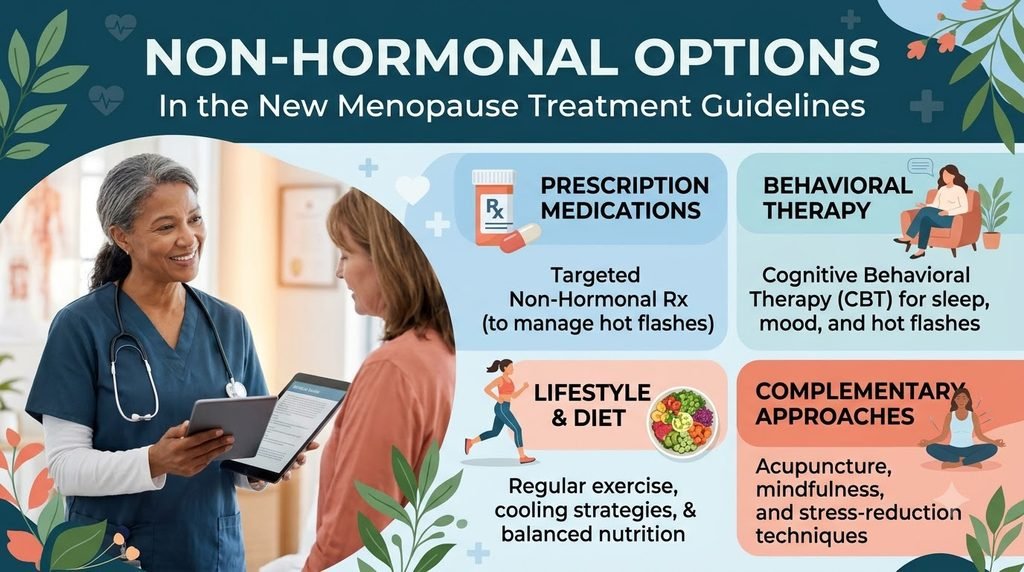
Non-Hormonal Options in the New Menopause Treatment Guidelines
Not everyone wants hormones. Others cannot take them. The good news is that the new menopause treatment guidelines also lay out non-hormonal options for hot flashes and related symptoms.
Prescription non-hormonal medicines
SSRIs and SNRIs. ACOG recommends these antidepressant-class medicines for menopausal symptoms in people who don’t want or can’t use hormones. They can help hot flashes. They can also help depressive symptoms.
These are used at doses and for reasons set by your doctor. Do not stop them suddenly without advice.
Neurokinin receptor antagonists. ACOG recommends this newer drug class for hot flashes and for sleep trouble linked to them. It is aimed at people who don’t want or can’t use hormones.
These medicines work on a brain pathway that helps control body temperature. Examples include fezolinetant and elinzanetant. Availability varies by country.
Some of these drugs need monitoring. For example, the fezolinetant label includes liver safety checks. Ask your doctor what tests apply to you.
Gabapentin. ACOG suggests gabapentin for hot flashes when other non-hormonal medicines don’t work or cause side effects. It is a later option, not a first one.
Common side effects can include drowsiness or dizziness. Your doctor can explain what to expect.
Non-drug approaches ACOG now supports
The new menopause treatment guidelines also give new recommendations for evidence-based non-drug options. ACOG “suggests” these. That wording means the evidence is helpful but not as strong as for hormones.
Cognitive behavioral therapy (CBT). CBT is suggested for hot flashes, sleep problems, and mood symptoms. It does not stop flashes from happening. It can change how much they bother you.
Mindfulness-based programs. These are suggested to improve sleep and mood symptoms. They often include breathing, body awareness, and calm attention practice.
Exercise. Physical activity is suggested to improve sleep and mood. Regular movement is also good for your bones, heart, and weight.
Clinical hypnosis. This is suggested to reduce hot flashes and to improve sleep and anxiety. It should be delivered by a trained professional.
Acupuncture. This is suggested to reduce hot flashes and to improve sleep and mood. Results vary from person to person.
Be realistic about the evidence
Reporting on the update notes that evidence for these non-drug tools is weaker than the evidence for hormone therapy. That is important to understand.
Weaker evidence does not mean useless. In the new menopause treatment guidelines, it simply means the proof is less firm. It means the average benefit may be smaller or less certain.
For many women, a combination works best. For example, a woman might use a medicine plus CBT and regular exercise.
What about supplements and plant estrogens?
Soy, black cohosh, and other plant-based products are very popular. But they are not part of the ACOG recommendations.
A clinician commenting on the guideline said ACOG discourages unproven remedies, including supplements and plant estrogens, for hot flashes.
Supplements are not tightly regulated. Quality and dose can vary. Some can also interact with medicines.
If you want to try one, tell your doctor first. Never treat “natural” as a promise of “safe.”
Simple lifestyle habits that may help
Lifestyle changes are not formal treatments in this guideline. But many women find them useful, and they are low risk.
- Dress in light layers you can remove quickly.
- Keep your bedroom cool and use breathable bedding.
- Notice your triggers. Some people find alcohol, caffeine, or spicy food sets off flashes.
- Aim for a balanced diet with plenty of vegetables, fruit, and protein.
- Move your body most days of the week.
- Keep a regular sleep schedule.
These steps will not replace medical care when symptoms are severe. But they can make daily life easier.
Diet and exercise: what to expect
Food will not switch off hot flashes. But a steady, balanced diet supports your heart, bones, and energy during midlife.
Exercise is the one lifestyle tool that appears in the new menopause treatment guidelines. ACOG suggests it to improve sleep and mood symptoms.
A sensible goal is regular movement you enjoy. Walking, swimming, cycling, and strength training are all fine choices. Ask your doctor what level is safe for you.
Strength work matters for bone health. Protein, calcium, and vitamin D also play a role. Your doctor can tell you how much you personally need.
Be wary of anyone who promises a “menopause diet” that cures symptoms. The new menopause treatment guidelines do not support food-based cures, and no single diet has strong proof for hot flashes.
What the New Menopause Treatment Guidelines Say About Mood
Mood is the area where the evidence is least clear. ACOG says there is not enough evidence to recommend for or against hormone therapy specifically to treat depressive symptoms.
If you have major depression, or if depression is your main symptom, ACOG says you should be treated using standard depression guidelines. That may include talk therapy, antidepressants, or both.
If you feel hopeless, or if you have thoughts of harming yourself, reach out right away. Contact your doctor, a local emergency service, or a crisis line in your country.
Mood changes during menopause are common. But you do not have to “just push through” them.
Health Screenings to Discuss During Menopause
Treatment for symptoms is only one part of midlife health. Screening helps catch problems early.
Please note that screening is not the focus of the new menopause treatment guidelines. The list below is general guidance. Ask your doctor how it applies to you.
Bone density
Estrogen drops at menopause, and bone loss can speed up. A bone density scan (DXA) measures bone strength.
Major US guidance recommends screening for women 65 and older. It also recommends screening for younger postmenopausal women who have higher risk factors.
Heart health
Heart disease risk rises after menopause. Ask your doctor to check your blood pressure at every visit.
Blood sugar checks are also a good idea, especially if you have risk factors like family history or excess weight.
Cholesterol and lipids
A lipid panel measures cholesterol and related fats. These numbers often shift in midlife.
How often you need testing depends on your results and risk level. Your clinician will guide you.
Breast screening
Mammograms are the standard breast screening test. Many guidelines start routine screening at age 40 or 50, and schedules differ by country and risk.
Talk to your doctor about the plan that fits your history. This matters even more if you are considering hormone therapy.
Cervical screening
Cervical screening continues after menopause. For many women with normal past results, testing is repeated every three to five years, depending on the test type, until about age 65.
Your doctor can confirm the schedule that applies to you.
Thyroid check
Thyroid problems can mimic menopause. Fatigue, mood changes, weight changes, and heart palpitations overlap.
A simple blood test can check your thyroid. It is worth asking about if your symptoms are unusual.
Mood and sleep check
Short questionnaires can help your clinician screen for depression and anxiety. Be honest about how you feel, even if it seems minor.
Also mention snoring, restless legs, or long pauses in breathing at night. These can point to other sleep problems that need separate care.
How to Prepare for Your Doctor Visit
The new menopause treatment guidelines work best when you show up ready to talk. A little prep makes a big difference.
Before the appointment
- Track your symptoms for two weeks. Note how often hot flashes happen and how they affect your sleep.
- Write down your medical history, including cancers, clots, and heart problems in you and your close family.
- List all medicines and supplements you take.
- Write down your top three goals. For example: “sleep through the night.”
Questions to ask
- Am I a good candidate for hormone therapy based on my history?
- Does my age or time since menopause change my options?
- What route and type of hormone would you suggest, and why?
- If I can’t use hormones, which non-hormonal option fits me best?
- What side effects should I watch for?
- When should we review this plan?
- Which screenings do I need now?
What to bring up even if it feels awkward
Mention vaginal dryness, pain during sex, urinary problems, and loss of interest in sex. These are common and treatable. They are also easy to overlook.
If your doctor brushes off your concerns, you can ask for a second opinion. A menopause-trained clinician may be available through your local health system.

Quick Guide: Which Path Might Fit You?
Use this as a conversation starter, not a diagnosis. The new menopause treatment guidelines support different paths for different people.
- You have bothersome hot flashes, no contraindications, and you are under 60 or within 10 years of menopause. Ask about systemic hormone therapy.
- You want to avoid hormones or cannot use them. Ask about an SSRI, SNRI, or neurokinin receptor antagonist.
- Other non-hormonal medicines did not work or caused side effects. Ask whether gabapentin makes sense.
- You prefer non-drug care. Ask about CBT, mindfulness, exercise, clinical hypnosis, or acupuncture.
- Your main problem is low mood. Ask for a full mood evaluation under standard depression care.
Whichever path you choose, plan a follow-up. The new menopause treatment guidelines stress ongoing review, not a one-time decision.
Real-World Scenarios
Every woman’s path is different. Here are a few examples of how the new menopause treatment guidelines might apply. These are illustrations, not medical advice.
Scenario 1: Age 52, severe night sweats, no health problems
She is two years past her last period and sleeping badly. She has no history of cancer, clots, or heart disease.
She is within the 10-year window. Under the new menopause treatment guidelines, hormone therapy is a strong, well-supported option to discuss. Her doctor may talk through patch, gel, or pill choices.
Scenario 2: Age 49, breast cancer survivor with hot flashes
Hormone therapy is usually off the table for her. The guideline points to non-hormonal options instead.
She and her care team might look at a neurokinin receptor antagonist, an SSRI or SNRI, or CBT. Her cancer team should be part of the decision, because some medicines can interact with cancer treatment.
Scenario 3: Age 63, hot flashes started a decade ago
She is past the age-60 mark and well beyond 10 years since menopause. The timing advice in the new menopause treatment guidelines applies to starting therapy, so this needs extra care.
Her doctor may weigh her heart and clot risk closely. Non-hormonal options may be considered first.
Scenario 4: Age 47, low mood and poor sleep, still having periods
Her symptoms may be linked to perimenopause. But they could also be depression, a thyroid problem, or a sleep disorder.
ACOG says depression should be managed under standard depression guidelines. A full evaluation comes before any treatment plan.
How to Judge Menopause Health News
Menopause is a hot topic online, and not every claim is reliable. A few habits can protect you.
First, check who wrote it. Look for a named medical reviewer and links to real guidelines, such as those from ACOG.
Second, look at the wording. Phrases like “cure,” “guaranteed,” or “doctors hate this” are red flags.
Third, compare it with the new menopause treatment guidelines. If a product claims results that the guideline does not support, be careful.
Fourth, check the date. Menopause advice has changed a lot, and older articles may be out of step with the new menopause treatment guidelines.
Finally, bring any claim to your own doctor. No article, including this one, can replace a visit that looks at your full history.
Common Myths About Menopause Treatment
Myth: “Hormone therapy is always dangerous.” The new menopause treatment guidelines show a more balanced view. Risk depends on your age, timing, health history, and the type of therapy.
Myth: “Natural remedies are always safer.” Supplements can still cause side effects or interact with medicines. ACOG does not recommend them for hot flashes.
Myth: “You just have to tough it out.” Menopause is natural, but suffering is not required. Effective treatments exist.
Myth: “If you’re over 60, you’re out of options.” You still have options. The choices and the level of caution just change.
Myth: “Hormone therapy is for everyone.” It is not. Some people have medical reasons to avoid it, and others simply prefer not to use it.
Frequently Asked Questions
What are the new menopause treatment guidelines?
They are ACOG’s Clinical Practice Guideline No. 13, published October 15, 2026. They give 17 recommendations and good practice points on treating hot flashes, night sweats, sleep problems, and mood symptoms.
Do the new menopause treatment guidelines recommend hormone therapy?
Yes, for the right people. ACOG strongly recommends systemic hormone therapy for hot flashes and related sleep trouble in people without contraindications. The decision should be made together with your doctor.
Is there a best age to start hormone therapy?
ACOG recommends starting before age 60 or within 10 years of the start of natural menopause. If you are outside that window, talk with your doctor about your personal risks and options.
What can I take if I can’t use hormones?
ACOG recommends SSRIs or SNRIs, or neurokinin receptor antagonists. It suggests gabapentin if other medicines don’t work or aren’t tolerated. Non-drug options like CBT, mindfulness, exercise, hypnosis, and acupuncture are also suggested.
Do supplements like soy or black cohosh work?
ACOG does not recommend them for hot flashes. Evidence is limited, and quality varies. Check with your doctor before taking any supplement.
How long can I stay on hormone therapy?
There is no fixed time limit. ACOG says the decision about stopping should be individual and based on ongoing review of risks and benefits.
Do the guidelines say anything about screening?
The ACOG guideline focuses on symptom treatment. Routine screening, such as bone density, blood pressure, cholesterol, breast, and cervical checks, is still important and should be discussed with your clinician.
Where can I learn more from trusted sources?
Start with ACOG for professional guidance. For patient-friendly information, see the NIH menopause health information and the MedlinePlus menopause overview.
Conclusion: What to Do Next
The new menopause treatment guidelines are a big step forward. They confirm that hormone therapy is a strong, evidence-backed option for many women. They also give real choices to women who can’t or don’t want to use hormones.
The main message is simple: your treatment should be personal. That is the heart of the new menopause treatment guidelines. Age, timing, health history, and your own goals all matter.
Here is your next step. Write down your top symptoms, review the questions above, and book a visit with your doctor. Ask how the new menopause treatment guidelines apply to you.
Share this guide with a friend who is struggling with symptoms. The more women who understand the new menopause treatment guidelines, the easier it is to ask for good care.
You deserve care that takes your symptoms seriously. With the right plan, many women find real relief.