The Atlantic salmon, scientifically known as Salmo salar, is often hailed as the “King of Fish.” This title isn’t just about its culinary status; it reflects one of the most demanding and sophisticated biological journeys in the natural world. Understanding the salmo salar lifecycle provides a fascinating window into how a single salmonid species survives across diverse aquatic ecosystems.
From the cool, bubbling freshwater streams of the Northern Hemisphere to the vast, salty expanses of the North Atlantic, these creatures undergo radical physical changes to adapt to their surroundings. In this guide, we explore every stage of this incredible odyssey, from a tiny egg hidden in the gravel to a powerful adult returning home.
The Beginning: Spawning and the Redd
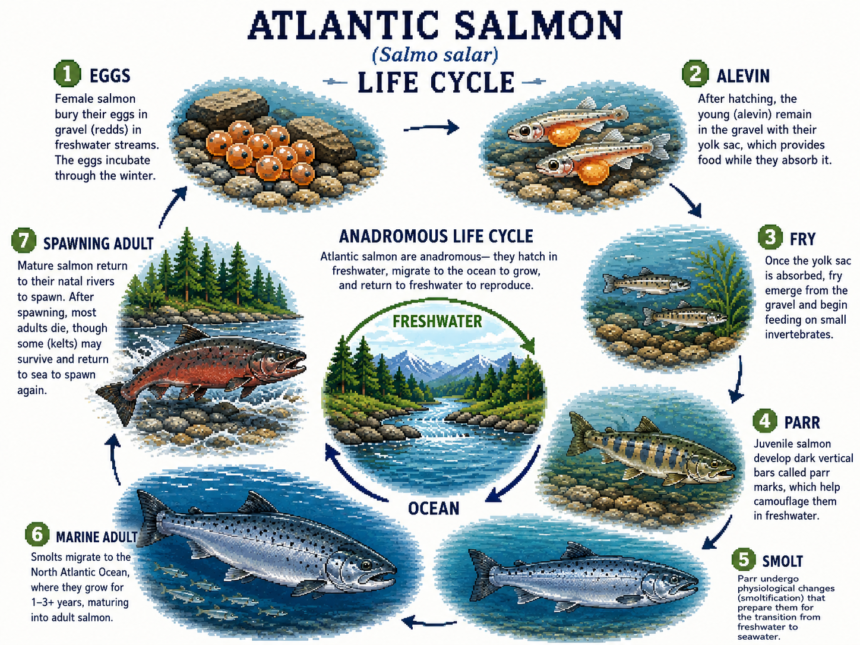
The salmo salar lifecycle begins in late autumn or winter. Mature adults travel thousands of miles to reach their original spawning grounds. The female utilises her tail to create a series of depressions in the gravel substrate, a process known as redd construction.
Once the eggs are deposited, the male provides milt fertilization. These eggs will stay buried in the cold, oxygen-rich water for several months, protected from predators and the harsh winter current. You can learn more about the biological complexity of these habitats at Nature.com.
1. Alevins: The Hidden Stage
In early spring, the eggs hatch into the alevin stage. At this point, they do not look like fish; they are tiny, translucent creatures with a large yolk sac attached to their bellies. This sac provides all the nutrients they need, allowing them to remain hidden within the safety of the gravel. According to research on ScienceDirect, this stage is critical for the development of vital organs.
2. Fry: Taking the First Swim
Once the yolk sac is absorbed, the tiny fish emerge from the gravel as “fry.” This is a high-risk period where they must find food—mostly microscopic larvae—while avoiding predators. They begin to develop parr marks, which are dark vertical stripes that provide essential camouflage against the riverbed. Organizations like the Wildlife Trusts monitor these populations to ensure river health.
The Growing Years: Parr and Smoltification
As the fry grow, they become “parr.” They may stay in their home river for one to four years, depending on water temperature and food availability. During this time, they are highly territorial, defending their small patch of the stream to ensure they get enough nutrients to grow.
The Transformation: Smoltification
When the parr reach a certain size (usually 12–15 cm), a remarkable biological “reset” occurs called the smoltification process. Their physiology changes to prepare for life in the ocean. Their parr marks fade, replaced by a silvery sheen that provides camouflage in the open sea. This process is documented extensively by the FAO.
The young salmon, now called “smolts,” migrate downstream toward the estuarine environment. This transition zone where the river meets the sea is vital for their acclimation to saltwater. For more on the importance of these habitats, visit the Marine Conservation Society.
Life at Sea: The Marine Migration
The marine migration is the growth phase of the salmo salar lifecycle. Atlantic salmon are anadromous fish, meaning they spend most of their adult life at sea but return to freshwater to breed. During their time in the North Atlantic, they feed voraciously on crustaceans and smaller fish, often travelling as far as the waters of Greenland and the Faroe Islands.
This period can last from one to three years. Those that return after one year are known as “grilse,” while those that stay longer grow significantly larger. The North Atlantic Salmon Conservation Organization (NASCO) tracks these movements to manage international fishing quotas.
Comparing the Environments
The transition between freshwater and saltwater requires significant cellular changes. The following table highlights the differences between these two life phases:
| Feature | Freshwater Phase (Parr) | Saltwater Phase (Adult) |
|---|---|---|
| Primary Goal | Growth and survival | Rapid weight gain and maturation |
| Appearance | Camouflaged (parr marks) | Silvery/Iridescent |
| Diet | Insects and larvae | Capelin, herring, and shrimp |
| Osmoregulation | Absorb salts through gills | Excrete excess salts |
The Final Stretch: The Return Journey
Perhaps the most mysterious aspect of the salmo salar lifecycle is the homing instinct. Using a combination of the Earth’s magnetic field and a highly developed sense of smell, the salmon find the exact river where they were born. This journey is incredibly taxing; once they enter freshwater, they stop eating entirely, relying on stored fat for energy.
The National Geographic has featured numerous documentaries on this “death march,” as many salmon do not survive the journey or the subsequent spawning. You can find detailed maps of these migratory routes at Smithsonian Magazine.
The Spawning Act
Once they reach their destination, the cycle begins anew. Interestingly, unlike Pacific salmon, Atlantic salmon do not always die after spawning. Some, known as “kelts,” manage to return to the sea, though the survival rate is low. Information on the genetics of this survival can be found in PNAS.
Threats and Conservation
The salmo salar lifecycle is currently under threat from various factors. Climate change is warming river waters, while physical barriers like dams prevent salmon from reaching their spawning grounds. Pollution and overfishing also play a role.
- Habitat Loss: Urbanisation near riverbanks destroys nesting sites.
- Climate Change: Rising sea temperatures shift food sources.
- Aquaculture: Sea lice from fish farms can infect wild populations.
Conservation groups like the WWF UK and the Salmon & Trout Conservation work tirelessly to restore river systems. Furthermore, data from the Natural History Museum and FishBase help scientists understand how to protect these vital salmonid species.
Governmental agencies also provide resources on how the public can help, such as the Environment Agency in the UK. For those interested in the latest peer-reviewed studies on salmon health, Frontiers in Marine Science is an excellent resource.
Frequently Asked Questions (FAQs)
How long is the Salmo salar lifecycle?
The entire cycle typically lasts between 3 to 8 years. This includes 1 to 4 years in freshwater as parr, followed by 1 to 3 years at sea, and finally the return migration to spawn.
Do all Atlantic salmon die after spawning?
No. While many die from exhaustion, a small percentage (around 5-10%) survive to become “kelts.” These fish return to the sea to recover and may return to spawn again in subsequent years.
Why is the homing instinct important?
The homing instinct ensures that salmon return to a river that has already proven to be a successful nursery for their ancestors. This increases the chances of survival for the next generation of eggs in the gravel substrate.
The Bottom Line
The salmo salar lifecycle is a testament to the wonder of evolution. From the intricate smoltification process to the epic marine migration, every step is a finely tuned survival strategy. By protecting our aquatic ecosystems and removing barriers to migration, we can ensure that the “King of Fish” continues its legendary journey for generations to come.