Key Takeaways
- CDC data as of Sept. 29, 2026 show 987 human cases in 43 states, including 750 neuroinvasive cases.
- About 8 in 10 infected people have no symptoms. About 1 in 5 get a fever-type illness. About 1 in 150 develop severe brain or spinal cord disease.
- Peak season runs late summer into early fall, so risk is not over yet.
- There is no human vaccine and no specific antiviral. Prevention is your best tool.
- Use an EPA-registered repellent such as DEET, cover up at dusk and dawn, and drain standing water.
- Report dead birds to your local or state health department. Never touch them with bare hands.
- Sudden stiff neck, confusion, or weakness is an emergency. Go to the ER.
One bite from a tiny mosquito can change a summer. For most people, it changes nothing. For a small group, it can mean weeks in the hospital.
That is why the West Nile virus 2026 US cases numbers deserve your attention. This season started earlier than any in about 20 years. This guide gives you the latest CDC figures, the symptoms to watch for, and the steps that lower your risk.
West Nile Virus 2026 US Cases: The Latest Snapshot
Let’s start with the numbers. All figures below come from CDC and state health departments, and every one has a date. Case counts change fast, so treat them as a snapshot.
National totals
CDC tracks West Nile cases through a system called ArboNET. State and local health departments report cases to it. CDC’s West Nile virus current-year data page says the data are preliminary and updated every one to two weeks from June through December.
The most recent national totals I could verify are from Sept. 29, 2026. CDC reported 987 total cases in 43 states, including 750 neuroinvasive cases. The CDC page itself was updated on Oct. 6, 2026, and it may show higher numbers now.
I could not confirm a current national death count for 2026. Please check the CDC page for the latest figure. I will not guess one here.
How the season built up
This year did not creep in quietly. CDC said the season had its earliest start on record in the modern surveillance era. At least 48 cases had been reported by June 30, 2026, and 38 of them were severe neuroinvasive cases.
Since 2004, the usual number by the end of June has been about 10 cases. So the June count ran nearly five times above average.
Here is how reported totals grew through the season:
| CDC data date | Total human cases | Neuroinvasive cases | States reporting |
|---|---|---|---|
| June 30, 2026 | 48 | 38 | 23 states with activity |
| Aug. 18, 2026 | 222 | 156 | 32 |
| Sept. 8, 2026 | 504 | 363 | 41 |
| Sept. 29, 2026 | 987 | 750 | 43 |
Sources: CDC statement (June 30); CDC ArboNET totals as reported by Newsweek (Aug. 18) and Medical Daily (Sept. 8); CDC figures as reported by Outbreak News Today (Sept. 29). Always confirm on the CDC page.
The jump from early September to late September is big. Part of that is real spread. Part of it is reporting lag, because labs and doctors take time to confirm and report cases.
The neuroinvasive share
Here is a striking detail. About 76% of the cases reported by Sept. 29 were neuroinvasive (750 of 987). That is the severe form that affects the brain or spinal cord.
That does not mean 76% of infected people get severely ill. Far from it. Doctors catch severe cases more often because those patients land in the hospital and get tested.
CDC says this plainly in its data notes. Mild cases are more likely to go unreported than severe ones. So the neuroinvasive share looks high, while the true number of mild infections stays hidden.
The hardest-hit states
Two states have led the count this year.
- California. California has reported the most cases nationally, at 211. That figure was part of the Sept. 29 CDC totals.
- Arizona. Arizona led early in the season. As of Aug. 18, Arizona had 76 cases, Texas had 31, and California had 29. California then surged past both.
Local numbers show the pattern too. A late-September report said Los Angeles County had 135 cases, and 120 of them were neuroinvasive.
New Jersey is a good example of how late-season activity can build. The state health department reported 26 human cases and one death. Per Gothamist, 19 of those cases caused neurological illness, and 69% were in people over 60. The state said about half its cases came in the last week of August and in September.
Cases in your state may differ. Check your state health department’s page for the most current local count.
How 2026 compares with recent years
The comparison is mixed. It depends on which part of the season you look at.
- Early season: The 2026 start was historic. CDC called it the earliest start and the highest early count since 2004.
- Early September: Totals actually trailed 2025. At the Sept. 8 mark, CDC had 504 cases. Reports said 771 cases had been counted by the same point in 2025.
- Severity share: The neuroinvasive share was higher in 2026. At that same early-September point, about 72% of cases were neuroinvasive, versus roughly 64% in 2025.
So is 2026 a record year? Not yet, and not on the numbers I could verify. Final 2025 totals are one benchmark. One data compilation lists 2025 at 2,167 cases and 177 deaths, but that came from a secondary source. Confirm final yearly totals on CDC’s site.
CDC says West Nile causes several thousand cases and about 100 deaths in an average year. That puts 2026 in context. This is a serious season, but the story is still unfolding.
A word about data limits
CDC lists several limits on its numbers:
- Doctors must think of West Nile, order the right test, and report it.
- Mild cases are underreported more than severe ones.
- Cases are counted by county of residence, not where the bite happened.
- Animal surveillance varies by state. No reports does not mean no risk.
- States may publish on a different schedule than CDC.
Keep these in mind when you read any headline number, including mine.
What Is West Nile Virus?
West Nile virus is a virus that spreads through mosquito bites. CDC calls it the leading cause of mosquito-borne disease in the contiguous United States.
The virus was first found in the US in New York in 1999. Since then, it has spread to every state in the lower 48. It is now a regular part of summer and fall across the country.
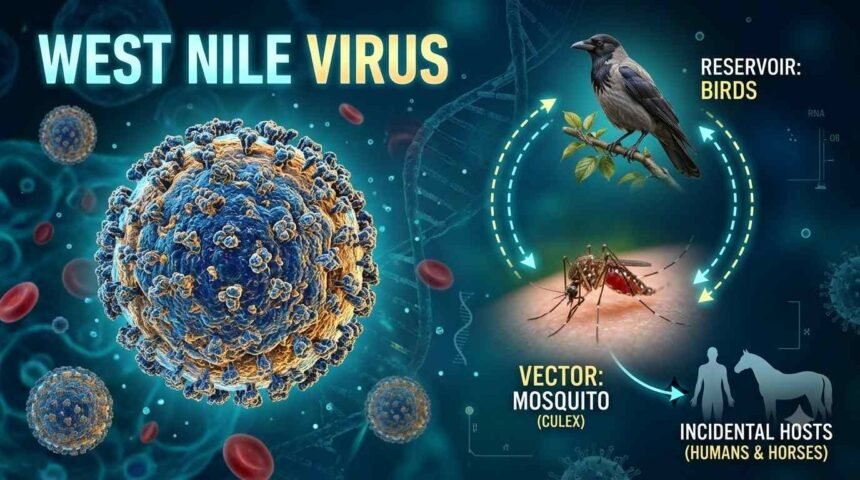
The virus lives mainly in birds. Mosquitoes pick it up from infected birds, then pass it on to people, horses, and other animals.
Most people never feel sick. Some get a flu-like illness. A small group develops serious brain or nerve problems.
How West Nile Virus Spreads
Mosquitoes and birds: the main cycle
Here is the basic chain:
- A mosquito bites an infected bird.
- The virus grows inside the mosquito.
- That mosquito bites a person, horse, or another animal.
- The new host may get infected.
The main carriers are Culex mosquitoes. These are common house mosquitoes. They breed in small pools of stagnant water, like clogged gutters, old tires, and bird baths.
Culex mosquitoes bite mostly from dusk to dawn. That timing shapes the prevention tips later in this article.
People are “dead-end hosts.” Our blood carries too little virus to infect other mosquitoes. So we catch it from mosquitoes, but we do not usually pass it back to them.
Rare ways it can spread
West Nile can spread in a few uncommon ways:
- Blood transfusions
- Organ transplants
- From mother to baby during pregnancy or breastfeeding (very rare)
The US blood supply is screened for the virus. Health departments sometimes report “asymptomatic blood donors” who test positive, which shows the screening works.
How it does not spread
You cannot catch West Nile from casual contact with an infected person. Hugging, touching, or sharing a room will not spread it. CDC also says you do not catch it from coughing or sneezing.
Most West Nile Infections Are Silent
This is the most important thing to know about the virus. Most people who get infected never know it.
About 8 in 10 infected people have no symptoms at all. They fight off the virus without ever feeling sick. Many never find out they were infected.
That is why the case counts above are only the tip of the iceberg. One report quoting CDC experts estimates that reported cases represent about one in 30 actual infections. For every case you see in the data, many more infections went unnoticed.
Here is the full picture of what happens after infection:
| Outcome | Rough share of infected people |
|---|---|
| No symptoms | About 8 in 10 (80%) |
| Fever-type illness (“West Nile fever”) | About 1 in 5 (20%) |
| Neuroinvasive disease | About 1 in 150 (under 1%) |
The odds of serious illness for any one bite are low. But millions of mosquito bites happen each summer. A low risk across millions of bites still adds up to thousands of cases.
West Nile Virus Symptoms
Knowing the symptoms helps you act fast. CDC explains the full range on its West Nile symptoms page.
Symptoms usually show up 2 to 6 days after a mosquito bite. They can appear as late as 14 days after.
Fever-type illness (about 1 in 5 people)
This milder form can feel like a bad flu. Common signs include:
- Fever
- Headache
- Body aches and joint pain
- Fatigue
- Nausea or vomiting
- Diarrhea
- A skin rash, sometimes on the chest, back, or stomach
- Swollen glands
Most people recover fully. But the tiredness and weakness can last for weeks or even months. This can be frustrating, even when the illness itself was “mild.”
Neuroinvasive disease (about 1 in 150 people)
This is the serious form. The virus reaches the brain, the spinal cord, or the tissue around them. Doctors name it based on where the infection settles:
- Meningitis: swelling of the tissue around the brain and spinal cord
- Encephalitis: swelling of the brain itself
- Acute flaccid paralysis (also called West Nile poliomyelitis): sudden muscle weakness or paralysis, often on one side
Warning signs of neuroinvasive disease include:
- High fever
- Severe headache
- Stiff neck
- Confusion or trouble thinking
- Sleepiness or hard to wake up
- Tremors or muscle jerks
- Seizures
- Sudden muscle weakness or loss of movement
- Vision loss or numbness (less common)
Neuroinvasive disease can be deadly. Survivors can face long-term effects, like memory trouble, weakness, and tiredness. Recovery can take months.
When to See a Doctor or Go to the ER
Not every fever after a mosquito bite is West Nile. But some signs mean you should not wait.
Go to the ER or call 911 if you have:
- A stiff neck with a high fever
- Sudden confusion or odd behavior
- A seizure
- Sudden weakness in an arm or leg, or trouble moving
- A severe headache that is new and does not ease up
- Trouble staying awake
Call your doctor soon if you have:
- A fever and body aches after time outdoors in mosquito season
- A fever with a rash
- Flu-like symptoms that last longer than a few days
- Symptoms that start to get worse instead of better
Tell the doctor about recent mosquito bites and where you have been. If West Nile is circulating in your area, say so. That context helps them decide on testing.
If you are over 60 or have a weak immune system, lean toward calling sooner. Your risk of serious illness is higher.
Who Is at Higher Risk?
Anyone can get West Nile virus. But some people are more likely to become seriously ill.
Higher risk of severe illness
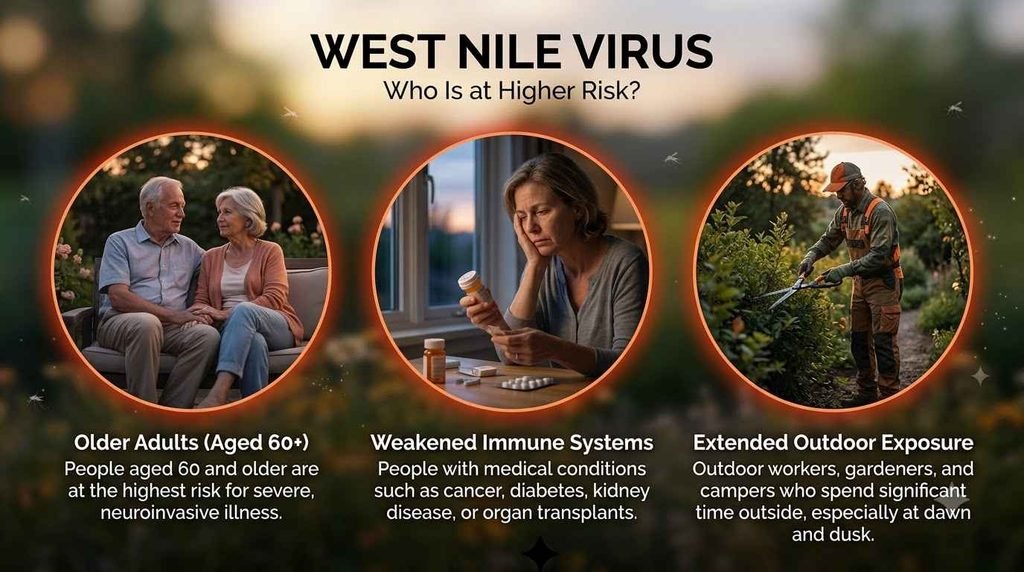
- Adults 60 and older. Risk rises with age. CDC notes that people 65 and older are much more likely to develop neuroinvasive disease than younger adults.
- People with weakened immune systems. This includes organ transplant recipients and people on immune-suppressing drugs.
- People with chronic conditions. Examples are diabetes, high blood pressure, kidney disease, and cancer.
Higher risk of getting bitten
- People who work outdoors, like farmers, landscapers, and construction workers
- Gardeners, hikers, and campers
- People who live near standing water, woods, or storm drains
- Evening joggers and anyone out at dusk and dawn
Age also showed up in this year’s local data. In New Jersey, state officials said about 69% of cases were in people over 60. That matches the national pattern.
Young, healthy people can still get very sick. They are just less likely to. Do not skip prevention because you feel low risk.
Peak Season: Why Late Summer and Early Fall Matter
West Nile season in most of the US runs from early summer into fall. The peak usually comes in late August and September.
There are three reasons for this timing.
- Warm weather speeds up the virus. Heat helps the virus grow faster inside mosquitoes.
- Mosquito numbers build over the summer. Populations grow, and more of them carry the virus by late season.
- Illness shows up with a delay. People bitten in August may not get tested and reported until September or October.
That last point explains why case counts keep rising into the fall, even after the bite risk starts to drop. It also explains why you should not relax in October. Reporting lags behind real-world risk.
Risk generally ends when the first hard frost kills the adult mosquitoes. In warmer states like Arizona, Texas, and southern California, mosquito activity can last much longer. Check your local forecast and health advisories.
A bite on a warm October evening can still carry risk. Keep your guard up until local officials say the season has ended or cold weather arrives.
Diagnosis and Treatment
How doctors diagnose West Nile
There is no way to diagnose West Nile from symptoms alone. Many illnesses look similar. Doctors need a lab test.
The usual test checks blood or spinal fluid for antibodies the body makes against the virus. A doctor may order a spinal tap (lumbar puncture) if they suspect meningitis or encephalitis. They may also order brain imaging to rule out other causes.
CDC’s guidance for clinicians is on its West Nile treatment and prevention page for health care providers.
Treatment: supportive care only
Here is the hard truth. There is no specific antiviral drug for West Nile virus, and there is no human vaccine.
Treatment focuses on supporting your body while it fights the virus:
- Mild illness: Rest, fluids, and over-the-counter pain relievers for fever and aches. Ask your doctor which medicine is safe for you.
- Severe illness: Hospital care. This can include IV fluids, pain control, help with breathing, and prevention of other infections.
Most people with mild illness get better on their own. People with neuroinvasive disease often need hospital care and long recovery. Some need rehab to regain strength.
Researchers are working on vaccines, but none are approved for people. That is why prevention matters so much.
West Nile Virus Prevention
The best defense is to avoid mosquito bites. The steps are simple and cheap. CDC lays them out on its West Nile prevention page.
Use an EPA-registered repellent
Repellent is the single most useful tool. Look for the EPA registration on the label. Registered products have been tested for safety and for how well they work.
CDC lists these active ingredients:
- DEET
- Picaridin
- IR3535
- Oil of lemon eucalyptus (OLE)
- Para-menthane-diol (PMD)
- 2-undecanone
DEET has the longest track record. Higher percentages last longer, not stronger. Always follow the label.
A few repellent tips:
- Apply it to exposed skin and clothing. Do not spray under clothes.
- Spray your hands first, then rub on your face. Do not spray directly on your face.
- Avoid cuts, irritated skin, eyes, and mouth.
- Put sunscreen on first. Let it dry, then apply repellent.
- Do not use oil of lemon eucalyptus or PMD on children under 3 years old.
- Wash repellent off with soap and water when you come indoors.
Dress to block bites
Mosquitoes bite through thin fabric, so thicker is better.
- Wear long sleeves and long pants outdoors.
- Choose loose-fitting clothes. Tight clothes let mosquitoes bite through.
- Tuck pants into socks if you are in a heavily wooded or wet area.
- Consider clothing and gear treated with permethrin. Follow the label, and do not apply it to skin.
Avoid dusk and dawn
Culex mosquitoes are most active in the evening and early morning. If you can, move activities indoors during those hours.
If you must be outside, use repellent and cover up. Plan evening walks, yard work, and kids’ play for midday when you can.
Remove standing water
Mosquitoes need water to breed. Even a bottle cap of water can host larvae. Cut off their nursery with a weekly sweep of your yard.
Use this quick routine:
- Empty flowerpot saucers, buckets, and wheelbarrows.
- Clean out gutters so water drains.
- Dump water from tires, tarps, and toys.
- Change bird bath water at least weekly and scrub it.
- Cover rain barrels with fine mesh.
- Fill low spots in your yard where water pools.
- Keep pool covers tight and drained.
Ask neighbors to do the same. Mosquitoes do not stop at fence lines.
Fix your window and door screens
Good screens keep mosquitoes out of your home.
- Check every window and door screen for holes.
- Patch or replace damaged screens.
- Keep doors closed.
- Use air conditioning when you can. Mosquitoes avoid cool, dry rooms.
Put it all together: a quick daily plan
- Check your local health department for West Nile activity.
- Apply EPA-registered repellent before heading out.
- Wear long sleeves and pants after sunset.
- Skip evening outdoor time when you can.
- Do a 10-minute water check around your home each week.
- Keep screens in good shape.
None of this is complicated. Done together, these habits cut your risk a lot.
Dead Bird Reporting: What to Do
Birds are the virus’s main reservoir. When a bird dies from West Nile, it often signals that the virus is active nearby. That makes dead bird reporting a useful early warning tool for health officials.
Crows, blue jays, ravens, magpies, and hawks are especially sensitive to the virus. A cluster of dead birds in one area is a red flag.
What to do if you find a dead bird
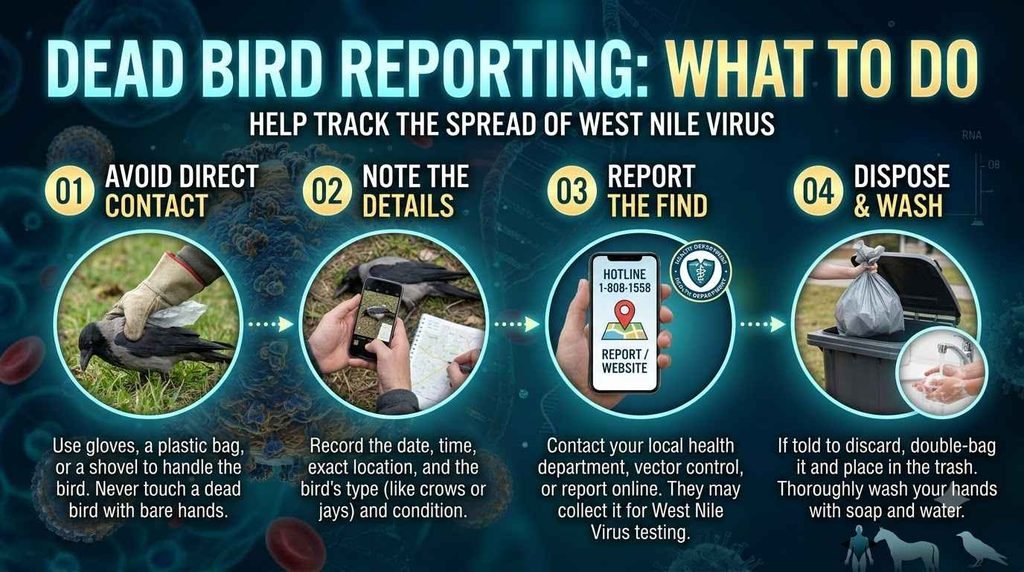
- Do not touch it with bare hands. Never pick it up without protection.
- Call your local or state health department. Many have a dead bird hotline or online form. If you are unsure who to call, start with your county health department.
- Note the details. Write down the species if you know it, the date, the location, and the bird’s condition.
- Follow their instructions. Some agencies want the bird tested. Others only log the report.
Not all agencies collect every bird. Many only accept fresh birds, and some limit testing based on local activity. A health department may simply log your report and tell you to dispose of the bird.
If you are told to dispose of the bird yourself
- Wear disposable gloves, or turn a plastic bag inside out over your hand.
- Place the bird in a sealed plastic bag.
- Put that bag inside a second bag.
- Throw it in your trash, following local rules.
- Wash your hands well with soap and water, even if you wore gloves.
Keep pets and children away from the bird.
A note on risk
Dead birds are not a direct source of infection for most people. The risk comes from mosquitoes that bit the bird. But it is still smart to avoid bare-hand contact with any wild animal.
One more thing: a dead bird does not always mean West Nile. Birds die from many causes. Your report simply helps officials decide.
Pets and Horses
West Nile affects animals too, but the risk differs by species.
Dogs and cats
Dogs and cats can get infected, but they rarely get sick. Most never show symptoms. Still, if your pet seems unwell after mosquito exposure, call your vet.
Do not use human repellent on pets unless the label says it is safe. Some products, like those with permethrin, are toxic to cats. Ask your vet for pet-safe options.
Horses
Horses are much more vulnerable. The virus can cause serious nerve illness in them. Signs include stumbling, weakness, muscle twitching, fever, and trouble standing.
A horse vaccine exists. Horse owners should talk to a veterinarian about it, especially before and during mosquito season. Also remove standing water around stables and use fly sheets and horse-safe repellents.
Report any sick horse to your vet right away. Many states also track horse cases.
How West Nile Compares With Other Mosquito-Borne Diseases
This article focuses on West Nile, but a quick comparison helps with context.
In the contiguous US, West Nile is the most common mosquito-borne disease. Most other mosquito-borne diseases here are rarer, or are mainly linked to travel abroad.
One key difference is that some others have vaccines or targeted treatments for certain groups. West Nile has neither for humans. That is why the prevention steps above matter so much.
Medical Disclaimer
This article is for general information only. It is not medical advice, diagnosis, or treatment. It does not replace care from a licensed health professional.
If you think you or someone you love has West Nile virus, contact a doctor. If you have severe symptoms like confusion, a stiff neck, seizures, or sudden weakness, call 911 or go to the nearest emergency room.
Case numbers in this article come from CDC and state health departments and change often. For the latest official data, visit the CDC’s West Nile page or your state health department.
Frequently Asked Questions
How many West Nile virus cases are there in the US in 2026?
As of Sept. 29, 2026, CDC data show 987 human cases in 43 states, including 750 neuroinvasive cases. These numbers are preliminary and rise as states report new cases. Check the CDC’s current-year data page for the latest count.
Which states have the most West Nile virus cases in 2026?
California has reported the most cases, at 211 as of the Sept. 29 CDC totals. Arizona led early in the season, and Texas also reported many cases. Counts shift weekly, so check your state’s health department.
What are the first symptoms of West Nile virus?
Early symptoms are often fever, headache, body aches, fatigue, nausea, and sometimes a rash. They usually start 2 to 6 days after a mosquito bite, and up to 14 days in some cases. Most people with symptoms have a milder, flu-like illness.
How many people with West Nile virus get sick?
About 8 in 10 infected people have no symptoms. About 1 in 5 gets a fever-type illness. About 1 in 150 develops serious neuroinvasive disease, like meningitis or encephalitis.
Is there a cure or vaccine for West Nile virus?
No. There is no specific antiviral drug and no approved human vaccine. Treatment is supportive care, like rest, fluids, and pain relief. Severe cases need hospital care. A vaccine does exist for horses.
When is West Nile season in the US?
Season usually runs from early summer to fall. The peak is often late August through September. In warmer states, activity can last longer. Cases keep being reported into the fall because of reporting delays.
What is the best mosquito repellent for West Nile virus?
Use an EPA-registered repellent. CDC lists DEET, picaridin, IR3535, oil of lemon eucalyptus, para-menthane-diol, and 2-undecanone. Follow the label, and avoid oil of lemon eucalyptus and PMD products on children under 3.
What should I do if I find a dead bird?
Do not touch it with bare hands. Call your local or state health department, and report the location and date. They will tell you whether they want the bird or whether you should dispose of it. If told to, use gloves or a plastic bag, seal the bird in a bag, throw it away, and wash your hands.
Conclusion: What the West Nile Virus 2026 US Cases Mean for You
The West Nile virus 2026 US cases tell a clear story. This season started earlier than any in about 20 years, and CDC data show 987 cases in 43 states as of Sept. 29, 2026. Most of those reported cases were the severe, neuroinvasive kind.
But the odds for any one person stay low. Most infections are silent, and only about 1 in 150 turns into serious illness. The risk is higher if you are over 60 or have a weak immune system.
Your takeaway is simple. Fall is still mosquito season, so keep up your habits until a hard frost arrives. Use an EPA-registered repellent, cover up at dusk and dawn, drain standing water, and fix your screens. Report dead birds to your health department.
And if a fever comes with confusion, a stiff neck, or sudden weakness, do not wait. Go to the ER. For the newest numbers, bookmark the CDC’s current-year West Nile data page.
Data sources: CDC ArboNET current-year data (page updated Oct. 6, 2026; verified national totals as of Sept. 29, 2026); CDC statement of June 30, 2026; New Jersey Department of Health weekly update (early Oct. 2026). Figures change often. Always confirm on the CDC page.