


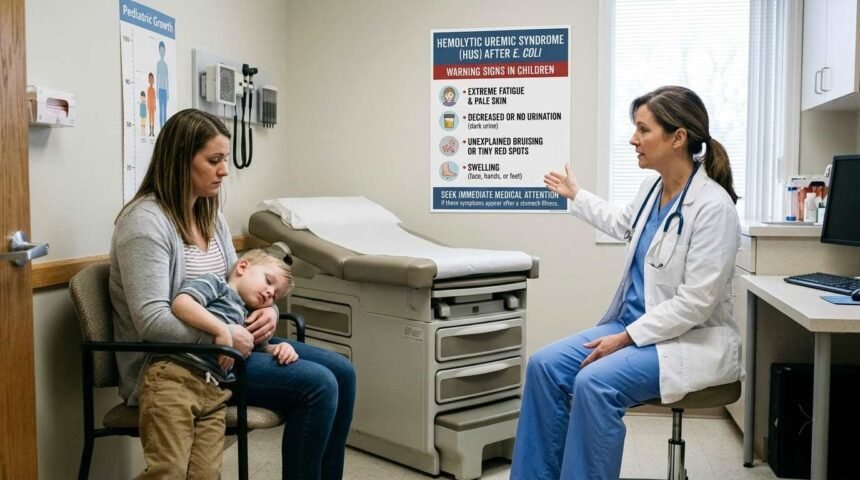
If your child has bloody diarrhea and is peeing much less than usual, go to the emergency room now. Do not wait for morning. Do not wait for a clinic slot. These are the two most important E coli HUS symptoms children can show, and together they can mean the kidneys are in danger.
This guide explains hemolytic uremic syndrome (HUS) in plain words. You will learn how it starts after an E. coli infection, which signs to watch for, what to avoid, and how doctors treat it. Every section ties back to one goal: helping you spot E coli HUS symptoms children can show. The CDC overview of E. coli infection is our primary source.
The emergency rule every parent should know
- Bloody diarrhea + decreased urine = emergency. Go to the ER immediately.
- Do NOT give antimotility drugs such as loperamide (Imodium).
- Avoid antibiotics and NSAIDs unless a doctor directs you to use them.
What is HUS and how E. coli (STEC) causes it
Hemolytic uremic syndrome, or HUS, is a serious condition that harms the blood and the kidneys. In children, it most often follows a gut infection with certain E. coli germs.
Not all E. coli is dangerous. Many types live in healthy guts. The harmful group is called Shiga toxin-producing E. coli, or STEC. The best-known type is E. coli O157:H7.
A STEC infection makes a poison called Shiga toxin. In the gut, this toxin damages the bowel lining. That is why the diarrhea often turns bloody.
In some children, the toxin then enters the bloodstream. It attacks the tiny blood vessels in the kidneys. That is how a stomach bug becomes a kidney emergency.
The three problems that define HUS
Doctors diagnose HUS when three things happen together:
- Red blood cells break apart. This is called hemolytic anemia. Your child may look pale and tired.
- Platelets drop. Platelets help blood clot. Low levels cause easy bruising.
- The kidneys stop filtering well. Waste and extra fluid build up in the body.
Broken red cells and tiny clots can clog the kidney’s filters. This can lead to kidney failure in children within days. That speed is why early action matters so much.
Why HUS in kids moves so fast
A child’s kidneys are small. They have little reserve when the filters clog. A few days of damage can be enough to stop them from working.
That is also why the E coli HUS symptoms children develop can seem sudden. One day your child has diarrhea. A few days later, the face looks puffy and the diapers stay dry. Parents who know this pattern can step in before the kidneys are badly hurt.
How common is HUS after a STEC infection?
Most children with a STEC infection get better without HUS. The CDC estimates that roughly 5 to 10 percent of people diagnosed with a STEC infection develop HUS.
That number sounds small. But HUS in kids is one of the most common causes of sudden kidney failure in young children.
You cannot tell at home which child will develop HUS. So every child with bloody diarrhea needs a medical check. Knowing the E coli HUS symptoms children develop helps you act at the right moment.
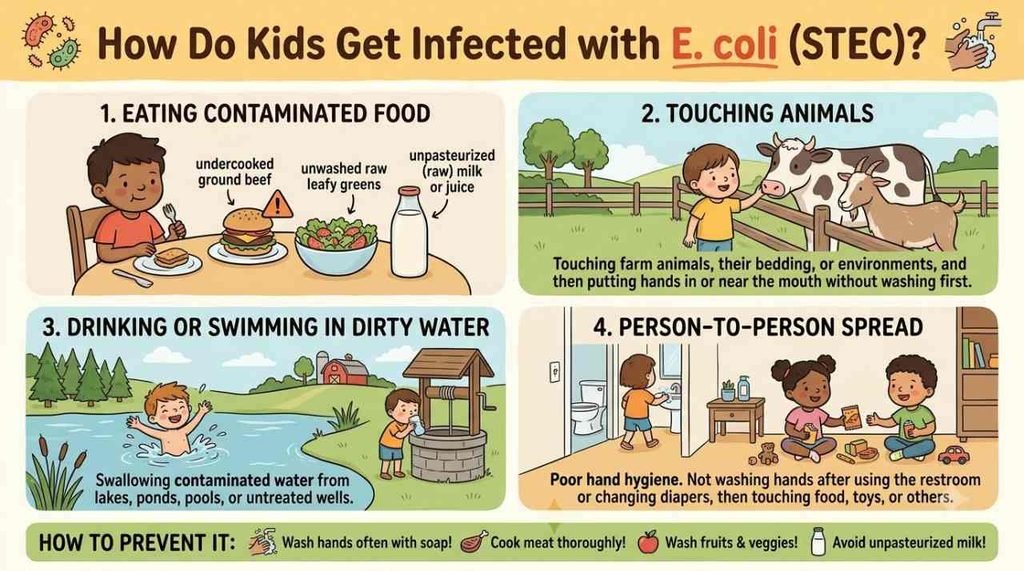
How kids get infected with E. coli (STEC)
STEC lives in the guts of cattle and some other animals. It spreads through their feces. A very small amount can make a child sick.
Children catch it in several ways. Here are the main sources behind the infections that lead to E coli HUS symptoms children can later show.
Undercooked beef
Ground beef is a common source. Germs from the gut can mix into the meat during processing. When meat is ground, the germs spread through the whole patty.
A burger that is pink in the middle may still carry live bacteria. Color alone does not tell you it is safe. A food thermometer does.
Raw milk and raw-milk products
Raw milk has not been pasteurized. Pasteurization is a heat step that kills harmful germs. Raw milk, and cheese made from it, can carry STEC.
Young children are at higher risk from these foods. Their bodies cannot fight the infection as well. That raises the odds of E coli HUS symptoms children in this age range may face.
Unwashed produce
Leafy greens, sprouts, and other raw produce can pick up STEC from soil or water. Animal waste can reach fields through runoff. Rinsing helps, but it may not remove every germ.
Water
Children can swallow STEC in untreated drinking water. They can also swallow it in lakes, ponds, and poorly kept pools or splash pads. A few mouthfuls are enough.
Petting zoos and farms
Cows, sheep, goats, and their pens can carry STEC. Children touch the animals, then touch their mouths. Hands, shoes, and strollers can carry germs home.
Person-to-person spread
STEC also spreads from child to child. This happens at daycare, at school, and at home. A sick child can shed the germ in stool for days or weeks.
Poor handwashing after diaper changes or bathroom trips is the usual cause. Toddlers who put toys in their mouths make it easier.
A recent example: raw-milk cheese
Outbreaks show how this works in real life. In late September 2026, the FDA was tracking a multistate STEC outbreak linked to raw-milk cheese. According to the tracking data in our newsroom file, 9 states were involved and 8 of 13 patients were hospitalized. Many of them were children under 5.
These numbers can change quickly. Check the FDA’s list of foodborne illness investigations for the latest counts and any recalled products.
E coli HUS symptoms children show: early signs vs. later signs
The E coli HUS symptoms children have come in two stages. First comes the gut infection. Then, in some children, the kidney problems follow.
Stage 1: Early signs of STEC infection
Symptoms usually start 3 to 4 days after your child swallows the germ. The range is 1 to 10 days. Early signs include:
- Severe stomach cramps
- Watery diarrhea that may turn bloody after a day or two
- Vomiting in some children
- A low fever, or no fever at all
Bloody diarrhea in toddlers is frightening. It can look like streaks of blood or like mostly blood. Call your child’s doctor the same day you see it. Go to the ER if any red flag in this guide appears.
Many children feel better in 5 to 7 days. But you cannot assume yours will.
Stage 2: Later signs of HUS
HUS often appears about a week after the diarrhea starts. It may show up just as the diarrhea seems to be getting better. This is a trap for parents.
Your child may seem to improve. Then they become pale, weak, and sleepy. Later signs include:
- Peeing much less, or not at all
- Pale skin
- Unusual tiredness
- Irritability or crying that you cannot soothe
- Swelling in the face, hands, feet, or belly
- Easy bruising or tiny red or purple dots on the skin
- Seizures
The E coli HUS symptoms children show at this stage are signs of organ stress. They need care in a hospital.
Early vs. later signs at a glance
- Early (days 1 to 4): cramps, watery diarrhea, mild or no fever.
- Middle (days 2 to 5): diarrhea turns bloody, vomiting may start.
- Later (about days 5 to 10): less urine, paleness, swelling, tiredness, bruising.
Use this list as a map, not a clock. Every child is different. The E coli HUS symptoms children have may arrive earlier or later than shown here.
The key timeline
Remember this simple pattern. Diarrhea comes first. Blood in the stool comes next. Falling urine and paleness come last. If you see the last two signs after bloody diarrhea, go to the ER now.
Warning signs of kidney trouble in children
The kidneys clean the blood and make urine. When they fail, the body cannot get rid of waste or extra fluid. Here is what the E coli HUS symptoms children show look like when the kidneys struggle.
Low urine output
This is the most important sign. Fewer wet diapers is a warning. So is a child who has not peed for 8 to 12 hours. Dark, tea-colored, or bloody urine is also a warning.
Low urine is the sign among the E coli HUS symptoms children show that parents miss most often. A child with diarrhea may pee less from simple dehydration. But with bloody diarrhea, you must treat low urine as an emergency. Doctors can tell the difference with tests.
How to track urine at home
Tracking helps you spot a change early. Jot down the time of each wet diaper or bathroom trip. Note the color, too.
If your child has bloody diarrhea, this log is a useful tool for the doctor. But do not wait for a “bad number” before you act. If your instinct says something is wrong, go to the ER.
Pale skin
Broken red blood cells cause anemia. Your child’s skin, lips, and inner eyelids may look pale. Parents often say, “He just looks washed out.”
Swelling
When kidneys cannot remove fluid, it collects in the body. Look for puffy eyes, swollen ankles, or a round, tight belly.
Fatigue and irritability
A child who is unusually sleepy, floppy, or hard to wake needs urgent care. So does a child who is cranky and cannot be calmed. Waste products in the blood can affect the brain.
Bruising and tiny red spots
Low platelets cause bruises without a clear cause. You may also see tiny red or purple dots, called petechiae. Nosebleeds or bleeding gums can happen too.
Seizures and confusion
Some children with HUS have seizures. Others seem confused or very drowsy. This is an emergency. Call your local emergency number.
Kidney failure in children can build quietly. Your child may not complain of pain. That is why you must watch for the E coli HUS symptoms children show in the days after bloody diarrhea.
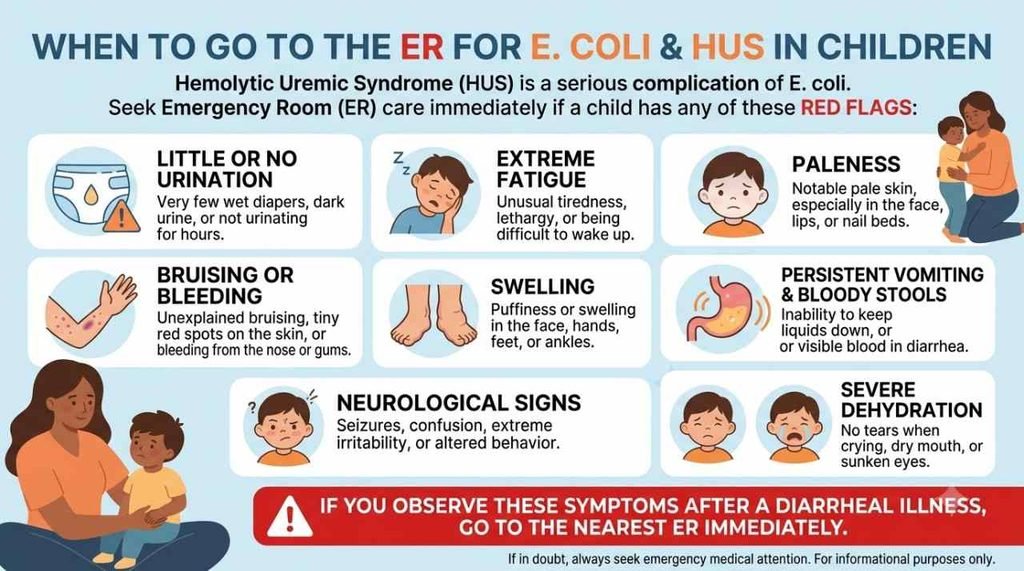
When to go to the ER for E coli HUS symptoms children may have
Use this checklist. It covers the E coli HUS symptoms children have that need urgent care. If your child has bloody diarrhea and any one of the signs below, go to the ER immediately.
ER red-flag checklist
- Bloody diarrhea plus decreased urine
- No pee for 8 hours or more (or no wet diaper in a baby for 6 hours)
- Pale skin or lips
- Swelling of the face, hands, feet, or belly
- Unusual sleepiness, weakness, or confusion
- Severe irritability that does not settle
- Bruising or tiny red or purple spots
- A seizure
- Repeated vomiting that stops your child from drinking
- Severe belly pain that does not ease
Call ahead and bring information
Tell the ER staff right away: “My child has bloody diarrhea and is peeing less.” That sentence helps them act fast.
Bring a list of foods your child ate in the past 10 days. Note raw milk, cheese, undercooked meat, or farm visits. Tell them about any sick family members. Share all medicines your child has taken.
What to do on the way to the ER
- Stay calm and keep your child comfortable.
- Do not give any anti-diarrhea medicine, antibiotic, or pain reliever.
- Offer small sips of an oral rehydration solution only if your child is alert and can drink.
- Note when the diarrhea started and when your child last peed.
- Ask the ER staff if they want a stool sample or a sealed soiled diaper.
Do not delay leaving to gather things. The E coli HUS symptoms children show at this stage need a hospital, not a home plan.
If the signs are milder
Your child may have bloody diarrhea but still pee normally and seem alert. Call your doctor the same day anyway. Do not wait it out. Ask what to watch for, and watch your child closely for a full week or more.
What NOT to do if your child may have a STEC infection
Some common home steps can make a STEC infection worse and may raise the chance of HUS in kids. When you worry about E coli HUS symptoms children could be developing, avoid these.
Do NOT give antimotility drugs
Antimotility drugs slow the gut. They include loperamide (Imodium) and similar products. Do not give them to a child with bloody diarrhea.
Diarrhea is the body’s way of flushing out the germ and its toxin. Slowing the gut may keep the toxin inside longer. Some experts link these drugs to a higher HUS risk. Skip them unless a doctor tells you otherwise.
Do NOT give antibiotics unless a doctor directs it
Antibiotics do not help most STEC infections. Some research suggests certain antibiotics may raise the risk of HUS. They may cause the germs to release more Shiga toxin.
Never use leftover antibiotics from an old illness. Never start one on your own. If your doctor wants one, they will weigh the risks and choose for your child’s case.
Avoid NSAIDs unless a doctor directs it
NSAIDs include ibuprofen and naproxen. They can reduce blood flow to the kidneys. In a child whose kidneys are already under stress, that can do harm.
If your child has pain or fever, ask a doctor which medicine is safe. Also ask for the right dose for your child’s age and weight. Do not guess.
Do NOT wait it out
It is tempting to wait a day or two. Most stomach bugs pass. But bloody diarrhea is not a normal stomach bug. And HUS can develop after the diarrhea seems to be fading.
Other mistakes to avoid
- Do not use herbal or “gut cleanse” remedies.
- Do not send your child to daycare or school while sick.
- Do not prepare food for others until you have washed your hands well.
- Do not force large amounts of fluid if your child is vomiting or swelling. Doctors manage fluids carefully in HUS.
How doctors diagnose HUS
Doctors confirm E coli HUS symptoms children have with your child’s history, an exam, and a few tests. Tell them about bloody diarrhea, urine changes, and any recent food or animal exposure.
Stool tests
A stool sample can show whether your child has a STEC infection. Labs look for the bacteria or for Shiga toxin. Results help the doctor and the health department.
Testing may not catch the germ once HUS begins. By then, the bacteria may be gone from the stool. So a negative test does not rule out HUS.
Blood tests
Blood tests check for the three signs of HUS:
- A complete blood count shows anemia and low platelets.
- A blood smear can show broken red cells.
- Other tests check for red cell breakdown.
Together, these tests confirm whether the E coli HUS symptoms children have are caused by HUS.
Kidney function tests
Doctors also check how well the kidneys work. They measure creatinine and urea in the blood. They check levels of potassium and other salts. A urine test looks for blood and protein.
Your child may also have blood pressure checks and urine measurements. Staff may weigh diapers to track output exactly.
Testing early means a faster plan for E coli HUS symptoms children are already showing. Early testing makes treatment faster. That is another reason to go to the ER at the first sign of E coli HUS symptoms children can show.
Questions to ask the doctor
- Does my child have a STEC infection, and which test showed it?
- Are the kidneys affected right now?
- What signs should I watch for at home?
- Which medicines should we avoid?
- Should we tell the daycare or school?
Treatment: hospital care, fluids, dialysis, and transfusions
There is no medicine that stops HUS once it begins. Fast care for E coli HUS symptoms children show gives the kidneys the best chance. Treatment supports your child’s body while the kidneys recover. Most children need to stay in the hospital.
Supporting your child in the hospital
You are an important part of the team. Stay with your child when you can. Share what you saw at home. Ask staff to explain each test. Tell them if your child’s behavior changes. You know your child best, and you often notice E coli HUS symptoms children show before a monitor does.
Hospital monitoring
Children with HUS are watched closely. Nurses track urine, weight, blood pressure, and blood tests. Some children go to a pediatric intensive care unit or a children’s kidney unit.
Fluids
Fluids are given through a vein. The goal is to protect the kidneys without overloading the body. This balance is delicate. That is why you should not manage fluids on your own.
Dialysis
Some children need dialysis for a time. A machine does the work of the kidneys. It removes waste, salts, and extra fluid. Dialysis can treat the kidney failure behind severe E coli HUS symptoms children develop.
Dialysis is often temporary. Many children’s kidneys recover over days or weeks. Your care team will explain what to expect.
Blood transfusions
If anemia is severe, doctors may give red blood cell transfusions. Platelet transfusions are used less often. They are usually saved for active bleeding or procedures.
How long does hospital care last?
It varies. Some children go home within days. Others stay for weeks, especially if they need dialysis. Your care team will tell you when your child’s kidneys and blood counts are safe enough for home.
Other supportive care
The team may treat high blood pressure with medicine. They may adjust diet and salts. They may manage seizures if they happen. Some children need nutrition support while they recover.
Ask the care team any question that comes to mind. Knowing the plan eases a frightening time.
Recovery and long-term kidney follow-up
Many children recover well from HUS. But recovery does not end at hospital discharge.
What recovery looks like
After the E coli HUS symptoms children had begin to fade, kidney function often improves over days to weeks. Energy, appetite, and color return slowly. Your child may tire easily at first.
Long-term kidney risks
Some children have lasting kidney damage. They may develop high blood pressure or protein in the urine. A smaller number develop chronic kidney disease. Serious cases can be life-threatening, which is why fast care matters.
Because problems can appear years later, doctors advise regular follow-up after E coli HUS symptoms children had in the past. Even a child who seems fully well needs it.
What follow-up usually includes
- Blood pressure checks
- Urine tests for protein
- Blood tests for kidney function
- Visits with a children’s kidney specialist (pediatric nephrologist)
Ask your doctor how often to come back. Also ask which medicines to avoid in the future. NSAIDs are often a concern after kidney injury.
When to call the doctor after you go home
Recovery can have setbacks. Call your child’s doctor if you notice any of these:
- Urine drops again or looks dark
- New swelling or fast weight gain
- Headaches, unusual sleepiness, or vision changes
- Blood in the stool returns
- Fever that does not settle
Go back to the ER if the E coli HUS symptoms children had before come back, such as bloody diarrhea with low urine.
Emotional recovery
A hospital stay can be scary for children and parents. Your child may be anxious or clingy for a while. Ask your care team about support. You do not have to handle it alone.
Prevention: food safety, handwashing, safe water, and daycare hygiene
Prevention is your best defense against E coli HUS symptoms children might otherwise face. You cannot remove all risk. But simple habits lower it a lot. Share these with grandparents, babysitters, and daycare staff.
Food safety
- Cook ground beef to an internal temperature of 160°F (71°C). Use a food thermometer.
- Serve only pasteurized milk, cheese, yogurt, and juice to young children.
- Wash fruits and vegetables under running water before eating.
- Keep raw meat away from ready-to-eat foods.
- Use separate cutting boards and plates for raw meat.
- Wash hands, counters, and utensils after touching raw meat.
- Refrigerate leftovers promptly.
Pay attention to food recalls. Check the CDC page on hemolytic uremic syndrome and the FDA outbreak list when news breaks.
A quick prevention checklist for busy parents
- Thermometer for the burgers.
- Pasteurized dairy only.
- Soap and water, every time.
- Safe water for drinking and play.
- Sick child stays home.
These five habits cut the chance that you will ever meet E coli HUS symptoms children can suffer.
Handwashing
Handwashing is the single best habit against the infection behind E coli HUS symptoms children develop. Wash with soap and water for at least 20 seconds. Do it:
- After using the toilet or changing a diaper
- Before eating or preparing food
- After touching animals or their pens
- After playing outside
Help young children wash. Hand sanitizer is a backup, not a replacement, when hands are dirty.
Safe water
Use treated drinking water. Teach your child not to swallow pool or lake water. Keep a child with diarrhea out of pools and splash pads for the safety of others.
Petting zoo and farm visits
Make handwashing part of every animal visit. Do not let children eat or drink near animals. Keep pacifiers and bottles out of animal areas. Clean shoes and strollers when you get home.
Daycare and school hygiene
Daycare is a common place for spread. Ask your daycare about its handwashing and diaper-changing rules. Keep a sick child home until the diarrhea has stopped.
Local health departments often have return rules after a STEC infection. Some require negative stool tests. Follow their advice and your doctor’s.
Tell the health department
STEC infections are reported to public health teams. Cooperate if they call. Your answers about food and travel can help them find the source and protect other families from E coli HUS symptoms children could otherwise suffer.
Care at home
If one child is sick, clean bathrooms and diaper areas well. Wash soiled clothing and linens in hot water. Do not share towels. Adults caring for the child should wash hands often.
Risk groups: toddlers, young kids, and school-age children
Anyone can get a STEC infection. But some groups face more risk of serious E coli HUS symptoms children in these age groups can develop.
Toddlers and children under 5
This is the highest-risk group for HUS, and toddlers face the greatest risk of E coli HUS symptoms children of any age. Their immune systems are still growing. They put hands and toys in their mouths. And they often attend daycare. Bloody diarrhea in toddlers always deserves a call to the doctor.
Young children
Preschoolers also face higher risk. They share toys, food, and bathrooms with other children. They are also less able to tell you how they feel.
School-age children
Older children can still develop HUS. They face risk from school lunches, farm trips, and camps. They can often describe symptoms better. Ask them about changes in bathroom habits.
Other groups
Older adults and people with weak immune systems can also get severe disease. This article focuses on children, but the same emergency rules apply to them.
No matter the age, the same rule holds. Know the E coli HUS symptoms children and adults share. Seek care fast.
Key takeaways on E coli HUS symptoms children can show
- HUS can follow a STEC infection, often about a week after diarrhea starts.
- Bloody diarrhea plus decreased urine is an emergency. Go to the ER immediately.
- The E coli HUS symptoms children show late include paleness, swelling, bruising, and tiredness.
- Never give antimotility drugs such as loperamide (Imodium).
- Avoid antibiotics and NSAIDs unless a doctor directs it.
- Most children recover, but kidney follow-up matters.
Common myths about E coli HUS symptoms children parents believe
Myths can delay care. Here are the most common ones.
Myth: “It is just a stomach bug.” Most stomach bugs do not cause bloody stools. Blood is a signal to call a doctor.
Myth: “Imodium will help my child feel better.” It may feel logical. But antimotility drugs can trap the toxin in the gut and are not safe here.
Myth: “An antibiotic will clear the germ.” In STEC infection, some antibiotics may raise HUS risk. Use them only if a doctor directs it.
Myth: “If the diarrhea stops, the danger is over.” HUS often appears when the diarrhea is easing. Keep watching for the E coli HUS symptoms children show later, such as low urine and paleness.
Myth: “Cooked meat is always safe.” Only the right temperature is safe. Use a thermometer.
Myth: “Only babies get HUS.” Toddlers and school-age children can get it too. Adults can as well.
FAQs about E coli HUS symptoms children parents ask
1. What are the first E coli HUS symptoms children have?
HUS follows the gut infection. First come cramps and diarrhea that turns bloody. HUS signs come about a week later: less urine, pale skin, tiredness, and swelling.
2. How soon after E. coli diarrhea can HUS start?
HUS often starts about a week after diarrhea begins. It can appear as the diarrhea is easing. Keep watching your child for at least two weeks.
3. Can I give my child Imodium for bloody diarrhea?
No. Do not give loperamide (Imodium) or other antimotility drugs. They may keep the toxin in the gut and raise the risk of HUS.
4. Should my child take antibiotics for E. coli?
Not unless a doctor directs it. Some antibiotics may raise the risk of HUS in a STEC infection. Let your doctor decide.
5. Is ibuprofen safe if my child has bloody diarrhea?
Avoid it unless a doctor says it is safe. NSAIDs like ibuprofen can reduce blood flow to the kidneys. Ask your doctor which pain reliever to use.
6. Can a child fully recover from HUS?
After treatment for E coli HUS symptoms children often recover well. Some have lasting kidney problems. That is why regular follow-up with a doctor is so important.
7. Is HUS contagious?
HUS itself is not contagious. But the STEC germ that causes it can spread from person to person. Careful handwashing and keeping a sick child home help stop it. Stopping the germ also protects other families from E coli HUS symptoms children can develop.
8. How can I lower my child’s risk of STEC infection?
Cook ground beef to 160°F (71°C). Avoid raw milk and raw-milk cheese. Wash produce and hands. Use safe water. The MedlinePlus guide to HUS also lists the signs to know.
Conclusion: act fast on E coli HUS symptoms children can have
HUS is rare. But it can harm a child’s kidneys quickly. You are the first line of defense, and knowing the E coli HUS symptoms children can show is how you use that power.
Remember the three core rules:
- Bloody diarrhea + decreased urine = emergency. Go to the ER immediately.
- No antimotility drugs like loperamide (Imodium).
- No antibiotics or NSAIDs unless a doctor directs it.
Learn the E coli HUS symptoms children can have, and teach them to others. Watch your child for at least two weeks after bloody diarrhea. Keep safe-food and handwashing habits at home.
Your action step today: Save the ER checklist in this guide to your phone. Share it with every adult who cares for your child. If you ever see bloody diarrhea with less urine, do not wait. Go.