Have you ever looked at a salmon and wondered where it has been? These remarkable creatures are the ultimate travellers of the natural world, navigating thousands of miles between freshwater rivers and the vast open ocean. While we cannot ask them about their journey, scientists and anglers have developed a fascinating method to uncover their autobiography: salmon scale reading.
Much like the rings of a tree, a salmon’s scales act as a chronological record of its life. By analysing these tiny, translucent discs, researchers can determine the fish’s age, how long it spent in a river, and how many years it feasted at sea. Understanding this process is not just a curiosity; it is a vital tool for biological research and protecting the future of our waterways.
What is Salmon Scale Reading?
At its core, salmon scale reading is the practice of examining the microscopic patterns on a fish scale to interpret its life story. As a salmon grows, its scales expand by adding layers of calcified material. These layers appear as concentric circles, known as circuli. When the fish grows rapidly (usually in summer or at sea), these rings are far apart. When growth slows (during winter or in freshwater), the rings are tightly packed.
By studying these patterns, experts can identify the freshwater phase, the moment of smoltification, and the subsequent marine growth. This data provides invaluable insights into the health of various populations, including both Atlantic salmon and Pacific salmon species.
The Science Behind the Scales: How It Works
Scales are dermal derivatives, meaning they grow from the skin. Unlike bones, which can be difficult to sample without harming the fish, scales can often be taken non-lethally from a living specimen. Here is how the process of fish ageing through scale analysis typically unfolds:
- Sampling: A few scales are gently removed from the “preferred area”—usually between the dorsal fin and the lateral line, where scales are most uniform.
- Cleaning: The scales are cleaned to remove mucus and debris that might obscure the growth rings.
- Magnification: Using a high-powered microscope or a specialized scale reader, the circuli are visualised and measured.
- Interpretation: Experts look for “annuli,” which are bands of crowded circuli that represent one year of life.
According to research published on ScienceDirect, the accuracy of this method depends heavily on the quality of the sample and the expertise of the reader. It allows us to track migration patterns and see how environmental changes affect growth rates.
Comparing Ageing Methods: Scales vs. Otoliths
While salmon scale reading is the most common method for live fish, it isn’t the only way to tell a fish’s age. Scientists also use otoliths (ear stones). Below is a comparison of these two primary methods:
| Feature | Scale Reading | Otolith Analysis |
|---|---|---|
| Ease of Collection | Easy, non-lethal. | Requires removal of the inner ear (lethal). |
| Accuracy | High for younger fish; can be difficult in older spawners. | Extremely high; considered the “gold standard.” |
| Life History Data | Shows growth, smolting, and spawning marks. | Shows daily growth increments and chemistry. |
| Equipment Needed | Standard microscope or projector. | Scanning electron microscope or thin-sectioning tools. |
For many government agencies tasked with monitoring wild stocks, scales remain the preferred choice because they allow for the release of the fish after sampling, supporting ongoing conservation efforts.
Decoding the Life Cycle: From River to Sea
The beauty of salmon scale reading lies in its ability to pinpoint specific milestones in the salmon’s life cycle. Each phase leaves a distinct “fingerprint” on the scale.
The Freshwater Years
Young salmon (parr) grow slowly in the nutrient-poor environment of their natal rivers. Their circuli are fine and close together. If a fish stays in the river for two years before heading to sea, the scale will show two distinct bands of winter growth.
Smoltification and Marine Growth
When a salmon undergoes smoltification, it prepares its body for saltwater. Once it reaches the ocean, its growth explodes. The marine growth zone on a scale is characterised by widely spaced, thick circuli. You can find more about this transformative phase at National Geographic.
Spawning Marks
Unlike some Pacific salmon that die after spawning, Atlantic salmon may survive to spawn multiple times. When a salmon returns to freshwater to breed, it stops feeding and uses its body’s energy reserves. This causes the edges of the scales to erode. When the fish returns to the sea and begins growing again, a jagged “scar” remains. These spawning marks tell us how many times a “kelts” (a post-spawn fish) has successfully reproduced.
Why Does Salmon Scale Reading Matter?
This isn’t just academic exercise. The data gathered from scale reading is critical for sustainable fishing and maintaining global biodiversity. By knowing the age structure of a population, scientists can predict future returns and set catch limits that prevent overfishing.
Organisations like the World Wildlife Fund use this data to advocate for habitat protection. If scale readings show that fish are spending less time at sea or returning smaller than usual, it can signal problems in the marine food web or the impact of climate change.
Furthermore, understanding the genetic health and resilience of these species is a key focus for groups like The Royal Society, who examine how environmental stressors affect the growth patterns recorded in these biological archives.
How You Can Help
If you are an angler, you can contribute to this vital science. Many river trusts and conservation groups, such as the Wild Salmon Center, encourage “catch and release” anglers to take scale samples (where legal and permitted) to help with data collection. By providing these samples, you are directly assisting fisheries professionals in their quest to save these iconic species.
Supporting healthy oceans is also essential. Research from the Marine Conservation Society highlights that the survival of salmon at sea is directly linked to the health of the entire ecosystem. Protecting the prey species that salmon rely on for their rapid marine growth is a priority for global sustainability goals.
Conclusion
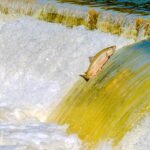
The next time you see a salmon leaping through a weir or featured in a BBC nature documentary, remember that every scale on its body is a page in a very long, very difficult book. Salmon scale reading allows us to read that book, giving us the knowledge we need to ensure that the “King of Fish” continues to swim in our rivers for generations to come.
From the microscopic circuli to the rugged spawning marks, these patterns are a testament to the resilience of nature. Through continued scientific exploration and dedicated wildlife protection, we can decode the mysteries of the deep and protect the delicate balance of our planet’s biodiversity.
Frequently Asked Questions (FAQs)
Can I read salmon scales at home?
While you can see the basic rings with a strong magnifying glass, professional salmon scale reading requires specialised equipment and years of training to accurately distinguish between annual rings and “false checks” caused by temporary stress or injury. For accurate data, samples should be sent to a laboratory, such as those discussed in PNAS.
Does removing scales hurt the fish?
If done correctly by a trained professional or experienced angler using the proper technique, removing 2–3 scales from a live fish is a minor procedure, similar to taking a hair sample. However, it is vital to keep the fish in the water and handle it with care to prevent stress. The welfare of the animal is always the priority, as noted by the NIH regarding biological sampling ethics.
How many years can a salmon live?
The lifespan varies by species and life strategy. Most Atlantic salmon live between 3 to 8 years, while some Pacific species may live up to 7 years. Scale reading has identified exceptional individuals that have survived multiple spawning migrations, proving just how hardy these fish can be.