

Wondering about kombucha alcohol content and whether your favorite bottle is truly alcohol free? This simple guide explains how much alcohol is really in kombucha, why it forms, and what changes the numbers. We cover standard ABV in store-bought brands, including Synergy kombucha alcohol content, Health-Ade kombucha alcohol content, Brew Dr kombucha alcohol content, and Humm kombucha alcohol content.
You will also learn why homemade kombucha alcohol content is often higher, and how hard kombucha compares with regular kombucha. A clear safety section explains what pregnant readers and people in recovery should know before they drink. Tables make the facts easy to scan, and every point is written in plain language based on trusted nutrition and food safety sources. Read on to understand the label, protect your health, and choose the kombucha that fits your life with total confidence.
Kombucha Alcohol Content: What You Need to Know
Kombucha is a tangy, fizzy fermented tea that fills grocery shelves. Many people drink it for flavor, gut health, or as a soda swap. Yet one question keeps coming up: how much kombucha alcohol content is really in the bottle?
The short answer is that all kombucha contains a little alcohol. It forms naturally during fermentation. Most store-bought bottles stay below 0.5 percent alcohol by volume, which is the legal line in the United States for a non-alcoholic drink.
I have brewed kombucha at home for years and compared many store labels along the way. I have also read food safety guidance and talked with fellow brewers about what really changes the numbers. This guide shares what matters about kombucha alcohol content, without scary claims or hype.
Here is a quick preview of what you will learn. Store brands are usually low. Homemade batches can climb much higher. Hard kombucha is a different product, made to contain real alcohol.
A quick safety note before we start. Alcohol and fermented foods affect real people, especially during pregnancy, recovery, or when taking medicine. Treat this article as general education, and ask a doctor or pharmacist about your own case.
The Short Answer
Regular store-bought kombucha usually contains about 0.3 to 0.5 percent alcohol. Homemade kombucha often lands between 0.5 and 3 percent, and sometimes more. Hard kombucha is made on purpose to hit about 4 to 8 percent.
That means regular kombucha will not make you drunk. Still, trace alcohol is not zero, and that matters to some people. The rest of this guide shows you why.
How Does Alcohol Get Into Kombucha?
To understand kombucha alcohol content, you need to know how kombucha is made. The process is simple but fascinating. Two kinds of microbes work together, and each one has a different job.
It starts with sweet tea. Then a SCOBY, short for symbiotic culture of bacteria and yeast, is added. The mix ferments for a week or two.
The Role of Yeast
Yeast eats the sugar in the tea. As it does, it makes two things: carbon dioxide and ethanol. Ethanol is the type of alcohol found in beer and wine.
This is the first stage of alcohol creation. It is the same basic reaction used in bread and beer. The yeast is the main reason any kombucha alcohol content exists at all.
The Role of Bacteria
The bacteria in the SCOBY then eat much of that ethanol. They turn it into acetic acid, the same acid in vinegar. This is why kombucha tastes sour and sharp.
Because bacteria use up part of the alcohol, the final drink stays low in ethanol. Yet the balance is not perfect. A little alcohol always remains, which is why kombucha alcohol content is never exactly zero.
Second Fermentation Adds More
Many brewers add fruit or juice and seal the bottle for a second round. This builds fizz and flavor. It also feeds the yeast with fresh sugar.
More sugar can mean more alcohol. That is one of the main reasons flavored, bottle-conditioned drinks can show higher numbers. We will see this again when we talk about homemade batches.
For a broader science background, the Wikipedia article on kombucha gives a helpful overview of how the culture, tea, and sugar work together. It also explains the history of the drink.
The Legal Limit: Why 0.5 Percent Matters
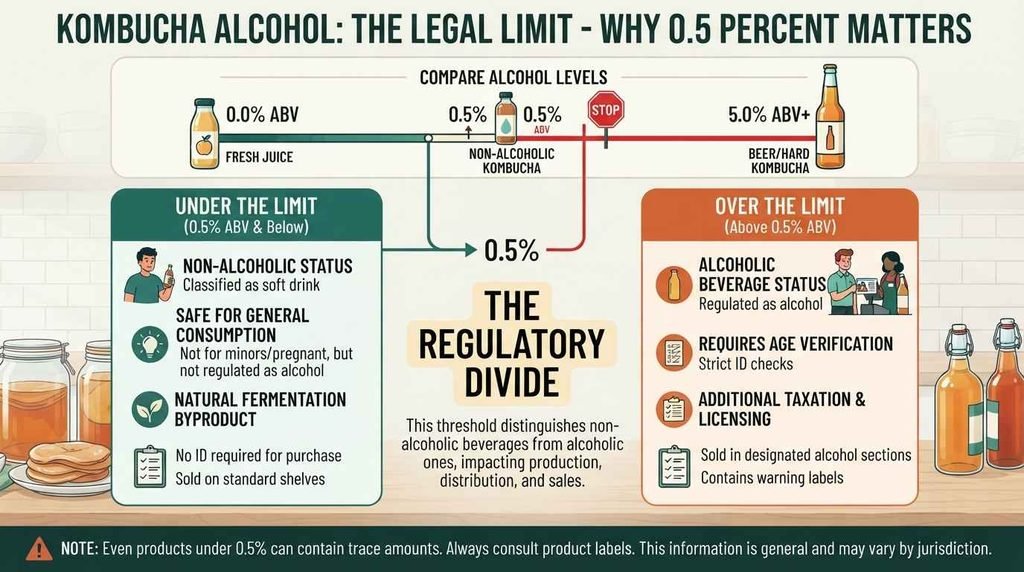
In the United States, a drink sold as non-alcoholic must contain less than 0.5 percent alcohol by volume. This rule comes from federal alcohol regulators. Kombucha that goes above that line may need to be labeled and sold as an alcoholic beverage.
That is why most brands design their products carefully. They control sugar, time, temperature, and storage to keep kombucha alcohol content under the limit. Some also use filtration or pasteurization to stop fermentation.
Still, kombucha is a living food. If a bottle sits warm on a shelf or in your car, yeast can keep working. That can push the alcohol a bit higher after it leaves the factory.
Why Raw Kombucha Can Change After Bottling
Unpasteurized kombucha still has live yeast and bacteria. These microbes do not stop just because the cap is on. If the bottle gets warm, the yeast speeds up and makes more alcohol and more fizz.
For this reason, store raw kombucha in the fridge. Cold temperatures slow fermentation and keep the number stable. This simple habit also protects flavor.
Some past product recalls and label disputes happened because the kombucha alcohol content of certain bottles tested above the legal line. These events pushed the industry to test more often and improve controls. Today, most large brands test batches regularly.
Standard ABV in Store-Bought Kombucha
Now let us look at what you actually find on shelves. Most mainstream brands label their drinks as containing less than 0.5 percent alcohol. That is the legal marker, and it is printed right on the bottle.
The actual number at the time of bottling is often even lower, around 0.2 to 0.4 percent. Over time and with warm storage, it may rise. Always check the label and the date.
For a clear explanation of how alcohol shows up in commercial products, the Healthline guide on kombucha alcohol content is a good second source. Use it alongside the label on your own bottle.
Brand Comparison Table
The table below shows what major brands generally state on their labels. Values can change by flavor, batch, and country. Please read your own bottle before you rely on any number.
| Brand | Typical Labeled ABV | Pasteurized? | Notes |
|---|---|---|---|
| Synergy (GT’s) | Under 0.5% | No (raw) | Store cold to keep ABV stable |
| Health-Ade | Under 0.5% | No (raw) | Flavors vary by batch |
| Brew Dr. | Under 0.5% | No (raw) | Often sold in organic lines |
| Humm | Under 0.5% | No (raw) | Many flavors and large sizes |
| Hard kombucha brands | 4% to 8% | Varies | Sold as alcoholic beverages |
As you can see, regular brands share the same legal limit. Real differences show up in handling, flavor, and sugar. Let us look at the big names one at a time.
Synergy Kombucha Alcohol Content
Synergy kombucha alcohol content is labeled as under 0.5 percent. Synergy is made by GT’s Living Foods, one of the oldest brands in the category. It is raw and unpasteurized.
Because it is a living product, storage matters. Keep it cold and drink it before the date on the bottle. This keeps the Synergy kombucha alcohol content close to its original level.
Some shoppers notice a stronger tang or more fizz in older bottles. That is the culture still working. If a bottle looks swollen or sprays on opening, chill it first and open slowly.
Health-Ade Kombucha Alcohol Content
Many shoppers search for Health-Ade kombucha alcohol content, and you may also see it written as health ade kombucha alcohol content. Both mean the same brand. Health-Ade labels its drinks as under 0.5 percent alcohol by volume.
The brand uses a raw, small-batch style, with flavors like ginger-lemon, pomegranate, and pink lady apple. The Health-Ade kombucha alcohol content stays low when the bottle is cold. As with any live drink, heat and time can raise it a little.
Some people search for health aid kombucha alcohol content because of the spelling. The brand name is Health-Ade, with the ending “ade” like lemonade. The label information is the same either way.
Brew Dr Kombucha Alcohol Content
Brew Dr kombucha alcohol content also falls under the 0.5 percent limit. Brew Dr. is known for organic teas and herbal blends. The drink is raw, so the cold chain matters.
The brand lists its alcohol as less than 0.5 percent on the label. If you buy it often, keep a few bottles in the fridge and avoid leaving them in a warm bag. That one habit protects the Brew Dr kombucha alcohol content and the taste.
Humm Kombucha Alcohol Content
Humm kombucha alcohol content is also labeled below 0.5 percent. Humm offers many fruity flavors and is easy to find in large bottles. Its taste is often lighter and sweeter than some other brands.
As with other raw products, always read the date and keep it cold. The Humm kombucha alcohol content can drift up if a bottle is stored warm for days. Fresh bottles from a cold shelf are the safest bet.
What the Numbers Mean in Real Life
A bottle at 0.5 percent contains very little alcohol. To compare, a typical beer sits around 5 percent, ten times higher. You would need to drink huge amounts of regular kombucha to feel anything, and the sour taste and fizz make that unlikely.
Ripe bananas, fruit juice, and some breads also contain small amounts of natural alcohol. So trace amounts in food are common in everyday life. Still, even small amounts matter to some people, which is why the safety section below is so important.
What the Label Does Not Always Tell You
A label shows the number at bottling, not always the number in your fridge a month later. Temperature, bottle age, and added juice can all change it. This is true for every brand when it comes to kombucha alcohol content.
Also, labels may say “less than 0.5%” without a more exact figure. That is legal, but it hides the range. If you need a precise value for medical or personal reasons, contact the brand directly and ask for batch testing information.
Tips for Reading Kombucha Labels
- Look for the ABV line. Most bottles print “less than 0.5% ABV” near the nutrition facts.
- Check for “raw” or “unpasteurized.” Raw drinks can keep fermenting.
- Check the date. Older bottles may have higher alcohol and more sourness.
- Look for added juice. Added sugar after bottling can start a new fermentation.
- Store it cold. Cold slows the yeast and keeps the number steady.
These five habits help you control kombucha alcohol content at home. They take only a few seconds at the store. Over time they protect your taste buds and your health.
Why Homemade Kombucha Has More Alcohol
Here is where things change. Homemade kombucha alcohol content is usually higher than store-bought. Many home brewers see numbers between 0.5 and 3 percent, and some batches go beyond that.
There is no factory testing in a home kitchen. There is also no filtration or batch control. Everything depends on your recipe, your timing, and your room temperature.
This does not mean homemade kombucha is bad. It just means you should know what is in your jar. A little awareness goes a long way.
The Main Reasons Homemade Batches Run Higher
First, home brewers often use more sugar. More sugar gives yeast more food, and more food means more ethanol. Second, home batches often ferment longer, and the longer the yeast works, the more alcohol it makes.
Third, many people do a sealed second fermentation with fruit or juice. This adds fresh sugar and traps the gas, so yeast stays busy. Fourth, warm kitchens speed up yeast. All four habits raise homemade kombucha alcohol content.
Finally, home brewers rarely filter their kombucha. Live yeast stays in every bottle and keeps working in the fridge. That is why a homemade bottle can keep creeping up over time.
Factors That Change Homemade Kombucha Alcohol Content
Use the table below to see how each choice affects your batch. It shows the direction of change, not exact numbers. Every kitchen is different.
| Factor | Effect on Alcohol | Why It Happens | How to Reduce It |
|---|---|---|---|
| More sugar | Higher | More food for yeast | Use the standard amount, about 1 cup per gallon |
| Longer fermentation | Higher | Yeast keeps producing ethanol | Taste often and bottle sooner |
| Warm room (above 80°F / 27°C) | Higher | Yeast speeds up | Brew in a cooler spot, about 70 to 78°F |
| Sealed second fermentation | Higher | Fresh sugar plus trapped gas | Shorten to 1 to 2 days and refrigerate fast |
| Added fruit or juice | Higher | Extra sugar feeds yeast | Use less fruit or use herbs and spices instead |
| Plenty of oxygen and a healthy SCOBY | Lower | Bacteria convert ethanol to acid | Use a breathable cloth cover and a strong SCOBY |
The table shows that you have real control. Small changes in sugar, time, and temperature move homemade kombucha alcohol content up or down. Smart brewers adjust all three.
How to Estimate Alcohol in Homemade Kombucha
Most home brewers cannot measure alcohol exactly. A standard hydrometer measures sugar density, not alcohol directly. Some brewers compare the density before and after fermentation to estimate ethanol, but kombucha also makes acids and other compounds, so the result is only rough.
For a precise answer, you need lab testing or a proper alcohol meter made for fermented drinks. Home test kits exist, but they vary in accuracy. If the exact homemade kombucha alcohol content matters for health or religious reasons, do not guess.
For real-world tips from other brewers, the r/Kombucha community on Reddit is full of experience and troubleshooting. Treat those posts as hobby advice, not as medical or legal guidance.
Tips to Keep Homemade Alcohol Lower
- Use the right amount of sugar. Do not add extra to speed things up.
- Keep a healthy SCOBY. Active bacteria turn more ethanol into acid.
- Brew with air. Cover the jar with breathable cloth and allow oxygen in.
- Refrigerate bottles quickly. Cold slows yeast and stops big increases.
- Drink sooner. Do not store bottles for weeks.
These steps will not bring homemade kombucha to zero. They simply help you keep kombucha alcohol content low and steady. If you need a drink that is truly alcohol free, choose another beverage.
Hard Kombucha vs. Regular Kombucha
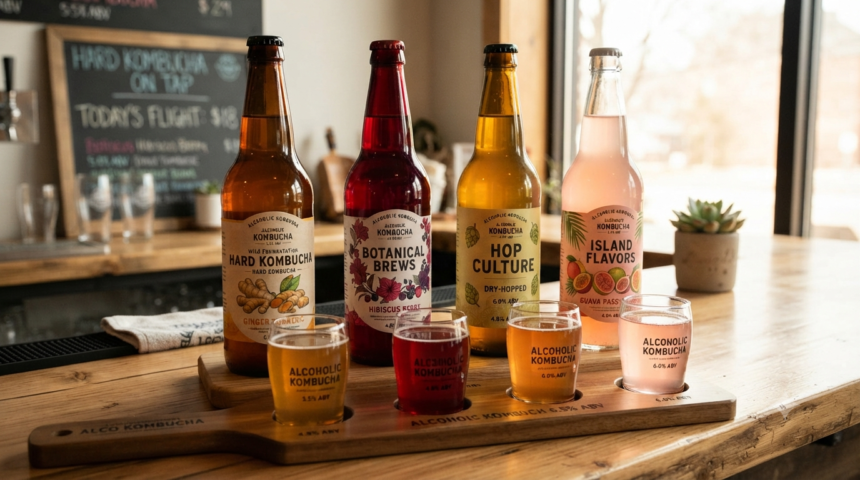
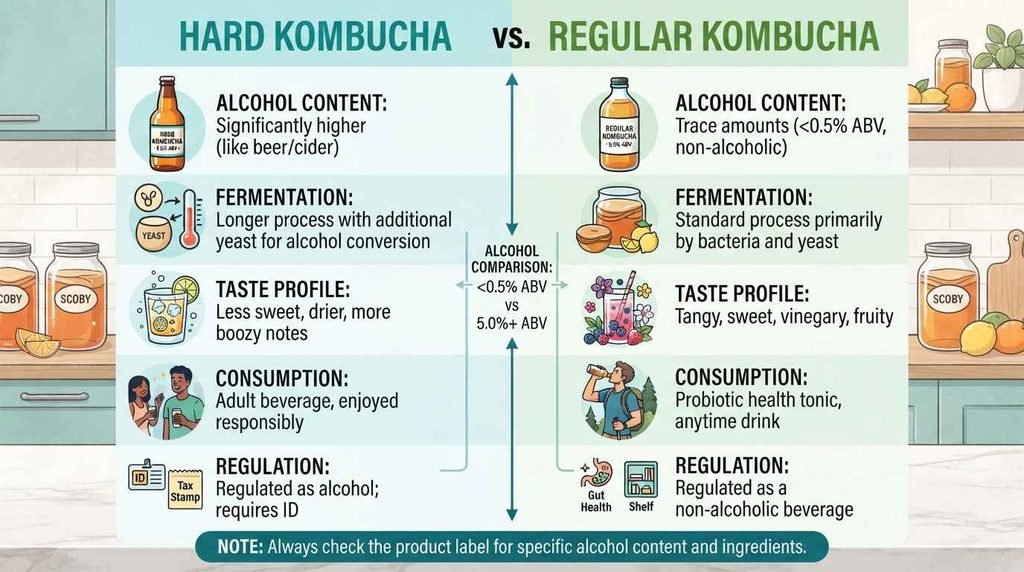
Hard kombucha is a different product. It is made to contain real alcohol, just like beer or hard seltzer. Brewers add extra sugar and use special yeast to push the alcohol into the 4 to 8 percent range.
Regular kombucha is made to stay under 0.5 percent. Its alcohol is a side effect of fermentation, not a goal. Hard kombucha reverses this idea, and kombucha alcohol content becomes the main feature.
The two products often look similar on the shelf. They may share flavors, fonts, and cans. That is why you must read the label every time.
Key Differences Table
This table compares regular store-bought kombucha, homemade kombucha, and hard kombucha. The ranges are typical, not exact. Always check the label of your product.
| Feature | Regular Store-Bought | Homemade | Hard Kombucha |
|---|---|---|---|
| Typical ABV | Under 0.5% | About 0.5% to 3%+ | About 4% to 8% |
| Legal category (US) | Non-alcoholic beverage | Not sold (home use) | Alcoholic beverage |
| Age restriction | None | None | 21+ in the US |
| Can it intoxicate? | Not realistically | Possible in strong batches | Yes |
| Sold where | Grocery stores, cafes | Made in kitchens | Liquor stores, some groceries |
| Safe in pregnancy? | Ask your doctor | Ask your doctor | No |
This comparison makes the gap clear. Regular kombucha stays low. Hard kombucha is a true alcoholic drink, and homemade kombucha lives somewhere in between. The kombucha alcohol content you choose should match your needs.
Taste and Use Differences
Hard kombucha usually tastes drier and slightly boozy, with a lighter tang than raw kombucha. Many brands add fruit and spices. Because it is alcoholic, people drink it socially, like beer or cider.
Regular kombucha is more of a daily wellness drink. It tastes sour and fizzy and often comes with probiotics. People drink it with meals, at work, or as a soda replacement.
Neither one is a health cure. Regular kombucha has some research interest, but no drink fixes illness. Hard kombucha is still alcohol, and you should treat it like any other alcoholic beverage.
Safety for Pregnancy and Sobriety
This section matters most, and it is where careful reading counts. This article is general information, not medical advice. If you are pregnant, in recovery, or managing a health condition, talk with a qualified professional about kombucha alcohol content before you drink.
Pregnancy and Breastfeeding
Major medical groups say there is no known safe amount of alcohol during pregnancy. Even tiny amounts raise concern for some doctors. That is why many obstetricians suggest skipping kombucha, especially raw and homemade versions.
There is a second concern. Raw kombucha is unpasteurized and may carry bacteria if it is made or stored poorly. Pregnancy lowers immune strength, so food safety matters more.
Some doctors allow small amounts of low-alcohol store-bought kombucha. Others say avoid it entirely. Your own doctor is the right person to decide, based on your health and history. Hard kombucha is not safe during pregnancy.
If you are breastfeeding, alcohol can pass into milk in small amounts. Ask your provider about timing and limits. Hard kombucha should follow the same rules as any other alcohol.
Sobriety and Recovery
For people in recovery from alcohol use, even a trace of ethanol can be a trigger. Kombucha also tastes and smells a little like beer or cider to some people. That can bring up strong memories or cravings.
Some people in recovery are fine with regular store-bought kombucha. Others avoid it completely. There is no single right answer, and your comfort comes first.
Before trying it, talk to your doctor, counselor, or sponsor. They know your story and your risks. If you want a similar drink with no alcohol, look for products with guaranteed 0.0 percent alcohol or choose sparkling water with fruit.
Other Groups Who Should Be Careful
Some people should check with a professional before drinking kombucha. This includes anyone with a weak immune system, liver disease, or a history of alcohol use disorder. It also includes people who take medicines that interact with alcohol.
Children should not drink homemade or raw kombucha. Their bodies are small, and even low alcohol levels matter more. Many families also avoid it for religious or personal reasons.
Safety Summary Table
Use this table as a quick reminder. It is a general guide and does not replace advice from your doctor.
| Group | Regular Store-Bought | Homemade | Hard Kombucha |
|---|---|---|---|
| Pregnant or trying to conceive | Ask your doctor first | Avoid | Avoid |
| Breastfeeding | Ask your doctor | Ask your doctor | Follow alcohol guidance |
| In recovery from alcohol use | Ask your counselor or doctor | Avoid unless cleared | Avoid |
| Children | Not recommended in raw form | Avoid | Never |
| Weak immune system | Ask your doctor | Avoid raw batches | Ask your doctor |
| Driving soon after | Generally low risk | Use caution | Do not drive |
This table is meant to help you ask better questions. Every body is different. The safest path is to discuss kombucha alcohol content with a professional who knows your situation.
Why You Can Trust This Guide
This article uses label information, legal definitions, and well-known food safety guidance. We avoid miracle claims and keep every statement modest. I also compared real products and brewed many batches at home to understand the practical side.
No article replaces a doctor. If a statement here does not fit your health situation, trust your healthcare provider. Your safety always comes first.
Common Mistakes People Make About Kombucha Alcohol Content
A few myths keep floating around. Clearing them up will help you make better choices.
- “Kombucha has zero alcohol.” It almost never does. Even store-bought bottles contain traces.
- “All brands are the same.” Handling, sugar, and storage change the final number.
- “Hard kombucha is just a stronger kombucha.” It is a separate product, sold as an alcoholic drink.
- “Homemade is always safe.” Homemade batches can run higher, and hygiene matters too.
- “A warm bottle is fine.” Warm storage can raise alcohol and pressure in raw bottles.
Avoid these mistakes and your understanding of kombucha alcohol content will be far more accurate. This also helps you shop smarter. You will spot misleading claims faster.
Frequently Asked Questions
How much alcohol is in kombucha?
Most store-bought kombucha contains less than 0.5 percent alcohol by volume. Homemade batches can be higher, often 0.5 to 3 percent. Hard kombucha usually has 4 to 8 percent.
Can kombucha get you drunk?
Regular store-bought kombucha will not realistically make you drunk. The alcohol level is too low. Hard kombucha can, since it is made to be alcoholic, and strong homemade batches may also have a noticeable effect.
Is the Health-Ade kombucha alcohol content safe for pregnancy?
Health-Ade labels its drinks as under 0.5 percent alcohol. Even so, doctors differ on whether any trace alcohol is acceptable during pregnancy. Ask your own doctor, and consider a pasteurized option if they approve kombucha at all.
Does the alcohol in kombucha increase over time?
It can, especially in raw bottles that are stored warm. Live yeast keeps working after bottling. Keep bottles cold and drink them by the date.
Is Synergy kombucha alcohol content different from Humm or Brew Dr?
All three labels state under 0.5 percent. Small real differences can come from flavor, sugar, and storage. Check the batch information on your bottle if the exact number matters to you.
Is homemade kombucha alcohol content dangerous?
Not by itself for most healthy adults, but it varies a lot. It is a bigger issue for pregnancy, recovery, children, and medication safety. Always label homemade batches and be honest with guests about what is inside.
Final Thoughts
Now you know the main facts about kombucha alcohol content. Store-bought brands like Synergy, Health-Ade, Brew Dr., and Humm label their products under 0.5 percent. Homemade batches can run higher. Hard kombucha is a true alcoholic drink.
Read the label, keep raw bottles cold, and watch the date. If you brew at home, control sugar, time, and temperature. These steps keep kombucha alcohol content more predictable.
If you are pregnant, in recovery, or managing a health condition, talk to a professional first. Your safety matters more than any trend. With the right information, you can enjoy kombucha, or skip it, with full confidence in your kombucha alcohol content choice.