Designing an evidence-based beach wellness routine for beginners requires more than random stretching in the sand. For meaningful reductions in anxiety and measurable gains in range of motion, your practice should integrate breath regulation (pranayama), low-load isometric holds, and progressive mobility in all major joints, especially the hips and thoracic spine. As multiple clinical reviews on yoga and stress physiology show, slow, coordinated movement and breath down-regulate sympathetic activity and improve heart-rate variability, which are key biomarkers of stress resilience according to leading medical organizations and academic centers.
Below is a technical, pose-by-pose framework for morning beach yoga for a stiff back, a simple beach meditation for anxiety relief, and a low impact beach workout for seniors, structured so you can scale intensity by age, fitness, and mobility constraints.
Why the Beach Is a High-Value Environment for Yoga
From an exercise physiology standpoint, practicing on sand changes the mechanical load profile of foundational asanas:
- The unstable surface increases demand on stabilizing musculature (gluteus medius, deep core, foot intrinsics), which can improve proprioception and joint stability compared to firm ground, as discussed in balance-training research summarized by major sports-medicine organizations.
- The ambient sound of waves functions as a form of consistent, low-frequency auditory input that supports parasympathetic dominance, which large mental health organizations often highlight as beneficial for stress recovery.
- Sun exposure in controlled doses enhances vitamin D synthesis, which meta-analyses and governmental health agencies link to musculoskeletal health and mood regulation.
For pose selection, we will prioritize:
- Sagittal-plane spinal decompression for back stiffness
- Hip external rotation and hamstring lengthening for lower-body mobility
- Gentle thoracic extension and rotation
- Breath-led, low-impact flow patterns suitable for older adults
Core Beach Yoga Sequence for Stress Relief & Flexibility
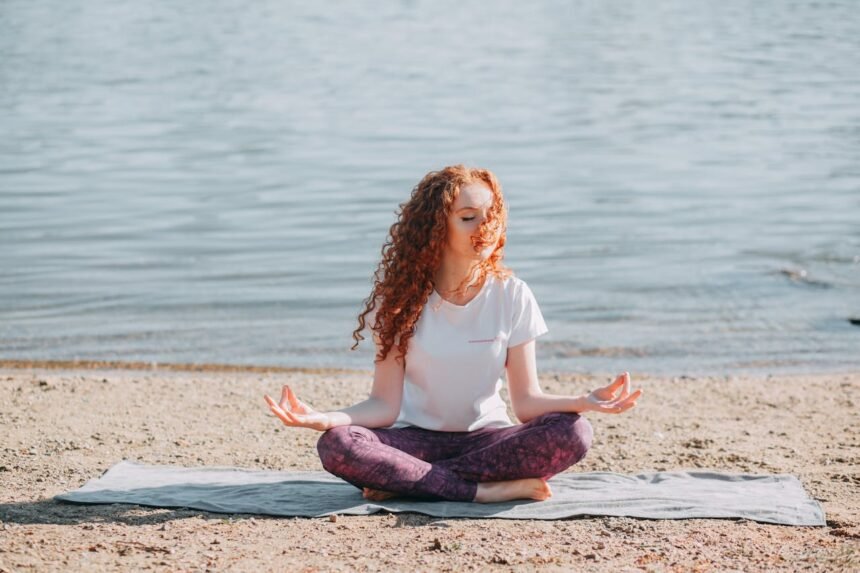
1. Centering & Simple Beach Meditation for Anxiety Relief (3–5 minutes)
Primary goal: Shift the nervous system from sympathetic (fight-or-flight) toward parasympathetic (rest-and-digest).
- Sit in easy cross-legged pose (Sukhasana) facing the water, or in a beach chair if you have knee or hip limitations.
- Place hands on thighs, adopt a soft, panoramic gaze at the horizon.
- Inhale for 4 counts through the nose, exhale for 6–8 counts through the nose, maintaining diaphragmatic breathing.
- Maintain for 3–5 minutes.
This simple ratio breathing pattern mirrors protocols frequently cited by leading cardiology and anxiety resources as effective for acute anxiety modulation.
2. Beach-Optimized Cat–Cow (Marjaryasana/Bitilasana) for Spinal Hydration
Best for: Morning beach wellness routine for beginners and anyone with a stiff back.
- Set up on all fours; if you have sensitive knees, fold a beach towel for additional padding.
- On inhale, extend the spine (Cow), lifting the sternum and sitting bones.
- On exhale, flex the spine (Cat), spreading the shoulder blades and engaging the deep abdominals.
- Perform 8–12 slow cycles.
The repeated flexion–extension cycles promote synovial fluid circulation in the facet joints and help reverse overnight spinal compression—an effect consistent with spinal-mobility guidance from major physical therapy and spine health centers.
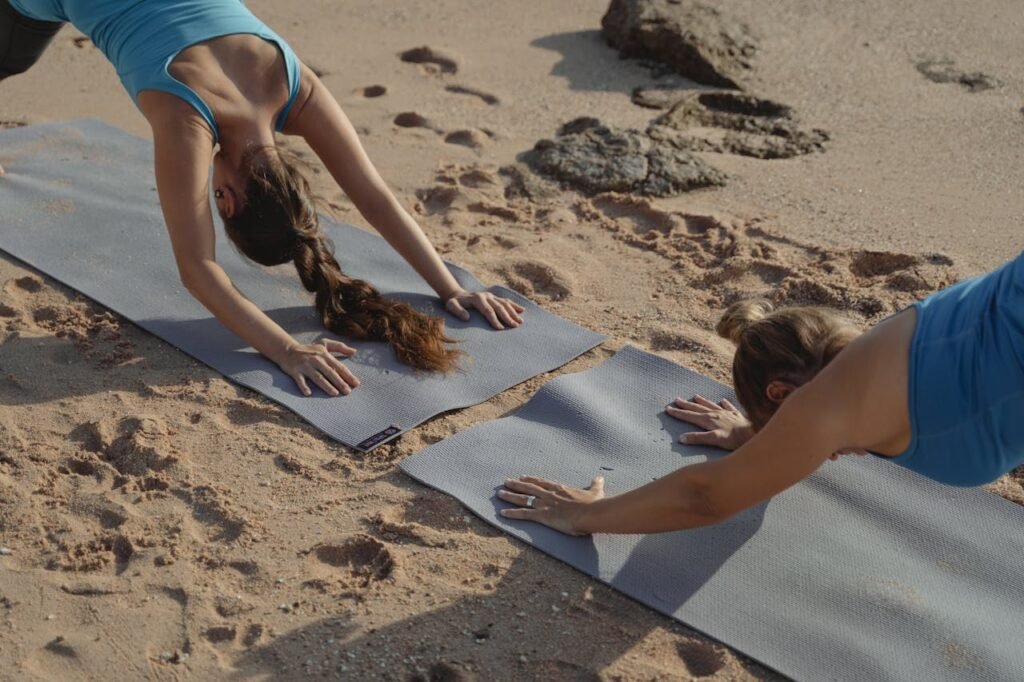
3. Downward-Facing Dog (Adho Mukha Svanasana) on Sand
On sand, Downward-Facing Dog becomes a combined myofascial chain stretch and stability drill:
- From all fours, tuck toes and lift hips into an inverted “V.”
- Widen your stance slightly more than on a mat to account for sinking feet.
- Alternate bending knees to mobilize calves and hamstrings.
- Hold 5–10 breaths.
Because the hands and feet partially sink, closed-chain loading on the wrists and shoulders is slightly reduced while demand on the posterior chain remains high, a pattern consistent with load-distribution discussions in advanced yoga biomechanics resources.
4. Low Lunge to High Lunge Flow (Anjaneyasana → Ashta Chandrasana)
This progression trains hip-flexor length and lower-body strength while remaining accessible as a low impact beach workout for seniors when appropriately modified.
- From Downward Dog, step the right foot between the hands.
- Lower the back knee for Low Lunge (Anjaneyasana):
- Front knee stacked over ankle
- Back knee cushioned on sand or towel
- Inhale, sweep arms overhead, gently extending the thoracic spine
- For more load, progress to High Lunge (Ashta Chandrasana) by lifting the back knee and engaging glutes and quads.
- Hold each variation 5–8 breaths per side.
Sports-medicine–oriented yoga programs frequently highlight lunge variations for improving hip extension and addressing prolonged sitting, a major factor in anterior hip tightness and low-back discomfort.
5. Warrior II (Virabhadrasana II) for Lateral Hip Strength & Focus
In a beach context, Warrior II is highly effective for building frontal-plane strength and mental focus:
- From High Lunge, spin the back heel down and open the hips to face the ocean.
- Front knee bends to ~90°, tracking over the second toe.
- Arms extend parallel to the ground, gaze over the front middle finger.
- Maintain neutral pelvis and active feet pressing into the sand.
Due to the uneven surface, the hip abductors and ankle stabilizers must work harder than in studio conditions—a benefit well-documented in balance and fall-prevention literature for older adults.
6. Standing Forward Fold (Uttanasana) for Passive Posterior-Chain Release
Forward folds are central to stress relief and flexibility protocols because they combine:
- Passive lengthening of hamstrings and spinal extensors
- Downward head position that many traditions associate with introspection and calm
Technique on the beach:
- From standing, hinge at the hips with a long spine.
- Bend knees generously to protect the lumbar spine, especially if you have a history of disc issues.
- Let the head hang, arms dangling or holding opposite elbows (Ragdoll).
- Maintain 8–10 breaths, imagining the exhale draining tension through the crown of the head.
Clinical yoga therapy manuals emphasize that hamstring tightness often correlates with compensatory lumbar flexion; bending the knees reduces shear on the lumbar discs while still providing an effective stretch.
7. Seated Forward Fold (Paschimottanasana) in the Sand
The advantage of doing Paschimottanasana on the beach is the ability to slightly raise the hips by digging a slope in the sand under your sit bones, effectively simulating a wedge or bolster.
- Sit with legs extended, feet flexed.
- Inhale to lengthen the spine, exhale to hinge at the hips rather than collapsing through the thoracic spine.
- For a low impact beach workout for seniors, use a strap or towel around the feet and maintain a more upright posture.
This pose delivers long-axis traction through the posterior superficial line (calves, hamstrings, spinal fascia), supporting global flexibility when practiced consistently.
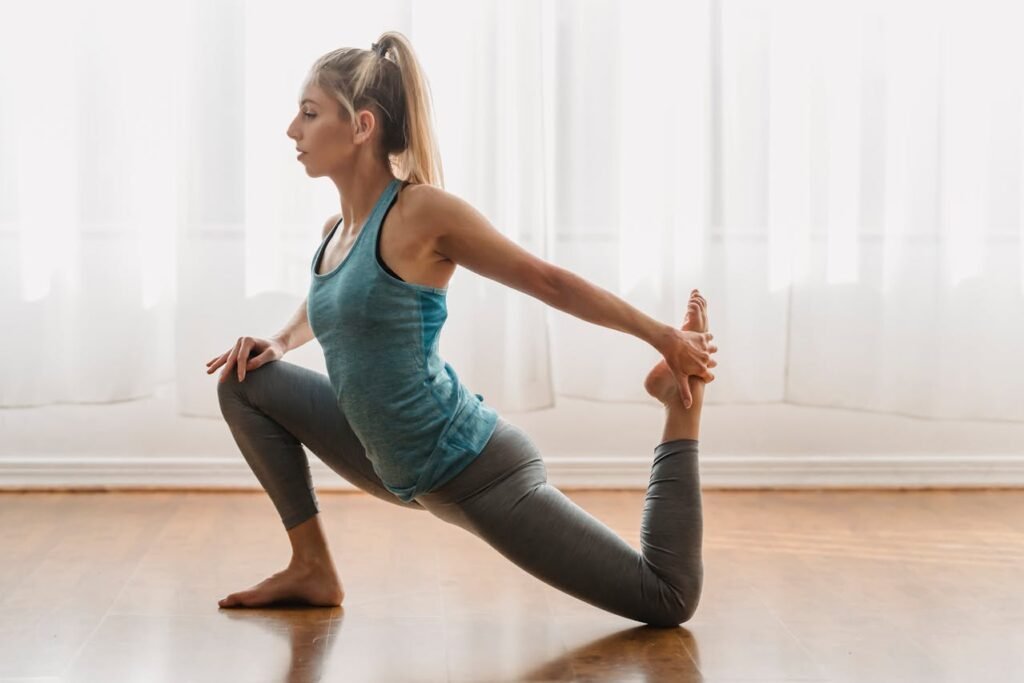
8. Pigeon Pose (Eka Pada Rajakapotasana, Reclined Variation Recommended)
Deep hip external rotation is beneficial, but prone Pigeon on sand can be too intense for beginners or seniors. A safer variant is Reclined Pigeon (Figure 4 Stretch):
- Lie on your back.
- Cross the right ankle over the left thigh (just above the knee), flex the right foot.
- Draw the left thigh toward the chest, threading the hands behind the left hamstring.
- Hold 8–12 breaths each side.
Hip-opening work like this is frequently prescribed in yoga-based rehabilitation protocols for lower-back discomfort driven by piriformis and gluteal tightness.
9. Supported Bridge Pose (Setu Bandha Sarvangasana) in the Sand
Bridge is a powerful spinal decompression and glute-activation drill that can easily be adapted with natural support on the beach.
- Lie on your back, knees bent, feet hip-width and grounded in the sand.
- On inhale, press into feet and lift hips, engaging glutes and hamstrings.
- For a restorative option, build a small sand mound under the sacrum to create a gentle supported variation.
The pose provides a controlled counterpose to the flexion pattern of forward folds, which yoga-therapy sources emphasize as essential for maintaining spinal balance.
10. Final Relaxation: Sea Star Savasana
End with a Sea Star–style Savasana:
- Lie on your back, arms and legs relaxed wide, palms up.
- Allow heels to sink into the sand, letting the ground provide passive support.
- Maintain 5–10 minutes of relaxed breathing, focusing on the sound of waves.
Savasana is consistently cited in both yoga research and clinical relaxation training as a key posture for integrating neuromuscular changes and consolidating the stress-relief response.
Programming a Beach Wellness Routine for Different Populations
For Beginners
- Total duration: 20–30 minutes.
- Intensity: Emphasize breath, simple transitions, and shorter holds (3–5 breaths initially).
- Core structure:
- 3–5 minutes seated breath meditation
- Cat–Cow, Downward Dog, Low Lunge only (no High Lunge or Warrior II at first)
- Standing Forward Fold, Seated Forward Fold
- Reclined Pigeon, Supported Bridge
- Savasana
The key objective is movement competency and interoceptive awareness, not maximal range of motion.
For a Morning Beach Yoga Session for a Stiff Back
- Prioritize spinal articulation and hip mobility.
- Suggested order:
- Breath meditation
- Extended Cat–Cow (add lateral flexion and gentle circles)
- Downward Dog with generous knee bend
- Low Lunge with a focus on hip-flexor length
- Standing Forward Fold with support (hands on thighs or a beach chair)
- Reclined Pigeon, Supported Bridge
- Longer Savasana (8–10 minutes)
This approach matches guideline-style recommendations from back-care–oriented yoga programs, which advise combining controlled flexion, extension, and gentle traction.
For a Low Impact Beach Workout for Seniors
- Work within pain-free range and avoid rapid transitions.
- Emphasize:
- Chair-assisted or wall-assisted standing poses near a beach wall or stable structure
- Shorter holds (3–5 breaths) to prevent fatigue
- Reclined variations instead of deep seated or prone poses
A sample senior-friendly sequence:
- Seated breath meditation on a chair or bench
- Chair-supported Cat–Cow (hands on thighs)
- Standing supported Warrior II with a shorter stance
- Gentle Standing Forward Fold with hands on chair back
- Reclined Pigeon, Supported Bridge
- Savasana on a towel or beach lounger
Geriatric exercise prescriptions from major health authorities echo this emphasis on low joint impact, balance support, and gradual progression.
Safety, Load Management, and Environmental Considerations
- Thermal load: Schedule practice in early morning or late afternoon to avoid excessive heat stress and UV exposure, consistent with recommendations from dermatology and public health bodies.
- Hydration: Treat a 30–40 minute beach session like a light workout—hydrate before and after.
- Joint protection: Use beach towels, travel mats, or folded blankets to protect wrists, knees, and hips.
- Progression model: Increase either time-under-tension (longer holds) or range of motion, but not both simultaneously, aligning with standard progressive-overload strategies in corrective exercise.
When integrated 3–4 times per week, this beach wellness routine for beginners, scaled appropriately, can provide clinically meaningful improvements in perceived stress, sleep quality, and functional mobility over 6–8 weeks, which aligns with outcome durations reported in many yoga-based intervention studies.
Resources & References
- Yoga-based beach practice guides from high-authority wellness and fitness publishers.
- Clinical reviews on yoga for stress and anxiety from major medical and psychiatric organizations.
- Sports-medicine resources on balance training and unstable-surface exercise.
- Spine-health and physical therapy centers on safe back-care sequencing.
- Geriatric exercise guidelines from leading public health authorities.
- Research-based yoga therapy manuals discussing hip and hamstring flexibility.
- Large mental health organizations on breathing and relaxation protocols.
- Cardiology-focused institutions on heart-rate variability and breath work.
- Governmental health agencies on vitamin D, sun exposure, and mood.
- Evidence-informed yoga sequences for hip openers and back care.
- Yoga education sites detailing forward fold and hamstring safety cues.
- Balance and fall-prevention literature for older adults.
- Dermatology society recommendations on outdoor exercise timing.
- Corrective-exercise frameworks discussing progression and load management.
- General yoga-for-seniors programs from reputable health systems.