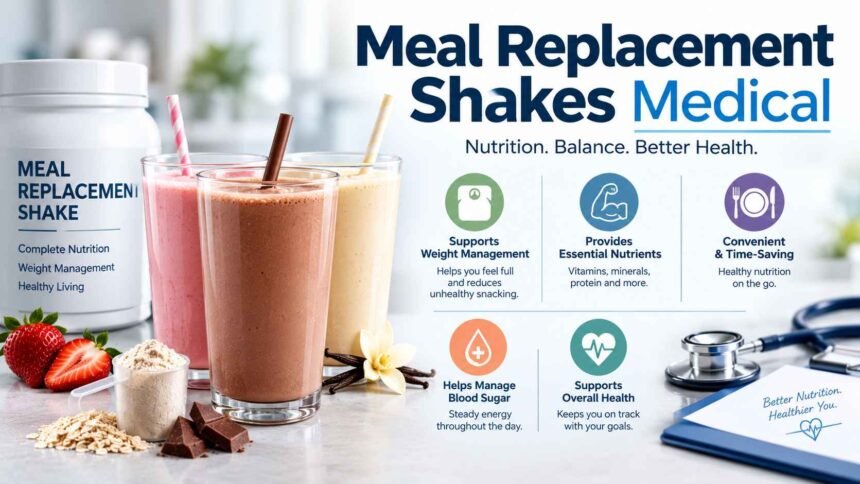
Meal replacement shakes medical programs and the shakes in your supermarket aisle can look almost identical: a tub of powder, a flavor, a protein number on the label. In practice they are very different tools. One is a convenience food meant to replace a meal or two inside an ordinary diet. The other is a clinical treatment that replaces nearly all food, run by a medical team under a protocol with lab tests, medication changes, and a planned exit.
Confusing the two is where people get hurt. Some skip the supervision and copy the calorie level. Others assume a clinical-grade program is needed when a simple grocery shake would do. This guide separates them: what each product is, what the evidence shows, who each suits, who should avoid them, and how to decide.
Meal Replacement Shakes: Two Very Different Categories
The phrase “meal replacement shake” covers two product categories with different purposes, calorie levels, and safety requirements.
Category 1: Grocery and pharmacy shakes. These are sold over the counter, usually as ready-to-drink bottles or powders, and are designed to replace one or sometimes two meals a day. The rest of your day is ordinary food. A typical serving provides a few hundred calories, protein, some fiber, and added vitamins and minerals. You buy them without a prescription or appointment.
Category 2: Medically supervised very low calorie diet (VLCD) formulas. These replace all or almost all meals for a set period, supplying around 800 calories a day or less. The NIDDK dictionary entry for the very low-calorie diet describes a VLCD as a diet supervised by a health care professional that often uses commercially prepared formulas to promote rapid weight loss in some patients with obesity, with people usually consuming about 800 calories a day or less.
When someone searches for meal replacement shakes medical information, they usually want to know whether a doctor-run program is meaningfully different from what they can buy themselves. It is, and the difference is the supervision, the formulation, the intensity, and the intended patient.
A Quick Side-by-Side Overview
| Feature | Grocery meal replacement shake | Medically supervised VLCD |
|---|---|---|
| Purpose | Convenience, portion control, modest calorie reduction | Rapid, therapeutic weight loss |
| Daily calories | Part of a normal 1,200–2,000+ kcal diet | About 800 kcal or less |
| Share of daily food | Usually 1–2 meals | All or nearly all meals |
| Supervision | None required | Physician or clinical team |
| Lab monitoring | None | Regular blood tests and clinic visits |
| Medication adjustment | Not addressed | Often essential |
| Duration | Open-ended | Typically up to about 12 weeks |
| Target user | Generally healthy adults | Adults with obesity and a medical reason |
| Exit plan | Not applicable | Structured food reintroduction and maintenance |

Grocery Meal Replacement Shakes: What They Are and Are Not
What You Are Actually Buying
Grocery shakes are formulated as convenient, relatively balanced mini-meals. Most contain:
- Protein, commonly 10 to 30 g per serving from milk, soy, pea, or other sources
- Carbohydrate and fiber in widely varying amounts, often with added sugars or sweeteners
- Fat at low to moderate levels
- Added vitamins and minerals, often 20 to 35% of daily values per serving
- Calories commonly in the 150 to 400 range, depending on whether the product is aimed at weight loss, general nutrition, or bulking
Products differ enormously. Some are essentially fortified milkshakes. Some are high-protein products closer to a sports drink. Others are built for older adults who struggle to eat enough, and these can have more calories than a typical meal. Reading the label matters more than reading the front of the tub.
Regulation: Why “Meal Replacement” Is a Loose Term
In many markets, grocery meal replacement shakes are sold as conventional foods or dietary supplements, not as medical treatments. This means the claims, dosing, and quality control are less tightly constrained than for a prescribed or clinically supervised product. In practice:
- A label that says “meal replacement” does not guarantee the product is nutritionally complete in the clinical sense.
- Calorie and nutrient content vary by brand and even by flavor.
- Nobody checks whether you, personally, should be using it.
That is not a reason to avoid them. It is a reason to treat them like any other packaged food: compare labels and judge them against your own needs.
What the Evidence Says About Grocery Shakes
Used as a structured part of a reduced-calorie plan, replacing one or two meals per day with a portion-controlled shake has been associated with modestly greater short-term weight loss than a typical self-directed diet. Meal replacements work mainly by making calories predictable. There is no guessing at portions, no cooking, and fewer chances to improvise.
That evidence has limits:
- Trials often include extra support such as counseling, group meetings, or tracking, so the shake alone may not explain the result.
- The benefit usually persists only while people keep using the replacements.
- Long-term data beyond a year or two are thinner.
Who Grocery Shakes Suit
- Adults who want a convenient breakfast or lunch with controlled calories
- People with busy schedules who often skip meals and then overeat
- Older adults or people with poor appetite who need extra nutrition (a different use, with different products)
- Anyone using them as a bridge on a day when a real meal is not practical
Limits and Cautions
- They are not a replacement for a varied diet over the long term.
- Many contain added sugar, sweeteners, or processed ingredients.
- Replacing several meals a day with a grocery product can push calories low without the monitoring a clinical VLCD provides. That is the main risk of copying a VLCD at home.
- People with diabetes, kidney disease, or other conditions should check the carbohydrate, protein, potassium, and phosphorus content with their care team.
Medically Supervised VLCDs: A Clinical Treatment, Not a Product
What a VLCD Is
A very low calorie diet restricts intake to about 800 kcal per day or less, usually by replacing normal meals with a nutritionally complete formula. The formulas are designed to supply essential protein, vitamins, minerals, fatty acids, and electrolytes within that tight calorie budget, so the body gets what it needs despite eating very little.
The structure matters as much as the shake. A well-run program typically includes:
- Medical screening before starting, covering history, medications, labs, and often an ECG.
- Regular clinic visits and lab tests during the program.
- Medication adjustments (especially for diabetes and blood pressure).
- Behavioral and lifestyle support, because rapid loss is useless without a plan to keep it.
- A stepped transition back to regular food and a long-term maintenance plan.
A University of Washington patient handout on medically managed VLCDs lays out this model: patients eat protein-enriched meal replacements, have regular lab tests and clinic visits, and are managed by a team because the diet is not appropriate for everyone. That description of supervision is the core of what separates a clinical program from a shake you can buy at a store.
How Much Weight Can Be Lost
The most cited review is the JAMA report from the National Task Force on the Prevention and Treatment of Obesity, which summarized the evidence on VLCD safety and efficacy. It found weight loss on VLCDs averaged 1.5 to 2.5 kg per week, with total loss after 12 to 16 weeks averaging around 20 kg. Standard 1,200 kcal diets in the same review produced about 0.4 to 0.5 kg per week and an average total of 6 to 8 kg.
The same report is also a sober read on the downsides:
- Serious complications of modern VLCDs were described as unusual, with gallstones the most common.
- There was little evidence that going below 800 kcal produced better results than about 800 kcal.
- Long-term maintenance of weight lost on a VLCD was not very satisfactory and was no better than with other obesity treatments.
That is a 1990s analysis, and formulas and program design have improved. But the central tension has not gone away: VLCDs lose weight fast, and keeping it off is the hard part.
Not the Same as Grocery Shakes
Patient-education material derived from NIH publications makes the point explicitly: VLCD formulas are not the same as the meal replacements sold at grocery stores or pharmacies, which are meant to replace one or two meals a day and should account for only part of daily calories. Over-the-counter shakes, bars, and entrees are built for partial replacement. Using them as your only food at 800 kcal a day, without supervision, is not a VLCD. It is an unsupervised crash diet with a nicer label.
Duration
Clinical VLCDs are short-term by design. Public health guidance generally limits them to about 12 weeks, followed by stepped food reintroduction. Longer unsupervised use increases the risk of nutrient deficiencies, gallstones, muscle loss, and metabolic adaptation.
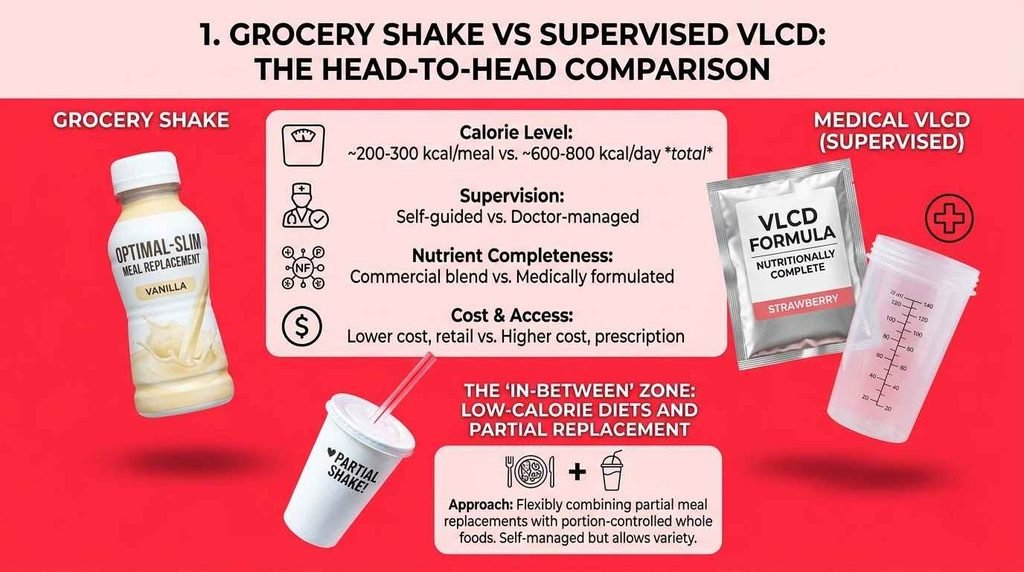
Grocery Shake vs Supervised VLCD: The Head-to-Head Comparison
Calories and Intensity
A grocery shake used for one meal a day barely changes the structure of your diet. A VLCD cuts intake to roughly a third or a half of normal needs. These sit at opposite ends of the intensity spectrum, and the physiological effects (ketosis, rapid fluid shifts, changes in blood pressure and glucose) are completely different.
Safety Net
On a grocery shake plan, nobody is monitoring your electrolytes, blood glucose, liver enzymes, or heart rhythm. On a VLCD, that monitoring is the point. Rapid weight loss can cause problems that you will not necessarily feel until they are significant, and the supervision exists to catch them.
Medication Management
This is among the most important differences and the most overlooked. When someone with type 2 diabetes or high blood pressure drops to 800 kcal a day, medication needs can change within days. Insulin and sulfonylureas can cause dangerous low blood sugar. Blood pressure drugs can lead to dizziness and fainting as pressure falls. Diuretics can compound fluid and electrolyte losses.
In supervised programs, clinicians reduce or stop medications at the start and adjust them as weight falls. The DiRECT trial protocol, discussed below, withdrew antidiabetic and blood pressure drugs at the start of total diet replacement. No grocery shake product includes that service.
Cost and Access
Grocery shakes are cheap and available immediately. Supervised programs involve clinic fees, formula costs, and time commitments, and access varies widely by region and insurance. That cost buys supervision, structure, and follow-up.
Outcomes
VLCDs produce faster and often larger early weight loss. Grocery shakes produce slower, steadier changes that are easier to sustain for many people. Neither reliably prevents regain without ongoing lifestyle change.
What DiRECT Shows About Medically Supervised Meal Replacement
The strongest modern evidence for supervised meal replacement comes from the Diabetes Remission Clinical Trial (DiRECT), a UK primary-care trial of adults with recent-onset type 2 diabetes.
The Intervention
Participants stopped diabetes and blood pressure medications and followed a total diet replacement formula of roughly 825 to 853 kcal per day for about three to five months. That was followed by stepped food reintroduction and structured support to maintain weight loss. This is what a medically supervised program looks like in a research setting: a formula diet embedded in clinical care.
The Results
According to Newcastle University’s announcement of the DiRECT five-year extension, almost half of participants (46%) were in diabetes remission at one year and 36% at two years. For those in remission at the end of year two, 26% were still in remission at year five. The study was published in The Lancet Diabetes & Endocrinology.
The University of Glasgow’s summary adds that the five-year results showed a halving of serious medical events needing hospitalization among those who received the diet intervention, suggesting wider health benefits. The full DiRECT five-year paper reports that weight management intervention at two years resulted in mean weight loss of 7.6 kg, with 36% of participants in remission.
How to Read These Results Honestly
DiRECT is encouraging, and it shows what supervised meal replacement can do for a specific group. But keep the context in view:
- The population was specific: adults with type 2 diabetes diagnosed within about six years and not on insulin.
- Support was intensive: the structure, coaching, and follow-up are not available from a shake alone.
- Remission faded for many: the drop from 46% at one year to a smaller share at five years shows how hard maintenance is.
- Critics note the resource needs: commentary in clinical references notes that the level of dietary and motivational support in the trial is not routinely available in primary care.
The lesson is not “shakes reverse diabetes.” It is that a carefully supervised formula diet, combined with medication management and long-term support, can produce meaningful metabolic change in the right patient.
Who Might Be a Candidate for a Medically Supervised VLCD
Eligibility is decided by clinicians, but programs generally consider adults with obesity, often defined as a BMI of 30 or above, particularly those with a BMI above 35 or 40, or with weight-related conditions. Common reasons include:
- Type 2 diabetes where substantial weight loss may improve or put the condition into remission
- Preparation for bariatric surgery or other surgery, where reducing liver size and surgical risk matters
- Obesity with serious comorbidities such as sleep apnea, fatty liver disease, or hypertension
- Failure of less intensive approaches where a clinician judges rapid loss to be worthwhile
Who Should Not Use a VLCD
VLCDs are not suitable for many people. Programs commonly exclude or require special caution for:
- Pregnant or breastfeeding women
- Children and adolescents (outside specialist care)
- People with type 1 diabetes (risk of ketoacidosis)
- Active or past eating disorders
- Recent heart attack, unstable heart disease, or arrhythmias
- Significant kidney, liver, or gallbladder disease
- Active psychiatric illness affecting eating
- Older adults (limited evidence and greater risk of muscle loss)
- Anyone taking medications that require tight monitoring unless a clinician manages them
If you fall into any of these groups, do not try to approximate a VLCD with grocery products. See a clinician.
Risks and Side Effects of Very Low Calorie Diets
Even supervised VLCDs carry risks. Knowing them helps explain why supervision matters.
Common, Usually Manageable
- Fatigue, lightheadedness, and headaches, especially in the first week
- Constipation or diarrhea, from the low-fiber, liquid nature of the diet
- Hair thinning during rapid weight loss
- Feeling cold, irritability, or poor concentration
- Bad breath (ketosis)
- Muscle cramps from electrolyte changes
Serious but Less Common
- Gallstones: rapid weight loss changes bile composition. The JAMA task force report identified gallstones as the most common serious complication.
- Electrolyte disturbances, including low potassium or sodium, which can affect heart rhythm
- Low blood pressure and fainting, especially if medications aren’t adjusted
- Low blood sugar in people taking glucose-lowering drugs
- Nutrient deficiencies if the formula is poorly composed or the diet is extended
- Gout flares in susceptible people
- Muscle loss if protein and activity aren’t managed
Regain
Weight regain is not a side effect of the formula itself, but it is the most common outcome without maintenance. Patient information from health services stresses that although VLCDs can produce short-term loss, weight is likely to return after the diet ends if there is no wider plan. This is why programs include food reintroduction and long-term support, and why a crash diet with no follow-up usually fails.
The “In-Between” Zone: Low-Calorie Diets and Partial Replacement
Between a grocery shake once a day and a full VLCD sits a middle option: a low-calorie diet (LCD) of roughly 1,000 to 1,500 kcal per day, often using meal replacements for two or three meals plus regular food for the rest.
For many people, this is the most sensible zone:
- Weight loss is slower but steadier, around 0.5 kg per week or somewhat more.
- Adherence is generally better, since the diet is less extreme.
- Risks are lower, though still worth discussing with a clinician if you have health conditions.
- Studies show that diets of around 800 to 1,000 kcal can produce similar results to VLCDs, likely because people stick to them more easily.
If your goal is steady weight loss without clinic visits, a structured LCD with partial meal replacement is a more realistic and safer self-directed option than an unsupervised 800 kcal plan.
How to Choose: A Practical Decision Guide
Use this framework to decide which category fits your situation.
Choose a Grocery Shake If You
- Are generally healthy and want a convenient, portion-controlled meal
- Plan to use it for one or two meals while eating regular food otherwise
- Have no conditions requiring medication adjustments with weight change
- Want a flexible, low-cost option
Consider a Medically Supervised Program If You
- Have obesity with weight-related conditions such as type 2 diabetes
- Have tried other approaches without success
- Need substantial weight loss for health or surgical reasons
- Can commit to clinic visits, labs, and a long maintenance phase
- Have a clinician willing to supervise
Do Not Try an Unsupervised VLCD If You
- Take medications for diabetes or blood pressure
- Have heart, kidney, liver, or gallbladder disease
- Are pregnant, breastfeeding, or have a history of disordered eating
- Are under 18 or older with frailty
- Would be eating 800 kcal or less of grocery products on your own
Questions to Ask a Clinician
- Is a VLCD appropriate for my medical history and medications?
- How will you adjust my medications as I lose weight?
- What monitoring will I have, and how often?
- How long will the diet last, and what happens afterward?
- What support will I get for maintenance?
- What are the costs, including formulas and visits?
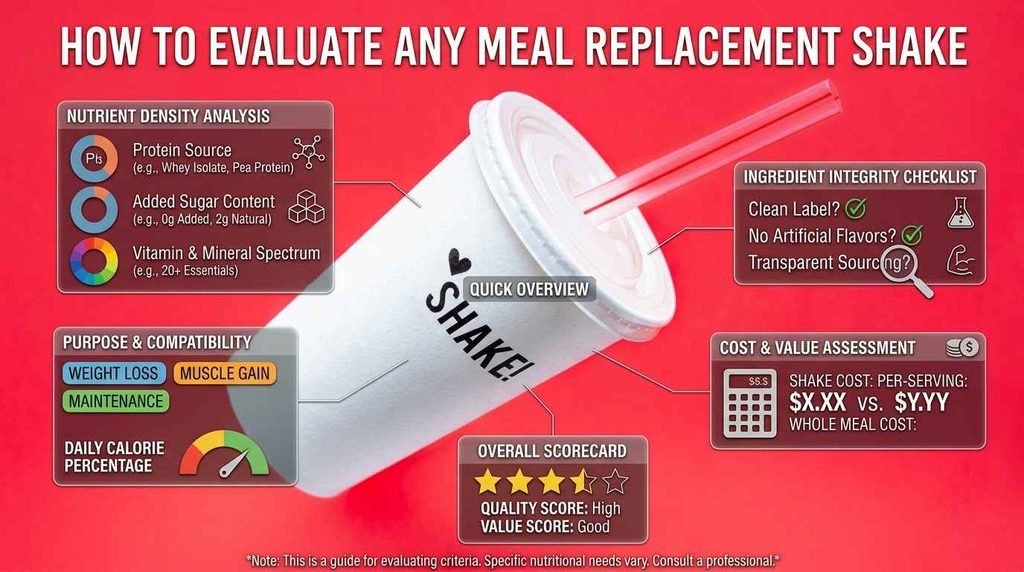
How to Evaluate Any Meal Replacement Shake
Whether you are buying a grocery product or discussing a clinical formula, a few checks help.
Read the calories per serving. Some shakes are 100 to 150 kcal snacks, others 400 or more. Know what you are replacing.
Check protein. For meal replacement, many people look for roughly 15 to 30 g per serving. Protein helps with fullness and preserving muscle during weight loss.
Check sugar and sweeteners. Added sugar can undermine the point. Some products use sugar alcohols that cause digestive upset.
Look at fiber. More fiber means better fullness and gut function.
Check micronutrients. Meal replacements should provide a meaningful share of daily vitamins and minerals. A protein shake alone isn’t a meal replacement.
Look for third-party testing, especially for products making strong claims.
Match the product to the purpose. A bulking shake is not a weight-loss tool, and a weight-loss shake is not appropriate for someone who is underweight or recovering from illness.
Be cautious with products claiming “medical” status. The phrase meal replacement shakes medical is sometimes used in marketing for products that are not supervised programs at all. A “medical grade” label doesn’t mean a doctor is involved. If supervision is the point, confirm who is actually managing the program.
Practical Tips for Using Meal Replacement Shakes Safely
For Grocery Shakes
- Start with one meal a day, usually breakfast or lunch.
- Eat real food for the rest, including vegetables, protein, and whole grains.
- Don’t push beyond two replacements a day without medical advice.
- Stay hydrated.
- Watch your hunger and energy. Persistent dizziness or fatigue means you should eat more and seek advice.
- Plan the exit: build habits around real meals so you aren’t dependent on the product.
For Supervised Programs
- Follow the protocol exactly, including fluid targets and supplements your team recommends.
- Report symptoms early, such as dizziness, palpitations, severe cramps, or abdominal pain.
- Attend every appointment and lab visit.
- Don’t extend the program beyond what your team advises.
- Take the reintroduction and maintenance phases seriously. Most of the long-term result is decided there.
- Build activity in, within your clinician’s advice, to protect muscle and support maintenance.
Warning Signs: Get Medical Help
Seek prompt care for chest pain, fainting, a racing or irregular heartbeat, severe abdominal pain (especially upper right, possible gallstones), persistent vomiting, confusion, or very low blood sugar symptoms such as shakiness and sweating in people on glucose-lowering medication.
Common Myths About Meal Replacement Shakes
“A shake is a shake: grocery and medical are the same.” They are not. The difference is calories, formulation, supervision, and purpose.
“If a VLCD works under supervision, I can copy it at home.” The supervision is a large part of why it is acceptable. Copying only the calorie level removes the safety net.
“Fewer calories always means faster, better loss.” The JAMA task force found little evidence that going below 800 kcal improved results.
“Rapid loss is always dangerous.” Under supervision, rapid loss in appropriate patients can be reasonable. Without supervision, in the wrong person, it can be risky.
“Meal replacements are a permanent solution.” They are a tool. Long-term success depends on sustainable eating habits.
“Diabetes remission means it’s cured.” Remission means blood sugar is in the non-diabetic range without medication. It can return, and ongoing monitoring remains necessary.
“Natural or organic shakes are safer for rapid weight loss.” Safety depends on calories, composition, and supervision, not the marketing.
Frequently Asked Questions
What is the difference between a meal replacement shake and a VLCD?
A grocery meal replacement shake replaces one or two meals within an ordinary diet. A VLCD replaces nearly all meals with a formula providing about 800 kcal or less per day under medical supervision.
Can I do a VLCD on my own with shakes from the store?
It is not advisable. Grocery shakes are not designed to be your only food, and without monitoring you risk nutrient deficiencies, electrolyte problems, gallstones, and medication-related complications.
How long can someone stay on a VLCD?
Public health guidance generally limits supervised VLCDs to about 12 weeks, followed by a structured transition back to regular food.
Who is eligible for a medically supervised VLCD?
Typically adults with obesity, especially those with weight-related conditions like type 2 diabetes, who are assessed by a clinician and have no contraindications.
Do I need to adjust my medications?
Often yes. Diabetes and blood pressure medications commonly need changes as you lose weight. Do not adjust them yourself. Your supervising clinician should manage this.
Will I regain the weight?
Regain is common without a maintenance plan. Long-term results depend on food reintroduction, ongoing support, physical activity, and sustainable habits.
Are meal replacement shakes good for diabetes?
Some can fit into a diabetes plan, but carbohydrate content and medication needs matter. Talk to your care team before using them, especially for more than one meal a day.
Are there cheaper alternatives to supervised programs?
A structured low-calorie diet using one to two grocery meal replacements plus regular food is a lower-risk self-directed option for many healthy adults, though it is slower.
How do I know if a program is truly medically supervised?
Ask who the supervising clinician is, how often you will be seen, what labs are done, how medications are handled, and what the maintenance plan includes. If the answers are vague, it is a product, not a program.
Final Takeaway on Meal Replacement Shakes Medical Options
The most useful way to think about meal replacement shakes medical programs versus grocery shakes is as two different tools for two different jobs.
- Grocery shakes are convenience foods. They can help with portion control and calorie awareness when they replace one or two meals within a balanced diet. They are low-risk for most healthy adults, but they are not treatment.
- Medically supervised VLCDs are clinical interventions. They produce faster and larger early weight loss, and in the right patients, such as adults with recent-onset type 2 diabetes, they can lead to remission. They also carry real risks, require monitoring and medication management, and need a long-term maintenance plan.
The line between them is not the shake itself. It is the calorie level, the formulation, the screening, the monitoring, and the plan for what happens afterward.
If you are generally healthy and want help managing portions, a grocery shake for one or two meals is a reasonable, flexible option. If you have obesity with medical complications, talk to your doctor about whether a supervised program makes sense. And if you are tempted to run an 800-calorie plan on your own with store-bought shakes, don’t. The numbers may look the same as in a clinic, but the safeguards are not.