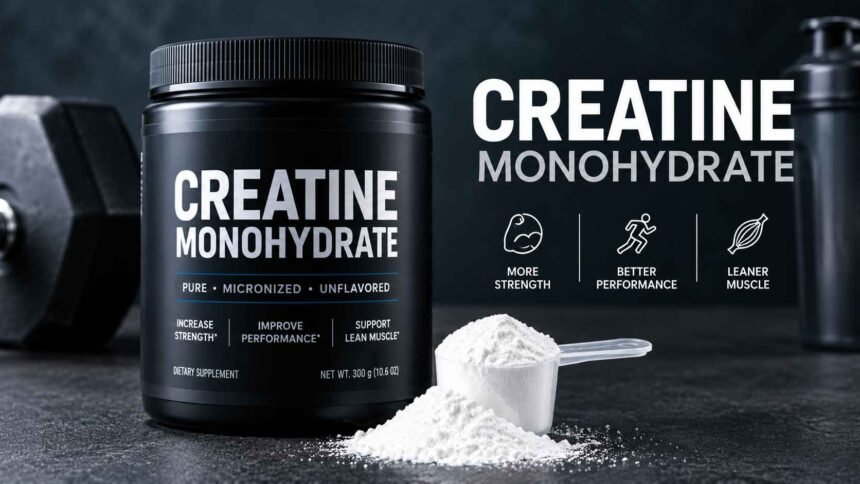
If you lift, sprint, play team sports, or simply want to keep muscle as you age, you have almost certainly been told to take creatine monohydrate. It is the most studied sports supplement in the world, and it is also one of the most misunderstood. Myths about kidney damage, “steroid-like” effects, and mandatory loading phases still circulate in gyms and comment sections.
This guide covers everything in one place: what it is, how it works, loading versus daily dosing, the kidney question, why it is not a steroid, the real creatine monohydrate side effects, how to pick the best creatine monohydrate, and how popular brands and formats (including gummies) compare.
What Is Creatine Monohydrate?
What is creatine monohydrate? It is the supplemental form of creatine, a compound your body already makes and uses every day. Creatine is built from three amino acids (arginine, glycine, and methionine) in the liver, kidneys, and pancreas. You also get it from food, mainly red meat, pork, poultry, and fish. A typical omnivore eats roughly one gram a day. A vegetarian eats close to none.
About 95% of the body’s creatine is stored in skeletal muscle, mostly as phosphocreatine. The rest sits in the brain, heart, and testes. The body turns over roughly 1 to 2% of its creatine pool every day, converting it to creatinine, which the kidneys excrete. That daily loss is the reason supplementation works: you are refilling a tank that drains slowly.
“Monohydrate” refers to the molecular form: one creatine molecule bound to one water molecule. This is the form used in the great majority of research. Other forms (ethyl ester, hydrochloride, buffered creatine, magnesium chelate, and others) are sold with claims of better absorption or fewer side effects, but none has beaten monohydrate in head-to-head evidence. Monohydrate is cheap, stable, and works.
How Creatine Works in the Body
Muscles run on adenosine triphosphate (ATP). During short, intense efforts such as a heavy squat, a sprint, or a jump, ATP is used up within seconds. Phosphocreatine donates a phosphate group to regenerate ATP quickly, letting you sustain high power output slightly longer.
Taking creatine raises the phosphocreatine stored in muscle. The International Society of Sports Nutrition position stand reports that supplementation increases muscle creatine and phosphocreatine by roughly 20 to 40%. That extra buffer translates into practical benefits:
- A rep or two more at the same weight
- Faster recovery between sets
- Greater training volume over weeks, which drives more strength and lean mass
- Better repeated-sprint performance
The benefit is not instant magic. It is a small, reliable edge that compounds across months of training.
Who Benefits Most
- Strength and power athletes: lifters, sprinters, throwers, and team-sport players
- Vegetarians and vegans: lower baseline muscle creatine means a larger response
- Older adults: combined with resistance training, creatine supports muscle and strength as sarcopenia sets in
- Anyone returning from injury or immobilization: it may help limit muscle loss and speed rehabilitation
Endurance athletes see smaller direct performance effects, though creatine can help with high-intensity bursts and recovery.
Loading Phase vs. Daily 3–5 g: Which Should You Choose?
This is the question that generates the most confusion, and the honest answer is that both reach the same destination. The difference is speed.
The Loading Protocol
The classic loading protocol is about 20 g per day (often written as 0.3 g per kilogram of body weight) split into four doses of 5 g, for 5 to 7 days. After loading, you drop to a maintenance dose of 3 to 5 g daily (roughly 0.03 g/kg).
Loading saturates muscle stores within about a week. If you have an event, a testing day, or a competition block coming up, this is the fast route.
The Daily 3–5 g Protocol
Skip loading and take 3 to 5 g every day. Muscle stores fill more gradually, usually reaching saturation in about three to four weeks. After that, the two approaches are essentially identical in muscle creatine levels and performance benefits.
Which Is Better?
| Factor | Loading (20 g/day for 5–7 days) | Daily 3–5 g |
|---|---|---|
| Time to saturation | ~5–7 days | ~3–4 weeks |
| End result | Same | Same |
| Stomach upset risk | Higher (large doses) | Low |
| Water weight shift | Faster, more noticeable | Gradual |
| Convenience | Requires 4 doses/day for a week | One scoop a day |
| Best for | Short timelines, athletes peaking | Most people, long-term use |
My recommendation for most people: skip the load. Take 3 to 5 g daily at any time of day. The benefits arrive a few weeks later, you avoid the bloating and stomach discomfort that large single doses can cause, and you reduce the chance of quitting early because of side effects.
Choose loading if you need results within a week, you are comfortable splitting doses across the day, and you tolerate large powder doses without GI trouble.
Practical Dosing Details
- Timing: consistency matters far more than timing. Some research hints at a slight edge for taking it close to training, but the effect is small. Take it when you will remember.
- With food or not: taking creatine with a meal, especially one with carbohydrates and protein, may modestly improve uptake and is gentler on the stomach.
- Mixing: it dissolves in water, juice, coffee, or a shake. The old myth that caffeine cancels creatine is not supported by strong evidence at normal intakes.
- Missed doses: just resume. Muscle stores decline slowly, over several weeks after stopping, so one missed day changes nothing.
- Cycling: there is no need to cycle on and off. Continuous daily use has been studied for years without problems in healthy people.
- Larger bodies: people with substantial muscle mass sometimes use up to 5 g or slightly more daily. More than that rarely adds benefit.
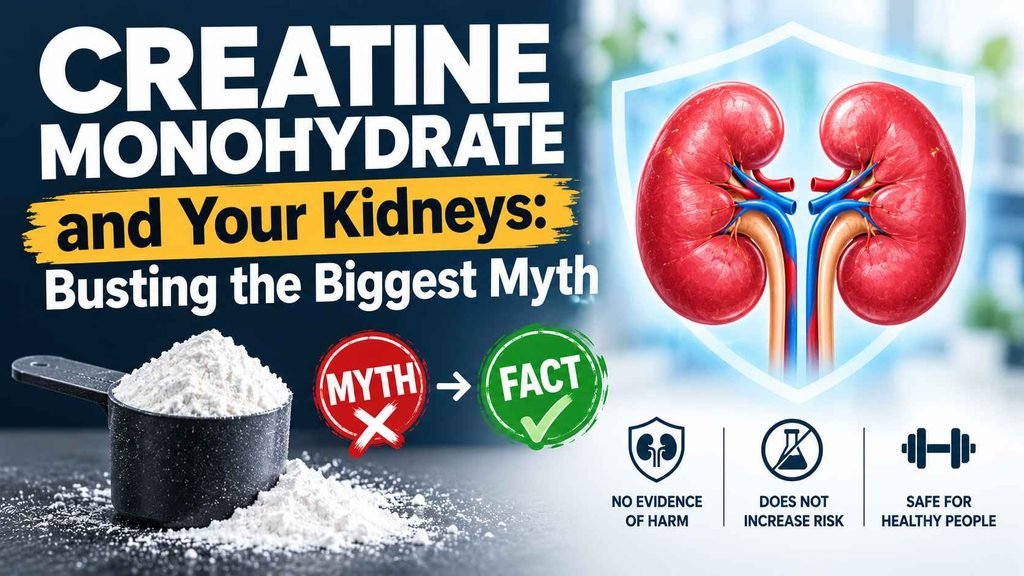
Creatine Monohydrate and Your Kidneys: Busting the Biggest Myth
The claim that creatine harms the kidneys is the most persistent myth in sports nutrition. It deserves a careful, honest answer.
Where the Myth Came From
The story rests on a measurement mix-up. Doctors often assess kidney function using blood creatinine, a breakdown product of creatine and muscle metabolism. When you supplement with creatine, your creatinine can rise slightly, because more creatine is turning over. A lab might flag that number as elevated and suggest reduced kidney function.
But a higher creatinine caused by supplementation is not the same as a kidney that is functioning poorly. It reflects a bigger creatine pool, not damaged filtration. If you take creatine and get a blood test, tell your doctor. They may use a different marker, such as cystatin C, to evaluate your kidneys more accurately.
Early case reports in the 1990s, involving individuals who often had other risk factors or other supplements, fueled the fear. Controlled research since then has not supported it.
What the Evidence Says in Healthy Adults
The ISSN position stand concludes that short- and long-term supplementation, with studies reaching up to 30 g per day for five years, is safe and well tolerated in healthy individuals. As reported by NutraIngredients, the ISSN authors wrote that there is no compelling evidence that creatine supplementation negatively affects renal function in healthy or clinical populations.
Medical institutions echo this. Scripps Health’s explainer on creatine and kidney health notes that studies have not found strong evidence that moderate amounts damage kidney function in healthy adults, and that much of the misinformation stems from confusing creatine with creatinine. It also points out that a daily dose of 3 to 5 g of creatine monohydrate is generally enough for most healthy adults.
The Honest Caveats
“Safe in healthy adults” is not the same as “safe for everyone.” Be careful if you:
- Have kidney disease or reduced kidney function. Research here is limited, and most clinicians recommend avoiding supplemental creatine or using it only under medical supervision.
- Take medications that affect the kidneys, such as certain NSAIDs at high doses, diuretics, or nephrotoxic drugs. Talk to your prescriber.
- Have diabetes or hypertension. These raise kidney risk independent of creatine, so check with your doctor first.
- Are dehydrated chronically or doing extreme cutting protocols. Keep fluids adequate.
If you have any doubt, get a baseline blood test (including eGFR and ideally cystatin C), then discuss it with a clinician.
Bottom line: for healthy adults at normal doses, the kidney myth does not hold up.
Creatine Is Not a Steroid
Another common worry is that creatine monohydrate is a steroid or a “gateway” to steroids. It is neither.
The Chemical and Legal Reality
- Different molecule class. Anabolic steroids are synthetic derivatives of testosterone. Creatine is an amino acid derivative. They share nothing structurally or functionally.
- No hormonal action. Creatine does not bind androgen receptors or act as a hormone. It works by refilling the cellular energy buffer.
- Natural source. You make it yourself and eat it in meat and fish.
- Not banned. It is not on the World Anti-Doping Agency prohibited list, is allowed in virtually all major sports, and is not a controlled substance.
- Sold legally as a dietary supplement in most countries.
Why People Mix It Up
Two reasons. First, the visible effects, such as extra muscle size and strength, look similar to what steroids produce, so people assume the mechanism must be similar. Second, creatine is heavily marketed alongside pre-workouts and mass gainers in the same aisle, which blurs distinctions.
The magnitude is also very different. Creatine’s effect is modest: a few percentage points more strength and perhaps a kilo or two of lean mass over months of training. Steroids produce much larger changes with substantial health and legal risks.
The ISSN position even describes creatine as a nutritional alternative with a favorable safety profile compared with potentially dangerous anabolic androgenic drugs. Their view is that label warnings against use under 18 are likely unnecessary given the science, though they recommend proper precautions and supervision for young athletes.
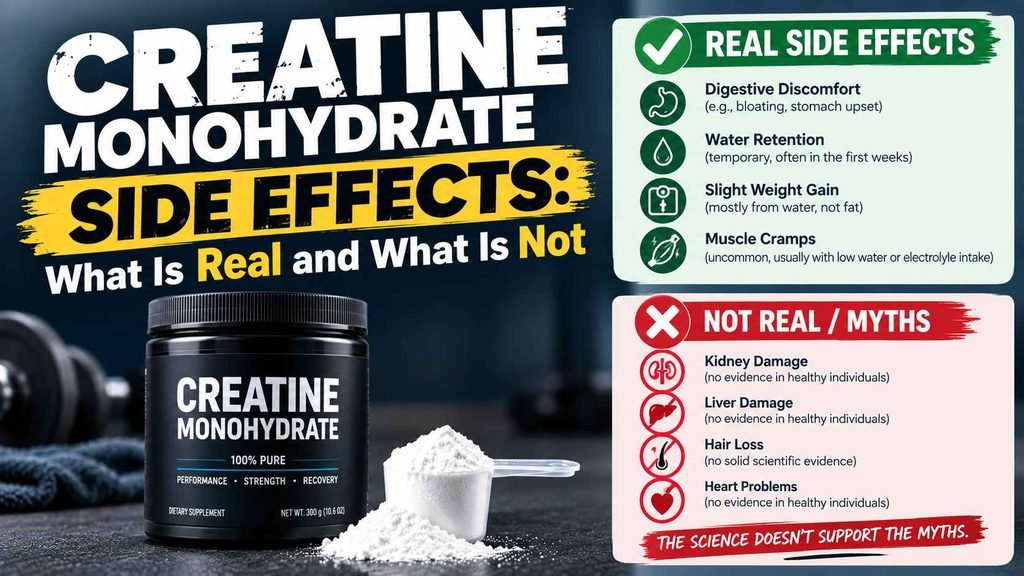
Creatine Monohydrate Side Effects: What Is Real and What Is Not
An honest look at creatine monohydrate side effects separates the real, minor ones from the myths.
Real and Common
Water weight gain. The most reliable effect. Creatine pulls water into muscle cells, which can add 1 to 2 kg (roughly 2 to 4 lb) in the first weeks. This is intracellular water, not fat, and it is part of how creatine works. Muscles can look fuller.
Stomach discomfort. Large single doses (more than about 5 to 10 g at once) can cause nausea, cramping, or loose stools, especially on an empty stomach. Fixes: split doses, take with food, use a micronized product that dissolves better, and skip the loading phase.
Non-responders. About 20 to 30% of people see minimal gains, often because their baseline muscle creatine is already high (for example, heavy meat eaters). This isn’t a side effect, but it can feel like a failure.
Commonly Claimed, Weakly Supported
Muscle cramps and dehydration. This is probably the most repeated claim, but controlled studies, including those in hot conditions, haven’t shown increased cramping or heat illness. Staying hydrated is wise either way.
Hair loss. One small 2009 study in rugby players found a rise in dihydrotestosterone (DHT), a hormone linked to male pattern baldness, after loading. It has not been replicated convincingly, and no study has demonstrated actual hair loss caused by creatine. If you are genetically prone to hair loss, the concern is theoretical rather than proven.
Bloating that looks like fat gain. The water retention is inside muscle, not under the skin. It usually settles as your body adapts.
Liver damage. Studies in healthy people have not found liver enzyme elevations at standard doses.
Rare or Situational
- Allergic reaction or rash: rare, usually from additives rather than creatine itself.
- Interaction with caffeine or stimulants: evidence is inconsistent; moderate intakes appear fine.
- Pregnancy and breastfeeding: research is limited, so consult a clinician.
For a conservative clinical view of cautions and side effects, Cleveland Clinic’s creatine dosage-form page lists issues to report to a doctor and mentions kidney disease as a condition to discuss before use.
Quick Safety Checklist
- Start with 3 to 5 g daily.
- Drink water through the day.
- Take with food if your stomach is sensitive.
- Tell your doctor if you take it before blood tests.
- Avoid it, or ask your doctor first, if you have kidney disease.
How to Choose the Best Creatine Monohydrate
With dozens of tubs on shelves, how do you pick the best creatine monohydrate? Skip the flashy marketing and check these factors.
1. Pure Creatine Monohydrate, Nothing Else
The simplest products have one ingredient. Avoid “matrix” blends and kitchen-sink formulas that include stimulants, proprietary blends, and fillers. If you want a pre-workout, buy one separately; don’t pay creatine prices for 5 g of mystery.
2. Third-Party Testing
Supplements are loosely regulated in many markets. Look for independent verification such as NSF Certified for Sport, Informed Sport, or Informed Choice, or at least a published certificate of analysis. This matters most for competitive athletes subject to drug testing, but it benefits everyone because it checks for contaminants and label accuracy.
3. Purity Source and Raw Material
The gold-standard raw material is Creapure, a branded, high-purity form made in Germany by AlzChem. Many brands use it and advertise it on the label. Creapure creatine monohydrate is manufactured to tight purity specifications with very low levels of impurities such as dicyandiamide and dihydrotriazine. It is not the only good raw material, and a product without the Creapure logo can still be excellent, but the logo is a quick quality signal. Many Creapure products cost somewhat more.
4. Micronized vs. Standard
“Micronized” means the particles are milled finer so the powder mixes more easily. The creatine is the same. If you dislike gritty drinks or get stomach upset, micronized is a sensible choice. If you don’t mind stirring, standard powder works identically.
5. Price Per Serving
Because every monohydrate delivers the same molecule, price per 5 g serving is a fair comparison among tested products. Large tubs of unflavored powder are usually the cheapest.
6. Flavored vs. Unflavored
Unflavored dissolves into almost anything. Flavored versions add sweeteners, acids, and colors you may not need. Choose based on whether you will actually take it consistently.
7. Format: Powder, Capsules, or Gummies
Powder is the cheapest and most reliably dosed. Capsules are convenient but require several to reach 5 g. Gummies are the most problematic, as discussed below.
A Simple Buying Rule
Pick a single-ingredient creatine monohydrate powder with third-party testing or a Creapure label at a fair price per serving. That is the best creatine monohydrate for nearly everyone.
Brand Breakdown: Nutricost, Thorne, and Bucked Up
Searchers often look for specific brands. Here is how to think about three popular ones. Formulations, certifications, and pricing change, so always read the current label and testing documentation before buying.
Nutricost Creatine Monohydrate
Nutricost creatine monohydrate is a staple of the value end of the market. It is popular because it is simple: a single-ingredient powder sold in large containers at a low price per serving. Reviewers often point to its value and clean ingredient list.
When evaluating nutricost creatine monohydrate powder, check:
- Whether you are buying the standard micronized version or a version using a branded raw material such as Creapure (Nutricost has offered different variants)
- The serving size on the label (commonly 5 g)
- Any third-party testing statement or certificate of analysis for the specific batch
- Whether the container is unflavored or flavored
It’s a strong candidate if your priority is the lowest cost per gram without sacrificing the basics. If you compete in drug-tested sport, look for a certification such as NSF Certified for Sport on the exact SKU.
Thorne Creatine Monohydrate
Thorne creatine monohydrate sits at the premium, quality-assurance end. Thorne is known for its focus on athletes and for products certified under programs such as NSF Certified for Sport. For tested athletes, that certification matters because it screens for banned substances and verifies that what’s on the label is in the tub.
The tradeoff is price: you typically pay more per serving than for budget brands. If you compete in a tested federation, work with a team that requires certified supplements, or just want strong quality control, the premium is justified. If you’re a recreational lifter, you can pay less and get the same molecule.
Bucked Up Creatine Monohydrate
Bucked Up creatine monohydrate comes from a brand better known for pre-workouts and a bold, high-energy marketing style. Bucked Up offers creatine products aimed at gym-goers who like flavored options and brand culture. As with any product from a stimulant-heavy brand, make sure you are buying the actual single-ingredient creatine rather than a creatine-containing blend, and check the label for added sweeteners, flavors, or additional ingredients.
Key checks: the amount of creatine per serving, the other ingredients listed, whether the product has independent testing, and the price per serving compared with plain powders.
The Bottom Line on Brands
All three can deliver the same active compound. Differences come down to:
| Priority | What to look for |
|---|---|
| Lowest cost | Large unflavored tub from a value brand |
| Tested-athlete safety | NSF Certified for Sport or Informed Sport on the exact product |
| Highest raw-material purity | Creapure label |
| Taste and convenience | Flavored powder, with the added ingredients in mind |
Don’t pay a premium for marketing. Pay for verified purity and testing if you need them.
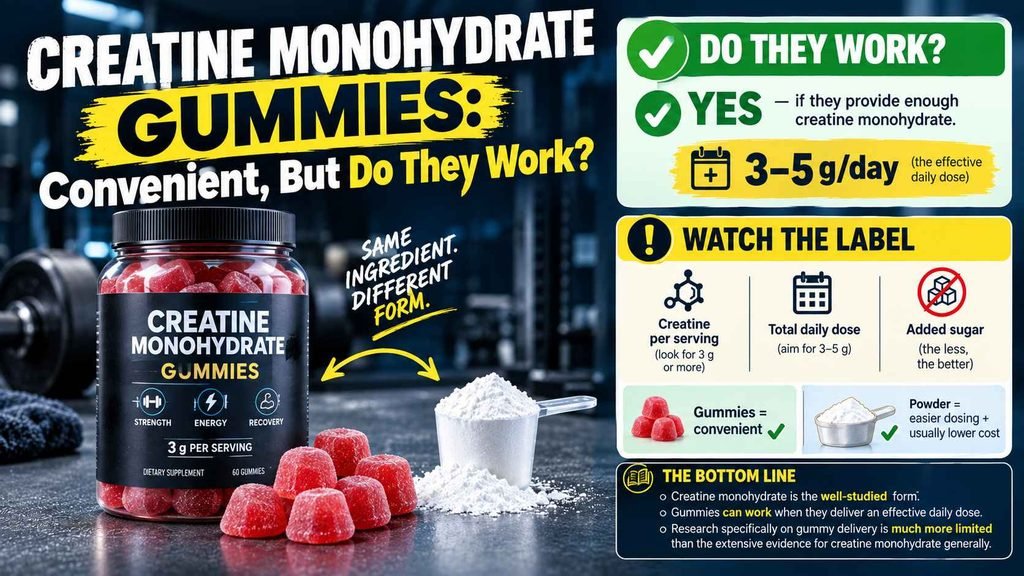
Creatine Monohydrate Gummies: Convenient, But Do They Work?
Creatine monohydrate gummies have exploded in popularity. They taste good, require no mixing, and feel more like candy than a supplement. The concern is whether they contain what the label says.
The Stability Problem
Creatine is not stable in warm, acidic, water-containing environments. In solution, it slowly converts to creatinine, which is inactive for performance. Gummies involve heat during manufacturing, acidic flavoring, and moisture, which are exactly the conditions that degrade creatine.
What Independent Testing Found
- In 2025, SuppCo bought creatine products from Amazon and sent them to an ISO-accredited lab. According to Athletech News’ coverage of the SuppCo report, powders performed well while many gummies were “massive failures,” with some containing little or no creatine and high creatinine levels. One popular gummy did pass, with slightly more creatine than advertised, so results vary by brand.
- Supplement maker NOW tested 12 creatine gummy brands. Natural Products Insider reported that five contained little to none of the labeled creatine, and the failing products also showed signs of creatine degradation. Seven met their label claims.
Dose Math
Many gummies supply 1.5 to 3 g of creatine per serving, so you may need several to reach 5 g. That raises sugar intake and cost per gram of creatine well above powder.
Verdict
Gummies can work if the creatine is really there, because the molecule is the same. But:
- Few peer-reviewed trials test gummies specifically
- Quality varies widely
- They cost more per gram
- Sugar and additives add up
If you love gummies and find a brand with a recent third-party test showing it meets its label, they are a reasonable choice. For everyone else, powder is the better value and the better bet.
Creapure Creatine Monohydrate: Is It Worth It?
Creapure creatine monohydrate deserves its own look since the question comes up constantly.
What Creapure Is
Creapure is a trademarked, high-purity creatine monohydrate manufactured in Germany. It’s produced under strict quality control and tested for contaminants and by-products. Brands that use it often display the logo on the packaging.
Does It Work Better?
No. Creapure and a clean, standard monohydrate are the same molecule, so muscle response should be equivalent. What you are paying for is purity assurance and consistency. Lower-grade raw materials from unverified sources can contain impurities, which is why third-party testing and brand reputation matter.
When It Is Worth the Premium
- You want a tested, traceable raw material and are willing to pay a little more
- You are cautious about contaminants
- You buy products where the label specifies Creapure and the brand is otherwise reputable
If a tested budget powder is available at a better price, that works too. Verification beats logos.
How to Take Creatine Monohydrate: A Practical Plan
Here is a straightforward protocol.
Step 1: Pick your product. Single-ingredient creatine monohydrate powder with independent testing or a Creapure label.
Step 2: Choose your approach.
- Standard: 3 to 5 g daily, no load
- Fast: 20 g/day split into four doses for 5 to 7 days, then 3 to 5 g daily
Step 3: Take it consistently. Any time of day works. Pair it with a routine meal or shake so you don’t forget.
Step 4: Mix it well. Stir 5 g into 200 to 300 ml of water, juice, or a shake. Warm liquids dissolve it faster, but avoid long storage in liquid, since creatine slowly degrades in solution.
Step 5: Train and eat properly. Creatine amplifies training. It does not replace progressive overload, adequate protein, and sleep.
Step 6: Be patient. Give it at least four weeks on the daily plan before judging results.
Step 7: Stay hydrated and monitor. Drink water regularly. If you have health conditions or take medications, get medical advice and mention creatine before blood work.
Creatine for Specific Groups
- Women: the same dose works. Creatine may support strength, bone health, and mood-related outcomes, and it’s no more “bulky” than for men.
- Vegetarians and vegans: often see larger gains because of low baseline stores.
- Older adults: combined with resistance training, creatine supports muscle and strength. Check kidney function first.
- Teens: the ISSN position stand considers supplementation acceptable under proper precautions and supervision in adolescent athletes, but it’s wise to involve a pediatrician or sports-medicine doctor.
Common Creatine Myths, Quickly Corrected
“Creatine is a steroid.” No. It’s an amino acid derivative with no hormonal action.
“You must load.” No. Daily 3 to 5 g reaches the same saturation in about a month.
“It damages kidneys.” Not in healthy adults at normal doses, according to long-term evidence.
“You need to cycle it.” No evidence supports cycling.
“Only bodybuilders benefit.” Older adults, vegetarians, and athletes in many sports benefit.
“It’s all water weight.” Early weight gain is water in muscle, but over time training with creatine builds real lean mass.
“Fancier forms absorb better.” Monohydrate remains the best-supported form.
“Gummies are just as good.” Only if they really contain the labeled amount, which independent testing says is often not the case.
Frequently Asked Questions
Is creatine monohydrate safe to take every day?
For healthy adults, yes. Daily use at 3 to 5 g is the standard approach, and long-term studies have not shown harm in healthy people.
How long does creatine take to work?
About a week with loading, about three to four weeks without.
What happens when you stop?
Muscle creatine returns to baseline over several weeks. You may lose some water weight and a little performance edge, but you don’t lose the muscle you built through training.
Can I take creatine on rest days?
Yes. Daily intake keeps stores topped up.
Does creatine make you gain fat?
No. It doesn’t add calories in a meaningful way. Weight gain is mostly water and lean tissue.
What’s the best time to take it?
Whenever you’ll do it consistently. A meal is a good anchor.
Do I need to drink more water?
Normal healthy hydration is enough, though drinking regularly is sensible.
Can I mix it with caffeine?
Moderate caffeine is generally fine.
Is creatine good for the brain?
Early research suggests possible cognitive benefits, particularly under sleep deprivation or in vegetarians, but the evidence is still developing.
The Final Word on Creatine Monohydrate
Creatine monohydrate earns its reputation. It is inexpensive, backed by decades of research, and effective for strength, power, and training adaptation. The fears that follow it around have not held up under scrutiny: it is not a steroid, it does not damage healthy kidneys at normal doses, and its common side effects are mild and manageable.
Keep it simple:
- Buy single-ingredient creatine monohydrate with independent testing or a Creapure label.
- Take 3 to 5 g daily. Load only if you need speed.
- Be skeptical of gummies unless a brand shows recent third-party proof.
- See a doctor first if you have kidney disease, take kidney-affecting medication, or are pregnant.
- Combine it with consistent training, adequate protein, and good sleep.
Whether you reach for Nutricost, Thorne, Bucked Up, or another brand, the active ingredient is the same. What you are really choosing is price, testing, and trust. Choose accordingly, take it daily, and let the training do the rest.
Disclaimer: This article is for educational purposes only and does not replace medical advice. Consult a qualified healthcare professional before starting any supplement, especially if you have a medical condition or take medication.