

HDL cholesterol is often called the good cholesterol, but what does that really mean? It helps carry extra cholesterol out of your blood so it does not build up in your arteries. When levels are too low, your heart health may be at risk. That is why so many people ask how to raise it safely.
This guide explains the HDL cholesterol meaning in plain language. You will learn why HDL is good, what causes low HDL cholesterol, and why very high HDL cholesterol is not always better. We also explain non-HDL cholesterol, a number your doctor may use to judge heart risk.
You will find nine practical ways to raise your levels, simple food tips, and easy tables to follow. Everything is based on trusted sources like the American Heart Association and MedlinePlus. Use it as a friendly starting point, and always talk to your own doctor before making changes.
Why HDL Cholesterol Deserves Your Attention
Most people hear about cholesterol only when a test comes back with a worrying number. Then they are told to eat less fat and take a pill. But cholesterol is not all bad, and HDL cholesterol proves it.
Your body needs cholesterol to build cells and make hormones. The trouble starts when too much of the wrong kind builds up in your blood. HDL cholesterol is the helper that works against this problem.
This guide is written for everyday readers. We keep the language simple and the paragraphs short. We also follow the E-E-A-T approach: experience, expertise, authority, and trust.
Because this is a health topic, we link to respected sources like the American Heart Association’s guide to HDL and LDL cholesterol. You can read them for more detail. This article supports your doctor’s advice and never replaces it.
HDL Cholesterol Meaning: What Does It Stand For?
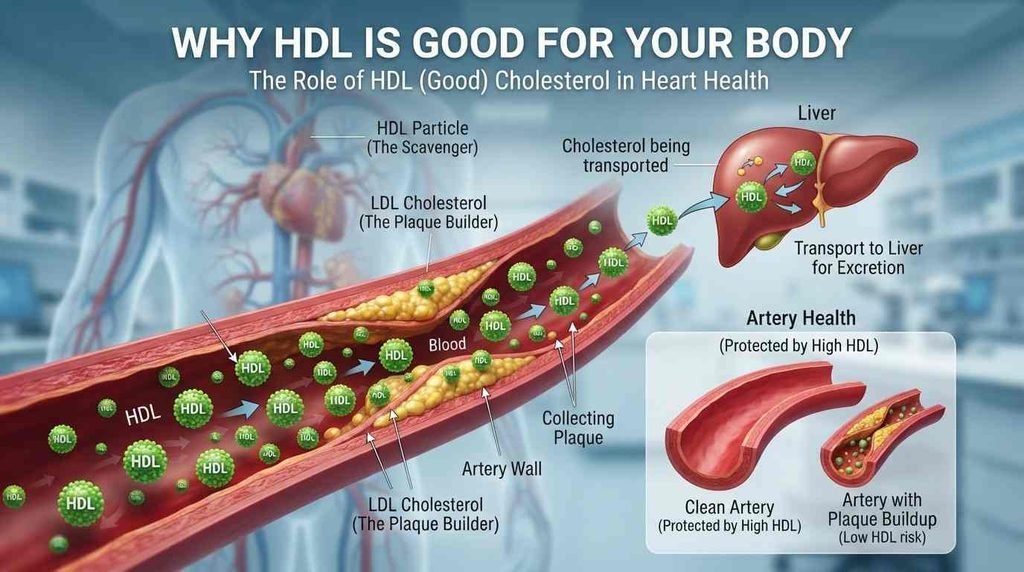
HDL stands for high-density lipoprotein. That is a mouthful, so let us break it down. A lipoprotein is a tiny package made of fat and protein that travels through your blood.
Cholesterol is a waxy, fat-like substance. It cannot move through blood on its own because fat and water do not mix. So your body wraps it in lipoproteins, which act like little delivery trucks.
The HDL cholesterol meaning comes down to this: it is the cholesterol carried by the high-density trucks. These trucks pick up extra cholesterol from your blood and body tissues. They then take it back to your liver for removal.
The MedlinePlus page on HDL cholesterol gives a clear, trusted overview of this process. It is a handy reference when you want a quick refresher. Many doctors point patients to it too.
Why Is It Called Good Cholesterol?
HDL gets the nickname good cholesterol because of its cleanup role. It helps stop cholesterol from sticking to artery walls. This process is sometimes called reverse cholesterol transport.
Think of a busy road with trucks dropping off goods all day. HDL is the garbage truck that comes later to clear the mess. Without it, trash piles up.
In medical studies, people with higher HDL cholesterol have often had a lower chance of heart disease. But this does not mean HDL alone protects you. It is one piece of a bigger picture.
Why HDL Is Good for Your Body
Let us look at the main reasons doctors like to see healthy HDL cholesterol levels. Each reason shows how this small particle supports your heart and blood vessels.
It Helps Clear Extra Cholesterol
This is the best-known job. HDL collects extra cholesterol and carries it to the liver. The liver then breaks it down or removes it from the body.
When this cleanup runs smoothly, less cholesterol sticks to artery walls. That lowers the chance of plaque forming. Plaque can narrow arteries and raise the risk of heart attack and stroke.
It May Calm Inflammation
HDL also seems to have antioxidant and anti-inflammatory effects. In simple terms, it may help protect the lining of your blood vessels from damage. Healthy vessel walls are less likely to collect plaque.
Researchers are still studying how strong these effects are. So we should not oversell them. But they help explain why HDL has earned its good reputation.
It Is a Useful Marker for Heart Risk
Doctors look at your HDL cholesterol as part of a full picture. A low level often signals other problems, like extra belly fat, poor blood sugar control, or high triglycerides. These problems tend to travel together.
So a result of HDL cholesterol low is not just a number. It can be a warning light that your lifestyle needs attention. That makes it a useful early clue.
An Important Reality Check
Here is something many articles skip. Raising HDL with pills has not clearly been shown to prevent heart attacks in large studies. This means the number alone is not the full story.
What seems to matter most is the overall pattern. Good habits that raise HDL also tend to lower LDL, blood pressure, and blood sugar. Those habits protect your heart in many ways at once.
That is why this guide focuses on lifestyle, not shortcuts. When you move more, eat well, and stop smoking, your whole heart health picture improves. HDL is just one of the helpful signs.
The Types of Cholesterol at a Glance
Before we go deeper, here is a simple table. It shows the main players in a standard cholesterol test, often called a lipid panel.
| Type | What It Does | Role in Heart Health |
|---|---|---|
| HDL cholesterol | Carries extra cholesterol back to the liver | Protective, so higher is usually better up to a point |
| LDL cholesterol | Carries cholesterol to body tissues | Can build up in artery walls, so lower is usually better |
| Triglycerides | A type of fat from food and made by the body | High levels raise heart risk, especially with low HDL |
| Non-HDL cholesterol | Total cholesterol minus HDL cholesterol | Shows all the harmful cholesterol types together |
| Total cholesterol | The sum of cholesterol in your blood | A broad number that needs the other values to make sense |
Notice that each number tells a different part of the story. No single value gives a full answer. Your doctor reads them together, along with your age, blood pressure, and family history.
What Is Non HDL Cholesterol?
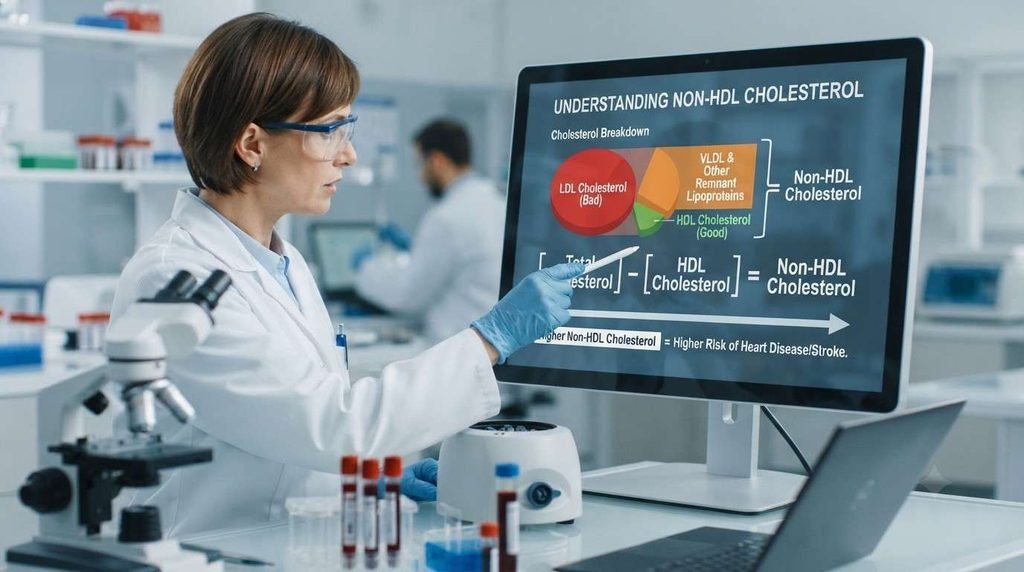
Many people ask, what is non HDL cholesterol, and why does it matter? The answer is simple. It is your total cholesterol minus your HDL cholesterol.
For example, if your total cholesterol is 200 and your HDL is 50, your non-HDL cholesterol is 150. You do not need special equipment. The number comes straight from a standard lipid panel.
So why bother with it? Because it counts all the types of cholesterol that can clog arteries. That includes LDL and other particles like very-low-density lipoprotein. It gives a fuller view than LDL alone.
Why Doctors Like This Number
Non HDL cholesterol is useful because it captures more risk. It is also handy when triglycerides are high. In that case, the usual LDL calculation can be less reliable.
The test usually does not need extra fasting. This makes it simple and low cost. Many doctors now watch it closely, especially in people with diabetes or metabolic problems.
A common target for many adults is a non-HDL cholesterol below 130 mg/dL. People at higher risk may need lower goals. Your doctor will set the right target for you.
When Non HDL Cholesterol Is High
A result of non HDL cholesterol high means you have too many of the artery-clogging particles in your blood. It can happen even when your LDL looks only slightly raised. Causes include a diet high in saturated fat, extra weight, little movement, and certain health conditions.
Genetics also play a role. Some families carry a tendency toward high cholesterol. If your parents or siblings had early heart problems, tell your doctor.
The good news is that many of the same habits that raise HDL also lower non-HDL cholesterol. Fiber, healthy fats, exercise, and a healthy weight help both. That makes lifestyle a double win.
Understanding Your Cholesterol Numbers
Here is a general guide to cholesterol numbers for adults in the United States. Numbers are in milligrams per deciliter, written as mg/dL. These ranges are common guideposts, not strict rules.
| Measure | Desirable or Optimal | Borderline or Worth Discussing | Concern |
|---|---|---|---|
| HDL cholesterol (men) | 60 or higher is protective | 40 to 59 | Below 40 |
| HDL cholesterol (women) | 60 or higher is protective | 50 to 59 | Below 50 |
| LDL cholesterol | Below 100 | 100 to 159 | 160 or higher |
| Non-HDL cholesterol | Below 130 | 130 to 189 | 190 or higher |
| Triglycerides | Below 150 | 150 to 199 | 200 or higher |
| Total cholesterol | Below 200 | 200 to 239 | 240 or higher |
Targets can be different for people with diabetes, heart disease, or other risk factors. Your doctor may set stricter goals. Never judge your health by this table alone.
How Often Should You Get Tested?
Healthy adults are often advised to check cholesterol every four to six years. People with risk factors may need it more often. Children are usually screened once between ages 9 and 11, and again in the late teens.
If you already have a high LDL, low HDL, or heart disease, your doctor may test you more often. This helps track progress and adjust treatment. Keep a copy of your results so you can compare them over time.
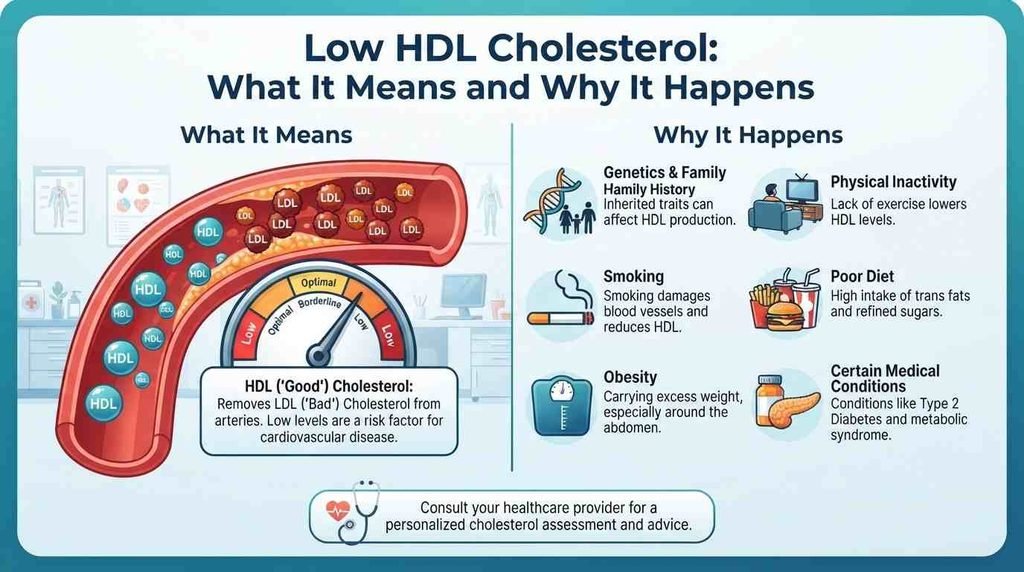
Low HDL Cholesterol: What It Means and Why It Happens
When your HDL cholesterol low result appears, it means you have fewer cleanup trucks on the road. In general, a level below 40 mg/dL for men or below 50 mg/dL for women is considered low. This is one factor that can raise your risk for heart disease.
Here is the tricky part. Low HDL cholesterol has no symptoms. You will not feel it, see it, or notice it in daily life. Only a blood test can tell you.
That is why regular testing is so important. It is easy to feel healthy and still have numbers that need attention. A simple blood draw can reveal the truth.
Common Causes of Low HDL
There is rarely a single reason. Usually, several things add up. Here are the most common ones.
- Smoking, which lowers HDL and harms blood vessels
- Lack of physical activity
- Excess weight, especially around the belly
- Type 2 diabetes or insulin resistance
- High triglycerides
- Diets heavy in refined carbs, sugar, and trans fats
- Certain medicines, such as some beta blockers, steroids, and certain hormone treatments
- Genetics, since some people are born with lower levels
If you take any regular medicines, never stop them on your own. Instead, ask your doctor whether they might affect your cholesterol. A simple medicine review can be helpful.
Why Low HDL Is a Risk
With fewer HDL particles, your body clears cholesterol more slowly. Extra cholesterol may stay in the blood longer and settle in artery walls. Over time, this can raise the chance of plaque and blockages.
A person with low HDL cholesterol often has other risk factors too. These include high blood pressure, high blood sugar, and extra weight around the middle. Together, they form what doctors call metabolic syndrome.
So treating low HDL is rarely about one number. It is about improving your overall health habits. That is good news, because habits are within your control.
High HDL Cholesterol: Is More Always Better?
It seems logical that more of a good thing is always better. For HDL cholesterol, the answer is not so simple. Many people are surprised to learn this.
A level of 60 mg/dL or higher is generally seen as protective. But HDL cholesterol high results at very extreme levels have raised questions in research. Some large studies found that extremely high HDL cholesterol did not always lower heart risk, and in some groups the risk was higher.
Scientists are still sorting out why. One idea is that the quality and function of HDL matter more than the number. Genetics may also play a role in some people with very high readings.
What to Do If Your HDL Is Very High
If you see high HDL cholesterol on your report, do not panic. Most people with levels in the 60s or 70s are doing well. Your doctor will look at your full profile, not just this one value.
Ask about your LDL, non-HDL cholesterol, blood pressure, and family history. These often tell more about your risk. Your doctor may also check for rare genetic causes if your level is unusually high.
Do not try to push your HDL even higher with supplements or drugs. There is no proof it will help. Focus on the habits that protect your heart as a whole.
9 Ways to Raise HDL Cholesterol
Now for the part most readers want. If you are asking how to increase HDL cholesterol, the good news is that daily habits can help. The changes are not flashy, but they work together to improve your heart health.
Healthline also shares practical ideas in its tips for raising HDL cholesterol. It is a helpful companion to this guide. Remember that results vary from person to person.
Here are nine ways to begin.
1. Quit Smoking
Smoking is one of the clearest enemies of healthy HDL. It lowers HDL and damages blood vessels at the same time. Quitting can help your HDL recover, and the benefits for your heart start quickly.
Quitting is hard, so do not go it alone. Ask your doctor about medicines, nicotine replacement, and support programs. Even a small step forward counts.
2. Move Your Body Every Day
Regular exercise is one of the best natural ways to raise HDL. Aerobic activity like brisk walking, cycling, swimming, or dancing works well. Many health groups suggest at least 150 minutes of moderate activity each week.
Start where you are. Even ten minutes after meals can help. Build up slowly, and pick something you enjoy so you stick with it.
Strength training adds more value. It helps with weight, blood sugar, and muscle health. Talk to your doctor before starting a new routine, especially if you have heart problems.
3. Reach and Keep a Healthy Weight
Extra weight, especially around the belly, is linked with low HDL cholesterol. Losing even a modest amount of weight may help raise HDL and lower triglycerides. It also helps lower non HDL cholesterol high readings.
Avoid crash diets. They are hard to keep up and can backfire. Aim for slow, steady changes that you can live with for years.
4. Choose Healthy Fats
The type of fat you eat matters more than most people think. Swap saturated fats, found in butter, fatty meats, and full-fat dairy, for unsaturated fats. Good choices include olive oil, avocado, nuts, seeds, and fatty fish.
These foods support HDL cholesterol and help lower LDL when they replace less healthy fats. They are also rich in nutrients. A small handful of nuts or a drizzle of olive oil is an easy start.
Watch your portions, though. Healthy fats are still high in calories. Moderation keeps your weight in check.
5. Cut Out Trans Fats
Trans fats raise LDL and lower HDL, which is a double hit. They hide in some fried foods, packaged snacks, and baked goods. Check labels for the words partially hydrogenated oil.
Many countries have cut trans fats, but they still appear in some products. Read ingredient lists when you can. Cooking at home gives you the most control.
6. Limit Sugar and Refined Carbs
Diets heavy in white bread, sweets, sugary drinks, and other refined carbs often go with hdl cholesterol low and high triglycerides. Cutting back can help both numbers. It also helps blood sugar and weight.
Swap white rice and sweet snacks for whole grains, beans, and fruit. You do not need to be perfect. Small swaps add up over time.
7. Eat More Fiber and Whole Foods
Foods rich in soluble fiber, such as oats, beans, lentils, apples, and berries, help lower LDL and non-HDL cholesterol. A diet built around whole foods also supports healthy weight and blood sugar. This creates a better setting for HDL cholesterol to thrive.
The Mediterranean style of eating is a popular example. It centers on vegetables, fruit, whole grains, legumes, nuts, olive oil, and fish. Many studies link it with better heart health.
8. Be Careful With Alcohol
Some studies show that light to moderate drinking is linked with higher HDL. But this does not mean you should start drinking. The American Heart Association does not recommend drinking alcohol to raise HDL or improve heart health.
Alcohol also adds calories and can raise triglycerides and blood pressure. If you already drink, keep it moderate or less. If you have liver disease, take certain medicines, or have a history of alcohol problems, ask your doctor first.
9. Manage Blood Sugar, Sleep, and Stress
Poorly controlled diabetes can lower HDL and raise triglycerides. Working with your doctor to keep blood sugar in range helps your whole cholesterol profile. Take medicines as prescribed and keep regular check-ups.
Sleep and stress matter too. Poor sleep and long-term stress are linked with weight gain and unhealthy habits. Aim for steady sleep, and find stress relief that works for you, like walking, music, or time with friends.
Habits and Their Typical Effect on HDL
Not every habit changes HDL by the same amount. Some have a bigger effect, and some help in other ways. This table gives a simple overview.
| Habit | Typical Effect on HDL | Other Heart Benefits |
|---|---|---|
| Quitting smoking | Can raise HDL over time | Better blood vessels, lower clot risk |
| Regular aerobic exercise | Small to moderate rise | Lower blood pressure, weight, and blood sugar |
| Healthy weight loss | Small to moderate rise | Lower triglycerides and non HDL cholesterol high readings |
| Swapping to unsaturated fats | Helps HDL while lowering LDL | Less artery plaque risk |
| Cutting trans fats | Prevents HDL from dropping | Lower LDL and less inflammation |
| Limiting refined carbs and sugar | Helps prevent a fall in HDL | Lower triglycerides and steadier blood sugar |
| Alcohol in moderation | Slight rise in some studies, but not advised as a strategy | Risks may outweigh benefits |
The effects shown are general. Your own results depend on your genes, age, and health. Keep your expectations realistic, and focus on steady progress.
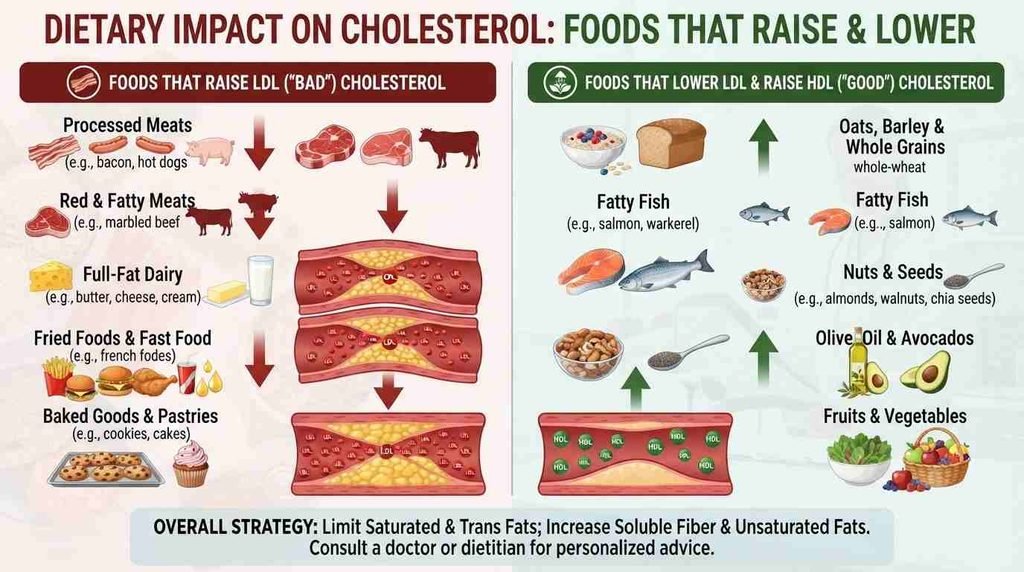
Dietary Impact on Cholesterol
Food plays a major role in cholesterol levels. What you eat affects HDL cholesterol, LDL, triglycerides, and your non-HDL cholesterol all at once. Let us look at how.
Dietary cholesterol, found in foods like eggs and shellfish, affects blood cholesterol less than many people think. For most people, saturated fat and trans fat have a larger effect. Still, people with certain conditions may need to be more careful, so follow your doctor’s advice.
The table below groups common foods by how they tend to affect your numbers.
| Food Group | Examples | Usual Impact on Cholesterol |
|---|---|---|
| Healthy fats | Olive oil, avocado, nuts, seeds | Support HDL and lower LDL when they replace saturated fat |
| Fatty fish | Salmon, sardines, mackerel | Lower triglycerides and support heart health |
| Soluble fiber foods | Oats, beans, lentils, apples | Help lower LDL and non-HDL cholesterol |
| Whole grains | Brown rice, whole wheat, barley | Support steady blood sugar and healthy weight |
| Saturated fat foods | Butter, fatty meats, full-fat dairy, palm oil | Can raise LDL, so keep them limited |
| Trans fat foods | Some fried and packaged baked goods | Raise LDL and lower HDL, so avoid them |
| Refined carbs and sweets | Sugary drinks, white bread, pastries | Linked with low HDL and high triglycerides |
Use this table as a simple guide, not a strict diet. No single food fixes cholesterol on its own. Your overall eating pattern matters most.
A Simple Heart-Friendly Day
This example shows how easy it can be. Start with oatmeal topped with berries and a few walnuts. Have a lunch of beans, vegetables, and whole grains with a little olive oil.
Snack on fruit or a small handful of nuts. For dinner, try baked salmon with a big side of vegetables. Water or unsweetened tea works well all day.
This is only an idea, not a medical plan. Your dietitian or doctor can help you build one that suits your tastes, culture, and health needs.
What About Supplements?
People often ask about niacin, fish oil, and other supplements. Fish oil may lower triglycerides but does not reliably raise HDL cholesterol. Niacin can raise HDL, but large studies did not show added heart benefits for most people who were already on statins, and it can cause side effects.
Because of this, doctors rarely use niacin just to raise HDL. Never start supplements without checking with your doctor. Some can interact with medicines or harm your liver.
When to Talk to Your Doctor
Lifestyle changes help many people, but some need more. Medicines like statins lower LDL and non-HDL cholesterol, which reduces heart risk. They are not designed mainly to raise HDL, yet they remain a key tool.
Book a visit if you have any of these situations:
- A result showing low HDL cholesterol along with high LDL or triglycerides
- A non HDL cholesterol high reading
- A family history of early heart disease
- Diabetes, high blood pressure, or kidney disease
- Chest pain, shortness of breath, or other warning signs
Seek emergency care at once for chest pain, sudden weakness, trouble speaking, or other signs of a heart attack or stroke. Do not wait for a routine appointment. Time matters in these cases.
When you see your doctor, bring your past lipid results and a list of your medicines. Ask what your numbers mean for you and what targets to aim for. A good plan is personal.
Common Myths About HDL Cholesterol
Myths can steer people in the wrong direction. Here are a few worth clearing up.
Myth: Higher HDL is always better. Fact: Moderate to high levels are fine for most, but extreme levels do not guarantee protection.
Myth: Only LDL matters. Fact: LDL is key, but non-HDL cholesterol, triglycerides, and HDL add to the picture.
Myth: Thin people do not need to check cholesterol. Fact: Genes and diet affect cholesterol too. Slim people can have low HDL cholesterol or high LDL.
Myth: A drink a day will fix my HDL. Fact: Health groups do not recommend drinking to raise HDL.
Myth: I would feel it if my cholesterol was off. Fact: Cholesterol problems are usually silent. Only a blood test can tell.
Frequently Asked Questions
What is the HDL cholesterol meaning in simple words?
It is the cholesterol carried by high-density lipoproteins. These particles pick up extra cholesterol and bring it to the liver for removal. That is why it is called good cholesterol.
What is a good HDL cholesterol level?
For most adults, 60 mg/dL or higher is considered protective. Below 40 mg/dL for men or below 50 mg/dL for women is generally considered low. Your doctor can tell you what is right for you.
What is non HDL cholesterol and what is a healthy level?
It is your total cholesterol minus your HDL. It counts all the harmful types of cholesterol together. Many adults aim for below 130 mg/dL, but your target may differ.
What causes low HDL cholesterol?
Common causes include smoking, inactivity, extra weight, type 2 diabetes, high triglycerides, some medicines, and genetics. Often, several causes work together.
How to increase HDL cholesterol naturally?
Quit smoking, exercise regularly, reach a healthy weight, choose healthy fats, avoid trans fats, and limit sugar and refined carbs. Eat more fiber and manage blood sugar. These steps help your whole heart health, not just HDL.
Can HDL cholesterol be too high?
Yes, in rare cases. Very high HDL cholesterol has not always been linked with better protection. Talk to your doctor if your level is unusually high.
Do I need medicine to raise HDL?
Usually not. Medicines are rarely used only to raise HDL. Doctors often focus on lowering LDL and non-HDL cholesterol instead.
Final Thoughts: Small Habits, Stronger Heart
HDL cholesterol is a helpful ally for your heart, but it works best as part of a bigger team. Now you know the HDL cholesterol meaning, why HDL is good, and what low HDL cholesterol can signal. You also know why non-HDL cholesterol deserves attention.
Here is the short version. Do not smoke, move daily, eat more whole foods, choose healthy fats, and keep a healthy weight. Get your cholesterol tested, and work with your doctor on a plan.
Start with just one change this week. Take a daily walk, swap a sugary drink for water, or add beans to a meal. Share this guide with someone you care about, and keep your heart in good shape.
Medical Disclaimer
This article is for general education and does not replace advice from a licensed doctor or other healthcare professional. Do not use it to diagnose or treat any condition. Do not start, stop, or change any medicine or supplement without talking to your doctor. If you have chest pain or other emergency symptoms, call your local emergency number right away.