



Wondering about creatine before or after workout? Here is what the research really says about timing, daily 3–5g saturation, rest days, loading myths and monohydrate absorption. Learn the best time to take creatine before or after workout for muscle gain, with simple tips, clear tables and safety advice reviewed against sources like Examine,
Healthline and the ISSN. If you have ever asked, “should I take creatine before or after workout?” this guide gives you a calm, practical answer. You will see what studies found, why consistency beats perfect timing, and how to build a routine you can actually stick with. We also explain how to avoid the most common mistakes, from skipping rest days to buying the wrong product.
Everything is written in plain language, so you can finish reading and start your plan today. Remember, this is educational content, not medical advice, so check with a doctor if you have health conditions.
Introduction: The Timing Question Everyone Asks
Almost every lifter eventually asks about creatine before or after workout. The question sounds small, but it causes endless debate in gyms and online forums. Some people swear by a pre-workout scoop, while others insist on a post-workout shake.
The honest answer is simpler than the debate suggests. Creatine works by building up in your muscles over time, not by acting like caffeine. That means the clock matters far less than most people think.
In this guide, we break down the evidence in plain English. You will learn when to take creatine before or after workout, how much to use, and what to avoid. By the end, you will have a clear routine that fits your life.
Who Is Writing This and Why You Can Trust It (E-E-A-T)
This article follows the E-E-A-T idea: experience, expertise, authoritativeness and trustworthiness. The advice here is based on published research, position stands from sports nutrition bodies, and well-known evidence reviews. It is not based on gym myths or marketing claims.
Supplements fall under “Your Money or Your Life” (YMYL) topics, because they affect health and spending. So we keep claims modest and point you to primary sources. You can cross-check the science yourself on Examine’s creatine page and in the open-access papers at the ISSN Journal.
We also include real-world advice, since lifters share useful experience in places like Reddit r/Supplements. Treat forum posts as anecdotes, not proof. Always combine them with research and, when needed, professional medical guidance.
What Creatine Actually Does in Your Body
Creatine is a natural compound stored mostly in your muscles. Your body makes some, and you get more from foods like red meat and fish. Inside muscle, it helps recycle ATP, the quick energy used for heavy lifts and sprints.
When your muscles hold more creatine, you can often squeeze out an extra rep or two. Over weeks, those extra reps add up to more training volume. More volume, paired with good food and sleep, supports muscle growth and strength.
This is why creatine is one of the most studied sports supplements ever. It is not a stimulant, and it does not work instantly. It works through steady storage, which is the key to the creatine before or after workout debate.

Creatine Before or After Workout: The Short Answer
Here is the short version. For most people, creatine before or after workout produces very similar results, as long as you take it every day. The total weekly intake matters more than the exact hour.
If you want a tie-breaker, some small studies hint at a slight edge for taking it after training. That edge is modest and not proven for everyone. So pick the time you will remember, and repeat it daily.
Think of it like brushing your teeth. Doing it at 7 a.m. or 9 p.m. matters less than doing it every day. The same logic applies when you ask, “do I take creatine before or after workout?”
Pre vs Post-Workout Study Results
Let us look at what researchers actually found. In a well-known 2013 study in the Journal of the International Society of Sports Nutrition, trained men took about 5g of creatine either right before or right after lifting. After four weeks, the post-workout group showed slightly better changes in body composition.
However, the difference was small, and the group sizes were limited. The researchers themselves called for more work. Later studies and reviews have generally found little or no meaningful gap between the two approaches.
You can read the broader discussion in the Healthline guide on the best time for creatine. The takeaway: creatine before or after workout is a minor detail. Daily consistency is the major one.
Table 1: Pre vs Post-Workout Evidence at a Glance
| Factor | Before Workout | After Workout |
|---|---|---|
| Typical dose studied | About 3–5g | About 3–5g |
| Body composition results | Good improvements | Slightly better in one small study |
| Strength gains | Similar | Similar |
| Practical convenience | Mix with pre-workout drink | Mix with post-workout shake |
| Strength of evidence | Limited, small trials | Limited, small trials |
| Overall verdict | Works well | Works well, tiny possible edge |
Why the Post-Workout Window May Help a Little
There are a few reasons researchers think taking creatine after workout could help slightly. After training, blood flow to your muscles rises. More blood flow may help deliver creatine to the tissue.
Your muscles are also hungry for nutrients after a session. If you take creatine with a meal or shake that includes carbs and protein, insulin can rise. Insulin may help muscle cells take in more creatine.
Still, these are theories, not guarantees. Many lifters see great results with a morning scoop on rest days and a pre-workout scoop on training days. The best plan is the one you keep.
Why Some People Prefer Creatine Before a Workout
Plenty of lifters like the ritual of mixing creatine into a pre-workout drink. It is easy to remember, because it is tied to something they already do. Habit is a powerful tool in fitness.
Another reason is simple convenience. If you train early, you may skip your post-workout shake or eat later. Taking creatine before or after workout then becomes whatever fits the schedule.
Some people also feel more mentally ready with a set routine before training. That feeling is psychological, not a direct creatine effect. Even so, a routine that keeps you consistent is a real benefit.
Daily 3–5g Saturation Consistency
This is the most important section in the whole article. Creatine works by saturation, meaning your muscles slowly fill up with it. A steady daily dose of 3–5g is enough for most healthy adults.
At that dose, saturation usually takes around three to four weeks. After that, your muscles stay near full as long as you keep taking it. Miss a few days, and levels drop slowly, not suddenly.
So when people ask, “when should I take creatine before or after workout?” the better question is, “Am I taking it daily?” Consistency beats timing every single time. Set a reminder, and treat it like a daily habit.
Table 2: Daily Creatine Saturation Guide
| Approach | Daily Dose | Time to Saturation | Best For |
|---|---|---|---|
| Steady daily dose | 3–5g | About 3–4 weeks | Most people, lowest stomach risk |
| Loading phase | About 20g split in 4 doses | About 5–7 days | Those wanting faster results |
| Maintenance after loading | 3–5g | Already saturated | Long-term users |
| Skipping days often | Irregular | Never fully saturated | Not recommended |
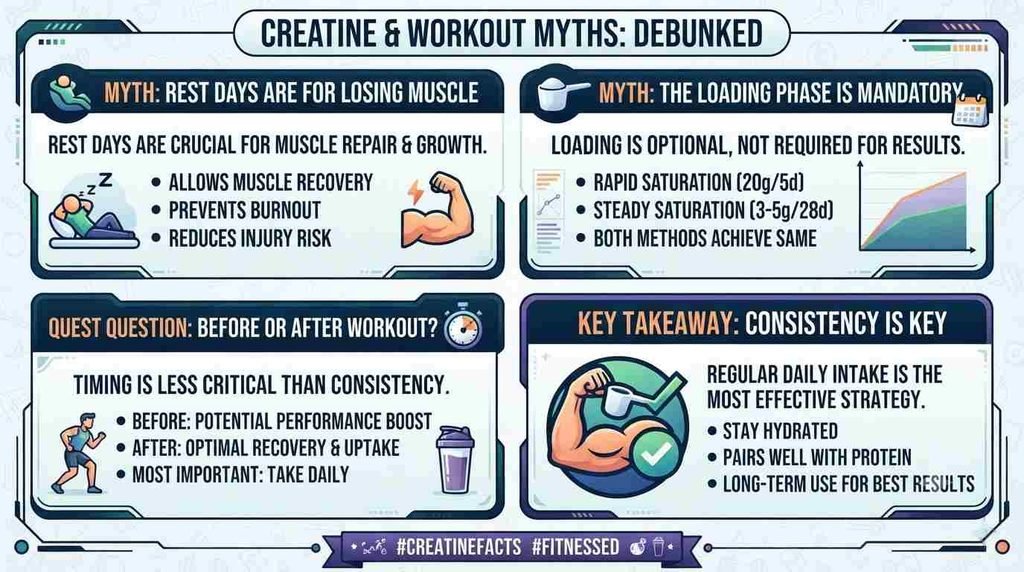
Rest Days and Loading Phase Myths
A very common myth says you should skip creatine on rest days. This is not supported by the science. Because creatine builds up over time, rest days are still part of the saturation process.
On rest days, simply take your usual 3–5g at any convenient time. Morning with breakfast works well for many people. This answers the question, “do you take creatine before or after workout on days off?” The answer is that there is no workout, so just take it with a meal.
Another myth is that you must always do a loading phase. Loading simply speeds things up. It is optional, and the slow-and-steady route reaches the same place in a few more weeks.
Understanding the Loading Phase Properly
A loading phase usually means about 20g per day, split into four 5g servings, for five to seven days. After that, you drop to a 3–5g daily maintenance dose. It is a faster route to full muscle stores.
The downside is that some people get stomach upset or bloating from large single doses. Splitting the dose helps, and so does taking it with food. If you have a sensitive stomach, skip loading entirely.
Loading is never required for success. Many experienced lifters never load and still do great. If you are not in a rush, the simple daily dose is easier, cheaper and gentler.
Table 3: Loading vs No Loading
| Feature | Loading Phase | No Loading |
|---|---|---|
| Daily amount at start | About 20g (4 x 5g) | 3–5g |
| Duration of loading | 5–7 days | Not applicable |
| Speed of results | Faster | Slower, around 3–4 weeks |
| Stomach comfort | May cause upset | Usually gentle |
| Cost in first week | Higher | Lower |
| Final outcome | Same saturation | Same saturation |
Creatine Before or After Workout for Muscle Gain
Many readers ask about creatine before or after workout for muscle gain specifically. The evidence suggests creatine supports muscle gain mainly by helping you train harder over time. The timing relative to your session is a small factor.
For muscle growth, focus on the big pillars first. Eat enough calories and protein, train with progressive overload, and sleep well. Creatine is a helpful add-on, not a replacement for any of these.
If you want a slight edge, you can take creatine after training with a protein and carb meal. If that is inconvenient, take it before. Either way, you will likely do well, as long as you never skip the daily dose.
Creatine Monohydrate Absorption Tips
Creatine monohydrate is the most researched and most reliable form. Fancy versions often cost more without better results. For most people, plain monohydrate is the smart buy.
To support absorption, take it with a meal that includes carbs and protein. This may raise insulin slightly, which can help muscles take up more creatine. Mix it in a full glass of water, around 250ml, and drink enough fluid through the day.
Finely ground or “micronized” monohydrate dissolves more easily and may be gentler on the stomach. Avoid mixing it into very hot drinks for long periods. Simple habits like these matter more than any expensive trick.
Table 4: Simple Absorption and Mixing Tips
| Tip | Why It Helps | How to Do It |
|---|---|---|
| Take with carbs and protein | May support uptake via insulin | Mix into a shake or take with a meal |
| Choose monohydrate | Best research record | Look for a trusted, tested brand |
| Use micronized powder | Dissolves better | Stir well in 250ml of water |
| Stay hydrated | Supports muscle and overall health | Drink water throughout the day |
| Split larger doses | Reduces stomach upset | Take 5g servings spread across the day |
| Be consistent | Keeps muscles saturated | Use phone reminders |
Do You Drink Creatine Before or After Workout? Real-Life Routines
People often ask, “do you drink creatine before or after workout?” or “do you take creatine before or after workout?” The practical answer depends on your lifestyle. Here are three simple routines.
First, the morning trainer can mix creatine into a pre-workout drink. Second, the evening trainer can add it to a post-workout shake with dinner. Third, the busy person can take it with breakfast every day, regardless of training.
All three routines can work well. What matters is that you pick one and stick with it. You can also check experiences on Reddit r/Supplements, but remember that stories are not studies.
Safety, Side Effects and Who Should Be Careful (YMYL)
For healthy adults, creatine monohydrate at 3–5g daily has a strong safety record in research. Common mild effects include small water weight gain and occasional stomach upset. These often settle with smaller doses or by taking it with food.
However, this is a health topic, so caution matters. If you have kidney disease, liver problems, or take medicines that affect the kidneys, talk to a doctor first. The same applies if you are pregnant, breastfeeding, or under 18.
Choose products that are third-party tested, and avoid supplements making wild promises. This article is for education, not personal medical advice. When in doubt, ask a qualified healthcare professional before starting.
Common Mistakes to Avoid
The first mistake is obsessing over creatine before or after workout while skipping days. Missed days slow saturation more than any timing choice ever could. A simple reminder system fixes this.
The second mistake is wasting money on expensive blends and trendy forms. Plain monohydrate has the best evidence. The third mistake is ignoring hydration, sleep and protein, which matter just as much.
Another mistake is expecting overnight miracles. Creatine is slow and steady, so give it at least four weeks. Track your lifts, and judge results over time, not after a few days.
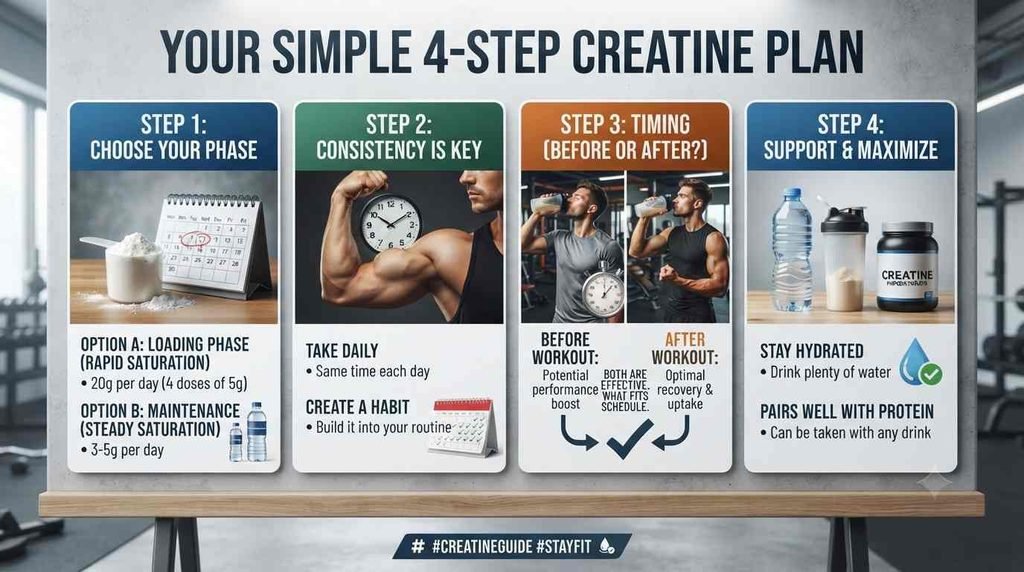
Your Simple 4-Step Creatine Plan
Step one: choose creatine monohydrate from a reputable, tested brand. Step two: take 3–5g every day, including rest days. Step three: pick a time you will remember, whether before or after training.
Step four: drink enough water and eat a balanced diet with enough protein. Give it four weeks before judging results. Adjust only if you feel stomach discomfort or have health concerns.
This plan answers the best time to take creatine before or after workout in the most practical way possible. The best time is the one you will repeat daily. Keep it simple, and let consistency do the work.
Frequently Asked Questions
Is it better to take creatine before or after workout? Both work well. A small study hinted at a slight edge after training, but the difference is minor. Daily consistency matters most.
Can I take creatine at any time of day? Yes. Because it builds up in muscles, the clock matters little. Take it with food if your stomach is sensitive.
Do I need to take creatine on rest days? Yes, take your usual 3–5g. Rest days still help maintain saturation.
Do I need a loading phase? No. Loading is faster but optional. The steady daily dose reaches the same level in a few weeks.
Is creatine safe? For healthy adults, research supports its safety at standard doses. Check with a doctor if you have kidney, liver or other health concerns.
Conclusion: Stop Overthinking, Start Being Consistent
The debate over creatine before or after workout is far smaller than it looks. Research shows only a slight possible edge for post-workout use, and many studies find no real gap. Your daily habit is what drives results.
Remember the core points: take 3–5g daily, include rest days, skip the myths about loading, and choose simple monohydrate. Pair it with solid training, food and sleep. Then take creatine before or after workout, whichever fits your life.
Use trusted sources like Examine, Healthline, and the ISSN Journal to keep learning. And talk to a healthcare professional if you have any concerns. Start today, stay consistent, and let the results build over time.
Disclaimer: This article is for educational purposes only and is not medical advice. Consult a qualified healthcare professional before starting any supplement.