



Hip impingement causes pinching pain in the front of the hip or groin, especially when you squat, sit for long periods, or twist. This guide explains what is hip impingement, how to spot hip impingement symptoms, and which hip impingement test methods doctors use.
You will learn how to fix hip impingement with smart hip impingement treatment, safe hip impingement exercises, and clear movements to avoid. We also explain fai hip impingement, hip impingement syndrome, and when hip impingement surgery may help.
Everything is written in simple, conversational language and supported by trusted medical sources. Use it to understand your hip, protect it from damage, and move with less pain. This article is for education only and does not replace advice from a doctor or physical therapist.
Introduction
Your hip pinches when you squat. Sitting in the car feels tight. Tying your shoes hurts.
These small signs are easy to ignore. Over time, they can limit the things you enjoy.
That pattern is often hip impingement, and it is more common in active adults than most people realize.
Why This Guide Is Different
This article follows the E-E-A-T rule: experience, expertise, authoritativeness, and trust. It also follows YMYL (Your Money or Your Life) care, because health advice can change real lives.
We keep claims realistic and point you to respected sources. Where evidence is limited, we say so.
Use this guide to learn, not to self-diagnose. A clinician can confirm what is happening in your hip.
What Is Hip Impingement?
So, what is hip impingement? It is a condition where the ball and socket of your hip joint do not fit together smoothly.
The bones rub or pinch during movement. Over time, this can irritate the cartilage and the soft tissue around the joint.
Doctors also call it femoroacetabular impingement, or FAI.
FAI Hip Impingement Explained
FAI hip impingement comes from the shape of the bones. Extra bone on the ball or the socket causes the joint to collide at certain angles.
Think of a door that rubs against its frame. It still opens, but with friction and damage over time.
The pinch is most noticeable when you bend the hip deeply.
Hip Impingement Syndrome
Hip impingement syndrome is the term used when the bone shape causes real pain and limits movement. Some people have the bone shape but no pain.
In other words, an odd-looking X-ray does not always mean a problem. Symptoms and function matter most.
For a general overview, WebMD offers clear patient explanations.

Understanding Hip Anatomy Issues
To understand hip impingement, you need a simple picture of the hip. It is a ball-and-socket joint.
The ball is the top of the thigh bone, called the femoral head. The socket is part of the pelvis, called the acetabulum.
A smooth, slippery cartilage lines both surfaces so they glide easily.
The Labrum and Cartilage
A ring of tissue called the labrum surrounds the socket. It deepens the joint and keeps the ball stable.
When bones pinch, the labrum can fray or tear. Cartilage can also wear down.
These tissues heal poorly because they have a limited blood supply.
Three Types of Impingement
| Type | What Happens | Who Is Often Affected |
|---|---|---|
| Cam | The ball is not perfectly round, with a bump on the neck | Younger, athletic men |
| Pincer | The socket covers too much of the ball | Middle-aged women |
| Mixed | Both cam and pincer shapes are present | Most common overall |
Many people have a mixed pattern. Imaging can show which shape you have.
Why Bone Shape Changes
Some people are born with these shapes. Others develop them during teenage growth years, especially in high-impact sports.
Genetics, hip development, and training load all play a part. You cannot change your bone shape with stretching alone.
But you can improve how your hip moves and how muscles share the load.
Muscles and Movement Patterns
Weak glutes, tight hip flexors, and a stiff lower back can make hip impingement feel worse. The pelvis tilts, and the joint closes sooner than it should.
Poor core control adds to the problem. The hip then takes stress that muscles should absorb.
This is why rehab focuses on the whole chain, not just the hip.
Hip Impingement Symptoms: What to Watch For
The most common hip impingement symptoms build slowly. You may brush them off as tightness at first.
Over weeks or months, the pain becomes more frequent. It often shows up with deep hip bending.
Here are the main signs.
Typical Warning Signs
- A deep ache or pinch in the groin
- Pain on the outer hip or buttock
- Stiffness after sitting
- Pain when squatting or climbing stairs
- Clicking, catching, or locking in the hip
- Reduced hip range of motion
- Pain when rotating the leg inward
Some people feel it in the thigh or knee. This is called referred pain.
The “C Sign”
Many people describe their pain by cupping their hand in a C shape around the outer hip. Doctors call this the C sign.
It is a helpful clue, but it is not proof by itself. Other hip and back problems can look similar.
A proper exam is still needed.
When to See a Doctor
See a professional if pain lasts more than a few weeks, wakes you at night, or limits daily tasks.
Get urgent care for sudden severe pain, an inability to bear weight, fever with hip pain, or a hip that looks out of place.
Never wait on warning signs like these.
Hip Impingement Test: How Doctors Diagnose It
A hip impingement test starts with a hands-on exam. Your clinician asks about your pain, sports, and work.
Then they move your hip into different positions. They watch where pain starts and how far the joint moves.
No single test is perfect, so doctors combine several clues.
Common Physical Tests
- FADIR test: The hip is flexed, adducted, and rotated inward. Pain suggests impingement.
- FABER test: The leg is placed in a figure-four position. It checks the hip and nearby joints.
- Log roll: The leg is rolled gently to check for joint irritation.
- Range of motion check: Compares both hips for stiffness.
These tests help guide the next step but cannot replace imaging.
Imaging Tests
- X-ray: Shows bone shape and signs of wear.
- MRI or MR arthrogram: Shows the labrum and cartilage in detail.
- CT scan: Gives a 3D look at bone shape, often before surgery.
Your clinician picks the test based on your symptoms and history.
Test Summary Table
| Test | What It Checks | Pain Response |
|---|---|---|
| FADIR | Impingement of ball and socket | Groin pinch |
| FABER | Hip and sacroiliac joint | Groin or back pain |
| X-ray | Bone shape | Painless |
| MRI | Labrum and cartilage | Painless |
Do not self-diagnose from a video. Many hip problems feel alike.
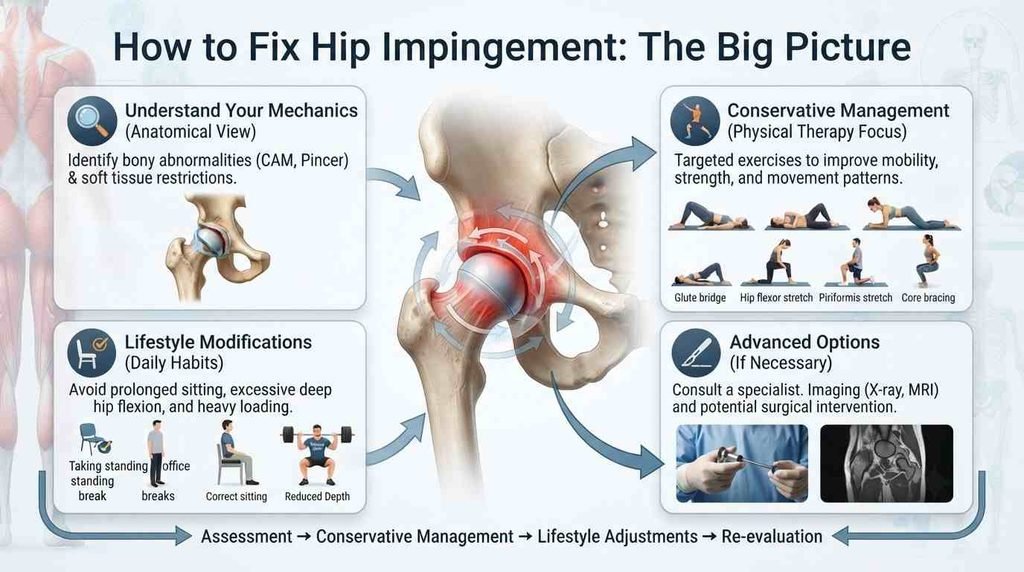
How to Fix Hip Impingement: The Big Picture
Many people ask how to fix hip impingement without surgery. The honest answer is that you cannot remove bone with exercise.
But you can reduce pain, improve movement, and protect the joint. Most people improve with the right plan.
Here is the typical roadmap.
Step 1: Calm the Pain
Cut back on movements that pinch the hip. Avoid deep squats, long sitting, and extreme end-range stretches for now.
Ice or heat can ease soreness. Use whichever feels better.
Gentle walking keeps the joint nourished.
Step 2: Adjust Daily Habits
Small changes help a lot. Sit with your hips slightly above your knees if you can.
Avoid crossing your legs deeply. Use a firm cushion in the car.
Break up long periods of sitting every 30 to 45 minutes.
Step 3: Start Guided Rehab
A physical therapist builds a plan based on your hip shape and strength. They teach controlled movement and fix weak links.
This step has the strongest evidence for most people with hip impingement.
For trusted orthopedic information, the Hospital for Special Surgery is a leading reference.
Step 4: Build Strength and Control
Strong glutes, core, and hip stabilizers help your joint stay centered. Better control means fewer pinching moments.
Progress slowly. Pain should stay mild and settle quickly.
Consistency beats intensity here.
Step 5: Return to Activity
Bring back sport and gym work step by step. Start with low-impact movement and add intensity slowly.
Some people must change certain lifts or techniques permanently. That is a smart trade for long-term hip health.
Patience prevents flare-ups.
Hip Impingement Treatment: Your Options
Good hip impingement treatment starts with conservative care. Surgery comes later and only if needed.
Most clinicians give non-surgical care a trial of several months. Let us review the main choices.
Activity Modification
This means changing how you move, not stopping completely. You avoid deep pinching positions and keep the rest of your life active.
Swapping deep squats for box squats is one example. Using a shorter stride when running is another.
The goal is to lower irritation while you rebuild.
Medication
Over-the-counter anti-inflammatory medicines may ease pain for some people. Ask a doctor or pharmacist first, especially if you have stomach, kidney, or heart concerns.
Medicine treats symptoms, not the bone shape. Use it as a bridge, not a plan.
Never ignore worsening pain.
Injections
A doctor may suggest a corticosteroid injection into the hip joint. It can calm inflammation and help confirm the pain source.
Relief often lasts weeks to a few months. It is not a cure.
Risks and benefits should be discussed with your specialist.
Physical Therapy
Physical therapy is a core part of hip impingement treatment. It improves strength, mobility, and movement habits.
Many people avoid surgery with good rehab. Others do rehab before and after an operation.
Community discussions on Reddit Physical Therapy can offer personal stories, but always confirm advice with your own clinician.
Treatment Comparison Table
| Option | Goal | Typical Time Frame | Best For |
|---|---|---|---|
| Activity change | Reduce pinching | Immediate | Everyone |
| Medicine | Ease pain | Days to weeks | Flare-ups |
| Injection | Calm inflammation | Weeks to months | Stubborn pain |
| Physical therapy | Build control | 6 to 12 weeks or more | Most people |
| Surgery | Reshape bone, repair tissue | Months of recovery | Failed conservative care |
Exercises to Avoid Completely
Some moves make hip impingement worse. They force the hip into the exact position that pinches.
Avoid them until a clinician says otherwise. Your hip will thank you.
This is one of the most useful parts of how to fix hip impingement.
Deep Squats and Deep Lunges
Going below parallel closes the front of the hip. The ball then jams against the socket.
Back squats, goblet squats, and deep split squats are common offenders. Use a box or limit your depth instead.
Stop where the pinch begins.
Leg Press With Deep Knee Bend
The leg press often lets the knees come close to the chest. The lower back may round and the pelvis tuck.
That position makes impingement stronger. Shorten the range if you use this machine.
Or skip it for now.
Pulling the Knee to the Chest
Popular hip flexor and glute stretches pull the knee toward the chest. These stretches can irritate an impinged hip.
Tightness feels like it needs stretching. But pushing into the pinch can inflame the joint.
Look for gentler options.
Pigeon Pose and Deep Hip Stretches
Deep external rotation with bending can bother the joint. The same goes for butterfly and happy baby poses held too long.
Yoga fans should modify these poses. Use props and stay in a comfortable range.
Never push through a sharp pinch.
High-Impact and Fast Twisting Moves
- Box jumps and deep jump squats
- Sprinting with sharp cuts
- Heavy deadlifts from the floor with rounded form
- Cycling with a very low seat
- Sit-ups and full crunches with the hips bent deeply
These moves can load the joint at its tightest angle.
Quick Avoid List
| Movement | Why It Hurts | Safer Swap |
|---|---|---|
| Deep squat | Over-bends the hip | Box squat to a high box |
| Knee-to-chest stretch | Closes the front of the hip | Gentle hip flexor stretch in neutral |
| Pigeon pose | Deep rotation with pressure | Supported figure-four on your back, small range |
| Deep lunge | Forces extreme hip bend | Short-step lunge or step-up |
| Low-seat cycling | Keeps the hip bent too much | Raise the seat height |
Every person is different. Your pain is the best guide.

Recommended Physical Therapy Movements
Now for the good news. Smart movement is the heart of hip impingement treatment.
These hip impingement exercises build strength and control without forcing the joint into its pinch zone.
Start slowly and stay below mild discomfort. Ask a physical therapist to check your form.
Phase 1: Calm and Wake Up
Use these when the hip is sore. They are gentle and safe for most people.
- Glute bridge: Lie on your back with knees bent. Lift your hips and squeeze. Do 2 sets of 10.
- Clamshell: Lie on your side with knees bent. Open the top knee without rolling the pelvis. Do 2 sets of 12.
- Diaphragmatic breathing: Breathe deeply into your belly. Do 5 slow breaths, a few times a day.
- Pelvic tilts: Rock your pelvis gently while lying down. Do 10 reps.
These wake up the muscles that support your hip.
Phase 2: Build Stability
Once Phase 1 is pain-free, add more challenge.
- Side plank with knee down: Hold 20 to 30 seconds. Do 3 rounds.
- Banded side steps: Keep your hips level. Do 2 sets of 10 steps each way.
- Single-leg bridge: Lift one leg and bridge with the other. Do 2 sets of 8.
- Bird dog: Reach opposite arm and leg while keeping the spine steady. Do 2 sets of 8.
These moves train the hip to stay centered.
Phase 3: Strength and Function
These movements mimic daily life and sport. Keep the range pain-free.
- Box squat to a high box: Sit back to a comfortable depth. Do 3 sets of 8.
- Romanian deadlift with light weight: Hinge at the hips with a flat back. Do 3 sets of 8.
- Step-ups: Use a low step. Do 3 sets of 8 per side.
- Farmer’s carry: Walk tall while holding weights. Do 3 rounds of 30 seconds.
Progress when the movement feels easy and your pain stays low.
Gentle Mobility Work
Mobility can help, but it should not hurt. Use the quadruped rock back in a small range, or a supported hip flexor stretch with a tucked pelvis.
For best results, move in smooth, controlled arcs. Do not force end range.
Mobility is about comfort, not extreme flexibility.
Weekly Exercise Plan
| Day | Focus | Example Movements |
|---|---|---|
| Monday | Strength | Bridges, clamshells, side plank |
| Tuesday | Walk and mobility | 20-minute walk, quadruped rock back |
| Wednesday | Stability | Banded side steps, bird dog |
| Thursday | Rest or easy walk | Light movement only |
| Friday | Strength | Box squat, Romanian deadlift |
| Weekend | Active recovery | Easy walk or swim |
Adjust the plan with your physical therapist.
How to Know It Is Working
You should notice less pain over weeks. Daily tasks like stairs and getting in the car should feel easier.
Some mild soreness is normal. Sharp pain, locking, or night pain is not.
Track your progress in a simple notebook.
Hip Impingement Surgery: When Is It Needed?
Most people try rehab first. Hip impingement surgery is considered when pain stays strong after months of proper care.
It may also be suggested for a significant labral tear or clear bone changes that block movement.
The decision is made with an orthopedic specialist.
What the Surgery Does
The most common method is hip arthroscopy. A surgeon uses small cuts and a camera to work inside the joint.
They may trim the extra bone, repair or clean up the labrum, and smooth rough cartilage.
The goal is to let the ball and socket move without pinching.
Possible Risks
- Infection
- Stiffness or scar tissue
- Nerve irritation or numbness
- Blood clots
- Pain that continues after surgery
- Possible future arthritis in some people
Your surgeon will review personal risks with you.
Recovery After Surgery
Expect crutches for a short period, followed by guided physical therapy. Many people return to normal daily life in a few months.
Return to high-level sport can take longer, often around six months or more. Timelines depend on the procedure and your body.
Follow your surgeon’s plan closely.
Questions to Ask Your Surgeon
- Is surgery truly my best option now?
- What is your experience with my type of impingement?
- What recovery can I expect?
- What if I wait?
- Are there other non-surgical options left?
A second opinion is always reasonable.
Lifestyle Habits That Protect Your Hip
Daily choices matter as much as exercise. Small changes reduce hip stress all day long.
They also lower the chance of flare-ups.
Try building these habits.
Sitting and Sleeping
- Sit on a cushion so your hips are above your knees.
- Avoid low sofas and deep chairs.
- Sleep on your back or on your side with a pillow between your knees.
- Get up and move every 30 to 45 minutes.
Good posture reduces pressure at the front of the hip.
Weight and Activity
Extra body weight adds load to the hip joint. Even small weight loss can ease pain for some people.
Stay active with low-impact options such as walking, swimming, or an upright bike with a high seat.
Consistent movement keeps the joint healthy.
Footwear and Surfaces
Supportive shoes help absorb shock. Avoid worn-out sneakers.
Running on soft, flat surfaces is kinder than hard concrete. Short strides can reduce impact.
Small details add up.
Is It Hip Impingement or Something Else?
Groin and hip pain have many causes. Do not assume.
A correct diagnosis is the basis of any good plan.
The table below shows common look-alikes.
| Condition | Typical Pain Spot | Key Clue |
|---|---|---|
| Hip impingement | Groin or outer hip | Pinch with deep bending |
| Hip arthritis | Groin, thigh | Morning stiffness, long-term ache |
| Labral tear | Groin | Catching or clicking |
| Hip flexor strain | Front of hip | Pain with lifting the knee |
| Lower back problem | Back, buttock | Pain travels down the leg |
| Sports hernia | Lower belly, groin | Pain with coughing or twisting |
A clinician can sort these out with a proper exam and imaging.
Frequently Asked Questions
What is hip impingement in simple terms?
It is a pinching problem in the hip joint, caused by extra bone shape that makes the ball and socket collide.
Can hip impingement go away on its own?
The bone shape does not disappear. Pain often improves with rest, rehab, and activity changes.
Is fai hip impingement the same thing?
Yes. FAI stands for femoroacetabular impingement, the medical name for the condition.
How long does hip impingement treatment take?
Many people notice change in six to twelve weeks. Some need longer, and some need further care.
What are the best hip impingement exercises?
Glute bridges, clamshells, side planks, and bird dogs are common starting points. A physical therapist should adjust them for you.
When should I think about hip impingement surgery?
When pain stays disabling after months of correct non-surgical care, or when imaging shows significant damage.
Conclusion
Hip impingement can feel frustrating, but it is manageable. With the right habits, smart exercises, and professional guidance, many people get back to a full and active life.
Know your hip impingement symptoms, avoid the moves that pinch, and build strength gradually. If pain does not improve, get a proper hip impingement test and talk about your options.
Protect your hip, stay patient, and keep moving. Small steps lead to big relief.
Key Takeaways
- Hip impingement syndrome comes from bone shape that causes pinching.
- Common signs include groin pain and pain with deep bending.
- Avoid deep squats, knee-to-chest stretches, and high-impact moves.
- Physical therapy is the foundation of treatment.
- Surgery is an option, not the first step.
Medical Disclaimer (YMYL Notice)
This article is for general education and is not medical advice. It does not replace care from a doctor or licensed physical therapist. Seek professional guidance before starting any treatment or exercise program, and get urgent care for sudden severe pain, inability to bear weight, fever with hip pain, or a hip that looks out of place.