


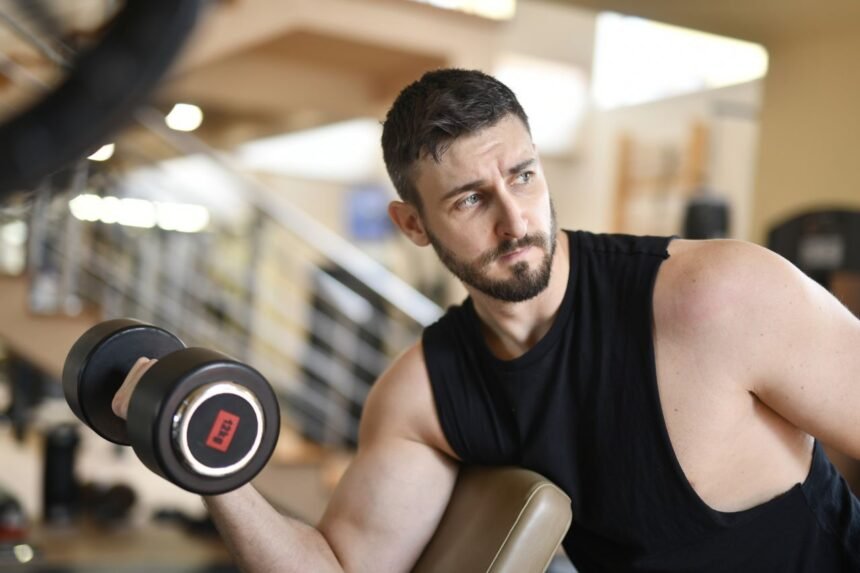
Bicep tendonitis causes pain at the front of the shoulder or the elbow, especially when you lift, pull, or reach overhead. This guide explains what is bicep tendonitis, the most common bicep tendonitis symptoms, and the causes behind them.
You will learn bicep tendonitis treatment options, safe bicep tendonitis exercises, and stretches for quick relief. We also cover distal bicep tendonitis, bicep tendonitis elbow pain, kt tape for bicep tendonitis, and when bicep tendonitis surgery becomes a real option.
Everything is written in simple, conversational language and backed by trusted medical sources. Use it to understand your pain, protect your arm, and recover with confidence. This article is for education only and does not replace advice from a doctor or physical therapist.
Introduction
Your arm hurts when you lift a bag. Reaching overhead feels sharp. Even a handshake can sting.
These small problems often point to the same cause. It is a tendon that is angry and swollen.
That condition is called bicep tendonitis, and it is more common than most people think.
Why This Guide Is Different
This article follows the E-E-A-T rule: experience, expertise, authoritativeness, and trust. It also follows YMYL (Your Money or Your Life) care, because health advice can affect your wellbeing.
We keep claims realistic and point you to respected sources. Where evidence is limited, we say so.
Use this guide to learn, not to self-diagnose. A clinician can confirm what is happening in your arm.
What Is Bicep Tendonitis?
So, what is bicep tendonitis? It is irritation or inflammation of the tendon that connects your biceps muscle to the bone.
The biceps has two tendons at the top, near the shoulder. It has one main tendon at the bottom, near the elbow.
When any of these tendons gets overworked, it swells and hurts.
How Your Biceps Works
The biceps muscle sits on the front of your upper arm. It bends your elbow and turns your forearm so your palm faces up.
It also helps stabilize your shoulder when you lift or throw.
Because it works in two joints, it takes a lot of daily stress.
Tendonitis vs. Tendinopathy
Tendonitis suggests short-term inflammation. Tendinopathy describes longer-term wear and tear inside the tendon.
Many cases begin as tendonitis and slowly become tendinopathy if the strain continues. This is why early care matters.
For a clear medical overview, the Cleveland Clinic offers helpful patient guides.
Two Main Types
| Type | Where It Hurts | Common Triggers |
|---|---|---|
| Proximal bicep tendonitis | Front of the shoulder | Overhead lifting, swimming, throwing |
| Distal bicep tendonitis | Inner elbow crease | Heavy pulling, forceful twisting, repeated lifting |
Most people deal with the shoulder type. The elbow type is rarer but can be more serious.
Bicep Tendonitis Symptoms: What to Watch For
The most common bicep tendonitis symptoms start slowly. They may feel like a dull ache at first.
Over days or weeks, the pain gets sharper. It often flares up with certain movements.
Let us look at the main warning signs.
Shoulder Symptoms
- Aching or burning at the front of the shoulder
- Pain that travels down the upper arm
- Tenderness when you press the front of the shoulder
- Pain when lifting your arm overhead
- A clicking or snapping feeling in the shoulder
- Night pain when you lie on the sore side
These signs usually point to the upper part of the tendon.
Distal Bicep Tendonitis Symptoms
Distal bicep tendonitis affects the tendon near your elbow. The pain feels different from shoulder pain.
- Pain in the crease of the elbow
- Aching when you bend or twist your forearm
- Tenderness when you press the inner elbow
- Weakness when turning a screwdriver or opening a jar
- Mild swelling near the elbow
If the pain came suddenly with a pop, see a doctor right away. That can mean a tear.
Bicep Tendonitis Elbow Pain vs. Other Problems
Elbow pain has many causes. Bicep tendonitis elbow pain sits at the front of the joint.
Tennis elbow hurts on the outside. Golfer’s elbow hurts on the inside. Triceps tendon problems hurt at the back.
Knowing the location helps you and your clinician narrow things down.
Symptom Checker Table
| Symptom | Likely Shoulder Type | Likely Elbow Type |
|---|---|---|
| Pain location | Front of shoulder | Inner elbow crease |
| Worse with | Overhead lifting | Pulling, twisting |
| Weakness | Mild | Noticeable in forearm turning |
| Pop or bulge | Rare | Seek care urgently if present |
| Night pain | Common | Less common |
This table is only a guide. It cannot replace a physical exam.
When to See a Doctor Now
See a healthcare professional quickly if you notice a sudden pop, a visible bulge, major bruising, numbness, or severe weakness.
Also get checked if the pain lasts longer than two weeks or wakes you at night. Early help prevents long-term damage.
Chest pain with arm pain is an emergency. Call your local emergency number.

Common Causes of Bicep Tendonitis
Most cases come from overuse. Repeating the same movement again and again irritates the tendon.
Age, poor form, and weak support muscles add to the problem. Often, several causes combine.
Here are the main ones.
Overuse and Repetitive Motion
Swimmers, tennis players, baseball pitchers, and weightlifters are at high risk. Painters, carpenters, and movers face the same strain at work.
Repeated overhead reaching wears down the tendon. So does heavy pulling.
Rest breaks help, but many people skip them.
Poor Technique and Sudden Load
Bad lifting form puts stress on the tendon. So does a sudden jump in weight or training volume.
Gym injuries often follow ego lifting. Adding too much weight too fast is a classic mistake.
Curls, heavy rows, and chin-ups are common triggers.
Age and Wear
Tendons lose flexibility and blood supply with age. After 40, the risk climbs.
Slow tendon healing means small injuries may linger. This is normal but manageable.
Shoulder Problems
Rotator cuff issues, impingement, and shoulder instability often show up together with bicep tendonitis. They change how the shoulder moves and overload the biceps tendon.
Treating only the biceps may not fix the root problem. Your clinician should check the whole shoulder.
For more on shoulder conditions, Healthline offers readable explainers.
Other Risk Factors
- Smoking, which reduces tendon blood flow
- Diabetes
- Some medicines, such as certain antibiotics
- Poor posture and weak back muscles
- Past shoulder or elbow injuries
Talk to your doctor if you have any of these and ongoing pain.
How Doctors Diagnose Bicep Tendonitis
Diagnosis starts with a conversation. Your clinician asks about your pain, work, and sports.
Next comes a physical exam. They press on the tendon and test your strength.
Special moves, such as the Speed test and Yergason test, can reveal tendon irritation.
Imaging Tests
Most cases do not need scans at first. If pain is severe or does not improve, tests may help.
- X-ray: Rules out bone problems.
- Ultrasound: Shows tendon swelling and movement in real time.
- MRI: Gives a detailed view of tendon tears and nearby damage.
Your clinician chooses the test based on your symptoms.
Why Proper Diagnosis Matters
Similar pain can come from the rotator cuff, neck, or joint. A wrong guess delays recovery.
A clear diagnosis lets you start the right bicep tendonitis treatment sooner. It also tells you if you need a specialist.
Bicep Tendonitis Treatment: What Works
The good news is that most people recover without major procedures. Early bicep tendonitis treatment focuses on calming the pain and protecting the tendon.
Then you rebuild strength step by step.
Patience is the key.
Step 1: Relative Rest
Stop the movements that cause pain. Avoid heavy lifting and overhead work for a while.
Do not stay completely still. Gentle motion keeps your shoulder from stiffening.
Think of it as pause, not shutdown.
Step 2: Ice and Heat
Ice can ease pain in the first days. Use it for 10 to 15 minutes, with a cloth between ice and skin.
Heat helps stiffness later. Use warm packs before gentle exercises.
Stop either one if it makes the pain worse.
Step 3: Pain Relief
Over-the-counter anti-inflammatory medicines may help some people. Ask a pharmacist or doctor first, especially if you have stomach, kidney, or heart issues.
Topical gels are another option. Always follow the label.
Never rely on pain pills to push through training.
Step 4: Physical Therapy
A physical therapist guides your recovery. They teach safe movement, fix posture, and build strength.
Physiotherapy resources such as Physiopedia explain treatment principles in detail.
Most people see better results with guided rehab than with rest alone.
Step 5: Injections (In Select Cases)
If pain stays strong, a doctor may suggest a corticosteroid injection near the tendon. It can reduce swelling and pain for some people.
Injections are used carefully, because repeated shots may weaken tendons. They are not a first choice for most.
Discuss risks and benefits with your doctor.
Treatment Timeline
| Phase | Time | Goal | Main Actions |
|---|---|---|---|
| Calm | Days 1 to 7 | Reduce pain | Rest, ice, gentle motion |
| Restore | Weeks 2 to 4 | Regain movement | Stretches, light bicep tendonitis exercises |
| Rebuild | Weeks 4 to 8 | Build strength | Progressive loading |
| Return | Weeks 8 to 12 | Back to sport or work | Gradual activity increase |
Mild cases may heal faster. Long-standing cases can take months.
KT Tape for Bicep Tendonitis
Many people ask about kt tape for bicep tendonitis. Kinesiology tape is a stretchy cotton strip with adhesive.
It does not fix a tendon. It may help some people feel supported and more aware of their arm position.
Research on taping is mixed, so treat it as a helper, not a cure.
How to Apply It Safely
Clean and dry the skin. Cut a strip long enough to run from the front of the shoulder down the upper arm.
Round the corners so the tape does not peel. Apply the anchor without stretch, then lay the strip along the muscle with light tension.
A physical therapist can show you the best method for your arm.
Tips for Tape Use
- Do not stretch the tape too hard.
- Remove it if the skin itches, burns, or turns red.
- Leave it on for up to three to five days, or as directed.
- Do not use it on broken skin.
- Keep doing your rehab work.
Tape works best alongside proper exercises, not in place of them.
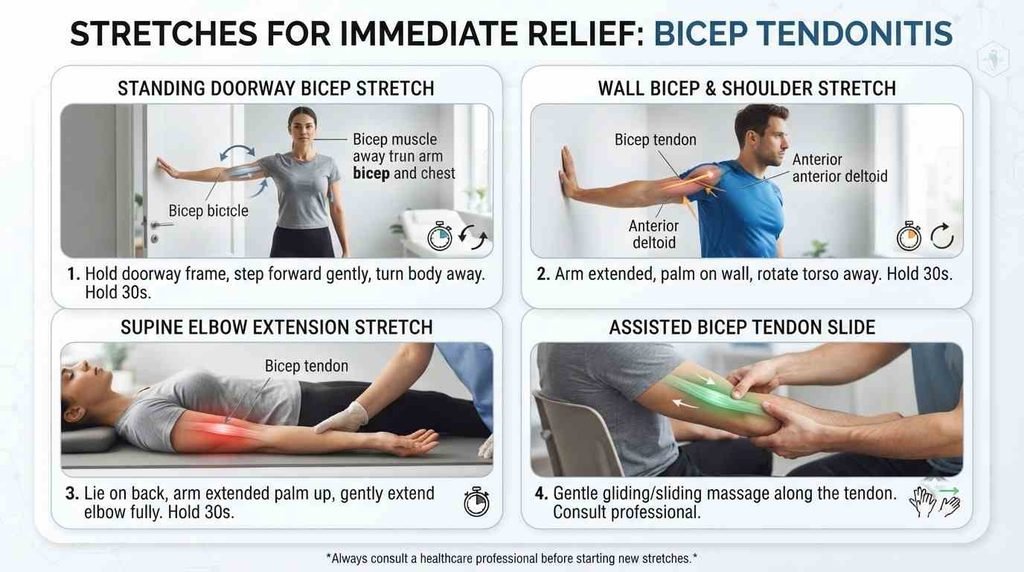
Stretches for Immediate Relief
Gentle stretching can calm stiffness and ease tension around the tendon. It is a great first step for bicep tendonitis.
Move slowly and never force a stretch. A mild pull is fine, but sharp pain means stop.
Hold each stretch and breathe normally.
Doorway Biceps Stretch
Stand in a doorway. Place your forearm on the frame with your elbow slightly below shoulder height.
Gently turn your body away until you feel a light stretch in the front of the shoulder.
Hold for 20 to 30 seconds. Repeat two to three times.
Wall Palm Stretch
Face a wall. Place your palm on it with your fingers pointing backward and your arm straight.
Slowly rotate your body away from the hand until you feel a gentle stretch along the arm.
Hold for 20 seconds and repeat three times.
Pendulum Swing
Lean forward and let the sore arm hang down. Support yourself with your other hand on a table.
Swing the arm in small circles, then forward and back. Let gravity do the work.
Do this for one minute, two or three times a day.
Cross-Body Shoulder Stretch
Bring the sore arm across your chest. Use your other hand to hold it just above the elbow.
Pull gently until you feel a stretch in the back of the shoulder.
Hold for 20 to 30 seconds and repeat twice.
Seated Elbow Extension
Sit tall with your arm resting on your thigh, palm up. Slowly straighten the elbow as far as is comfortable.
Pause, then bend it back. This helps with distal bicep tendonitis and bicep tendonitis elbow stiffness.
Do 10 slow repetitions.
Safety Rules for Stretching
- Warm up first with a warm shower or heat pack.
- Never bounce.
- Stop if pain rises above a mild level.
- Stretch daily, not just when it hurts.
- Skip these moves if a tear is suspected.
If stretching worsens your symptoms, see a clinician.

Bicep Tendonitis Exercises: At-Home Recovery Plan
After the pain settles, you need to rebuild strength. Smart bicep tendonitis exercises help the tendon handle load again.
Start light. Progress only when the exercise feels easy and pain stays low.
A good rule is to keep pain at 3 out of 10 or less, and to see it settle within 24 hours.
Phase 1: Gentle Activation
These moves wake up the muscle without stressing the tendon.
- Isometric bicep hold: Bend your elbow to 90 degrees. Push your palm gently up against a table. Hold 20 to 30 seconds. Repeat 5 times.
- Shoulder blade squeezes: Pull your shoulder blades back and together. Hold 5 seconds. Do 10 reps.
- Wrist and forearm turns: Rotate your forearm slowly palm up and palm down. Do 10 reps.
Do them once or twice a day.
Phase 2: Light Strengthening
Once you can do Phase 1 without pain, add light resistance. A resistance band or a small can works well.
- Slow band curls: Take three seconds to lift and three seconds to lower. Do 2 sets of 10.
- External rotation with a band: Keep your elbow at your side and rotate the forearm outward. Do 2 sets of 10.
- Scapular rows: Pull a band toward your ribs while keeping your shoulders down. Do 2 sets of 10.
These protect the shoulder, which supports the biceps tendon.
Phase 3: Return to Strength
Now raise the challenge step by step. Use slightly heavier weights and slower control.
- Hammer curls: Palms facing each other. Lower slowly.
- Eccentric curls: Lift with the other hand, lower with the sore arm over four seconds.
- Light overhead reaching: Only after the shoulder feels stable.
Tendons respond well to slow, controlled loading. Fast, jerky moves often cause setbacks.
Exercise Plan at a Glance
| Phase | Exercise | Sets and Reps | Pain Limit |
|---|---|---|---|
| 1 | Isometric hold | 5 x 20 to 30 sec | 3 out of 10 |
| 1 | Shoulder blade squeeze | 1 x 10 | 3 out of 10 |
| 2 | Slow band curl | 2 x 10 | 3 out of 10 |
| 2 | Band external rotation | 2 x 10 | 3 out of 10 |
| 3 | Hammer curl | 3 x 8 to 10 | 3 out of 10 |
| 3 | Eccentric curl | 3 x 6 | 3 out of 10 |
Adjust the plan with a physical therapist, especially if you have distal bicep tendonitis.
Daily Habits That Speed Healing
- Sleep with your arm supported on a pillow.
- Keep your posture tall when sitting.
- Carry bags close to your body.
- Avoid heavy pulling until cleared.
- Eat enough protein and drink enough water.
For exercise form tips and tendon rehab science, Physiopedia is a helpful reference.
Signs You Are Doing Too Much
Pain that lasts more than a day after exercise is a warning. So is swelling, new numbness, or night pain.
If you notice these, drop back one phase. Give the tendon more time.
Slow progress is still progress.
Distal Bicep Tendonitis: Special Notes
Distal bicep tendonitis is less common, but it needs extra attention. The tendon near the elbow can tear if overloaded.
Men who lift heavy, work in manual trades, or use repeated forearm twisting are at higher risk. Smoking and steroid use also raise the risk.
The key difference is the possible link with tears.
Partial vs. Complete Tears
A partial tear may feel like stubborn aching and weakness. A complete tear often brings a sudden pop, bruising, and a visible change in the muscle shape.
A complete tear usually needs prompt medical care. Waiting too long can make repair harder.
See a doctor fast if you suspect it.
Managing Bicep Tendonitis Elbow Pain
Start with relative rest, ice, and gentle range-of-motion work. Avoid heavy curls, chin-ups, and forceful twisting.
Use a neutral grip, such as hammer curls, as you return to training. This often puts less stress on the elbow tendon.
A physical therapist can guide your progression.
For patient-friendly explanations of elbow tendon injuries, visit the Cleveland Clinic.
Bicep Tendonitis Surgery: When Is It Needed?
Most people never need bicep tendonitis surgery. Rest, rehab, and time solve the problem in most cases.
Surgery becomes an option when pain stays severe after months of proper care. It is also considered for tendon tears or when other shoulder damage is present.
The decision is personal and made with a specialist.
Common Surgical Options
- Biceps tenodesis: The surgeon detaches the tendon from the shoulder socket and reattaches it to the upper arm bone.
- Tenotomy: The tendon is released and allowed to retract. It is simpler but can change the shape of the arm.
- Distal tendon repair: For elbow tears, the tendon is reattached to the forearm bone.
- Related shoulder surgery: Rotator cuff repair or decompression may be done at the same time.
Your surgeon will explain which procedure fits your case.
Recovery After Surgery
Expect a sling for a few weeks, followed by guided physical therapy. Strength training usually returns gradually over several months.
Full recovery times vary by procedure and person. Follow your surgeon’s plan closely.
Risks include stiffness, infection, and nerve irritation. Ask about them before you decide.
Questions to Ask Your Surgeon
- Which procedure do you recommend and why?
- What are the risks for my case?
- How long until I can return to work or sport?
- What happens if I wait?
- Are there non-surgical options left to try?
A second opinion is always reasonable.
Preventing Bicep Tendonitis From Coming Back
Prevention is easier than treatment. Small habits protect your tendons for years.
Most relapses come from returning to activity too fast. Patience again wins.
Smart Training Habits
- Warm up for five to ten minutes before lifting or sport.
- Increase weight or volume slowly, by about 5 to 10 percent per week.
- Use full range of motion and controlled form.
- Balance pulling with pushing exercises.
- Include rest days and sleep.
These steps keep stress on the tendon in a safe range.
Strengthen the Support System
Strong shoulders, upper back, and core reduce the load on the biceps tendon. Rotator cuff work and rows are especially useful.
Good posture also helps. Rounded shoulders change how the tendon glides.
Think of the whole chain, not just the biceps.
Workplace and Daily Life Tips
- Take breaks from repetitive overhead tasks.
- Use tools and carts instead of lifting heavy loads.
- Keep items within easy reach.
- Stay active but avoid sudden, heavy efforts.
Small changes add up over time.
Is It Bicep Tendonitis or Something Else?
Shoulder and elbow pain can come from many sources. Do not assume.
The table below shows how related problems differ.
| Condition | Typical Pain Spot | Key Clue |
|---|---|---|
| Bicep tendonitis | Front of shoulder or inner elbow | Pain with lifting and pulling |
| Rotator cuff injury | Outer shoulder | Weakness raising the arm, night pain |
| Shoulder impingement | Top and front of shoulder | Pain when reaching overhead |
| Tennis elbow | Outer elbow | Pain when gripping |
| Pinched nerve in neck | Neck, shoulder, arm | Tingling or numbness |
Because these overlap, a professional exam is the safest path.
Frequently Asked Questions
What is bicep tendonitis in simple terms?
It is pain and swelling in the tendon that attaches your biceps to the bone, usually from overuse.
How long does bicep tendonitis take to heal?
Mild cases may improve in a few weeks. Longer cases can take two to three months or more.
Can I keep working out?
Yes, but change what you do. Avoid painful movements and focus on light, pain-free bicep tendonitis exercises.
Does kt tape for bicep tendonitis really work?
It may give a feeling of support for some people. Evidence is mixed, so use it with proper rehab.
When is bicep tendonitis surgery necessary?
Only if long-term, correct treatment fails or if there is a significant tear. Most people recover without surgery.
What is the best bicep tendonitis treatment?
A mix of relative rest, guided exercise, good habits, and time works best for most people. Your clinician may add medicine or other care.
Conclusion
Bicep tendonitis can feel frustrating, but it is manageable. With early rest, gentle stretches, and smart rehab, most people return to normal life.
Know your bicep tendonitis symptoms, respect your pain, and progress slowly. Get medical help quickly if you notice a pop, a bulge, or major weakness.
Protect your tendons, build your shoulders, and listen to your body. Recovery is a steady process, not a race.
Key Takeaways
- Bicep tendonitis is usually caused by overuse and poor load management.
- Symptoms include front-shoulder or elbow pain with lifting.
- Start with gentle stretches, then move to phased strengthening.
- Most people do not need surgery.
- See a professional for sudden or severe symptoms.
Medical Disclaimer (YMYL Notice)
This article is for general education and is not medical advice. It does not replace care from a doctor or licensed physical therapist. Seek professional guidance before starting any treatment or exercise program, and get urgent care for sudden severe pain, a pop, numbness, or chest pain.