


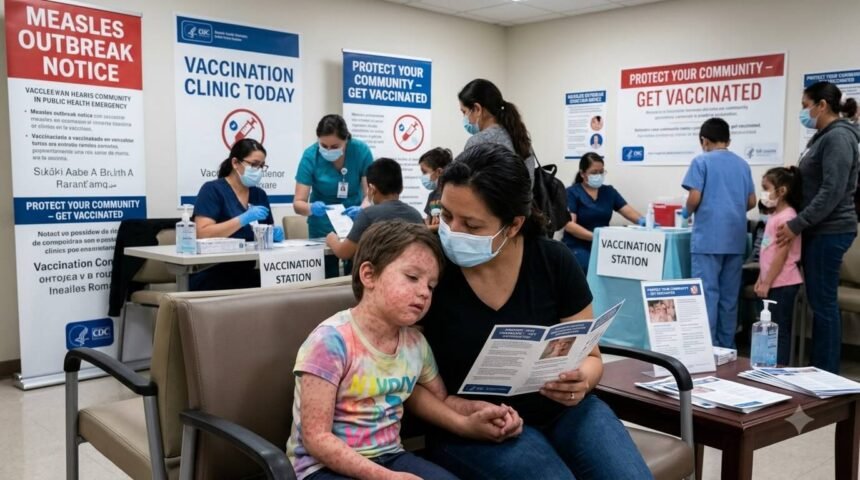
The measles outbreak now reshaping American public health is no longer a story about one town or one state. The Centers for Disease Control and Prevention (CDC) reported 3,659 confirmed cases as of September 24, 2026, the highest annual total in about 35 years, with the year not yet over. All of 2025 produced 2,289 cases and three deaths.
This guide explains the numbers in plain language: how many cases, what “outbreak” means, how well the MMR vaccine works, who is most at risk, and why Pennsylvania’s death count and the national death count do not match.
Key takeaways
- Cases: 3,659 confirmed U.S. cases as of Sept. 24, 2026, up from 3,471 on Sept. 17 (CDC data as reported by Reuters and Becker’s Hospital Review).
- Outbreaks: 40 outbreaks in 2026, linked to about 95% of cases.
- Vaccination: about 95% of 2026 patients were unvaccinated or had unknown vaccination status.
- Hospitalization: roughly 9% of cases required hospital care, versus 11% in 2025.
- Deaths: CDC confirmed two measles-related deaths on Sept. 29, 2026. Pennsylvania’s health department has reported five measles-associated deaths as of Sept. 30.
- Protection: two doses of MMR are about 97% effective against measles.
The case count, date-stamped
Measles numbers are only meaningful with a date attached. Here is where the national count stood on each CDC reporting date this month and last year:
| Date / period | Confirmed U.S. cases | Source note |
|---|---|---|
| All of 2025 | 2,289 | CDC; 3 deaths, 11% hospitalized |
| Sept. 17, 2026 | 3,471 | CDC; 47 jurisdictions, 39 new outbreaks reported at that point |
| Sept. 24, 2026 | 3,659 | CDC; 40 outbreaks, 95% outbreak-associated |
That is 188 new confirmed cases in a single week. Compared with the same stretch of 2025, cases in the first 39 weeks of 2026 were up 146%. The 2026 total is also about 43 times the 85 cases recorded in 2000, the year the United States declared measles eliminated.
A few details from the CDC breakdown help put the total in context:
- Age: about 61% of patients are 19 or younger, which means roughly four in ten are adults.
- Hospitalization: about 9% of 2026 cases have been hospitalized.
- Undercounting: the CDC tally includes only lab-confirmed cases. Probable cases reported by states are not in the headline number, so the true burden is likely higher.
One caution for anyone tracking this day to day: the CDC updates its dashboard on a weekly schedule, while state health departments often post sooner. State and federal numbers can therefore differ for a few days without either one being wrong.
What counts as a measles outbreak?
The word “outbreak” gets used loosely in headlines. In public health it has a specific meaning.
Outbreak definition: the CDC defines a measles outbreak as three or more related cases. “Related” means epidemiologically linked, such as the same school, household, congregation, workplace, or travel exposure. Three unconnected cases in three different states are not an outbreak. Three cases traced to one gym are.
Two other definitions matter when you read the news:
- Ending an outbreak. Health departments typically declare an outbreak over after 42 days with no new cases. That is two full incubation periods of 21 days each, long enough to be confident a chain of transmission has truly broken. South Carolina’s health department used exactly this rule.
- Elimination. Measles is “eliminated” when the virus has not circulated continuously in a country for 12 months or more. Elimination does not mean zero cases. The U.S. recorded 85 cases in 2000, the year it earned the status. What it means is that imported cases stopped turning into year-long chains of spread.
With 40 outbreaks accounting for about 95% of 2026 cases, this year’s measles outbreak problem is not scattered travelers. It is sustained spread inside communities with lower vaccination coverage.
State-by-state: where the 2026 cases are
According to CDC data compiled by USAFacts, these ten jurisdictions had the most confirmed cases from January 1 to September 24, 2026:
| State | Confirmed cases |
|---|---|
| Pennsylvania | 850 |
| South Carolina | 670 |
| Utah | 535 |
| Texas | 192 |
| Virginia | 178 |
| Wisconsin | 164 |
| Florida | 148 |
| Ohio | 134 |
| Arizona | 110 |
| New York | 69 |
Three states have crossed 500 cases. Pennsylvania’s own health department reported a higher figure, 943 cases across 39 counties as of Sept. 30, because it counts more recent weeks than the CDC’s Sept. 24 snapshot.
Measles outbreak South Carolina: the largest in decades
The measles outbreak South Carolina experienced is the reason 2026 started so fast. The South Carolina Department of Public Health (DPH) confirmed the Upstate outbreak in the fall of 2025, centered on Spartanburg County. It then accelerated: 185 cases in early January, 310 on January 9 (99 new cases in a single update), 646 on January 20, and 933 on February 10.
DPH reported the final total of 997 cases and announced the end of the outbreak on April 26, 2026, after 42 days with no new cases. The last new case had been reported March 17. Because the outbreak began in 2025, its 997-case total is larger than the 670 South Carolina cases the CDC attributes to calendar-year 2026.
The DPH data show who was affected. In its March 3 update (990 cases at that point):
- 923 patients were unvaccinated, 19 had one MMR dose, 26 had two doses, and 22 had unknown status.
- 637 patients were ages 5 to 17, 260 were under 5, and 85 were adults.
- DPH had learned of 21 hospitalizations as of Feb. 24, among both children and adults.
The pattern was classic: a virus entering tightly connected schools and congregations with low vaccination rates. The outbreak is widely described as the largest single measles outbreak in the United States in more than three decades.
Measles outbreak Texas: from the 2025 epidemic to 2026 clusters
The measles outbreak Texas residents remember began in January 2025 in the South Plains region. The Texas Department of State Health Services declared it over on August 18, 2025, after 42 days without new cases. Final totals: 762 cases, 99 hospitalizations, and two deaths in unvaccinated school-aged children.
Texas in 2026 looks different. DSHS reported 192 confirmed cases in Texas residents as of September 16, 2026: 22 locally acquired, 6 tied to domestic travel, 8 to international travel, and 156 in the “unknown/other” category. DSHS notes that a subset of confirmed cases are among people housed in federal detention facilities. Earlier reporting from the Texas Tribune and CIDRAP tied most of the state’s early-2026 cases to a detention facility in Hudspeth County, which had 99 cases by April.
That means the 2026 Texas count reflects a different transmission setting from the 2025 community epidemic. The CDC’s Sept. 24 count for Texas, 192, matches the state’s figure.
Florida measles outbreak: a campus cluster and a slower tail
The Florida measles outbreak of 2026 began at Ave Maria University in Collier County. The first cases appeared in late January. According to a letter from the university, state health officials indicated the cluster most likely began with a student’s holiday travel from another state. Ave Maria requires proof of vaccination but, under Florida law, allows students to opt out by signing a waiver. By mid-February, reports of more than 40 cases made it one of the largest measles outbreaks ever recorded on a U.S. college campus.
By March 21, 2026, the state reported 143 cases for the year, with 104 (73%) in Collier County. About 72% were acquired in Florida. Growth then slowed sharply. The CDC’s Sept. 24 count for Florida is 148, which means very little was added over six months.
Anyone searching measles outbreak Florida should note one reporting caveat: during the campus outbreak, some case updates came from the university and local media rather than state data. When state and school figures differ, trust the Florida Department of Health’s dated counts.
Wake County measles outbreak: what the record actually shows
Searches for Wake County measles outbreak spiked after measles reached the Raleigh area, but the facts need care. In the most recent public reporting I could find, from March 2026, there were no confirmed measles cases in Wake County residents, and no declared outbreak in the county.
What did happen: on February 5, 2026, a person visiting from South Carolina who had measles went to five locations in Raleigh’s Brier Creek area, including a gym, two grocery stores, a pharmacy, and a restaurant. Exposures were also reported in Durham and Orange counties, and Johnston County confirmed its first case since 2018. North Carolina had 24 confirmed cases statewide since December as of March 3, 2026. About 72% of those patients were unvaccinated and most were under 18.
Why Wake County officials stayed alert:
- Wake’s estimated kindergarten vaccination coverage is about 94%, just under the 95% community-protection threshold.
- About 28% of Wake County schools fall below 95%.
- Durham County’s kindergarten coverage is lower, at about 88%.
If you live in the Triangle, check Wake County Public Health and the North Carolina Department of Health and Human Services dashboard for anything newer than the reporting above. Wake County Public Health offers MMR vaccination by appointment at 919-250-1120.
Pennsylvania: the center of the 2026 outbreak
Pennsylvania has the largest measles outbreak of any state, with the most cases: 850 in the CDC’s Sept. 24 data and 943 across 39 counties in the state’s own Sept. 30 figures, with about 176 people hospitalized. Lancaster County, home to large Amish and Mennonite communities, is the epicenter, with roughly 40% of the state’s cases. Chester County, the only Philadelphia-area county with cases, had nearly 80 as of late September.
Pennsylvania also drove the national conversation about deaths, which brings us to the most confusing part of this story.
Pennsylvania’s deaths vs. the national count
Here are the two sets of numbers, side by side:
| Reporter | Deaths reported | As of |
|---|---|---|
| Pennsylvania Department of Health | 5 measles-associated deaths | Sept. 30, 2026 |
| CDC national dashboard | 2 measles-related deaths | Sept. 29, 2026 |
What Pennsylvania has reported: two infants in Lancaster County (announced Aug. 25, the state’s first measles deaths in 35 years), an unvaccinated 18-year-old in Mifflin County, a 40-year-old woman in Jefferson County, and, on Sept. 30, an unvaccinated Lancaster County resident whose death the state said meets its measles-associated death definition.
What the CDC shows: one death on Sept. 23 and two on Sept. 29, without saying in which states they occurred. So it is not publicly known how many of the CDC’s two correspond to Pennsylvania’s five, and this article does not guess.
Why the numbers differ. The CDC said it is working with the Council of State and Territorial Epidemiologists to build a standardized case definition for measles deaths. In the meantime, press reports say the CDC shifted to counting deaths using National Center for Health Statistics (NCHS) mortality records, confirming a death only after measles is verified as the underlying cause. State health departments, by contrast, have traditionally reported “measles-associated” deaths in real time, using a definition that includes a death within 30 days of symptom onset and a positive test, plus review of medical records. Epidemiologists note that “measles-associated” has long been a standard used by both the CDC and the World Health Organization.
The disagreement also became political. HHS Secretary Robert F. Kennedy Jr. has said that only one of the Pennsylvania deaths resulted from measles. Pennsylvania Governor Josh Shapiro and state officials have pushed back and sought CDC help resolving the count.
How to read this responsibly:
- Treat “five” as Pennsylvania’s official reported count and “two” as the CDC’s current confirmed national count.
- The CDC says its figure is subject to change as reviews finish.
- Both agencies recommend MMR vaccination as the best protection. Pennsylvania has described the Lancaster County residents who died, and the Mifflin County teen, as unvaccinated.
Whatever the final tally, measles deaths were rare in the U.S. for decades. Before the vaccine, about 400 to 500 Americans died of measles each year.
How effective is the MMR vaccine?
The evidence on MMR is among the strongest in modern medicine.
- One dose is about 93% effective at preventing measles.
- Two doses are about 97% effective, and protection usually lasts for life.
- Breakthrough cases can happen, but they are uncommon and tend to be milder. In South Carolina’s outbreak, only 26 of 990 patients had received two doses, about 3%.
Those numbers are why vaccination coverage matters so much for communities. Measles is among the most contagious viruses known: an infected person can pass it to up to 9 of 10 unprotected people nearby, and virus particles linger in the air for up to two hours after the person has left a room. Because of that, public health agencies say about 95% of a community needs immunity to block sustained spread. Below that line, outbreaks become likely.
The standard schedule
- First dose: 12 to 15 months of age
- Second dose: 4 to 6 years of age
- During outbreaks or before international travel, infants as young as 6 months can receive an early dose. This early dose does not replace the two standard doses later.
Adults and catch-up
Most adults born before 1957 are considered immune from natural infection. Adults born in 1957 or later need evidence of immunity: written records of vaccination, a lab-confirmed past infection, or a positive immunity blood test (titer). Without evidence, one dose is the general recommendation, and two doses for higher-risk groups such as healthcare workers, international travelers, and college students. People vaccinated with an inactivated vaccine between 1963 and 1967 should talk to a clinician about revaccination.
MMR is a live vaccine, so it is not given during pregnancy or to people with severely weakened immune systems. Anyone in those groups should speak with a clinician about exposure planning.
Who is at risk?
Anyone without immunity can catch measles, but risk is not evenly spread.
Highest risk of catching it
- Unvaccinated children and adults
- Infants too young for the first dose (under 12 months)
- People with no documented vaccination or past infection
- Travelers to regions with active spread
Highest risk of severe disease
- Children under 5 (about one in three young children with measles may be hospitalized, per North Carolina health officials)
- Pregnant people who lack immunity
- People with weakened immune systems
- Adults over 20, who also face higher complication rates than school-aged children
Where outbreaks keep appearing
2026’s outbreaks cluster where tight social networks overlap with lower vaccination coverage: religious schools and congregations, homeschool cooperatives, college campuses that allow waivers, and congregate settings such as detention facilities. These are descriptions of setting, not blame. Measles finds any gap in immunity, whether it is caused by access barriers, hesitancy, or simply missed doses.
Complications to know about
- Pneumonia occurs in about 1 in 20 unvaccinated children.
- Encephalitis (brain swelling) occurs in about 1 in 1,000 cases and can cause permanent brain damage.
- Between 1 and 3 of every 1,000 children who get measles die from respiratory or neurologic complications.
- Measles can also erase part of the immune system’s memory of other infections for months to years.
Symptoms, contagious window, and isolation
Symptoms usually start 7 to 14 days after exposure and can take up to 21 days to appear.
- Early phase (2 to 4 days): high fever (sometimes above 104°F), cough, runny nose, red watery eyes.
- Koplik spots: tiny white spots inside the mouth, often 2 to 3 days after symptoms begin.
- Rash (3 to 5 days after symptoms begin): flat red blotches that start on the face and spread downward.
A person with measles is contagious from about 4 days before the rash appears to 4 days after. That means people spread it before they know what they have.
Isolation vs. quarantine:
- Isolation applies to a person with measles: stay home until 4 days after the rash starts.
- Quarantine applies to a person exposed who may not be immune: up to 21 days from exposure. Schools and states set their own detailed rules.
If you suspect measles, call your clinic or urgent care before you walk in so staff can bring you in through a separate entrance and protect other patients. Go to the emergency department for trouble breathing, confusion, seizures, or a child who is very drowsy or not drinking.
Is the United States about to lose measles elimination?
This decision is still pending. The Pan American Health Organization (PAHO) postponed its review of U.S. elimination status from April to November 2026. The Americas as a region lost verified measles-free status on November 10, 2025, after Canada’s loss of status. A Lancet letter this year argued the U.S. is highly likely to lose its own status, but no final ruling has been issued. Losing the label would not change an individual’s risk or CDC vaccine guidance overnight. It would signal that measles is again circulating continuously.
What to do now
- Check your records. Find your and your children’s MMR documentation. Ask your clinician or state immunization registry if you cannot find it.
- Close the gap. If you or your child is behind on MMR, call a clinic or local health department. Pennsylvania delivered more than 53,000 MMR doses in September, more than double a typical month, which shows how quickly catch-up can move.
- Plan for exposure notices. Know the rules for your school or workplace, including quarantine of non-immune contacts.
- Travel smart. Confirm vaccination before international trips and watch for exposure alerts tied to airports, trains, and events.
- Use dated sources. Rely on the CDC dashboard and your state health department, and note the “as of” date every time.
Frequently asked questions
How many measles cases are there in the U.S. in 2026? The CDC confirmed 3,659 cases as of September 24, 2026, across 47 or more jurisdictions, with 40 outbreaks.
Which state has the biggest measles outbreak in 2026? Pennsylvania, with 850 cases in the CDC’s Sept. 24 data and 943 in the state’s Sept. 30 count.
Is there a Wake County measles outbreak? In the latest reporting available to this article (March 2026), Wake County had exposures from a visitor but no confirmed resident cases and no declared outbreak. Check Wake County Public Health for current status.
Is the measles outbreak South Carolina had over? Yes. DPH declared it over on April 26, 2026, at 997 total cases.
Is there a measles outbreak Texas is dealing with right now? Texas reported 192 confirmed cases in 2026 as of Sept. 16, a subset of them in federal detention facilities. The large 2025 West Texas outbreak ended August 18, 2025.
Do adults need another MMR shot? Only if they lack evidence of immunity or are in a higher-risk group. Adults with two documented doses are considered protected. Ask a clinician about records or a titer test before getting an extra dose.
Can vaccinated people get measles? Rarely. Two doses are about 97% effective, and breakthrough illness is typically milder.
How long is measles contagious? From about 4 days before the rash to 4 days after.
Why does Pennsylvania report more measles outbreak deaths than the CDC? The state reports measles-associated deaths using its own definition and timeline, while the CDC is currently counting deaths it can verify through national mortality records and is developing a standard definition with state epidemiologists.
Sources and date notes
- CDC Measles Data and Research: https://www.cdc.gov/measles/data-research/index.html
- CDC MMR vaccine information: https://www.cdc.gov/vaccines/vpd/mmr/public/index.html
- CDC clinical overview: https://www.cdc.gov/measles/hcp/clinical-overview/stay-alert-for-measles-cases.html
- WHO measles fact sheet: https://www.who.int/news-room/fact-sheets/detail/measles
- South Carolina DPH, Texas DSHS, Florida Department of Health, Pennsylvania Department of Health, and North Carolina DHHS dashboards
- Reporting on CDC figures from Reuters (Sept. 29, 2026), USAFacts (updated Sept. 25, 2026), CIDRAP, NBC News, and The Washington Post
This article is for general information and is not medical advice. Talk to a healthcare provider about your own vaccination needs. Case counts change weekly; confirm the latest CDC “as of” date before relying on any number here.