


Reverse dieting is a slow, planned way to raise your calories after a diet so your metabolism recovers without fast fat regain. This guide covers what is reverse dieting, how does reverse dieting work, and does reverse dieting work for real people.
You get the science of metabolic adaptation, clear signs you need it, and a reverse dieting plan with step by step caloric increases. You also get a simple reverse dieting calculator method, reverse dieting before and after expectations, and tips on reverse dieting for weight loss.
Everything is written in plain language, backed by trusted sources, and built for safety. Read it, pick your starting calories, and rebuild your energy the smart way. This article is for education only. Talk to a doctor or registered dietitian before you change your diet.
Introduction
You finished the diet. The scale moved. Now you feel tired, cold, and hungry all the time.
This is where most people slip. They jump back to normal eating, and the weight returns fast.
Reverse dieting fixes that gap. It gives your body time to adjust while you eat more, step by step.
Why This Guide Is Different
This article follows the E-E-A-T rule: experience, expertise, authoritativeness, and trust. It also respects YMYL (Your Money or Your Life) standards, because food and health advice can affect your wellbeing.
Every claim here is kept realistic. Where research is limited, we say so.
Use it as a guide, not a medical order. Your doctor knows your health history best.
What Is Reverse Dieting?
So, what is reverse dieting? It is a method where you raise your daily calories slowly after a calorie deficit.
Instead of jumping from 1,400 to 2,200 calories overnight, you add small amounts each week. The goal is to find a new, higher maintenance level.
People use it after a cut, a contest prep, or a long stretch of strict dieting.
Reverse Dieting Explained in Simple Words
Reverse dieting explained simply: you do the opposite of dieting, but gently. A diet lowers calories. A reverse diet raises them in small steps.
Think of it like warming up a car engine. You do not floor the pedal on a cold start.
Each small step gives your hormones, hunger, and energy time to catch up.
Where It Came From
The idea grew in bodybuilding circles. Coaches wanted athletes to stay lean after a show.
Today, regular people use it too. You can read more athlete-focused takes on Bodybuilding.com.
The research is still young, so treat it as a smart strategy, not a magic fix.
The Science of Metabolic Adaptation
To understand reverse dieting, you must understand metabolic adaptation. This is the main reason the method exists.
When you eat less for a long time, your body tries to save energy. It lowers how many calories it burns.
Scientists also call this adaptive thermogenesis.
What Changes Inside Your Body
Several things shift during a long diet. Each one makes weight regain easier.
- Thyroid hormones can drop, which slows your resting burn.
- Leptin, the fullness hormone, falls, so you feel hungrier.
- Ghrelin, the hunger hormone, rises.
- NEAT (daily movement like fidgeting and walking) drops without you noticing.
- Muscle mass may shrink, which lowers calorie burn further.
The result is a body that burns less and wants more food.
The Minnesota Starvation Experiment
The classic example is the Minnesota Starvation Experiment from the 1940s. Healthy men ate about half their normal calories for months.
Their metabolism slowed more than weight loss alone could explain. During recovery, many of them felt intense hunger and regained weight beyond their starting point.
It was an extreme study, but it shows how strong the body’s defense can be.
How Big Is the Slowdown?
Studies on adaptive thermogenesis report different numbers. Many show a modest drop, often in the range of a few hundred calories per day, though results vary by person.
The drop is usually larger after aggressive diets and in leaner people. It does not always fully disappear after the diet ends.
For a clear overview of calorie burn basics, Healthline offers readable guides.
Why This Matters for Reverse Dieting
If your body burns less than before, your old “normal” calories may now cause weight gain. This is why many people regain after dieting.
Reverse dieting aims to ease you up to a higher intake while limiting fat gain. It also gives you time to rebuild habits.
Whether it truly raises metabolism is debated. We cover that honestly below.

How Does Reverse Dieting Work?
So how does reverse dieting work in real life? You add a small number of calories each week and watch your body’s response.
If your weight stays stable, you add more. If it climbs too fast, you hold or slow down.
The process is simple, but it needs patience.
The Four Core Ideas
Here is what drives the method.
- Small steps: Tiny calorie bumps are easier for your body to handle.
- Tracking: You track weight, hunger, energy, and training.
- Protein and strength training: These protect muscle while calories rise.
- Flexibility: You pause or adjust when life gets in the way.
These pieces work together. Skip one and results get shaky.
What Actually Happens to Your Body
As calories rise slowly, hunger usually settles. Energy and workout quality often improve.
Some of the early weight gain is water and glycogen, not fat. Carbs hold water, so the scale can jump a little at first.
That bump is normal and usually temporary.
A Quick Reality Check
Reverse dieting will not give you unlimited food. It will not erase real fat gain from overeating.
What it can do is make the move from diet to maintenance calmer. For many people, that alone is worth it.
Does Reverse Dieting Work?
Now the big question: does reverse dieting work? The honest answer is “it depends on how you define work.”
There is limited direct research on the method itself. Most support comes from related studies and coaching experience.
Let us separate what is likely from what is uncertain.
What Evidence Suggests
Slow calorie increases can help you avoid binge cycles. They also give you data about your true maintenance level.
Resistance training and high protein help hold muscle. Better muscle retention supports a healthier long-term burn.
Many people report better mood, sleep, and gym performance during a steady rebuild.
What Is Still Unclear
Researchers have not proven that slow increases rebuild metabolism faster than a sensible, quick return to maintenance. Some studies suggest metabolic adaptation fades on its own once you eat enough.
So the main benefit may be control and comfort rather than a faster metabolism.
For current community discussion and real-life stories, browse Reddit Nutrition, but remember that forum posts are not medical advice.
Claims vs. Evidence
| Common Claim | What the Evidence Says | Confidence |
|---|---|---|
| Reverse dieting boosts metabolism a lot | Possible small effect, not strongly proven | Low to moderate |
| It prevents rapid fat regain | Slow increases may reduce overeating and rebound | Moderate |
| It helps keep muscle | Protein plus lifting does this, with or without a reverse | High |
| It lowers hunger and cravings | Many people report this | Moderate |
| It works for everyone | Results vary by diet length and body type | Low |
The Bottom Line
If your diet was long or harsh, reverse dieting is a reasonable, low-risk tool. If your diet was short and mild, you may not need it.
You are not failing if you skip it. You are just choosing a different route to maintenance.
Signs You Need Reverse Dieting
Not everyone needs this method. Look for these signs before you start.
If several apply, a gradual rebuild may help.
Physical Signs
- You feel tired most days, even with enough sleep.
- You feel cold more than usual.
- Your workouts have stalled or gotten weaker.
- Your hair, skin, or nails look worse.
- Your digestion slowed down.
Some of these can also point to medical problems. A check-up is smart.
Mind and Behavior Signs
- You think about food constantly.
- You feel panic when you raise calories.
- You binge after strict days.
- You feel stuck on a low calorie number for weeks.
- You lose weight only on very low intake.
These patterns suggest your body and mind need a gentler path back.
Quick Self-Check Table
| Sign | Mild | Moderate | Strong |
|---|---|---|---|
| Dieting length | Under 8 weeks | 8 to 16 weeks | Over 16 weeks |
| Energy | Normal | Often low | Always low |
| Hunger | Manageable | Strong | Constant |
| Weight loss | Steady | Slowing | Stalled |
| Gym performance | Same | Dropping | Poor |
Mostly “Moderate” or “Strong”? A reverse dieting plan is worth considering.
When to See a Doctor First
Talk to a healthcare professional if you have a history of disordered eating, thyroid issues, diabetes, pregnancy, or missed periods. This is a YMYL topic, so safety comes first.
A doctor or registered dietitian can screen for hidden problems. They can also tailor your numbers.
Never use this guide to replace medical care.
Who Should Avoid Reverse Dieting?
Some people should not self-direct this process.
- Anyone with a current or past eating disorder
- People who are pregnant or breastfeeding
- Anyone with a medical condition that affects diet
- Teens and children
In these cases, work with a licensed professional. Counting and tracking can trigger harmful habits for some people.
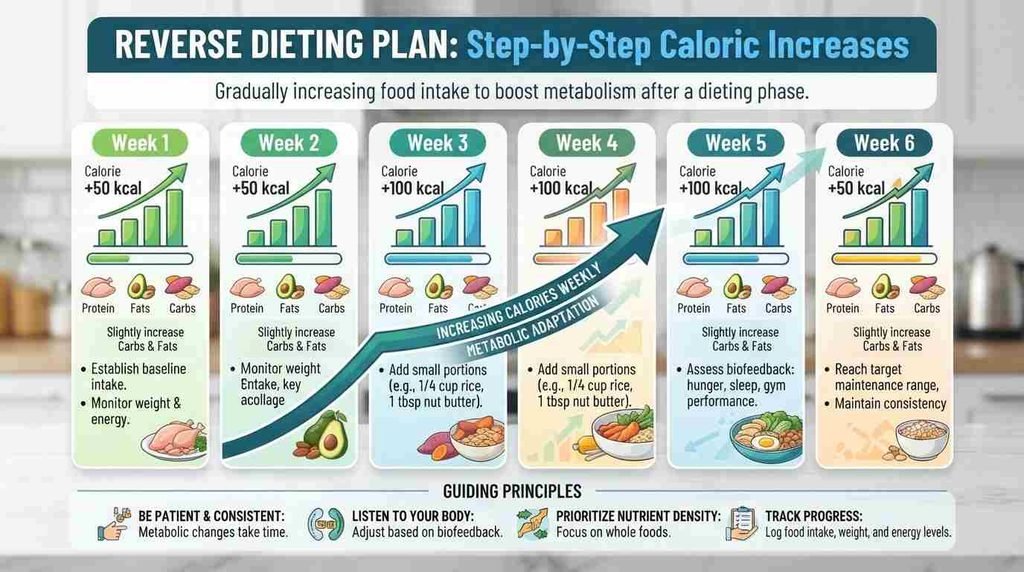
Reverse Dieting Plan: Step by Step Caloric Increases
Now the core of the guide. This reverse dieting plan shows you how to raise calories in small, safe steps.
Follow it for 8 to 12 weeks, then reassess. Slow is the whole point.
Step 1: Find Your Starting Point
Track your food for at least one to two weeks. Weigh yourself daily, same time, same conditions.
Your current average intake, while your weight is stable or slowly dropping, is your baseline.
Write it down. Every later step builds on this number.
Step 2: Set Your Protein and Training
Protein supports muscle and fullness. A common target is about 1.6 to 2.2 grams per kilogram of body weight for active people, but ask a professional for your own number.
Keep lifting weights two to four days a week. Muscle is your best ally during a rebuild.
Do not add lots of cardio to “cancel out” extra food.
Step 3: Choose Your Weekly Increase
Most plans add 50 to 150 calories per week. Smaller people and long dieters usually pick the lower end.
Some coaches prefer a percentage, such as 2 to 5 percent of current calories. Either way, keep it small.
Most of the extra calories can come from carbs and a little fat.
Step 4: Track Your Response
Every week, check three things: average scale weight, hunger and energy, and gym performance.
Use weekly averages, not single days. Daily weight swings from water, salt, and stress are normal.
If your weekly average is stable or up by a small amount, you are on track.
Step 5: Adjust Up, Hold, or Slow Down
Use a simple rule set.
- Weight stable or slightly up (under 0.5% of body weight): Add calories again.
- Weight rising faster: Hold calories for a week or add less.
- Weight dropping: Add a bigger step.
This keeps you in control without guessing.
Step 6: Add Movement Back Slowly
Your NEAT may have dropped during the diet. Aim for a steady daily step count rather than extra hard workouts.
A walk after meals is easy and kind to your body. It also helps digestion and mood.
No need to chase high numbers.
Step 7: Know When to Stop
Stop raising calories when your weight starts to climb steadily, or when you reach your target maintenance.
That is your new baseline. From here you can hold, build muscle, or start a gentle cut again.
Take a diet break before the next fat loss phase. It makes the next phase easier.
Sample 8-Week Reverse Dieting Plan
This table shows an example for someone starting at 1,600 calories with a 100-calorie weekly increase. Your numbers will differ.
| Week | Daily Calories | Added Calories | Main Focus |
|---|---|---|---|
| 1 | 1,600 | Baseline | Track and set habits |
| 2 | 1,700 | +100 | Extra carbs around workouts |
| 3 | 1,800 | +100 | Watch hunger and sleep |
| 4 | 1,900 | +100 | Check weekly weight average |
| 5 | 2,000 | +100 | Add a few daily steps |
| 6 | 2,000 | Hold | Let the scale settle |
| 7 | 2,100 | +100 | Review energy and lifts |
| 8 | 2,200 | +100 | Reassess maintenance |
Where to Add Extra Calories
Carbs usually go first. They fuel training and help restore glycogen.
Add healthy fats next, in smaller amounts. Keep protein steady.
Choose whole foods most of the time, such as rice, oats, potatoes, fruit, olive oil, and nuts.
Reverse Dieting Calculator: How to Estimate Your Numbers
People often search for a reverse dieting calculator. Most online tools do the same simple math.
You can do it by hand in a few minutes. Here is how.
The Simple Formula
Start with your current calories. Add a weekly increase. Stop at your estimated maintenance.
A basic way to estimate maintenance is body weight in pounds times 14 to 16 for many active adults. Treat it as a rough guess, not a promise.
Your real maintenance is the level where your weight stays flat over several weeks.
Example Calculation
Say you weigh 150 pounds and eat 1,500 calories after a long diet. Your rough maintenance guess is 2,100 to 2,400.
You could add 100 calories weekly. You would reach about 2,100 in six weeks.
Then you watch the scale and adjust.
Reverse Dieting Calculator Quick Reference
| Current Calories | Weekly Increase | Weeks to Add 400 Calories | Best For |
|---|---|---|---|
| 1,200 to 1,500 | 50 | 8 | Small frames, long diets |
| 1,500 to 1,800 | 75 | 5 to 6 | Moderate dieters |
| 1,800 to 2,200 | 100 | 4 | Active people |
| 2,200 and above | 150 | 3 | Larger or very active people |
A calculator gives a starting point. Your body gives the final answer.
Tools That Help
A food scale, a calorie tracking app, and a weekly weight log are enough. Keep things simple.
For general nutrition basics, Healthline has plain guides on calories and macros.
Always cross-check numbers with a professional if your health is a concern.
Reverse Dieting for Weight Loss
Can reverse dieting for weight loss really help? It can, but not in the way people expect.
It is not a fast fat loss method. It is a bridge that makes the next fat loss phase smoother.
Let us look at how.
Better Maintenance, Better Next Cut
When you reach a higher maintenance level, you have more room to cut later. A cut from 2,300 calories feels easier than one from 1,700.
You also keep more muscle, which helps your long-term burn.
This is the main benefit for weight loss goals.
Fewer Binge and Rebound Cycles
Strict dieting followed by a sudden food free-for-all often leads to rebounds. Slow increases keep structure in your day.
That structure lowers stress around food. Many people find it calming.
A calmer mindset supports lasting habits.
Do Not Expect Weight Loss During the Process
Most people stay about the same or gain a little as calories rise. That is expected.
If you want fat loss, finish the reverse first, then start a moderate deficit. Mixing both goals often fails.
Patience pays off here.
Reverse Dieting Before and After: What Real Results Look Like
People love reverse dieting before and after photos. They can be useful, but they can also mislead.
Lighting, posture, water, and time of day change how you look. Do not judge your progress by one photo.
Look at the bigger picture.
Typical Changes You May Notice
- Better energy during the day
- Stronger workouts
- Less hunger and fewer cravings
- Better sleep and mood
- A small, controlled scale increase
These changes tend to show up over weeks, not days.
Realistic Timeline
| Timeframe | What May Happen |
|---|---|
| Weeks 1 to 2 | Water and glycogen bump, hunger settles |
| Weeks 3 to 5 | Energy and gym performance improve |
| Weeks 6 to 8 | Weight steadies, maintenance becomes clearer |
| Weeks 9 to 12 | You reach a new baseline and decide your next phase |
Your timeline may be longer if your diet was very long or severe.
The Honest Truth About Photos
Expect your body to look a bit softer as glycogen and water return. This does not mean you gained all fat.
Take photos weekly in the same light and pose. Compare trends, not days.
Measurements like waist and hips are also helpful.
Common Reverse Dieting Mistakes to Avoid
Small errors can ruin a good plan. Watch for these.
- Adding too many calories too fast
- Panicking at a one-day scale jump
- Skipping protein and strength training
- Not tracking food accurately
- Using reverse dieting as a way to stay obsessive about numbers
- Ignoring hunger, sleep, and stress
If tracking makes you anxious, take a break and talk to a professional.
How to Fix a Stall or Fast Gain
If the scale climbs too quickly, hold calories for one to two weeks. Check your food logging first.
If you feel stuck with no progress, review sleep, stress, and steps. These matter as much as food.
Only change one thing at a time so you know what worked.
Tips to Make Reverse Dieting Easier
Small habits help the process feel natural.
- Plan meals ahead so extra calories are easy to hit.
- Sleep seven to nine hours when possible.
- Drink enough water and eat fiber-rich foods.
- Keep stress low with walks, hobbies, or breathing time.
- Stay patient and focus on trends.
Share your journey with trusted friends or an online group. Reddit Nutrition can offer community support, though you should verify medical claims with professionals.
Sources and Expert Help
Use reputable sources such as Healthline for health explainers and Bodybuilding.com for training and nutrition ideas.
For personal medical or nutrition decisions, a registered dietitian or doctor is the best guide. They can review your labs, history, and goals.
Good advice should always fit your body, not just a template.
Frequently Asked Questions
What is reverse dieting in one sentence?
It is a slow, planned increase in calories after a diet to help your body adjust and reach a higher maintenance level.
Does reverse dieting work for everyone?
No. It seems most useful after long or strict diets. Short, mild diets may not need it.
How long should a reverse dieting plan last?
Most plans run 6 to 12 weeks. Very long diets may need more time.
How much should I add each week?
Many people add 50 to 150 calories weekly. Smaller people usually choose smaller steps.
Will I gain fat during reverse dieting?
You may gain a little weight, mostly water and glycogen. Slow increases aim to limit fat gain, though some is possible.
Can I use a reverse dieting calculator instead of tracking?
A calculator gives a starting point only. Weekly weight and body signals decide your real numbers.
Conclusion
Reverse dieting is a calm, structured way to leave a diet behind. It helps you raise calories without panic, protect muscle, and learn your real maintenance level.
It is not a magic metabolism switch. Its biggest strengths are control, comfort, and a smoother path to your next goal.
Start with your baseline, add small steps, track weekly trends, and stay patient. Your future self will thank you.
Key Takeaways
- Metabolic adaptation is real, but its size varies.
- Look for signs such as low energy, constant hunger, and stalled progress.
- Add 50 to 150 calories per week and watch your response.
- Keep protein high and keep lifting.
- Get professional help if you have health concerns.
Medical Disclaimer (YMYL Notice)
This article is for general education and is not medical advice. It does not replace care from a doctor or registered dietitian. Consult a qualified professional before changing your diet, especially if you are pregnant, have a medical condition, or have a history of disordered eating.