Key Takeaways
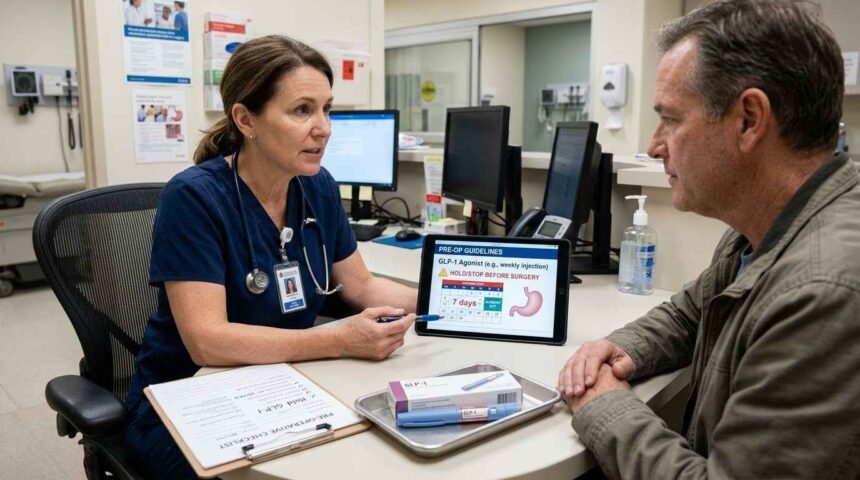
- A GLP-1 agonist can slow how fast your stomach empties. Under anesthesia or deep sedation, leftover stomach contents can raise the risk of aspiration.
- In November 2024, the FDA updated GLP-1 drug labels with a warning about pulmonary aspiration during general anesthesia or deep sedation.
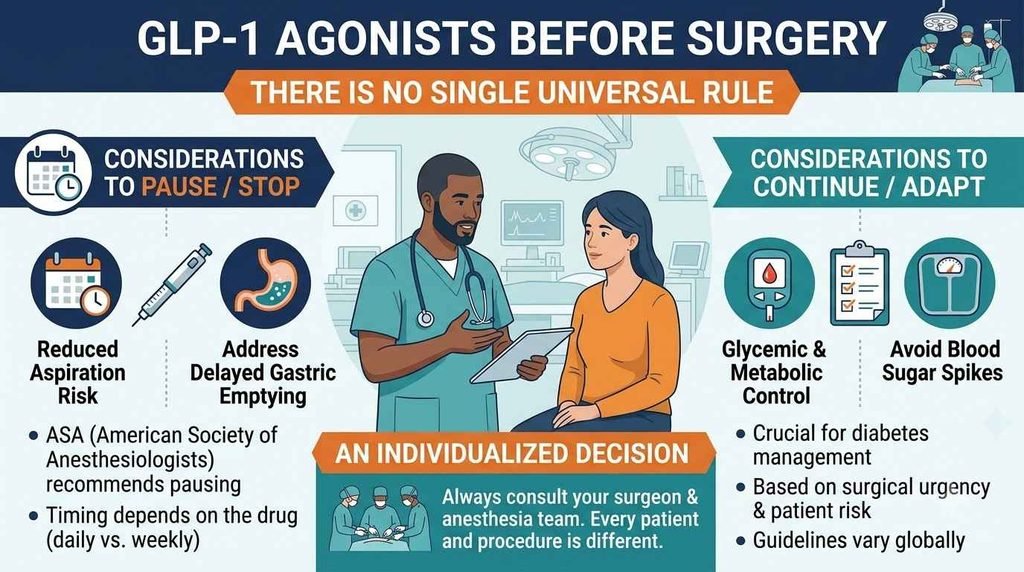
- There is no single universal rule on when to hold these drugs before surgery. Guidance has changed, and expert groups still differ.
- Do not stop or continue your medicine on your own. Your surgeon and anesthesiologist decide with you.
- Tell your team the exact drug, dose, weekly or daily schedule, last dose date, why you take it, and any stomach symptoms.
- Be honest on the day of surgery. A forgotten or hidden dose can lead to a delay or cancellation, and that is far better than an aspiration event.
You booked your surgery. You read your pre-op papers. Then you notice a line about “medications,” and you wonder if your weekly injection counts.
It does. A GLP-1 agonist before surgery is now a standard question for anesthesia teams. This guide explains why, what the FDA and major medical groups have said, and exactly what to tell your care team. It will not tell you when to stop or start your medicine, because no one can do that for you from a web page.
What Are GLP-1 Agonists, and Why Do People Take Them?
GLP-1 receptor agonists are prescription medicines that copy a natural gut hormone. They help the body manage blood sugar and appetite.
People take them for two main reasons:
- Type 2 diabetes. They help lower blood sugar.
- Chronic weight management. Some brands are approved for long-term weight care in certain adults.
This article covers only how these drugs relate to surgery and anesthesia. It does not cover weight loss or diabetes care.
Common GLP-1 medicines
Here are the main drugs patients mention to their surgical teams. The NIDDK page on prescription medications for overweight and obesity lists several FDA-approved options.
| Drug (generic) | Common brand names | Usual schedule |
|---|---|---|
| Semaglutide | Ozempic, Wegovy, Rybelsus (pill) | Weekly injection; daily pill |
| Tirzepatide | Mounjaro, Zepbound | Weekly injection |
| Liraglutide | Victoza, Saxenda | Daily injection |
| Dulaglutide | Trulicity | Weekly injection |
Tirzepatide also acts on a second gut hormone called GIP. Doctors often group it with GLP-1 drugs, and its label carries the same anesthesia warning.
Schedules and doses vary by patient. Your own prescription label is the source of truth for your drug.
One more point matters here. Use only the medicine your prescriber gave you. If you take any version that did not come through a licensed pharmacy with a prescription, tell your anesthesiologist that too. They need to know exactly what is in your body.
Why a GLP-1 Agonist Before Surgery Matters
The concern is not that these drugs are unsafe in general. The concern is how they interact with anesthesia.
Delayed gastric emptying
GLP-1 drugs work in part by slowing how fast food leaves your stomach. That helps you feel full longer. It is part of how the medicine works.
Doctors call this delayed gastric emptying. Most people feel it as fullness, bloating, or nausea. Some feel nothing at all.
Retained stomach contents
Standard pre-op fasting rules assume a normal stomach. Anesthesia teams usually ask patients to avoid solid food for several hours before a procedure. That time is meant to let the stomach empty.
If your stomach empties more slowly, food or liquid may still be inside after you fasted. This is called retained gastric contents. You may have followed every instruction and still have a fuller stomach than expected.
Aspiration risk
Here is why that matters. Anesthesia and deep sedation relax the muscles and reflexes that normally protect your airway.
If stomach contents come up, they can enter the lungs. This is aspiration. It can cause lung injury and serious pneumonia, and in rare cases, death.
Anesthesia teams plan around aspiration risk every day. A GLP-1 medicine adds one more factor for them to weigh. That is why your anesthesiologist needs to know about it early.
How common is this?
The honest answer is that it is rare, and the data are still developing. The FDA label itself describes aspiration events in people on these drugs as rare postmarketing reports.
Studies on retained stomach contents have found that GLP-1 users show it more often. Studies on actual aspiration events are mixed. A 2025 meta-analysis of elective upper endoscopy, for example, did not find a statistically significant link between GLP-1 use and aspiration. It still noted that delayed emptying is a known risk factor.
Long-standing diabetes can also slow stomach emptying on its own. So the picture is not simple. Evidence level here: mixed observational studies, case reports, and expert consensus, not large randomized trials.
What the FDA Label Says
The FDA took a clear step on this topic. In November 2024, the agency updated the labels for all GLP-1 receptor agonists with a warning about pulmonary aspiration during general anesthesia or deep sedation.
Here is what the updated label language covers, in plain terms:
- Warnings and Precautions. The labels describe rare postmarketing reports of pulmonary aspiration in people undergoing elective surgery or procedures with general anesthesia or deep sedation.
- Fasting did not always prevent it. In those reports, patients had “residual gastric contents despite reported adherence to preoperative fasting recommendations.”
- Adverse reactions and postmarketing sections. The warning also appears in other label sections.
- Medication Guide. Patients are counseled to tell their healthcare provider if they are scheduled for surgery or procedures that use anesthesia or deep sedation.
- Patient counseling. Prescribers are told to explain that the drug may slow stomach emptying and may complicate anesthesia or deep sedation.
What the label does not say
This part is just as important. The FDA label does not give a stop or start schedule.
The label language states that available data are insufficient to inform recommendations for reducing aspiration risk. That includes whether changing preoperative fasting or temporarily stopping the drug could reduce retained gastric contents.
Read that again. The FDA did not say “stop your medicine.” It said to tell your provider, and it said the evidence is not yet strong enough to set a single rule.
You can read the FDA’s safety information for semaglutide products on its Ozempic, Wegovy, and Rybelsus safety page. You can also review a GLP-1 prescribing label on DailyMed to see the warning in the official label text.
Labels get updated. Always check the current version, or ask your pharmacist.
There Is No Single Universal Rule
If you searched online, you may have seen confident advice like “stop it one week before.” Be careful with that.
There is no single universal rule on when to hold these drugs before surgery. Guidance has changed over time, and professional groups do not fully agree. Here is a plain-language summary of what has been published.
How guidance has changed
| Date | Source | What it said (summary) |
|---|---|---|
| June 29, 2023 | American Society of Anesthesiologists (ASA) consensus-based guidance | Suggested holding daily GLP-1 agents on the day of the procedure and weekly agents one week before. This was an early, cautious position. |
| Oct. 29, 2024 | Multisociety guidance (ASA, AGA, ASMBS, ISPCOP, SAGES) | Said most patients can continue GLP-1 drugs before elective surgery, after an individual risk review. Higher-risk patients may need a liquid diet for 24 hours or other steps. |
| Nov. 2024 | FDA label updates (all GLP-1 receptor agonists) | Added a warning on aspiration during general anesthesia or deep sedation. Gave no stop or start schedule. |
| 2025 | UK multidisciplinary consensus (Association of Anaesthetists and partner societies) | As summarized in later reviews, advised continuing these drugs perioperatively. |
| 2025 | SPAQI consensus (Society for Perioperative Assessment and Quality Improvement) | Addressed continuation and fasting. Details differ from the groups above. |
Sources: ASA guidance notes (2023, 2024); ASA/AGA multisociety news releases (Oct. 29, 2024); FDA label text (Nov. 2024); published reviews of UK and SPAQI consensus statements. Check each society’s own site for its current wording.
In October 2024, ASA also issued an Affirmation of Value for the newer multisociety document. So the 2023 wording is no longer the latest ASA-affiliated position.
What the 2024 multisociety guidance emphasizes
The 2024 guidance stresses shared decision-making. That means the patient, the procedural team, the anesthesia team, and the prescriber decide together. They weigh the medical need for the drug against your personal risk.
Key ideas from that guidance include:
- Most patients should continue their GLP-1 drugs before elective surgery.
- Patients at the highest risk for significant GI side effects may follow a liquid diet for 24 hours before the procedure.
- The team can also adjust the anesthesia plan, or use ultrasound right before the procedure to check stomach contents in the highest-risk patients.
- In rare cases, the procedure may be delayed.
Note the wording. These are things a team may do, based on individual risk. They are not steps for you to start on your own.
Why sources disagree
Several reasons explain the gaps:
- Limited data. Large trials on this exact question are still lacking.
- Different goals. Some groups focus on aspiration risk. Others focus on keeping diabetes under control.
- Long drug half-lives. Some of these drugs stay in the body for a long time. Stopping a weekly injection a few days early may not clear it.
- Different countries, different rules. One 2025 review notes that a Brazilian diabetes society suggests much longer hold times for some drugs than US groups do. Meanwhile, UK groups advise continuing. Those differences show how unsettled this field is.
A 2026 review also described US and UK positions as pointing in different directions. So if you read two sources that disagree, that does not mean one author made a mistake. It reflects real, ongoing debate.
What can change the plan for you
Teams may weigh factors such as:
- Which drug you take. Different drugs have different half-lives.
- Your dose. Higher doses tend to cause more stomach side effects.
- Weekly or daily use. The schedule affects how long the drug stays active.
- How long you have been on it. Early weeks or a recent dose increase may matter more.
- Your symptoms. Nausea, vomiting, bloating, or feeling full all the time are important clues.
- Other health conditions. Diabetes with nerve complications and some stomach conditions can slow emptying.
- The type of procedure and anesthesia.
This is why a single online rule cannot fit everyone. Your team has to look at your whole picture.
Send This to Your Anesthesiologist
This is the most useful section in this article. If you remember one thing, remember this: tell your surgical team and your anesthesiologist about your GLP-1 medicine before the procedure.
Do it early. Do not wait for the day of surgery.
Why early matters
If your team learns about the drug weeks ahead, they have time to choose a plan. They can talk to your prescriber, order a test, or adjust your diet instructions.
If they learn on the morning of surgery, their options shrink fast. A delay or cancellation becomes more likely.
What to tell them
Give your team these details. Write them down so you don’t forget anything.
- Exact drug name. For example, semaglutide, tirzepatide, liraglutide, or dulaglutide. Include the brand name if you know it.
- Dose. The number on your prescription label, such as the milligram strength.
- Weekly or daily. Say how often you take it, and the day of the week if weekly.
- Last dose date. Give the exact date, and the time if you can.
- Why you take it. Diabetes, weight management, or both. This helps the team balance blood sugar needs.
- Recent changes. Tell them if you started recently or raised your dose.
- Stomach symptoms. Mention nausea, vomiting, bloating, fullness after small meals, constipation, or reflux.
- Other medicines. List all your drugs, including other diabetes medicines.
- Any product not from a licensed pharmacy. Say so plainly.
A simple message you can send
Use your hospital’s patient portal, or call the pre-op line. Here is a sample you can copy and fill in:
“Hi, I’m scheduled for [procedure] on [date] with Dr. [name]. I take [drug name] [dose] [weekly/daily] for [diabetes/weight management]. My last dose was on [date]. My current stomach symptoms are [none / describe]. Please tell me who should review this before my procedure and what I should do about my medicine. I will not change anything until I hear from you.”
That last sentence matters. It tells the team you are waiting for guidance.
Who to tell
Tell all of these people if you can:
- Your surgeon or procedural doctor
- The pre-op nurse or pre-admission testing team
- The anesthesiologist or nurse anesthetist
- The doctor who prescribes your GLP-1 medicine
The prescriber matters too. If your team decides to pause the drug, the prescriber can help plan how to keep your blood sugar safe.
If you cannot reach anyone
Call the surgical office or the hospital pre-op line. Ask for the anesthesia department. If your procedure is soon and you still have no plan, say that clearly. Do not guess.
Pre-Op Checklist for GLP-1 Patients
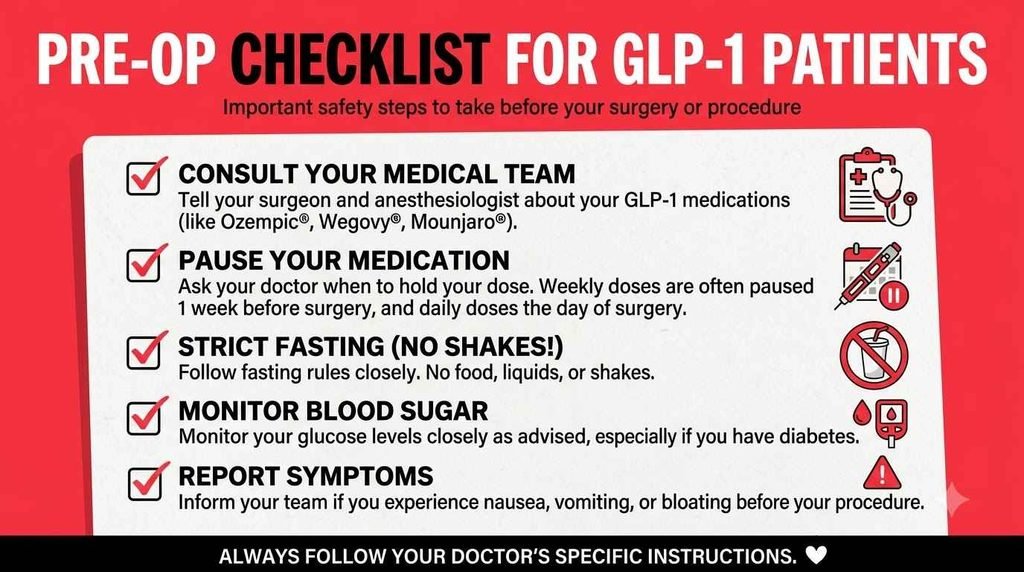
Use this list as a way to prepare questions and information. It does not replace the instructions your care team gives you.
- Confirm the plan. Ask your surgeon’s office who will review your GLP-1 medicine.
- Write down your drug details. Name, dose, schedule, start date, and last dose date.
- Send the information early. Use the portal or phone, and ask for a reply in writing.
- List your symptoms. Note any nausea, vomiting, bloating, or fullness, and when they happen.
- Ask about your medicine specifically. Say, “What should I do about my [drug name] before this procedure?” Then follow the answer you are given.
- Ask about diabetes medicines. If you have diabetes, ask what to do about blood sugar checks and other medicines.
- Ask about eating and drinking. Ask whether your fasting or diet instructions differ because of your GLP-1 medicine.
- Ask what happens if symptoms change. For example, if you feel sick the day before.
- Get everything in writing. Keep a copy of your final instructions on your phone.
- Bring your medicine information on the day. Bring the pen or bottle, or a clear photo of the label.
- Tell the team again on arrival. Repeat your drug, dose, and last dose date to the nurse and the anesthesiologist.
Notice that no step says “stop your medicine” or “keep taking it.” That decision belongs to your team.
Steps a Care Team May Choose
Different teams handle this in different ways. The steps below are options your team may consider. They are not instructions for you to follow by yourself. Your team decides what fits your case.
A clear liquid diet before the procedure
Some teams may ask higher-risk patients to follow a liquid-only diet for a set time, often up to 24 hours, before the procedure. The goal is to help the stomach be emptier. The 2024 multisociety guidance describes this as an option for patients with concern for delayed emptying.
Do not begin a liquid diet because you read this article. Ask your team first. They will tell you exactly what counts and for how long. This matters especially for people with diabetes, who need a plan for blood sugar.
Longer or modified fasting
Some groups have discussed changing the usual fasting times for GLP-1 patients. Others say the data do not show that this works. This is one of the areas where guidance differs. Your team will tell you what applies to you.
Gastric ultrasound
A quick bedside ultrasound can look at what is in your stomach right before the procedure. Teams call this point-of-care gastric ultrasound.
It can help show whether the stomach looks empty or full. If it looks full, the team can change the plan. Not every hospital offers it, and it is not needed for every patient.
Treating the stomach as full
Sometimes the team is unsure whether your stomach is empty. In that case, the anesthesiologist may choose to treat you as a “full stomach” patient.
That can mean a different way of placing the breathing tube, so the airway is protected quickly. This is a technical decision for the anesthesia team. You do not need to arrange it. Just know it is a normal, safe-minded approach.
Changing the type of anesthesia
In some cases, the team may adjust the anesthesia plan to reduce aspiration risk. This depends on the procedure. Your anesthesiologist will explain the choice that fits.
Delaying or rescheduling the procedure
When risk stays too high and the procedure is elective, the team may postpone it. This is rare, and it can feel frustrating. But it is a safety step, not a punishment.
Adjusting the medicine
Some teams, working with your prescriber, may decide to hold a dose. Others may decide to continue. The 2024 US multisociety guidance leans toward continuing for most people, with extra steps for higher-risk patients. Other timelines exist.
If your team does choose to hold a dose, they should also tell you how to manage your blood sugar. Ask for that plan in writing.
Risks of Stopping Without Guidance, and Risks of Continuing
Neither choice is risk-free. That is why the decision should be shared.
Risks of stopping on your own
- Blood sugar problems. If you take the drug for diabetes, stopping can raise your blood sugar. High blood sugar around surgery can raise the chance of infection and slow healing.
- A false sense of safety. These drugs can stay in the body for days. One long-acting drug has a half-life of up to about a week, so skipping one dose a day or two early may not change much.
- No backup plan. Without your team’s input, you may have no plan for other diabetes medicines.
- Confusion on the day. If you change your routine without telling anyone, your team may misjudge your risk.
- Mixed messages. You might stop when your team wanted you to continue, or the other way around.
Risks of continuing without telling anyone
- Retained stomach contents. Your stomach may still hold food after fasting.
- Aspiration. Stomach contents could enter the lungs during anesthesia.
- Last-minute changes. The team may delay or cancel if they learn about the drug late.
- Missed chances. Without early notice, the team cannot use tools like a liquid diet or ultrasound plan.
The balanced view
Doctors have to weigh the benefit of keeping you on a drug against the small but real aspiration risk. The multisociety guidance describes this as balancing “the metabolic need” for the drug against individual risk. In plain language, your doctors weigh your health needs against your risk, and that is a decision for you and them together.
If you have diabetes, your blood sugar plan is part of the safety plan. Ask about it directly.
Procedures Where It Matters Most
The FDA label language focuses on general anesthesia and deep sedation. These are the situations where your airway reflexes are reduced.
General anesthesia
This is when you are fully asleep, often with a breathing tube. It is the main setting where aspiration is a concern. Many elective surgeries use it.
Deep sedation
Deep sedation is a heavier level of sedation than “light” or “minimal” sedation. You may not respond to touch or voice. The FDA label names deep sedation along with general anesthesia.
Upper endoscopy and colonoscopy
These procedures often use sedation. Studies of upper endoscopy have found more retained stomach contents in GLP-1 users. Because the stomach must be clear for a good view, the issue also affects the quality of the exam.
Teams that do these procedures often already use liquid diets for bowel prep. Your endoscopy unit will have its own rules. Follow theirs once they have reviewed your medicine.
Bariatric and abdominal surgery
Procedures involving the stomach or digestive tract can be especially sensitive to what is in the stomach. Teams in this area are used to GLP-1 questions. Be open with them.
Lower-risk settings
Procedures done with only local numbing, or with very light sedation, raise less concern about aspiration. The label language is not about those. But always tell the team anyway. They decide what level of sedation is truly planned, and plans can change.
If you are not sure what type of anesthesia you will get, ask. Then tell them about your medicine either way.
Day of Surgery: Honesty Is Your Safety Tool
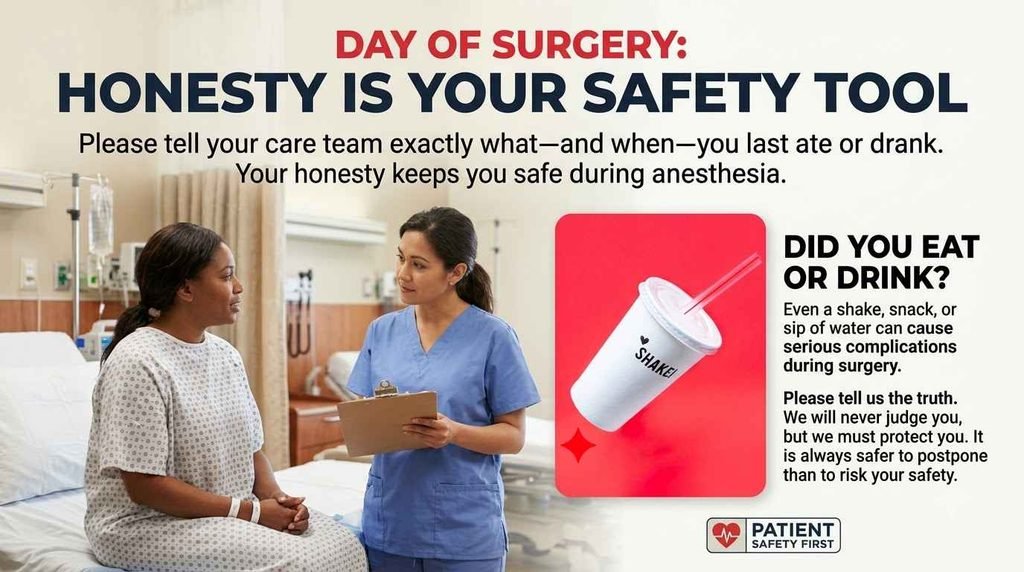
Picture the pre-op bay on the morning of your procedure. A nurse asks, “Any medication changes? Any weekly injections?”
This is the moment some patients hesitate. They worry that admitting a recent dose will cause a problem. Others simply forget.
Why hiding or forgetting a dose is dangerous
Your anesthesiologist builds the plan from what you tell them. If they think your stomach is normal when it is not, they may choose a plan that carries more risk.
An honest answer lets them protect you. A hidden dose can lead to an airway emergency that could have been avoided.
Possible delay or cancellation
If you disclose a recent dose late, the team may:
- Take extra time to check your stomach
- Change the anesthesia plan
- Delay the start
- Reschedule the procedure
That can be disappointing and costly. It is still much better than aspiration. Your team would rather reschedule than risk harm.
How to make it easy
- Say it first. When you arrive, say, “I take [drug] and my last dose was [date].”
- Repeat it to each person who asks.
- Bring written notes or a photo of your label.
- Mention any nausea, vomiting, or fullness, even if it seems minor.
- Tell them if you ate or drank anything, even a small snack.
If you feel sick the day before or morning of
If you have vomiting, strong nausea, or severe bloating before your procedure, call your surgical team right away. Do not wait to see if it passes. Those symptoms can matter more than usual if you take a GLP-1 drug.
After Surgery: Restarting Your Medicine
Restarting is another point where there is no single rule. The answer depends on your drug, your procedure, how well you are eating and drinking, and your diabetes plan.
Follow your care team’s plan
Before you leave the hospital, ask these questions:
- Should I restart my GLP-1 medicine, and when?
- Do I restart at my usual dose, or at a different dose?
- What should I do if I missed a weekly dose?
- How should I handle blood sugar until then?
- What stomach symptoms should make me call?
Get the answers in writing. Your discharge papers should include them.
Why restart timing is individual
After some surgeries, your stomach and bowels may be slow to recover. Pain medicines can slow digestion further. If you restart a drug that also slows emptying, nausea or vomiting may get worse.
Your team also needs to check that you can eat and drink. So the right time can be different for each person.
Special note for missed doses
Some drugs have rules about what to do after a missed dose, such as how many days have passed. These rules vary by product. Check your prescribing label or ask your pharmacist. Do not guess based on a friend’s advice.
Call your team if you notice
- Vomiting that does not stop
- Severe belly pain or swelling
- Trouble keeping fluids down
- Very high or very low blood sugar readings
- Fever, cough, or trouble breathing
Trouble breathing after anesthesia needs urgent care. Call emergency services if it is severe.
Medical Disclaimer
This article is for general education only. It is not medical advice, diagnosis, or treatment. It does not replace the judgment of your surgeon, anesthesiologist, or prescribing clinician.
Do not stop, start, delay, or change any prescription medicine based on this article. Always ask your own care team what to do about a GLP-1 agonist before surgery.
Guidance, FDA labels, and drug products change. Information here reflects sources available as of October 9, 2026. If you have urgent symptoms, such as trouble breathing, call emergency services.
Frequently Asked Questions
Should I stop my GLP-1 medicine before surgery?
There is no single universal answer. Guidance differs by drug, dose, schedule, and your personal risk. Ask your surgeon and anesthesiologist, and do not change your medicine on your own.
Why do anesthesiologists ask about Ozempic and anesthesia?
Ozempic contains semaglutide, which can slow stomach emptying. Under anesthesia, leftover stomach contents can raise the risk of aspiration. The FDA added a warning about this to GLP-1 drug labels in November 2024.
What does the FDA say about GLP-1 drugs and surgery?
The FDA updated GLP-1 labels with a warning about rare reports of pulmonary aspiration during general anesthesia or deep sedation. The label tells patients to tell their provider about planned procedures. It does not give a stop or start schedule.
Do I need to tell my team about tirzepatide before surgery?
Yes. Tirzepatide (Mounjaro, Zepbound) is a weekly drug, and its label carries the same aspiration warning. For any tirzepatide surgery plan, tell your surgeon and anesthesiologist the dose, schedule, and last dose date.
What should I tell my anesthesiologist about my GLP-1 drug?
Share the exact drug name, dose, weekly or daily schedule, last dose date, and why you take it. Also share any nausea, vomiting, bloating, or fullness. Include your other medicines.
Can I eat or drink before surgery if I take a GLP-1 drug?
Follow the exact instructions your team gives you. Some teams may ask for a liquid diet or other changes before certain procedures. Never decide on your own. Ask for the plan in writing.
What happens if I forget to tell the team about my last dose?
Tell them as soon as you remember, even on the day of surgery. The team may check your stomach, change the anesthesia plan, delay, or reschedule. Late disclosure is far safer than hiding it.
When can I restart my GLP-1 medicine after surgery?
Your care team will set the timing. It depends on your drug, procedure, recovery, and diabetes plan. Ask for restart instructions before you go home.
Conclusion: Your GLP-1 Agonist Before Surgery Is a Team Decision
A GLP-1 agonist before surgery is a medicine question, not a reason to panic. The FDA says aspiration events are rare, and many patients get through anesthesia safely. But the drugs can slow stomach emptying, and your anesthesiologist needs to know.
The rules are not settled. Guidance moved from a more cautious 2023 position toward a risk-based approach in 2024, and other countries differ. That is why there is no single universal protocol.
Your takeaway is simple. Tell your surgeon and anesthesiologist early, share the exact details, follow only the plan they give you, and be honest on the day. Never stop or continue your medicine on your own. For help with the vocabulary, the MedlinePlus entry on tirzepatide and related drug information can give you a plain-language drug summary to bring to your appointment.