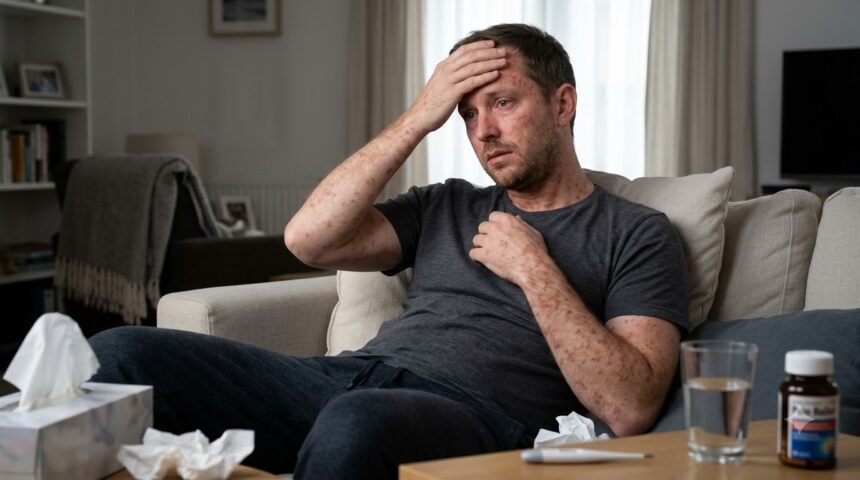
With 3,659 confirmed US cases as of September 24, 2026, the highest annual total since 1991, more adults are asking what measles actually looks like. Measles symptoms in adults often start like a bad flu or cold, and the telltale rash arrives days later, after you may already have exposed other people. This guide gives the day-by-day timeline, explains prodrome versus rash, spells out the contagious window, shows how measles differs from the flu, and tells you when to call a clinician and when to go straight to the emergency room.
Measles Symptoms in Adults: The Short Version
- Incubation: 7 to 14 days after exposure, up to 21 days.
- Prodrome (days 1 to 4 of illness): high fever, cough, runny nose, red watery eyes, sometimes tiny white spots inside the mouth.
- Rash (usually day 3 to 5 of illness): flat red spots starting at the hairline and face, spreading down to the trunk, arms, legs, and feet.
- Contagious window: about 4 days before the rash appears through 4 days after.
- Who to call first: your clinician, by phone, before walking into any clinic. Go to the ER only for red-flag symptoms, and phone ahead there too.
A note on scope: this article is general information, not a diagnosis. If you think you have measles, call a healthcare professional.
Why Adults Are Searching for This Now
As of September 24, 2026, the CDC reported 3,659 confirmed measles cases in 2026, with 40 outbreaks and about 95% of cases outbreak-associated. Roughly 61% of patients were 19 or younger, which means a substantial minority were adults or of unreported age. About 95% of patients were unvaccinated or had an unknown vaccination status.
Adults matter for two reasons. First, many adults born after 1957 never received two documented doses of MMR, or cannot find their records. Second, the CDC identifies adults over 20 as one of the groups more likely to suffer complications from measles, along with children under 5, pregnant women, and people with weakened immune systems.
The CDC updates its numbers weekly, so check its measles page for anything newer than September 24.
The Timeline: Day by Day
Understanding the sequence is the most useful skill for spotting measles symptoms in adults early. Here is the typical course.
Days 0 to 7 or more after exposure: no symptoms. After you breathe in the virus, it multiplies silently in the respiratory tract and nearby lymph nodes. You feel fine. You can feel fine for as long as two to three weeks.
Days 7 to 14 (range up to 21): first symptoms. Illness begins, usually with fever.
Illness days 1 to 4: the prodrome. Fever, cough, runny nose, and red eyes build. You feel progressively worse.
Illness days 3 to 5: the rash. The rash appears, and fever often peaks around the same time.
Days 5 to 8 of illness: recovery begins in uncomplicated cases. Fever falls, the rash fades in the order it appeared, and a cough can linger for a week or two.
The rash typically shows up about 14 days after exposure, though the range is wider. That gap between exposure and rash is exactly why contact tracing for a measles exposure runs for three weeks.
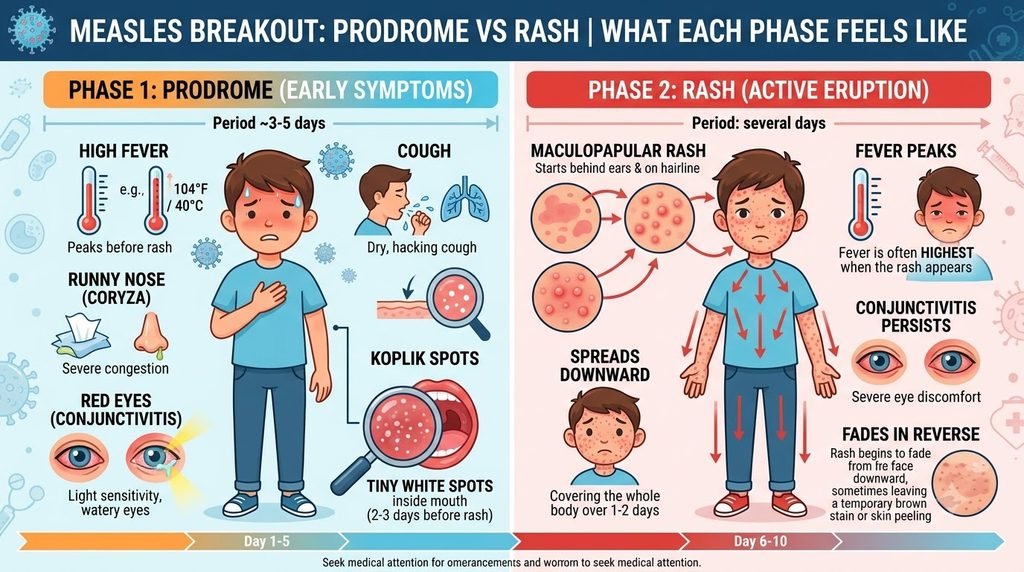
Prodrome vs Rash: What Each Phase Feels Like
The prodrome: looks like flu
The prodrome is the early phase before the rash, lasting roughly two to four days. Adults commonly report:
- High fever. Often 101°F or higher and can climb above 104°F, usually higher and more sustained than a typical cold.
- Cough. Dry or hacking, and it can become persistent.
- Runny nose (coryza). Often heavy congestion.
- Red, watery eyes (conjunctivitis). Eyes may be light-sensitive and look inflamed or bloodshot.
- Fatigue and body aches. Many adults feel flattened.
- Koplik spots. Tiny white or bluish-white dots on a red background, usually on the inside of the cheeks near the molars. They typically appear a day or two before the rash and fade within a day or two after it appears. Few people look for them, and a clinician is far more likely to spot them.
The cough, runny nose, and red eyes are often called the “three Cs.” Combined with a high fever, they form the classic opening of measles.
The rash: the part everyone remembers
The rash is a flat red rash, often with small raised bumps that merge together as it spreads. Key features:
- Starts on the face and hairline, often behind the ears.
- Spreads downward to the neck, trunk, arms, thighs, and feet over about three days.
- Usually not itchy, which helps distinguish it from some allergic and other viral rashes.
- Fades in the same order, head first, sometimes leaving a brownish tint or fine peeling.
- Appears while fever is at its peak. If your fever is falling when the rash arrives, measles is less likely.
On darker skin, a measles rash can be harder to see and may look purplish or darker than surrounding skin. Pay attention to the timing and the other symptoms, not the color alone.
Why the sequence matters
The rash is not the start of measles. By the time it appears, you have already been sick for several days and have already been contagious. If you wait to “see if a rash shows up” before calling a doctor, you can expose a lot of people in the meantime.
The Contagious Window
Measles is among the most contagious infections known. Up to 9 out of 10 unprotected people exposed to an infected person will become infected. The virus can stay in the air of a room for up to two hours after the infected person has left it, so you do not need face-to-face contact to be exposed.
The contagious window runs from about 4 days before the rash appears until 4 days after it appears, counting the day the rash begins as day zero. In practice that means:
- You can spread measles during the prodrome, when it still feels like flu.
- You can spread it before you or anyone around you suspects measles.
- You are generally no longer considered contagious after the fourth day following rash onset, in people with a typical immune system.
People with weakened immune systems may shed the virus longer, and their isolation period may be extended by a clinician.
Isolation versus quarantine
- Isolation is for someone who has measles: stay home until 4 days after rash onset.
- Quarantine is for someone who was exposed and lacks evidence of immunity: health departments generally ask them to stay home from about day 5 through day 21 after exposure.
School and workplace rules vary by state and county, so follow your local health department. Some allow an exposed, unvaccinated person to return earlier after an MMR dose given within 72 hours of exposure.
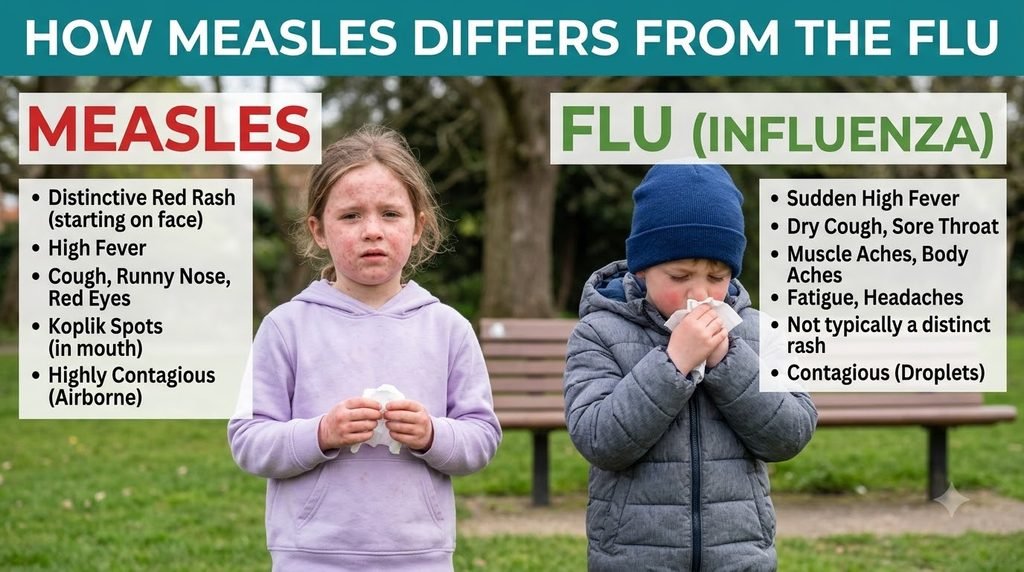
How Measles Differs From the Flu
In the first days, measles and influenza are easy to confuse. Here are the differences that help.
- Eyes. Red, watery, light-sensitive eyes are a hallmark of measles and are uncommon with flu.
- Rash. Measles causes a spreading red rash. Flu does not.
- Mouth spots. Koplik spots occur in measles, not flu.
- Onset. Flu hits abruptly, often within hours. Measles builds over a few days.
- Fever. Both cause fever, but measles fever often stays high or climbs when the rash appears.
- Body aches. Severe muscle aches and chills are more characteristic of flu.
- Season and exposure. Flu circulates widely in winter. Measles requires exposure to a case, often in a community with an outbreak, or travel.
- Vaccination. A recent flu shot does nothing against measles. Your MMR status is the relevant history.
Also consider other illnesses with fever and rash: rubella, roseola, scarlet fever, a drug reaction, dengue, and others. Only testing can settle it. Measles testing typically involves a nose and throat swab and a urine sample for PCR, plus blood tests for antibodies, ordered through your clinician and the health department.
Call a Clinician First, Not the ER: Unless There Are Red Flags
This is the most important practical advice in this article. Showing up unannounced at a waiting room with measles can expose infants, pregnant women, and immunocompromised patients.
Call your clinician if you have
- A fever of 101°F or higher with cough, runny nose, or red eyes, particularly if you were exposed or live in or traveled to an outbreak area.
- A new rash that began at the face and is spreading downward with fever.
- A known exposure and you lack documented immunity, even before any symptoms.
- Uncertainty about your vaccine status and symptoms that fit.
How to call: tell the receptionist or nurse that you think you might have measles or were exposed. They will arrange a safe way for you to be seen, often a separate entrance, a masked visit, a car-side exam, or a telehealth visit first. Wear a well-fitting mask when you travel to the appointment if you can, and do not take public transport.
Go to the emergency room (and call ahead if you can) for red flags
- Trouble breathing, fast breathing, or chest pain.
- Confusion, severe headache, stiff neck, seizure, or unusual sleepiness, which can signal brain involvement.
- Signs of severe dehydration: very little urine, dizziness when standing, no tears, dry mouth.
- A fever that will not come down despite fever reducers, or one that keeps rising.
- Bluish lips or skin.
- Severe ear pain, persistent vomiting, or inability to keep fluids down.
- Being pregnant or immunocompromised with any suspected measles, where your clinician needs to be involved immediately.
If you must go to an ER, phone ahead and tell them you may have measles so they can prepare an isolation room. In a life-threatening emergency, call 911 and tell the dispatcher.
Complications in Adults
Most healthy adults recover, but measles is not a mild illness. Possible complications include:
- Diarrhea and ear infections, among the most common.
- Pneumonia, the most common serious complication and the leading cause of measles deaths. It can be caused by the measles virus itself or by a secondary bacterial infection.
- Encephalitis, swelling of the brain, in roughly 1 in 1,000 cases. It can cause seizures, deafness, or permanent brain damage.
- Pregnancy complications, including preterm birth, low birth weight, and pregnancy loss, in women who are not immune.
- “Immune amnesia.” Measles can wipe out part of the immune system’s memory of past infections for months to years, raising the risk of other infections.
- SSPE (subacute sclerosing panencephalitis), a rare, fatal brain disease that can appear 7 to 10 years after infection.
The CDC estimates that 1 to 3 of every 1,000 infected children die from measles in the United States. In 2026, the Pennsylvania Department of Health has reported five measles-linked deaths in the state’s outbreak, while the CDC’s national tally listed two as of the end of September. Counts differ because states and the CDC use different methods, and the CDC is working on a standardized definition. See our companion guide for the full numbers.
What Treatment Looks Like
There is no specific antiviral for measles. Care is supportive:
- Rest and fluids to prevent dehydration.
- Fever reducers such as acetaminophen or ibuprofen, taken as directed on the label. Do not give aspirin to children or teens.
- Treatment of complications, such as antibiotics for a bacterial pneumonia or ear infection and hospital care when needed.
- Vitamin A, which the World Health Organization recommends for children with measles under medical supervision. Do not self-treat with high-dose vitamin A. Too much can be harmful, and adults should not use it unless a clinician advises it.
Do not take leftover antibiotics or unproven remedies hoping to treat measles. They do not work against a virus.
Preventing Measles If You Are an Adult
Two doses of the MMR vaccine are about 97% effective at preventing measles, and one dose is about 93% effective. Practical guidance from the CDC for adults:
- Born in 1957 or later with no evidence of immunity: get at least one dose of MMR.
- Higher-risk adults: healthcare workers, international travelers, and college or trade-school students generally need two doses.
- Born before 1957: generally considered immune, though outbreak or healthcare settings may still call for vaccination.
- Vaccinated between 1963 and 1967 with an early inactivated vaccine: that vaccine was less effective, so revaccination may be advised.
- No records? Another dose is considered safe. A blood test for antibodies is an option.
- Pregnancy: MMR is a live vaccine and is not given during pregnancy. Women planning a pregnancy should be vaccinated at least four weeks beforehand.
- Weakened immune system: speak to your specialist before any vaccine.
- After an exposure: MMR within 72 hours or immune globulin within six days may prevent or reduce illness in some people. Call your clinician immediately.
Kindergarten MMR coverage has fallen from 95.2% in 2019-2020 to 92.4% in 2025-2026, according to the CDC, which helps explain why outbreaks are spreading.
Can a Vaccinated Adult Get Measles?
Yes, but it is uncommon. No vaccine is 100% effective, and a small share of fully vaccinated people can become infected if exposed. Illness in these cases is usually milder, with a shorter course, and they are less likely to spread the virus. In 2026 so far, roughly 95% of patients were unvaccinated or of unknown vaccination status.
What to Do If You Think You Have Been Exposed
- Do not wait for symptoms. Contact your local health department or clinician right away, especially if you are pregnant, immunocompromised, or caring for an infant.
- Find your records. Immunization registry, previous doctors, employer, military, or school records.
- Ask about post-exposure vaccination or immune globulin. The timing window is short.
- Watch for symptoms for 21 days. Take your temperature daily.
- Limit contact if you are not immune. Follow quarantine guidance from your health department, and avoid infants, pregnant people, and immunocompromised people.
- At the first sign of fever, cough, or red eyes, call ahead instead of showing up in person.
Frequently Asked Questions
What are the first signs of measles in adults?
Usually a high fever, cough, runny nose, and red, watery eyes, beginning 7 to 14 days after exposure. The rash comes later, about 3 to 5 days into the illness.
How long after exposure do measles symptoms in adults appear?
Typically 7 to 14 days, and sometimes as late as 21 days.
How long is a person with measles contagious?
From about 4 days before the rash to 4 days after it appears. Most people with measles are therefore contagious before they know what they have.
What does a measles rash look like?
A flat red rash with small bumps that merge, beginning at the hairline and face and spreading downward over about three days. It is usually not itchy and often appears with a high fever.
How is measles different from the flu?
Measles causes red, watery eyes, a spreading rash, and sometimes white mouth spots, and it builds over days. Flu comes on suddenly, with strong body aches and no rash.
Should I go to the ER if I think I have measles?
Call your clinician or health department first so they can arrange safe care. Go to the ER for red flags: trouble breathing, confusion, seizure, stiff neck, severe dehydration, or a fever that will not come down. Phone ahead if you can.
Can adults get serious measles complications?
Yes. Adults over 20, pregnant women, and people with weakened immune systems face higher risks of pneumonia, brain swelling, and other complications.
Do I need an MMR booster as an adult?
If you were born in 1957 or later and cannot show evidence of immunity, get at least one dose, and two if you are a healthcare worker, student, or international traveler. If you are unsure, another dose is considered safe unless you are pregnant or severely immunocompromised.
How long should I stay home with measles?
Until 4 days after the rash appears. Your health department will give you exact dates.
Bottom Line
Measles symptoms in adults follow a predictable pattern: a flu-like prodrome with high fever, cough, runny nose, and red eyes, followed days later by a rash that starts on the face and spreads downward. The danger is that you are contagious before the rash shows up. If the pattern fits, especially after an exposure or in an outbreak area, call your clinician before you go anywhere, and keep the ER for red-flag symptoms.
The best protection is simple: confirm you have two documented MMR doses, or get caught up.
This article is for general information and is not a substitute for medical advice. Case counts change weekly; check source dates. If you think you or a family member has measles, contact a healthcare provider or your local health department.